Showing posts sorted by relevance for query ywam. Sort by date Show all posts

Wednesday, April 27, 2016

YWAM Publishing: Ronald Reagan (A Schoolhouse Crew Review)

Ronald Reagan: Destiny at His Side A Schoolhouse Crew Review

People talk about "Where I was when ... happened."  Until a month or so ago, I'd have said that my first "I remember..." was the Challenger Disaster in January 1986.  Most of my generation remembers counting down with Mission Control and watching the shuttle lift off, only to see explode moments later, and American watched dumbfounded as President Reagan spoke that night to comfort a mourning nation, including a unique address made directly to the millions of children who witnessed the horror.  However, as I read the opening chapter of YWAM Publishing's Heroes of History Ronald Reagan: Destiny at His Side I began to recall a fuzzy, yet earlier memory, and the stunned whisper that echoed through every home: "The President has been shot!"

Reagan waves to the crowd; seconds later, John Hinkley, Jr shot Reagan in an assassination attempt.
Public Domain via Wikimedia Commons

In the two years Luke has been studying American History, we have read several of YWAM's Heroes of History biographies.  Each time we have enjoyed the well-researched stories, and this volume (and accompanying Digital Unit Studyis no different.  This recounting of the life of President Ronald Reagan presents in the same format, beginning with a defining moment in the subject's life and then returning to the subject's early days.  Here the opening chapter is entitled "Get us to GW!" and recounts the frantic moments following the attempted assassination of President Reagan, a mere 69 days into his administration.  The chapter ends as Reagan slips into unconsciousness in the entrance to George Washington University Hospital and the reader is launched back to 1916 where a precocious five-year-old boy nicknamed Dutch is astounding his parents by reading the newspaper aloud.

Ronald Reagan, Host for General Electric Theater
Host, General Electric Theater
Public Domain via Wikimedia Commons
As the book progresses back to early 1981 and beyond, we learn about Reagan's impoverished and almost vagrant childhood, and his intense desire to pulls his family out of poverty.  However, his desire to no longer be poor is not purely a desire to be rich, but to also provide for others.  Reagan negotiates a plan for his brother to join him at Eureka College, and his motivation for wanting to do well as an actor and later television emcee is to provide for his family. Proof of this success was not the Malibu houses he once owned but the Rancho del Cielo he ran with his second wife, Nancy.
Authors Janet and Geoff Benges provide a detailed progression of Reagan's political ideals. This man grew up in an era where President Franklin D. Roosevelt was considered little short of a miracle worker, shepherding the nation out of the Great Depression.  As Reagan grew older, though, he began to feel that the ideals of the Democratic Party no longer represented his philosophies.  In 1964, he publicly crossed over to the Republican party. However, though he was aware that while the Democratic party no longer represented him, he recognized that staunch idealism - on either side - was going to leave the country in a quagmire.  He openly brokered a cross-party agreement with the California Welfare Reform Act during his tenure as California's governor.  While he may have eventually become the face of the Republican Party by the time he campaigned for the White House in 1980, the Benges show how Reagan never left behind the idea that the government didn't belong to the political parties but instead to the people.

Reagan returns to the White House, 1981
At Nancy's insistence,
he wears bullet-resistant vests at all times while in public.
Public Domain via Wikimedia Commons
The book doesn't shy away from the more controversial topics, either.  It addresses the air traffic controller's strike, and Reagan's use of law, not emotion, to handle it.  The Iran-Contra affair is discussed.  Through this retelling, one can also understand that Nancy Reagan's seemingly lavish refurbishment of the White House was not only a First Lady's pride in America's house but a wife's attempt to create a place where her husband and visiting dignitaries not need to leave the building.  After nearly losing her beloved Ronnie twice in the span of three days, she was understandably desperate to keep her husband and his visitors safe.

In addition to the paperback copy of Ronald Reagan: Destiny at His Side, we received the Digital Unit Study.  This 82-page study guide contains chapter review questions, essay prompts, and suggestions for hands-on activities.  There is also an extensive list of recommendations for supplemental books and websites, as well as videos about the life of Ronald Reagan.  Reagan has an extensive movie career, and two of his most successful films are included, providing the release year, leading actors, and synopses for Knute Rockne All American and Bedtime for Bonzo.  Luke has been using one of essay topics to craft an addition to his Luke's American Adventures series; look for that in the next few weeks!


Ronald Reagan: Destiny at His Side is a biography of a man that many argue is among the greatest American Presidents. Authors Janet and Geoff Benge bring to the forefront Reagan's tenacity and resultant successes, yet deftly balance these high peaks with the equally deep valleys he experienced.  They discuss how his father's alcoholism exacerbated the Depression-era poverty the family lived in, and how in an era where the dissolution of marriage was almost unheard of, his glittering Hollywood marriage to Jane Wyman ended in divorce, with the relationship torpedoed by war, work, and the death of a premature daughter.   Through the books pages, we see the rise of a brilliant man that read at an early age, negotiated keenly, and spoke resoundingly.  As old then as my daughter is now, I clearly remember when Reagan uttered his iconic statement, "Mr. Gorbachev, tear down this wall!"  The book doesn't shy away from Reagan's final days: a man whose brilliance sadly became ravaged by Alzheimers' Disease, yet to the end was determined to control his destiny like the cowboy he came to be.

For more about the Heroes of History Series, follow YWAM Publishing on Social Media, or click the banner below to read other reviews.  For reviews of some of the other books from the series that we've used, click on the title graphic.

Social Media: 

Facebook: http://on.fb.me/o9VOMN
Twitter: http://twitter.com/YWAMpublishing
Pinterest: http://www.pinterest.com/YWAMpublishing
The YWAM Publishing Blog: www.ywampublishingblog.com

YWAM Reviews from Adventures with Jude:

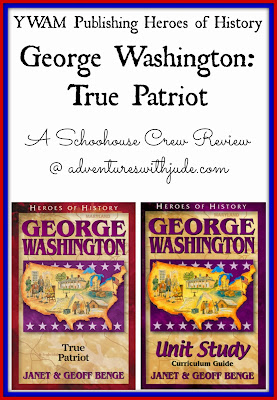
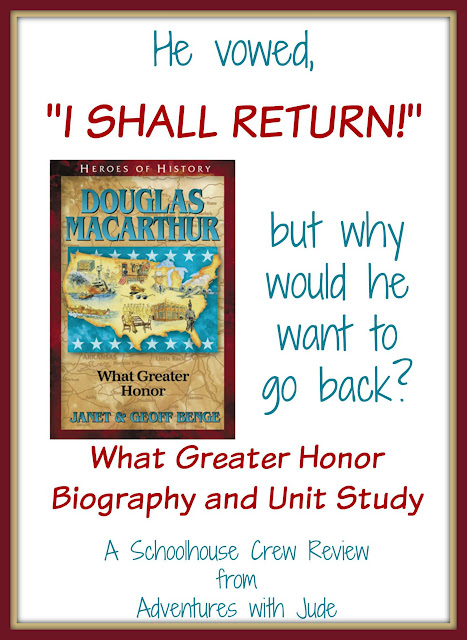
 George Washington: True Patriot review  Douglas MacArthur: What Greater Honor review

Christian Heroes {YWAM Publishing Review}


Additional photography credits:

Reagan on Horseback, By White House photographer [Public domain], via Wikimedia Commons

©2012- 2016 Adventures with Jude. All rights reserved. All text, photographs, artwork, and other content may not be reproduced or transmitted in any form without the written consent of the author. http://adventureswithjude.com

Thursday, September 24, 2015

YWAM Publishing: Douglas MacArthur (A Schoolhouse Crew Review)


YWAM Publishing's Heroes of History is a favorite biography source for us.  About 18 months ago, Douglas MacArthur: What Greater Honor along with a copy of the accompanying Unit Study Curriculum Guide.  Luke reviewed their edition on George Washington, and we were hooked.  Since then, we've purchased a half dozen of them for his US History course, and they've become beloved by every big kid in the house.  (In fact, Clara Barton got "misplaced" a few times...and was found in Celia's room -- she had absconded with it and fallen asleep reading it.)  When given the opportunity to review another of YWAM Publishing's titles, Luke was just working his way through the Great Depression and on the eve of American involvement World War II.  This meant he had a fairly easy choice:  who else but Douglas MacArthur?  We chose to review Douglas MacArthur: What Greater Honor and its accompanying Unit Study program.

I have to admit, I knew very little about MacArthur beyond his infamous line, "I shall return," and honestly, I wasn't even sure what it was about, other than something he said during World War II.  Most of what I studied about WWII was centered around the European theater;  it wasn't until we visited the National World War II museum this summer that I understood the magnitude of the fight in the Pacific. After a rout by the Japanese, MacArthur had been forced to flee the Philippines; it took him three long years to methodically, island-by-island, fight his way back to the Philippines and free them from Japanese control.   Yet even after these crash yet intensive lessons about the Pacific side of the war, we still didn't know the answer to "Who was the man behind this ferocious vow?" 

What makes the Heroes of History special is that the books aren't simply a recitation of what someone did, but an exploration of the person and character behind the action. The average soldier doesn't simply re-enlist for enough years to rise to the rank of Five Star General,  so how did he get to that point?  Through the story, we learned about the tenacity and dedication of the man in the uniform.  Like the other books in the series, the bulk of the Hero's story is told in flashback. 

MacArthur's tale begins on the PT Boat as the newly appointed Pacific commander and his family are being whisked to safety in Australia. Though if he had his way he'd be fighting alongside his enlisted men, he recognized his country needed him to leave the tiny island of Corregidor in order to orchestrate the liberation of the entire Pacific. We learned how MacArthur began his military career with honor, deftly handling both incidences of brutal hazing and an inquiry into the practice at West Point, ultimately graduating first in his class.  Through his idea of the "Rainbow Division," gave the entire nation both the responsibility and the honor of defending the United States when it entered WWI. As for the Philippines, his father Arthur MacArthur, also a career military man, had helped liberate the islands during the Spanish-American war.  After graduation, the younger MacArthur was assigned to the Philippines as an engineer, and later re-assigned to be an aide-de-camp for his father. Together the two toured the Pacific, and this was when Douglas became endeared to the region. He was happy to be returned there after his war-era service on the US mainland, continuing the task of helping the Filipino people achieve independence; this time, he was help their army establish itself, one of the final steps to becoming independent nation and shedding its "US Territory" status.  After the Japanese attacked Pearl Harbor, they turned their sights on the American army in the Philippines.  It was no longer a fight between nations; it was a personal attack.

General MacArthur surveys the beach at Leyte shore
just after the American forces sweep ashore
1944
National Archives and Records Admin
(US public domain)
After so many years of MacArthur pere and fils building the Philippines toward independence, Douglas refused to allow them to become annexed to the Japanese empire without a fight.  He explained that he had followed his Commander-in-Chief's orders to extricate himself from the island to better facilitate a counter-attack, but vowed "...the primary object of which is the relief of the Philippines...and I shall return."  It wasn't simply a desire to win that fueled his island-by-island eviction of the Japanese, but a desire to see the men he fought alongside have the same measure of freedom that brought him to them.

His commitment to fairness and freedom made him the ideal candidate to become the Supreme Commander of Japan after the imperialist surrender, leading the American-led postwar rebuilding of a nation decimated by years of fighting and two atomic bombs. Yet, he was a humble man, buried in his everyday uniform, with none of the many medals he had earned pinned to his chest.

Before we even began the Unit Study, Luke and I found ourselves wondering why do we know so little about this man? Is it because he refused to play Truman's brand of politics during the Korean War? Was it was that he was eclipsed by the younger Eisenhower - the commander of the European theater - in the 1952 Presidential nomination?  These questions left us clamoring for more - and grateful for the Unit Study.  By including things such as essay prompts, activities that helped us learn more about MacArthur and his character, and additional reading resources, it helped us find the true story of the man, often reduced to an often-misfocused catchphrase, who should be celebrated for his contribution to freedom.  Though ultimately not called to do so, he was prepared to give his life in the fight to free his friends.  Scripture tells us there is no greater love than to do so.  Despite the accolades and rewards for his work, he found there to be no greater honor than being a simple soldier fighting for freedom.

Members of the Crew reviewed titles from both the Heroes of History and Christian Heroes: Then and Now series.  Click the banner below to discover the heroes they learned about. You can also follow YWAM Publishing on social media:

Facebook: https://www.facebook.com/YWAM-Publishing-482973445102/timeline/
Twitter: https://twitter.com/YWAMpublishing
Pinerest:  http://www.pinterest.com/YWAMpublishing


YWAM Publishing Review


©2012- 2015 Adventures with Jude. All rights reserved. All text, photographs, artwork, and other content may not be reproduced or transmitted in any form without the written consent of the author. http://adventureswithjude.com

Thursday, June 1, 2017

YWAM Publishing: Abraham Lincoln

I was very excited for to review the biography Heroes of History - Abraham Lincoln:  A New Birth of Freedom from YWAM Publishing because their Heroes of History series is one of our favorite history resources. In the past, Luke did the history reading, but the torch has been passed down.  Matthew currently studying American History got tapped to complete this review.


Abraham Lincoln is not a new person of interest in our homeschool. Since I was a child, I've been fascinated by him.  In my opinion, Lincoln belongs in the pantheon of men who define the American spirit -- he's the quintessential, "pull yourself up by your own bootstraps," self-made man. When Luke was studying American History, he found that much of our nations' history can be tied to Lincoln - either a foreshadowing of what would happen during his presidency, or tied back to his administration.  We both came to appreciate Lincoln's respect for justice and the laws of the land.  From the very beginning of his presidency, Lincoln was aware of the role of the executive branch of government, and what powers the Constitution gave or withheld.

"First Reading of the Emancipation Proclamation"
Lincoln Presidential Library and Museum, Springfield, IL

There are literally thousands of books written about Abraham Lincoln.  (If you ever visit the museum next to the Peterson House/Fords Theater NHS, you can see three stories' worth of books ringing a support column.) I think the only way to write a good book about Lincoln is to not try to include it all, but pick a single theme and run with it.  All of the YWAM Heroes of History books that we have studied begin with a defining moment in the subject's life that exemplifies a character trait, and then show how his (or her) life revolved around this belief, and this is the perspective on Lincoln that authors Janet and Geoff Benge have written from.  The book's opening chapter describes how his experience as a Captain in the Illinois Militia helped define Lincoln's opinion that the United States was founded on laws that were meant to be obeyed at all times, not just when convenient.  Clearly, Lincoln's understanding of the law did not begin with his election.

The story then fades back to Lincoln at age seven, when a lack of book education left men like his father ripe for exploitation.   Fancy "Philadelphia lawyers" took advantage of the practical but less-than-specific surveys of the frontier to take over homesteads, and Lincoln's family fell victim.  Despite all I had read about Lincoln in the past, I never knew that this was a major catalyst for the family's move to Indiana.  I knew that slavery had played a role in choosing Indiana but hadn't realized that a land grab had ultimately set them on the road there. Now having studied Lincoln's first inaugural address, I'd say he became as good an attorney as any Philadelphia lawyer!

Reproduction Cabin
Lincoln Presidential Library and Museum, Springfield, IL

While not a trait outlined in the opening pages, I think this book also does an excellent job of highlighting Lincoln's tenacity.  He often found himself moving on or at loose ends but managed to channel that into an opportunity for growth.  Even when running for state government for the first time, Lincoln he says that he's used to not winning, so while he wanted to be the common man representing the common man, if he's wasn't chosen, he figured he'd survive the disappointment.  Lincoln saw much tragedy in his life - uprooting, a voracious mind with little opportunity for formal learning, political defeat and the deaths of so many he loved - yet never did he simply give up.  There were some times where he might have floundered a bit, but never did he admit defeat.  While the book is not explicit in its message of perseverance,  it's hard to justify any "I'll just quit," when you see that a man who grew up in a dirt-floor cabin, writing on the ground with a stick because he had no paper or pencil, rose to become one of history's most enduring leaders through his own determination.

In addition to the biography, we also received the Study Guide that goes with the book.
While Luke spent close to three months specifically reading about Lincoln, Matthew has learned most of his knowledge over the last three summers, visiting historical sites affiliated with our 16th president's life.   We've been lucky to visit many National Park sites that are either directly tied to Abraham Lincoln, or affiliated with him. However, due to our travel itineraries, we haven't studied these places in chronological order; in fact, we visited Gettysburg over a year before we had the opportunity to visit where Lincoln was born, and it took us another year after that to visit his adult home and the cemetery where he was interred.  The Unit Study contains both vocabulary and chapter comprehension questions, but also provide ideas for essays and projects that help the student understand the man behind the almost legendary reputation.

Lincoln Home NHS
Springfield, IL
The guide also provides a cross-curricular activity foundation.  Matthew is not necessarily an avid unit-study person, but using some of the ideas helped tie things together.  For example, we adapted some of the mapping activities as a basis to show the breadth of Lincoln's lasting influence on just the National Park service.  As he organized the timeline of NPS-related sites related to Lincoln, Matthew learned that while Teddy Roosevelt and Yellowstone get the popular glory for being the first national park, the Yosemite Grant, the foundation of what would become Yosemite National Park, was signed into law by President Lincoln.  Once again, we found an imprint left by a quiet, unassuming boy from Kentucky who grew up with respect for America's laws and her lands -- one more way in which Abraham Lincoln will forever belong to the ages.


100 Crew families have been studying YWAM's Heroes of History and Christian Heroes: Then and Now. Click the banner below to read about their stories.

Christian & History Heroes {YWAM Publishing Reviews}


©2012- 2016 Adventures with Jude. All rights reserved. All text, photographs, artwork, and other content may not be reproduced or transmitted in any form without the written consent of the author. http://adventureswithjude.com

Wednesday, March 30, 2016

Homeschooling Lessons I Learned the Hard Way: 3 Ways to Create a Customized Curriculum

This post contains affiliate links. Click here for more details. 


Once you've determine the "best for you" style of curriculum, and  made your budget, it's time to go back to acquire your winners.  But what happens if you don't have any clear winners?  Maybe it's because the price tag on your "perfect" program isn't, "We'll have pasta twice a week for a couple of months and skip the Oreos, and that'll free up the difference," but more like "We won't eat for two months if I buy this."  When you have a child who tests two years behind in language skills -- or an early and avid reader who is skipping ahead, what do you do?  How do you balance the "have to do" with "but I'd rather be doing..." things?

Make your own curriculum!


Now, I'm not going to tell you it's as easy as just ordering things as packages and kits.  It's a lot of work.  However, sometimes you need to look at programs by subject, or at each subject from a different perspective. Here is how we create our own curricula that is customized to each need.

Unit Study


A Unit Study is a fairly self-contained program that combines literature, grammar/writing, art, and often history and/or science with a focus on a a single core subject. Sometimes you can include math with your work,  but often unit studies will need a separate math and/or phonics instruction program.  I think that unit studies is one of the most economical curriculum style available.  It lends itself to lots of library use, which helps keeps costs down.  We also get a lot of use from our Amazon Prime membership -- what we need to purchase, we get from Amazon with quick shipping, and then take advantage of Prime Music and Prime Video, too.  Pre-prepared unit studies are probably one of the most flexible curriculum options.  Many offer a "here's six activities, do two" approach, allowing you to pick what suits your child's needs most.

However, you can create your own unit studies relatively easily You will want to create an outline of resources that suit your child's learning style and academic needs, combining different media and topics that capture your child's interests. Here's our template for unit studies!


Unit studies can be for all grades and ages!  Luke has been working his way through high school US History and Literature using a Unit Study approach!  Here's an example of one of his history units (keeping in mind this is an Honors caliber course, so there is a lot of reading and writing.):

Colonial/Revolutionary America
Timeline Text: Notgrass America The Beautiful
Literature: Five 4ths of July, The Autobiography of Benjamin Franklin
Historical Reading: YWAM William Penn, Founding Mothers by Cokie Roberts, YWAM George Washington, YWAM John Adams
Video:  America: The Story of Us, Crash Course US History,  1776 (film of Broadway Musical)
Field Trips: Fort Necessity National Battlefield, Valley Forge National Historic Park, George Washington's Mount Vernon,
In Depth Research Study - George Washington:  Happy Birthday, Mr. President?, A Biography of George Washington (Part I, Part II, Part III)

Links are to reviews and/or entries in Luke's blog series, Luke's American Adventures.  He's done a lot of writing, but found he didn't want to write a paper for the sake of writing a paper.  He found his niche as a guest blogger here, working to show a lesser known side of history.   What he loved about unit study was being able to see literature and history in context of an era.  Now, obviously, because we live in New Jersey we have access to a number of early American-themed field trip sites. Many places offer virtual field trips, and the Colonial Williamsburg Foundation offers a Virtual Field Trip series.


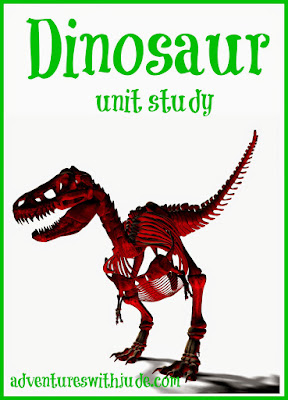
Jude did a unit study on Dinosaurs, one of his favorite subjects.

We took a lapbook as our tether, and then wandered off each day in a different direction.  Jude especially liked this study, because it allowed for a new activity every day.  Unit studies are also great for when you're starting to homeschool, because you can try a huge variety of activities and get a feel for what your child really enjoys and what he'd rather not do.


Reading Level (Not Grade Level) Literature Programs


We have really struggled with finding a "grade level" reading/literature program for the little boys.  The biggest problem is there does not seem to be a consensus of what belongs in a specific grade.  I have looked at some books and said, "This is WHAT GRADE??" I've found that often literature programs seem to include books a grade level or two above the chronological grade.  I firmly believe that children rise to the level we challenge them with, but there is a fine line between "challenge" and "overwhelm."  You know your child, and what that threshold is. What I've done is taken books in quality literature programs - mainly just to have a book list - and charted them according to Scholastic Grade Level and/or Lexile Score, and created a cheat sheet of books according to reading level.  Here's a sampling from some "Grade 2" level programs.


I'll also add in books that look like fun, and that others have suggested as interesting for the age range.  Our plan is to choose books according to ability. If we hang out at a specific level for a while, that's fine.  When they're ready to move on, we'll slide up the scale.  This works two ways - for Jude, it allows him to not get overwhelmed with books that are too hard, but also gives me a list for Damien, who is slightly advanced for his age with reading skills. I will admit that it probably isn't a perfect way to categorize books for two reasons:

  • You can see from the second column of titles that sometimes a higher "grade level" is "easier" from a Lexile scoring, but I find using those gives me a good starting point to decide if the book is worth a quick skim to see if it will work.  
  • If I know Jude is doing well with a grade 2/early 3rd book, and struggling with a 4th, I know to hang out in around there, and not move up to something in the 5-point-somethings too soon just because a program says "This is what we do for kids in 3rd grade."  Our motto is confidence first, challenge next. I'd rather him read six simpler books and be a confident reader than struggle through a hard one too soon and hate to read.


This also really dovetails nicely with the Unit Study method.  Finding books that are in the appropriate reading level range will help open up topics, especially for Jude.  If it's a new concept he's that not certain he will enjoy, being able to find something at or even slightly below grade level will allow the information to be more easily absorbed.  This way, the focus isn't on trying to push forward in reading level, but is on gaining knowledge and broadening horizons.  If it's a subject that is really loved, then we'd try a harder book, because the reading may be harder but the topic is already familiar.

Play


While Jude and Damien do have "serious" schoolwork to do, they also spend a fair amount of time playing.  Damien loves to play superheroes, and one day he spent the entire day drawing pictures of his favorites.  That day's program evolved into telling me about each character, having a mock battle with the papers, keeping track of how many DC Super Heroes and how many Marvel Super Heroes he's drawn (individually and combined) and writing their names on their pictures and a master list, and debating each character's powers.  Damien has "played" all day but practiced language organizattion/storytelling, penmanship, and math.  I would say that we are definitely "eclectic" homeschoolers, but I find a personal affinity to some of the tenets of Waldorf-style education.  Sometimes, especially with younger students, you don't actually need a "curriculum" for everything, but instead you need to just provide opportunity.

I would also argue that while educational approach also needs to mature as a child grows, we never outgrow our desire to learn from activities we consider fun.  One of my new favorite resources for the older boys is the Great Courses.  They're college-caliber audit-style classes in any number of topics.  While there are a number of courses that have fulfilled core requirements (Luke is combining a couple courses in Shakespeare to create a senior lit course, and used their Anatomy and Physiology for senior science), they also bring a huge variety of electives to the party.  Matthew has studied ancient architecture and engineering.  He has found this field fascinating, and that excitement translates to a desire to learn more, motivating him to read texts, have organized discussions, and write gradable essays. Luke has studied cooking techniques with the program.  Combining the video program with a practicum in the kitchen has sparked an interest in being an amateur chef -- and I can't complain about having the night off from dinner duty!

Today is Day 3 of the Schoolhouse Crew Review spring Blog Hop.  There are over 50 bloggers participating in this season's theme, 5 Days of Tips for Homeschool Parents.  I'll be featuring a different group of bloggers each day, and encourage you to check their blogs out and see what advice they have for you!

Adventures with Jude
Day 1: Choosing Curriculum
Day 2: Homeschooling Isn't Cheap
Day 3: Creating a Customized Curriculum (this post)
Day 4: Don't Lose the Big Picture
Day 5: 8 Truths about Homeschooling (live 4/1 @ 8 am)


Annette @ A Net In Time
Brandy @ Kingdom Academy Homeschool
Brenda @ Counting Pinecones
Carol @ Home Sweet Life
Cassandra @ A Glimpse of Normal
Chareen @ Every Bed of Roses
Cristi @ Through the Calm and Through the Storm
Crystal @ Crystal Starr
DaLynn @ Biblical Womanhood
Danielle @ Sensible Whimsy


©2012- 2016 Adventures with Jude. All rights reserved. All text, photographs, artwork, and other content may not be reproduced or transmitted in any form without the written consent of the author. http://adventureswithjude.com

Wednesday, May 2, 2018

YWAM Heroes of History: Thomas Edison (Homeschool Review Crew)


This review of Thomas Edison: Inspiration and Hard Work is our fifth review for YWAM Publishing.  It is always a blessing and an honor when vendors come back to the crew, especially multiple times, because it means that we are doing a great job with sharing their products.  However, the blessing is not one-sided. I am always excited to work with these books because the Heroes of History series is one of my favorite history resources.  When we've reviewed prior volumes, Luke or Matthew has read the books and worked on the Unit Studies that accompany the biography.  Our reviews have always come at a time when we're just about at that point in history, so it's a tiny jump to that person's story.  This time, Matthew is studying WWII, and ready to re-visit one of our prior reviews, Douglas MacArthur.  That meant Jude got to pick a new book -- and it's pretty exciting when a fourth child gets something new and not a hand-me-down. He chose the biography of one of his favorite inventors, Thomas Edison.

If you ask people, "Can you name famous people from New Jersey?" their lists would be short. Sure, we have Jon Bon Jovi and Bruce Springsteen in current times,  but most people can't name too many historic New Jersey residents. Most do not realize President Grover Cleveland was a native son, or that President Woodrow Wilson was also from our state.  General George McClellan, Commander at Antietam, followed his military career with a political one, becoming Governor of New Jersey.  However, Thomas Edison tops everyone's list of "Historic New Jersey People." After all, he was nicknamed, "The Wizard of Menlo Park."  Between his inventions and being from our state, that makes him one of Jude's favorite people.

Most biographies focus on Edison's time in New Jersey and his inventions here. Janet and Geoff Benge's story goes all the way back to Edison's childhood in Milan, Ohio, and the very beginnings of his curiosity.  A four-year-old Thomas Alva Edison, nicknamed Al, was full of questions.  At first, they were wonderings about what life would be like for the people he saw heading west in prairie schooners.  His curiosity soon got him in trouble; he nearly drowned in a wheat silo and burned down the town's flour mill.  Though he was nearly twenty years younger than his siblings,  nobody remembered to tell Al he was only a child, and treated him like an equal.  This did not bode well for when 8-year-old Al headed off to school.


Jude found he really identified with Edison here.  He, too, does not learn in a mainstream way.  Like Edison, he only lasted three months in a regular school.  Al's bout with scarlet fever left him with impaired hearing; Jude has issues with auditory processing.  As much as she wanted her son to attend a particular school, Mrs. Edison recognized her son's potential, the damage that school was doing to him, and taught him herself.  I don't claim to be raising another Edison, and there were far fewer fireworks when we withdrew Jude, but I feel a kinship to his mama.  It's not easy keeping up with a curious mind.

The story continues through Edison's adulthood, as he invented and worked in telegraphy, and highlight not only his triumphs and his struggles.  It includes a retelling of when he sold a stock ticker patent to a New York company.  For a child of the rural midwest, New York City was overwhelming.  He had hoped to sell his patent for five thousand dollars, but would settle for three.  The Gold and Stock company offered him forty thousand. That would set him up with a better workshop in nearby Newark to create even more things.  Edison didn't allow near-bankruptcy to stop him; he reapplied himself until he was in the black again.  Then, he moved to Menlo Park.

Jude was particularly interested in this section, because we have been to Edison's workshop in Menlo Park.  It was here that Edison perfected the light bulb, lighting the town with incandescent light on December 31, 1879.  He developed a way to make Bell's telephone transmit sound better, and then took that knowledge and created the phonograph machine.  He determined a way to electrify New York City, and moved his young family there.  Unfortunately, just as the now father of three was reaching success there, he found himself a widower.  We learned how he reinvented his life again, with a new family and a new research facility in East Orange, New Jersey.

I don't think it's giving away the ending too much to say that Thomas Alva Edison died in 1831, at  the age of 84.  The Benges end the story dramatically, including the news reports of his death.  Like many of the newspapers, they quote his speech to the National Electric Light Association.  Like the writers of the past, they chose fitting last words to honor a man who was motored by the repetition of experimental science.  (Sharing those words would be giving away the ending...so you'll just have to read that part yourself.)


As with the other Heroes of History stories, there is an accompanying Study Guide. Like the others, there are hundreds of activities and resources that you could do. Thankfully, you're given explicit permission that you don't have to do them all.  Think of it as a giant brainstorm for all things you might want to do, all in one place.  Then you can decide if you want your child to do traditional things, like answer discussion questions and write essays. If you have a "tinkering" style of learner, like Tom was, there are hands-on activities suggested.  (And while I'd suggest adult supervision, most are not likely to risk needing to call the fire department.)


Because Jude is only in fifth grade, we didn't do much of the unit study on paper.  We're at the point where we are transitioning from "early reader" or "elementary overview" style books to content-driven biographies.  I used the concrete questions to check if he was understanding what was written, saving some of the more open-ended discussions for another time.  One thing I really like about both the books and study guides is they are adaptable for so many ages.  When my high-school level boys used them, they were great for independent learning and writing practice.  For Jude, formal writing is an emerging skill that we haven't really begun to transition to every class, so I was happy to be able to discuss topics with him to help him work through a dilemma in his head and verbalize his thoughts, without the stress of organizing paragraphs.

Included with the guide are suggestions for further reading on Edison, including both children's and adult-level books.  While I will have Jude re-read this book again (likely with a more cursory middle school American History course), long-term planning has me wondering if a third trip through the book when he gets to high school is worthwhile. I can see me keeping the book itself for a long time (he's already made me promise to keep it so he can read it again), but by then it might be good to have a new book to read.  Having the list and the notes about individual suggestions helps me choose books that are good quality.  In the meantime, there are other books now on his wish list, such as Thomas Edison: The Great Inventor (Ed. Caryn Jenner) because of the description.


Once again, YWAM has blessed us with a fantastic book and study. We're very happy to add this to our growing collection.  Jude has moved on to reading the other editions we already have, and is making a list of books he wants to read next.

If you'd like to read our prior reviews follow the links below.  Click the banner below to read this current round of Crew reviews.

Ronald Reagan, Destiny At His Side
Douglas MacArthur, What Greater Honor
Abraham Lincoln, A New Birth of Freedom
George Washington, True Patriot


Christian Heroes, Heroes of History & Study Guides {YWAM Publishing  Reviews}


Want to keep up with all of our adventures?
Subscribe below to get Adventures with Jude delivered to your inbox.

Enter your email address:


Delivered by FeedBurner


©2012- 2017 Adventures with Jude. All rights reserved. All text, photographs, artwork, and other content may not be reproduced or transmitted in any form without the written consent of the author. http://adventureswithjude.com

Friday, October 11, 2013

YWAM Publishing - George Washington: True Patriot (A Schoolhouse Crew Review)


YWAM Logo photo YWAMLogo_zpse2d5593a.jpg

George Washington has the nickname "First in war, First in peace, and First in the hearts of his countrymen."   I'll admit that my lifelong admiration of pulled-up-by-his-bootstraps Abraham Lincoln has put the first President just behind Number 16.  After working with Luke on YWAM Publishing's George Washington: True Patriot and George Washington: Unit Study Curriculum Guide,  I may just have changed my mind.

George Washington True Patriot Review


 George Washington: True Patriot is part of YWAM's Heroes of History series. Geared for students aged 10+, this biography explores Washington's youth and contribution to the American Revolution.  It is available as 224-page paperback ($6.99), or as a Kindle, Nook, or Audiobook version.   While it is an excellent standalone book (even as a "for fun" read),  there is also a companion Unit Study Curriculum Guide ($7.49, paperback only). 

George Washington: True Patriot
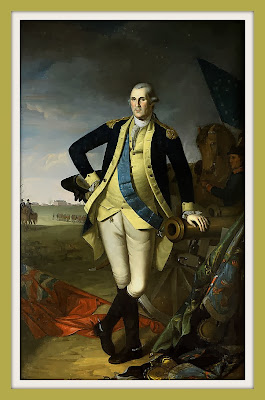

George Washington at Princeton
Charles Willson Peale
[Public domain],
via Wikimedia Commons
This story starts long before most others. I don't recall learning much about pre-Revolutionary George, beyond he was a surveyor by trade and a scout during the French & Indian War.  I had no idea the complexity of his childhood.  The first chapter begins as the newly commissioned General George Washington is standing on the shores of Boston Harbor.  He recognizes that he is giving up his lifelong dream of being an officer in the British Army - by their reckoning, he is now a traitor - and summoning the courage to begin leading a ragtag bunch of rebels.  It then moves into a flashback of Washington's childhood and youth.  Most history books list a man's accomplishments.  This book explores the man's psyche.

We learned about a more human side of Washington.  When his brother Lawrence was ill, George volunteered to go with him to the Caribbean when it was clear he could not go alone.  After Lawrence and Austin died - along with his parents - he wondered if he would be next to go.  He married Martha Custis and took on the responsibility of caring from them and the estate-in-trust left to them.  He and Martha did not have any children, though he cared for her children as his own; he later raised one of his grandsons after stepson Jacky's death. 

George Washington also was no stranger to adversity.  His father had been married and widowed; he had two older half-brothers that he had never met until he was six years old.  He had a number of younger brothers and sisters, and a very overbearing mother.  She ran his life with an iron fist from the first, and when his father died not long after George's eleventh birthday, George was devastated when she decreed he would not be permitted to attend school in England like his brothers Lawrence and Austin.  He was now the "man of the house" would be behave as such.  After reading this, I wonder if many of his skills as a scout and woodsman were honed trying to sneak away from this burdensome responsibility.   During the French and Indian War, twice he was nearly killed.  Several other times, disease nearly killed him.  When so many of his siblings died in infancy, and his elder brothers dying before reaching middle age, and all of his younger ones dying before him as well, one has to recognize that he was born do to great things.

I never realized the risks and sacrifices the Washingtons made to this nation.  Sure, I knew that George would be considered a traitor to the Crown, but I never knew that he went to the Continental Congress meeting in September of 1774 and did not return home to Mount Vernon for almost eight years.  He left Mt. Vernon hoping to be back by the end of the harvest time, but the next he saw Martha and Jacky Custis was when they joined him in Cambridge, just outside of Boston, for Christmas 1775.  The separation and the risk weighted heavily on Washington; he missed his home and family dearly, but dared not give up because if the colonists lost he would be hanged and his family homeless. 

By the end of this book, I no longer saw George Washington as a long-ago "historical figure" but a living, breathing, very human man.  I think the books I read as a child on Lincoln showed his humanity - his childhood, his hard work, how he learned his sense of justice. George Washington's childhood, smothered by an overbearing mother, gave rise to a fiercely independent young man.  He exemplified the quintessential Colonial "never give up" spirit.  He was often chosen almost unanimously by his peers to be the leader of  a group.  I would now argue that he almost is more important that Abraham Lincoln - without Washington's intimate knowledge of the shortcomings of the British army, Lincon's presidency  - or even the establishment of the United States as a free nation - would never have been possible.  Over two hundred years since his death in 1799, he remains "first in the hearts of his countrymen."

General George Washington Resigning His Commission, John Trumbull
Public Domain

Curriculum Guide & Unit Study


This is a mid-sized (64 page) lesson plan.  From the guide:
It provides the schoolteacher and homeschooling parent with ways to use the book as a vehicle for teaching or reinforcing various curriculum areas, including
  • Creative writing.
  • Drama.
  • Movie critiquing.
  • Reading comprehension.
  • Essay writing.
  • History and geography concepts.

    As there are more ideas than could possibly be used in one unit, it is the parent/teacher’s job to sift through the ideas and select those that best fit the needs of the student or students.

And yes, there are any number of ideas.  There are some that are more suited to a group setting, while others are more conducive to a single-student homeschool.  We are using it for Luke as part of a high school level course, and I do believe there is enough in it to make it a suitably in-depth study of Washington and the colonial/post-Revolution eras.  However, I also think it could easily be suitable for a middle school level study by adjusting expectations (ie, shorter writing pieces, choosing from one or two categories of activity instead of "one of everything," etc.)

One of the activities I assigned were the chapter questions.  There were four questions for each chapter.  Three were fact based - read the book, answer the question. The final one for each chapter was  critical thinking question.  Some required you to climb into the mindset of the men in the book (for example, when the Founding Fathers wrote the Declaration of Independence, why didn't they include the slaves under the ideal of "right to liberty" that they deemed inalienable?) while others were more of an inference (after the British regiment he was with was brutally defeated when General Braddock insisted on maintaining protocol, what did George learn?). With all of the questions, they were clearly written and the answers easily found within the text.  (And for the teacher/parent, they're also all in the appendix.)

Beyond the questions, there were essay suggestions, and then "projects."  These can easily work for both the home and classroom student.  If you are a homeschooler, then you can just choose a few to work on; if you're a classroom teacher, the list can be given and the student allowed to choose, making for a variety of presentations to the class.

One that we chose was to research and plan a levée.  Martha Washington held these informal (by her standards) parties every week.  Luke's conclusion: Martha was a smart lady.  A levée was a way to look like a great hostess while using up the leftovers from the night before's formal dinner!    Instead of a formal meal,  hors d'oeurves consisting of two-bite canapés followed by miniature tarts and puddings were served - allowing them to use the leftovers from the night before for provisions while creating new dishes and a more relaxed atmosphere.    Even their beverage menu - wine punches in summer, mulled wine and eggnog in winter - was a way to use up half-bottles leftover from the previous evening's dinner.   Luke set a menu, went grocery shopping, and is in the process of preparing each of the dishes.  (We are only doing one or two at a time and serving them as our family's dinner since we aren't planning to have a fifty-person open house anytime soon!  We will be sharing our recipes after we finish perfecting our dishes.)

sample levee menu


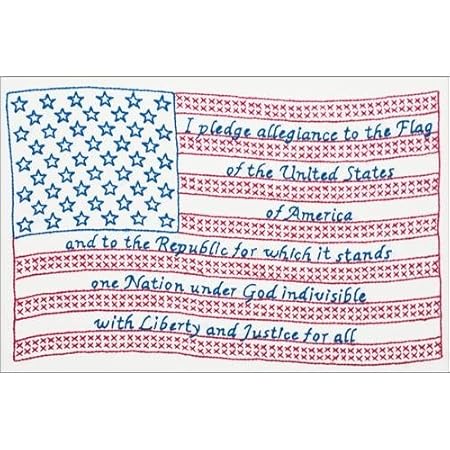
For a hands-on project, Luke chose to work on a sampler.  (His occupational therapist was thrilled!)  He chose this pre-printed one.

Amazon.com

A funny: I misread the package and thought it was an entire kit.  It was not - the package only contained the pre-printed sampler and no embroidery floss.  I ordered a box each of red and blue -far more than we needed for this project but I also have other projects to use it for - and the total due for them came to $17.76!

I started to teach Luke how to stitch his sampler, but we really struggled because he's right-handed and I'm a southpaw.  So at this point, I called in a "Special Guest Professor" -- Grammy!

embroidery sampler
My parents came one Sunday afternoon for dinner, and Luke was working on his sampler when they arrived.  Mom volunteered (ok, she pretty much got drafted) to help sort him out. They worked together for an hour or so, figured out what was going on, how to work right-handed and not just "backwards left" and Luke is cruising along on his sampler.  (No, that's not why I invited them, but I'm not foolish enough to say "No, thank you!")

The third project Luke is working on is a question-and-answer game. He is writing the game out and we are going to laminate it and donate it to his brother's school for the teacher to use in her American History classes.
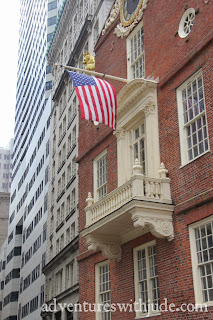
Old State House Boston
Old State House (balcony)
Boston, Massachusetts


Finally, instead of a formal paper, Luke wrote a three-part biographical summary on George Washington.  He tried to choose some more obscure facts. For example, we recently visited Boston and the Old State House, where the Declaration of Independence was first proclaimed in the New England colonies.  What we did not know before reading this book -- George Washington was one of the men assembled there.  Everyone knows that Benedict Arnold was a traitor, but it was George himself that discovered it (and that he was the subject of the incriminating correspondence that led to the finding).  We also learned Mount Vernon's original name -  Epsewasson - and that it was renamed by George's brother Lawrence Washington to honor Admiral Vernon. Epsewasson was George's home until Lawrence returned from England, and he actually inherited Ferry Farm upon their father's death.  He came to own Mt. Vernon after the death of his brother's wife and daughter. 


We really enjoyed this study.   Even if it was just a simple "read the book, answer the question," study, it is well worth the time.  The book George Washington: True Patriot is long on pages but well written; it flows easily and pulls the reader into the story.  Janet and Geoff Benge have written a book that describes the details of George's life without the reader feeling bogged down in the minutiae. However, the companion Curriculum Guide & Unit Study provide a strong program for exploring not just George's life but also the era he lived in.

Based on how much he liked this review, Luke has requested that we explore some of the other Heroes of History programs. 


Click the banner below to read the other crew members' experiences with this program, as well as Jim Elliot: One Great Purpose  from WYAM's Christian Heroes: Then and Now series.


Photobucket


©2012- 2013 Adventures with Jude. All rights reserved. All text, photographs, artwork, and other content may not be reproduced or transmitted in any form without the written consent of the author. http://adventureswithjude.com

Wednesday, November 20, 2013

Our 2013 Schoolhouse Crew Review Favorites


Wow, what a year!  I tallied that we did just about 50 Schoolhouse Crew Reviews.  We had math products, writing courses, some preschool ideas, and several great books.  I never imagined we would have so much to keep us busy!  The best part of being part of the Crew was trying out so many things that we never knew about -- all things that we were either skittish about trying or never even heard of!

The Crew as a whole votes on their favorite vendors and reviews.  I've also polled everyone here at Adventure Academy, and these are our "Blue Ribbon" Favorites.  Well, almost everyone - Damien's Top 3 are based on how much fun he seemed to have with them.

Note: If you click on the vendor names, you will be able to read our full product review.

Luke


Homeschool Spanish Academy   This is Luke's favorite class, and the universe revolves around when Nora is available for a lesson.  He started with the program in July with once/weekly classes, and then we continued with two lessons/week once the review finished.  His already midway through Spanish 1B and it's not even Christmas!  He is registered and scheduled for lessons through Easter - he wanted to schedule his next block early so he didn't miss out!


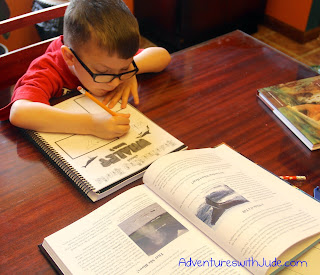
Writing with Sharon Watson   This is where Luke finally started to "get" writing.  The lessons, hints, and ideas in this program made sense to him.  Luke really struggled late in the Crew year when he took a course with Bridgeway Academy, and often he wound up doing things the "Sharon Watson Way" and then revising to fit the new instructor's requests, because they still didn't work for him and the Greek Temple Prewriting exercise he learned from Writing with Sharon Watson suited the way his brain thought.


YWAM Publishing - George Washington: True Patriot  I have to admit, this was one of my favorites as well.  We learned so much about George Washington!  Not just the basics of the historical figure, but really about the personality of the man and what made him such a great leader.  Luke is currently working on YWAM's book on William Penn, and we will definitely be using this series throughout his US History program.


Matthew


VocabularySpellingCity

Mayan Mysteries

Math Rider


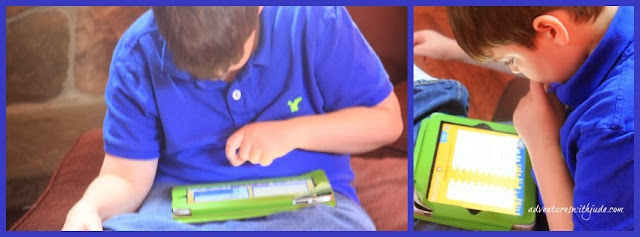
If you take a moment to look at these reviews, you'll see a common thread -- they're all web-based programs that have iPad apps.  Yep, Matthew is a self-admitted "gamer."  VocabularySpellingCity is a program that is a fantastic supplement to his weekly spelling/vocab assignments; Mayan Mysteries and Math Rider are both interactive video game style programs that don't "feel like" learning. 

Celia

MacPhail Center for Music Online Program  Celia loves her teacher as much today as she did six months ago.  Whatever Jeremy says goes.  I suggested she bring her violin on vacation, just to practice a little bit.  I got shot down.  Jeremy said he wants her to be a proficient Twinkler by the time she comes home, so can we please fit her violin in the car somewhere?   Oy.  She is excited to learn and always looks forward to her weekly lessons.


Tie: Time 4 Learning
Tie: Bible Study for All Ages

Celia couldn't decide between these two programs.  She loved the music in the Bible Study program, but also the variety of activities in Time 4 Learning. 

Baker Publishing Group: The Adventures of Lily Lapp  Celia devoured both books 1 and 2 that we read for the review, and then anxiously awaited books 3 and 4.  She had a greater appreciation for the Amish families that we saw when we recently went to Lancaster County, PA.  Her eagle eye spotted this sign at a woodworking shop, and wonders if the woodburner had read the Lily books too -- Whispering Pines is the name of Lily's family farmette.


Jude


Apologia Swimming Creatures of the Fifth Day  This was Jude's favorite.  He still talks about the fish and the whales and all the other sea creatures.   It was one of the first times he realized that learning was supposed to be fun and interesting.

Tie:  Reading Kingdom
Tie:  ABeCeDarian 

Jude's expressive language skills are on par with a 3 year old.  Both of these visual programs really work for him.  He is slowly learning to spell and read simple words with these programs.

IXL K-12 Math and Language Arts Practice  Jude has long liked the IXL program, and now moving up to "First Grade" he is finding it still a fun way to practice math!


Damien


Apologia Swimming Creatures of the Fifth Day  This was really Damien's first foray into homeschooling.  He loved learning about the fish and the animals, and likes this book read to him "for fun."

Moving Beyond the Page   While Luke was actually the review student for this program, Damien is the beneficiary as we invested in their 4/5 year old program after falling in love with the 11-13 program.  Our family's new favorite read-aloud -- well, giggle-along, really -- is the book A is for Musk Ox that is part of the PreK/K program.

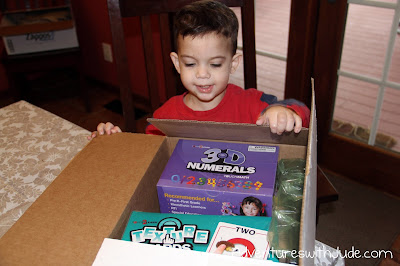
Touch Math (Level PK)  This was Damien's first formal math program.  He loved the shapes and manipulating them.  Counting them, reshaping them, and just generally using this tactile program has really grasp concepts quickly.


Meg


MacPhail Online Music Program - I have always wanted to learn how to play the violin.  In order to get Celia to practice more, she is now showing me what she learned and becoming my "teacher."  I'm not ever going to reach the heights of Itzhak Perlman, but I have a passable "Twinkle Twinkle Little Star" and taught myself to play "Adoro Te Devote."  She likes having a partner to play with, and I can cross "learn to play violin" off my bucket list. 


Papa's Pearls: A Father's Gift of Love and Wisdom to His Children and Grandchildren - This is one of my favorite books. The author writes from her heart, in a friendly tone, and makes me feel part of her family.

SchoolhouseTeachers.com  My first Crew Review, and I still love this program.  For us, it is a perfect fill-in for activities that need a little rounding but not an entire curriculum.


I'm so excited that our family has been accepted onto the 2014 Crew!  I can't wait to see what exciting programs the new year will bring!


Click on the ribbon to see what programs were Crew and family favorites!

http://schoolhousereviewcrew.com/announcing-the-2013-blue-ribbon-awards/


©2012- 2013 Adventures with Jude. All rights reserved. All text, photographs, artwork, and other content may not be reproduced or transmitted in any form without the written consent of the author. http://adventureswithjude.com
Related Posts Plugin for WordPress, Blogger...
Pin It button on image hover