Showing posts with label presidents. Show all posts

Thursday, June 1, 2017

YWAM Publishing: Abraham Lincoln

I was very excited for to review the biography Heroes of History - Abraham Lincoln:  A New Birth of Freedom from YWAM Publishing because their Heroes of History series is one of our favorite history resources. In the past, Luke did the history reading, but the torch has been passed down.  Matthew currently studying American History got tapped to complete this review.


Abraham Lincoln is not a new person of interest in our homeschool. Since I was a child, I've been fascinated by him.  In my opinion, Lincoln belongs in the pantheon of men who define the American spirit -- he's the quintessential, "pull yourself up by your own bootstraps," self-made man. When Luke was studying American History, he found that much of our nations' history can be tied to Lincoln - either a foreshadowing of what would happen during his presidency, or tied back to his administration.  We both came to appreciate Lincoln's respect for justice and the laws of the land.  From the very beginning of his presidency, Lincoln was aware of the role of the executive branch of government, and what powers the Constitution gave or withheld.

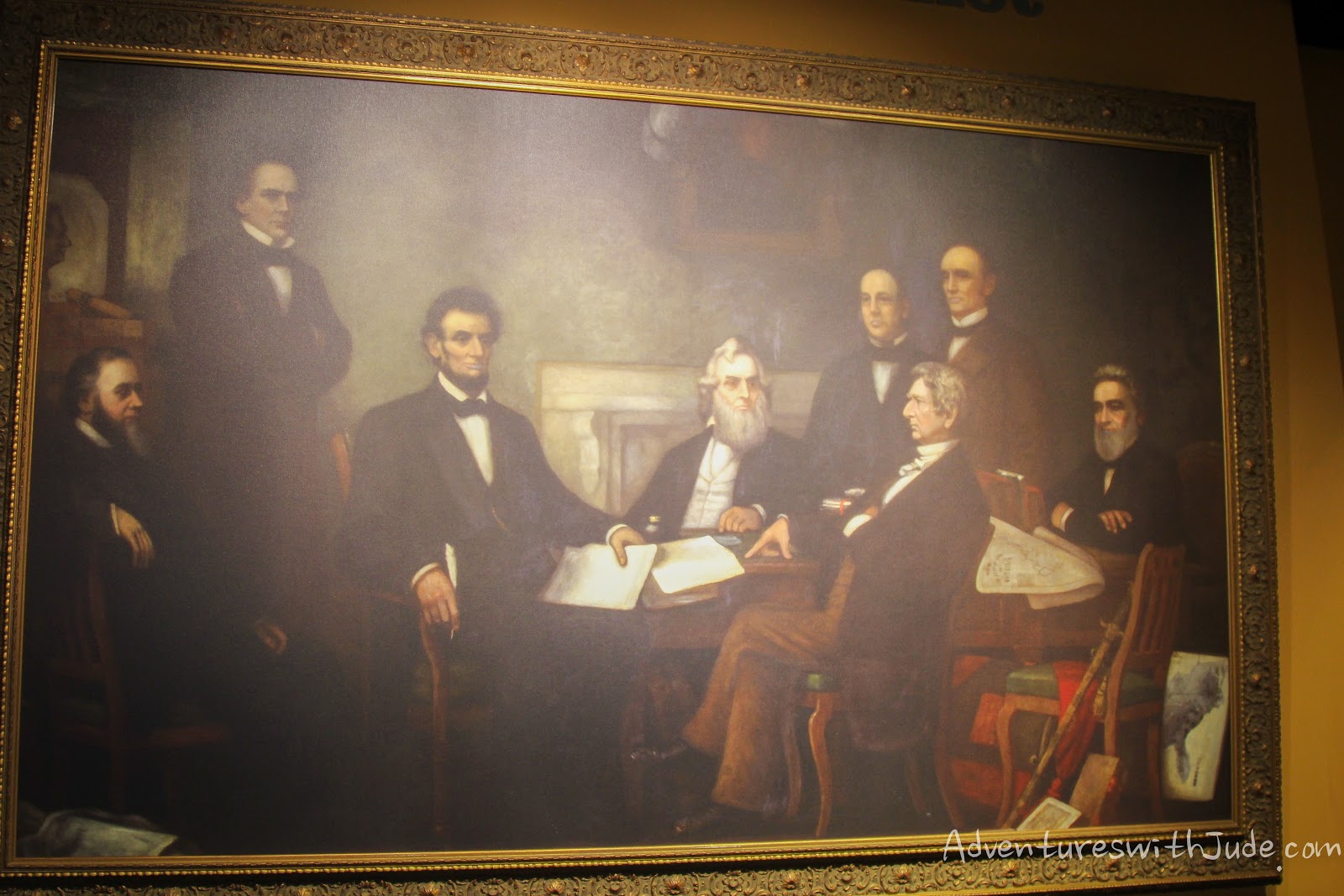
"First Reading of the Emancipation Proclamation"
Lincoln Presidential Library and Museum, Springfield, IL

There are literally thousands of books written about Abraham Lincoln.  (If you ever visit the museum next to the Peterson House/Fords Theater NHS, you can see three stories' worth of books ringing a support column.) I think the only way to write a good book about Lincoln is to not try to include it all, but pick a single theme and run with it.  All of the YWAM Heroes of History books that we have studied begin with a defining moment in the subject's life that exemplifies a character trait, and then show how his (or her) life revolved around this belief, and this is the perspective on Lincoln that authors Janet and Geoff Benge have written from.  The book's opening chapter describes how his experience as a Captain in the Illinois Militia helped define Lincoln's opinion that the United States was founded on laws that were meant to be obeyed at all times, not just when convenient.  Clearly, Lincoln's understanding of the law did not begin with his election.

The story then fades back to Lincoln at age seven, when a lack of book education left men like his father ripe for exploitation.   Fancy "Philadelphia lawyers" took advantage of the practical but less-than-specific surveys of the frontier to take over homesteads, and Lincoln's family fell victim.  Despite all I had read about Lincoln in the past, I never knew that this was a major catalyst for the family's move to Indiana.  I knew that slavery had played a role in choosing Indiana but hadn't realized that a land grab had ultimately set them on the road there. Now having studied Lincoln's first inaugural address, I'd say he became as good an attorney as any Philadelphia lawyer!

Reproduction Cabin
Lincoln Presidential Library and Museum, Springfield, IL

While not a trait outlined in the opening pages, I think this book also does an excellent job of highlighting Lincoln's tenacity.  He often found himself moving on or at loose ends but managed to channel that into an opportunity for growth.  Even when running for state government for the first time, Lincoln he says that he's used to not winning, so while he wanted to be the common man representing the common man, if he's wasn't chosen, he figured he'd survive the disappointment.  Lincoln saw much tragedy in his life - uprooting, a voracious mind with little opportunity for formal learning, political defeat and the deaths of so many he loved - yet never did he simply give up.  There were some times where he might have floundered a bit, but never did he admit defeat.  While the book is not explicit in its message of perseverance,  it's hard to justify any "I'll just quit," when you see that a man who grew up in a dirt-floor cabin, writing on the ground with a stick because he had no paper or pencil, rose to become one of history's most enduring leaders through his own determination.

In addition to the biography, we also received the Study Guide that goes with the book.
While Luke spent close to three months specifically reading about Lincoln, Matthew has learned most of his knowledge over the last three summers, visiting historical sites affiliated with our 16th president's life.   We've been lucky to visit many National Park sites that are either directly tied to Abraham Lincoln, or affiliated with him. However, due to our travel itineraries, we haven't studied these places in chronological order; in fact, we visited Gettysburg over a year before we had the opportunity to visit where Lincoln was born, and it took us another year after that to visit his adult home and the cemetery where he was interred.  The Unit Study contains both vocabulary and chapter comprehension questions, but also provide ideas for essays and projects that help the student understand the man behind the almost legendary reputation.

Lincoln Home NHS
Springfield, IL
The guide also provides a cross-curricular activity foundation.  Matthew is not necessarily an avid unit-study person, but using some of the ideas helped tie things together.  For example, we adapted some of the mapping activities as a basis to show the breadth of Lincoln's lasting influence on just the National Park service.  As he organized the timeline of NPS-related sites related to Lincoln, Matthew learned that while Teddy Roosevelt and Yellowstone get the popular glory for being the first national park, the Yosemite Grant, the foundation of what would become Yosemite National Park, was signed into law by President Lincoln.  Once again, we found an imprint left by a quiet, unassuming boy from Kentucky who grew up with respect for America's laws and her lands -- one more way in which Abraham Lincoln will forever belong to the ages.


100 Crew families have been studying YWAM's Heroes of History and Christian Heroes: Then and Now. Click the banner below to read about their stories.

Christian & History Heroes {YWAM Publishing Reviews}


©2012- 2016 Adventures with Jude. All rights reserved. All text, photographs, artwork, and other content may not be reproduced or transmitted in any form without the written consent of the author. http://adventureswithjude.com

Monday, June 20, 2016

Ronald Reagan: Politic's Leading Man

Luke's American Adventures: Ronald Reagan: Politic's Leading Man


Ronald Wilson Reagan was born on February 6, 1911, in Tampico, Illinois, to John Edward "Jack" Reagan and Nellie Wilson Reagan. Nicknamed "Dutch," by his father, Reagan's early childhood was spent moving after his father’s reputation became too much for that town. The family finally settled in Dixon, Illinois in 1920, where Jack opened a shoe store. In 1928, Reagan graduated from Dixon High School. During the school year, Reagan was an athlete, high school thespian, and student body president; his summers were spent as a lifeguard. An athletic scholarship allowed Reagan to enroll at Eureka College, where he majored in economics and sociology while being active in student life. He was part of the football, track, and swim teams, served as student council president, and acted in school productions. After graduating in 1932, he found work as a radio sports announcer in Iowa, eventually find his way to California and an acting contract with Warner Brothers.

The Gipper


Ronald Regan as George "The Gipper" Gip, 1940
Public Domain, via Wikimedia Commons
In 1937, Reagan signed a seven-year contract with the movie studio, and ultimately had a thirty-year career in Hollywood. He appeared in more than 50 films, and performed his best-known role in the 1940 biopic Knute Rockne, All American, where he portrayed Notre Dame football star George Gipp. Another notable role was in the 1942 film Kings Row, in which Reagan portrays an accident victim who wakes up to discover his legs have been amputated. In 1940, Reagan married actress Jane Wyman, with whom he had daughter Maureen and adopted a son, Michael before the couple divorced in 1948. During World War II, Reagan entered the Army. Disqualified from combat duty due to poor eyesight, he spent his time in the Army making training films, rising to the rank of Captain.

From 1947 to 1952, Reagan served as president of the Screen Actors Guild. During this time, he met actress Nancy Davis, who had sought his help after she was mistakenly listed as a possible communist sympathizer on the Hollywood blacklist. Both were immediately attracted to each other, but Reagan was skeptical of marrying again due to his painful divorce from Wyman. Over time, he recognized Nancy as his kindred spirit, and they wed in 1952. The pair had two children, Patricia Ann and Ronald, and the marriage lasted over fifty years.

As Reagan's film career began to plateau, he landed a job as host of the weekly television drama series The General Electric Theater in 1954. Part of his responsibility as host was to tour the United States as a public relations representative for GE. It was during this time that his political views shifted from liberal to conservative; he led pro-business discussions, speaking out against excessive government regulation and wasteful spending—central themes of his future political career.

Ronald Reagan, host of The General Electric Theater
Public Domain, via Wikimedia Commons

Politics and Presidency


Reagan stepped into the national political spotlight in 1964, when he gave a well-received televised speech for Republican presidential candidate Barry Goldwater. Two years later, in his first race for public office, Reagan defeated Democratic incumbent Edmund "Pat" Brown Sr. by almost one million votes, winning the California governorship was reelected to a second term in 1970. After making unsuccessful bids for the Republican presidential nomination in 1968 and 1976, Reagan finally received his party's nod in 1980. In that year's general election, he overwhelmingly defeated Democrat incumbent President Jimmy Carter, winning the electoral college 489 to 49 and capturing almost 51 percent of the popular vote. At age 69, Reagan was the oldest person elected to the U.S. presidency.

Attempted Assassination


President Regan's first post-recovery national address
Public Domain, via Wikimedia Commons
In his inaugural speech on January 20, 1981, Reagan announced that "government is not the solution to our problems; government is the problem." He called for an era of national renewal and hoped that America would again be "a beacon of hope for those who do not have freedom." He and Nancy Reagan also ushered in a new era of glamor to the White House with designer fashions and a controversial redecoration of the executive mansion that had last seen substantial updating during the Kennedy administration. On March 30, 1981, less than eight weeks into his term, President Reagan exited the Washington Hilton Hotel with several of his advisers and shots rang out. Quick-thinking Secret Service agents thrust the wounded president into his limousine, and the driver raced to George Washington University Hospital, not daring to wait for an ambulance. His would-be assassin, John Hinckley Jr., also shot three other people, none of them immediately fatal. (Press Secretary James Brady was left paralyzed, and when he died in 2014, coroners deemed the cause of death a complication of the shooting.) At the hospital, doctors determined that the gunman's bullet had pierced one of the president's lungs and narrowly missed his heart. Reagan, known for his good-natured humor, later told his distressed wife the problem: "Honey, I forgot to duck." Within several weeks of the shooting, President Reagan was back at work.

On the domestic front, President Reagan advanced numerous conservative policies. Tax cuts were implemented to stimulate the United States' economy. He also advocated for increases in military spending, reductions in certain social programs and measures to deregulate business. By 1983, the nation's economy had begun to recover and, according to many economists, entered a seven-year period of prosperity. Critics, however, charged that his policies had actually increased the deficit and hurt the middle class and poor. In 1981, Reagan once again made history by appointing Judge Sandra Day O'Connor as the first woman to the U.S. Supreme Court.

The most pressing foreign policy issue of Reagan's first term was the Cold War. Dubbing the Soviet Union "the evil empire," Reagan embarked on a massive buildup of U.S. weapons and troops. He implemented the Reagan Doctrine, which provided aid to anti-communist movements in Africa, Asia, and Latin America. In 1983, he announced the Strategic Defense Initiative; nicknamed "Star Wars," the SDI was a plan aiming to develop space-based weapons to protect America from attacks by Soviet nuclear missiles. In the Middle East, Reagan sent 800 U.S. Marines to Lebanon as part of an international peacekeeping force, in June 1982. Nearly one year later, in October 1983, suicide bombers attacked the Marine barracks in Beirut, killing 241 Americans. That same month, Reagan ordered U.S. forces to invade the Caribbean island of Granada after Marxist rebels overthrew the government. In addition to the problems in Lebanon and Grenada, the Reagan administration had to deal with an ongoing contentious relationship with Libyan leader Muammar al-Qaddafi.

President Ronald Reagan and First Lady Nancy Reagan pay their respects to Beirut bombing victims
Public Domain, via Wikimedia Commons 


“Tear Down This Wall”


In November 1984, Ronald Reagan was re-elected in another landslide, defeating Democratic challenger Walter Mondale. Reagan carried 49 of the 50 U.S. states in the election, and received 525 of 538 electoral votes—the largest number ever won by an American presidential candidate. Yet his second term was tarnished by the Iran-Contra affair, a convoluted "arms-for-hostages" deal with Iran to funnel money toward anti-communist insurgencies in Central America. Though he initially denied knowing about it, Reagan later announced that it was a mistake.

"Mr. Gorbachev, tear down this wall."
 Public domain, via Wikimedia Commons
During his second term, Reagan also forged a diplomatic relationship with the reform-minded Mikhail Gorbachev, chairman of the Soviet Union. In 1987, the Americans and Soviets signed a historic agreement to eliminate intermediate-range nuclear missiles. That same year, Reagan spoke at Germany's Berlin Wall. This symbol of communism was erected during the Kennedy administration, and famously challenged the leader, “Mr. Gorbachev, tear down this wall.” More than two years later, Gorbachev allowed the people of Berlin to dismantle the wall, ending Soviet domination of East Germany. After leaving the White House, Reagan returned to Germany in September 1990—just weeks before the country was officially reunified—and, with a hammer, took several symbolic swings at a remaining chunk of the wall.

After leaving the White House in January 1989, Reagan and wife Nancy returned to their home in Los Angeles, California, and the Ronald W. Reagan Presidential Library and Center for Public Affairs opened two years later in Simi Valley, California. In November 1994, Reagan revealed in a handwritten letter to the American people that he had recently been diagnosed with Alzheimer's disease. Nancy split her time between caring for him and becoming involved with the National Alzheimer's Association and its affiliate, the Ronald and Nancy Reagan Research Institute in Chicago. Nearly a decade later after the revelation, 93-year-old Ronald Reagan died at his Los Angeles home, making him the nation's longest-lived president at that time. A state funeral was held in Washington, D.C., and President Reagan was later buried on the grounds of his Simi Valley library. Nancy Reagan died of heart failure in 2016 at the age of 94 and was also interred at The Ronald Reagan Presidential Library and Center for Public Affairs. (In 2006, Gerald Ford surpassed Reagan for the longest-lived title. Coincidentally, when Nancy died in 2016, she was the second-eldest First Lady at her death; Bess Truman is the eldest.)


©2012- 2016 Adventures with Jude. All rights reserved. All text, photographs, artwork, and other content may not be reproduced or transmitted in any form without the written consent of the author. http://adventureswithjude.com

Friday, June 10, 2016

The End of Camelot

Luke's American Adventures: The End of Camelot John Fitzgerald Kennedy

Few events in the postwar era of America have cast such a long shadow over our national life as the assassination of President John F. Kennedy. The murder of a handsome and vigorous president shocked the nation to its core. In their grief, Americans were inclined to take to heart the legends that emerged during the immediate aftermath. Though the assassin was a communist and an admirer of Fidel Castro, many insisted that President Kennedy was a martyr to the cause of civil rights and deserved a place of honor next to Abraham Lincoln as a champion of racial justice. Others held him up as a great statesman who labored for international peace. But by far the most potent element of Kennedy’s legacy was the idea of Camelot.

The legend of Camelot was well-known to the era. “Camelot” was Lerner and Loewe's musical adaptation of T.H. White's popular novel, "The Once and Future King." While the plot of the musical is rather dark, focusing on the forces set out to destroy the kingdom, the musical begins with Arthur extolling the perfection of the kingdom, and how something as arbitrary as the weather is controlled for the inhabitants’ convenience.


It was also one of President Kennedy’s favorite musicals. Just after her husband was buried, Jacqueline Kennedy agreed to a magazine interview. Sitting down with Theodore White from Life Magazine, Mrs. Kennedy reflected on her husband. The television once was a blessing; Kennedy’s youthful and poised appearances during debates with Richard Nixon played a significant role in his election. Now, just a few years later, it would broadcast news of his death and his funeral. Only the most hard-hearted person could be left unaffected by their son’s salute of his father’s coffin. By today’s jaded standards, we’d call her interview “damage control,” and in a way it was. However, what she wanted was for her husband to be remembered as passionate and an idealist. Smartly, Mrs. Kennedy shared JFK’s affection for the musical, particularly the closing lines of the title song. Arthur shares them with Tom, the new knight who has come to take up the mantle for a new generation:


She added, “There'll be great presidents again ... but there will never be another Camelot." One could forgive a grieving wife for believing her husband to be a singular man, but does the political idea hold up to the passage of time?

In current public opinion polls, Kennedy consistently ranks among Thomas Jefferson and Abraham Lincoln as one of the most popular American presidents, agreeing that he was young and full of progressive ideas. Historian Arthur Schlesinger Jr. wrote it was "as if Lincoln had been killed six months after Gettysburg or Franklin Roosevelt at the end of 1935.” The 1964 Civil Rights Act was a posthumous accomplishment, and many wonder what a second term would have accomplished. Conversely, critics have derided Kennedy's womanizing and laissez-faire attitude, arguing he was more style than substance. Perhaps, with what we’ve learned over time, Camelot is not an exact explanation of the early 1960s in America, but an appropriate metaphor: a time seemingly perfect yet filled with underlying tribulations, and an unanticipated end that still holds out hope for the future. 


©2012- 2016 Adventures with Jude. All rights reserved. All text, photographs, artwork, and other content may not be reproduced or transmitted in any form without the written consent of the author. http://adventureswithjude.com

Friday, June 3, 2016

Roadwork Ahead: Eisenhower Highways


Luke's American Adventures: Roadwork Ahead: Eisenhower Highways


On June 29, 1956, President Dwight Eisenhower signed the Federal-Aid Highway Act of 1956. The bill created a 41,000-mile “National System of Interstate and Defense Highways” that would, according to Eisenhower, eliminate unsafe roads, inefficient routes, and traffic jams that got in the way of “speedy, safe transcontinental travel.” But did the highway get in the way of itself?

Since before the founding of the nation, Americans have always been looking for more efficient means of transportation around the country. During the colonial era, the only practical way to travel and trade across long distances was along the nation’s natural waterways. A few roads connected major cities, but travel on them was challenging and time-consuming. Large ships moved passengers and freight across the oceans, and smaller boats plied the nation’s rivers, lakes, and canals. The first “National Road,” established a few years after the Revolutionary War ended, evolved from a need to get supplies and people beyond the frontier. While much of the road’s alignment is followed or overlapped by US Route 40, many of the routes original aspects, such as toll pikes, stone bridges, and inns, are preserved to this day.

The National Road Recapturing Glory

This “Main Street of America” was soon followed by wagon trails. The Oregon Trail, the Santa Fe Trail, and the Natchez Trace told travelers the destinations of the paths.


“Stagecoach stops” were settled and often run by settlers along the trails, such as the Mahaffie Farmstead in Kansas City. Though times have progressed since the 18th century, original towns and villages can still found along the routes of these original “highways.”

One hundred years later, the country had doubled in size, and there was a need to get people and goods across the nation faster. New steam-driven trains sped along thousands of miles of track, providing fast, reasonably reliable, and relatively direct transportation from coast to coast and points in between. When the “Golden Spike” of the Transcontinental Railroad was hammered into the ground in 1869, what used to take months of gruesome travel by ship, wagon, or stage could be traversed in under a week!

American innovators sought out an even more efficient means of transportation, one not limited to places a horse could negotiate or a track could be laid. At first, personal cars were fragile luxury items, but Henry Ford’s new “assembly line” mass manufacturing quickly made them reliable and affordable.

By the post-WWII years, the end of gasoline rationing and owning your own “set of wheels” seemed the bonus of the American dream: the freedom to come and go as you pleased, and without being reliant on a schedule.

1950 Ford Country Squire
Credit: Josephew  via Wikimedia Commons

However, a major problem was that these modern cars were traveling across antebellum roads. Stagecoach trips often ended outside the town saloon; you could almost consider the Oregon Trail a pub crawl. Towns settled as people decided they just didn’t want to go any farther; more sprang up when the Railroads came by and needed depots. The first cross-country car roads followed the familiar wagon trails. Unfortunately, these routes were made of terrain more suitable for a horse-drawn wagon than a self-propelled automobile. The routes often traversed marshes; while a horse and its rider could cross the mud, cars ran the risk of losing traction completely.

The routes also often conformed to the land and were full of steep hills and sharp turns. They followed the topography, rather than being a straight path, often increasing the driving distances. For example, Baltimore, MD to Washington, PA - the “eastern” portion of US 40, is over 300 miles long. The Eisenhower System highways cut that distance to under 250 miles. That’s a lot of gas saved! Limited access and higher speed limits make the Eisenhower roads more time efficient, too. Interstate-95 is the “Eisenhower Equivalent” of US 1. The drive from Houlton, Maine to Miami on US highways is a 42 hour, 2000 mile trek. The same journey on Interstate 95 is only 8% shorter in distance - 1842 miles - but the drive time is a mere 27 hours.


When the Interstate Highway Act was first passed, most Americans supported it. Building the Interstate Highway system would get people where they wanted to go more quickly on newly-built modern roads. However, progress doesn’t come without a price.

Wide rights-of-way consumed thousands of acres of land. The county’s natural mountain ranges, forests, rivers, and natural routes were excavated into and either partially or fully removed or bypassed. Community battles were waged to save historical landmarks. Most significantly, the coming of the Interstate Highway dramatically affected the flavor of America. These roadside colonies connected travelers to the communities through which they passed. The construction of Interstate Highways fundamentally altered this pattern of commercial development as long-distance travelers abandoned those former routes. Once-vibrant towns faded into obscurity leaving the roadside stores and restaurants struggling to make ends meet. With the coming of Interstate, whole architectural genres and local businesses were driven to extinction by abandonment. Disney Pixar’s Cars touches upon this “death by interstate” ideal. In the film, race car rookie Lightning McQueen learns that Radiator Springs, the town the majority of the movie is set in, used to be a popular stopover along the old U.S. Route 66, but with the construction of an interstate bypassing it, the town literally vanished from the map. The demise of the fictional Radiator Springs mirrors the path of many small towns across the nation; what once built up around pioneer trails and railroad lines fell into obscurity with this new highway system.

However, as these little roadside towns fell by the wayside, the same “if you build a road, they will come” phenomenon occurred near these new highways. Gas stations were built at these exits - after all, the cars needed fuel. With mini-towns popping up at each exit, exponentially shorter intervals - as frequent as every mile or two - meant drivers no longer needed to “tank up” every time they saw gas over the fear of running out because the next town was twenty or thirty miles away. Competition made travel more affordable; if a driver feels one exit’s gas prices are “on the high side,” he can easily take a chance that there will be lower prices at the next exit.


Since people were already stopping for gas, they might as well eat, so next came the quick-service restaurants. Instead of a relaxing meal to enjoy sitting still, these restaurants prided themselves on getting people their food quickly so they could get back on the road. One of the most famous of these “fast food” eateries is a little burger joint named McDonalds from San Bernardino, California that eventually expanded to an international chain. What made these restaurants so popular was the standardization of menu and ingredients. Customers knew that whether they drove through California or the Carolinas, they’d have the same meal, and at the same speed -- fast.

While the prevailing thought in American industriousness is, “If there is an easier, more efficient way, we will find it,” many realize that retaining natural beauty is just as important as progress. Thankfully, agencies like the National Park Service dedicate themselves to the restoration and preservation of historical and natural landmarks and beauty. On our summer road trip last year, my family had the privilege of traversing one of these protected “scenic highways”. It was an amazing ride through the Great Smoky Mountains along the Cherohala Skyway, and well worth spending eight hours traveling to an area that an interstate could have gotten us to in less than three.


However, there is no way we would have been able to see as much of the country that we did without the interstate system. Simple math says interstate speeds averaging 70 mph get travelers to their destinations nearly twice as quickly as the 40 mph average of the “local” route. In under four weeks, we traveled from New Jersey to Texas, visiting 30 venues in 16 states. Both types of highway have their place.

The Dwight D. Eisenhower National System of Interstate and Defense Highways was an innovation that changed America. The highway system, the greatest public works project in American history, made travel faster, easier, and safer and revolutionized the American economy. However, there were serious adverse effects of the highways; they affected the environment and led to the demise of many small towns. The Interstate System has both supporters and critics, but all agree that President Eisenhower was right when he said the Interstate System would “change the face of America.”


©2012- 2016 Adventures with Jude. All rights reserved. All text, photographs, artwork, and other content may not be reproduced or transmitted in any form without the written consent of the author. http://adventureswithjude.com

Monday, May 30, 2016

Truman the Human


Luke's American Adventures: Truman the Human  @ adventures with Jude

Born on May 8, 1888, in Lamar, Missouri, Harry was the first of three children born to John Anderson Truman, a farmer and mule trader, and his wife, Martha Ellen Truman. When his parents chose his name, they decided on “Harry,” to honor his maternal uncle, Harrison Young, but could not decide on a middle name. After more than a month of discussion, they settled on an initial, instead of a second name. “S” was a tribute to both his maternal grandfather, Solomon Young, and his paternal grandfather, Anderson Shipp Truman. A shy, bespectacled Truman grew up a farm in Independence, Missouri. He entered a Kansas City business college after graduating high school -- his second choice because poor eyesight precluded a chance for a commission to West Point Military Academy. Finances forced him to drop out after only one semester, and he took up a number of jobs to help the family. He first was a timekeeper for a railroad construction company, and then a clerk and a bookkeeper at two separate banks in Kansas City.


From Shy Child to Confident Soldier


After five years, he unhappily returned to the farm as its bookkeeper. As a child, an overbearing mother kept Harry from becoming friends with other boys. Seeking male camaraderie, he joined the National Guard and found himself well-liked and respected. He found time amidst it all to court Elizabeth “Bess” Wallace, a high school classmate. She refused to marry him, but they continued their courtship.

Harry Truman, WWI
Public Domain,
via Wikimedia Commons
When World War I erupted, thirty-three-year-old Harry was two years older than the age limit for the draft and eligible for exemption as a farmer. However, he volunteered for active duty, helping to organize his National Guard regiment to join the 129th Field Artillery and serve in the French theater. While in France, the newly promoted Captain Truman found himself assigned Battery D, known for being the most unruly battery in the regiment. Despite a generally shy and modest temperament, Truman captured the respect and admiration of his men and led them successfully through heavy fighting during the Meuse-Argonne campaign, and turned the regiment one of the most respected units of the Army.

When the war ended in 1918, Truman returned home to Bess. When he was sent off to France, she had realized that there was no man for her but Harry. However, he refused to marry her before he left, fearing the war would leave her a widow. They were married in 1919, and their only child, daughter Mary Margaret, was born four years later. That same year, he and a military buddy, Eddie Jacobson, set up a haberdashery shop in Kansas City. However, when the business failed in 1922, Truman owed $20,000 to creditors. A man who believed in never taking the easy way refused to declare bankruptcy and insisted on paying back all the money he borrowed. It took him over fifteen years to fully repay the debt.

A Political Career


While looking for a new job after his menswear shop closed, he was approached by Democratic boss Thomas Prendergast. They had a mutual connection through Prendergast’s nephew James, who had served with Truman during the war. Pendergast appointed Truman to a position as an overseer of highways, and after a year, chose him to run for one of three county judge positions in Jackson County. Truman was elected to an administrative judge position but was defeated when he ran for a second term. Undaunted, Truman ran again in 1926 and was elected as a presiding judge, a position he held until he was elected to the United States Senate in 1934.

Truman's campaign "sound" car, 1934
Public Domain, via Wikimedia Commons

In his freshman term, Senator Truman was appointed to two Senate committees: the Appropriations Committee, which was responsible for allocating tax money for Franklin Delano Roosevelt’s New Deal projects, and the Interstate Commerce Committee, which oversaw railroads, shipping, and interstate transport. Along with Senator Burton Wheeler, Truman began investigating railroads. In 1940, he initiated legislation that imposed tighter federal regulation of the railroads, which helped him establish his reputation as a man of integrity, earning him his notorious nickname, “Truman the Human.”

By the time Truman was up for reelection in 1940, Thomas Pendergast had been convicted of tax evasion and associated with voter fraud. Many predicted Truman’s connection to Pendergast would result in defeat. However, Truman didn’t try to hide or distort his relationship with Pendergast. His reputation as a frank and ethical man helped him win reelection. In his second term, Truman chaired a special committee to investigate the National Defense Program. With World War II waging in Europe, Franklin Roosevelt was quietly beefing up the military, and Truman’s committee’s role was to prevent war profiteering and wasteful spending in defense industries. He gained public support and recognition for his straightforward reports and practical recommendations, and again his lack of pretense earned him the respect of his colleagues.

Path to the White House


In 1944, President Franklin D. Roosevelt decided to run for an unprecedented third term. FDR deemed his acting vice president, Henry Wallace, unacceptable. Instead of a figurehead, FDR wanted to revolutionize the office and staff it with someone who could truly be second in command. Though Wallace was committed to FDR’s New Deal principles, he was too socially liberal and politically insensitive to gain congressional support. However, to replace Wallace, FDR had to find a steady leader who would be a stronger ticket mate.

Truman’s popularity, as well as his reputation as a fiscally responsible man and a defender of citizens’ rights, made him FDR’s choice. Truman had represented his constituents’ wishes in voting for isolationism, but he personally realized that US involvement in WWII was inevitable. A simple man, even after his time in Washington, he spoke of his evolving position, saying, “ We are facing a bunch of thugs, and the only theory a thug understands is a gun and bayonet.”
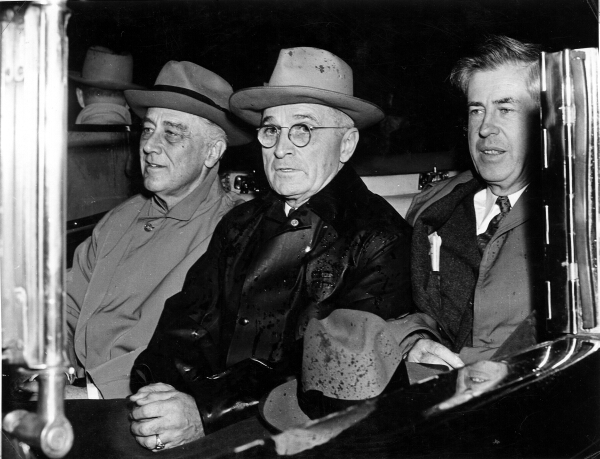
President Franklin D. Roosevelt, Vice-President-elect Harry S. Truman, and Vice-President Henry Wallace
Public Domain, via Wikimedia Commons

Truman was initially reluctant to accept the candidacy, preferring the modest job of Senator. However, true to his character, he took the nomination seriously and campaigned vigorously. Roosevelt and Truman were elected in November of 1944, and Truman took the oath of office on January 20, 1945. He served as vice president just 82 days before FDR suffered a massive stroke and died. An urgent summons brought him to the White House, where he was greeted by the newly widowed Eleanor Roosevelt, who broke the news by saying, “Harry, the President is dead.” The once-reluctant vice president was sworn in as the thirty-third president on April 12, 1945. With no prior experience in foreign policy, Truman was thrust into the role of Commander-in-Chief. In the first six months of his term, he announced the Germans’ surrender, dropped the atomic bombs on Hiroshima and Nagasaki that ended World War II, and signed the charter ratifying the United Nations.

In spite of these early successes, Truman’s diplomatic situation was beset with challenges. The Soviet Union had been a powerful ally to the United States during the war, but international relations deteriorated quickly when it became apparent that the Soviets intended to remain in control of Eastern European nations. These countries were expected to be returned to their pre-Hitler governments, and in response to these actions, the USSR was excluded from both NATO and from profiting in the reconstruction of Asia, beginning the Cold War. Republicans won both houses of Congress in 1946, which was seen as a judgment of President Truman’s policies, and polls indicated that reelection in 1948 was all but impossible. Polls were so lopsided that there was little reason to believe that New York Governor Thomas Dewey would not win the general election. The Chicago Tribune famously went to press with the headline “Dewey Defeats Truman” before the final votes were counted. The early polls were wrong; the final outcome was a win for Truman with 49.5 percent of the vote. Seventy years later, this is still considered one of the greatest upsets in the history of American elections.

"Dewey Defeats Truman"
By Museum claims ownership [Public domain],
via Wikimedia Commons

The Little White House


In November 1946, President Truman had finished 19 months in office but was physically exhausted. His doctor ordered a rest in a warm climate. In 1912, President William Howard Taft used Key West, Florida’s naval base as a layover en route to Central America to inspect construction of the Panama Canal. Recalling this, Truman decided to decamp to there for the winter. Despite the distance, Bess, who abhorred the public eye and the scrutiny given to the First Lady, stayed behind in Missouri.
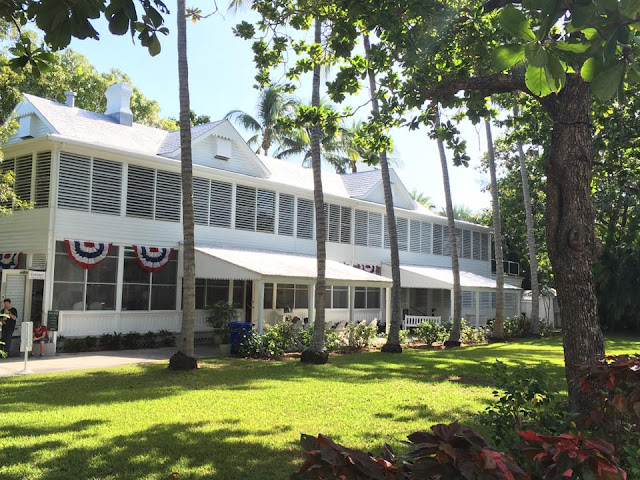
The Little White House, Key West, Florida  
This Key West retreat gave Truman a restorative atmosphere, but he realized that with new technology, where the President was, so too the White House could be. Only a three-hour flight from Washington, DC, an early morning telephone call could summon people for an afternoon meeting. While serious work was done here, the laid-back, Caribbean-like atmosphere permeated proceedings. At first, President Truman adhered to the standard business dress code. Then, the down-to-earth spirit came to life, and Harry decided that if the locals dressed in casual clothes, then who was he to wear a suit to go fishing? Khaki pants and tropical print shirts - the louder, the better - became the “Key West Uniform.” Despite the holiday atmosphere, serious business took place there. Truman began using the property as his “winter White House,” and spent 11 working vacations here, frequently meeting with high-ranking officials to discuss significant legislation such as the Marshall Plan and his fifth Civil Rights Executive Order.

He continued to visit after his presidency ended in 1953. To date, six American presidents have used it as the functioning White House of America and as a retreat and summit meeting location. The house remains on standby for Presidential use to this day.


A Third Administration?


During his second administration (first elected) as president, Truman announced his domestic policy initiative, the “Fair Deal” program, in his 1949 State of the Union address. Building on Roosevelt’s “New Deal,” it included universal health care, an increase in the minimum wage, more funding for education and a guarantee of equal rights under the law for all citizens. The program was not an independent success. In 1948, racial discrimination had been banned in federal government hiring practices, the military was desegregated, and the minimum wage had gone up. National health insurance was rejected, as was more money for education.

President Truman initiating Korean involvement
Public Domain, via Wikimedia Commons
The Korean War broke out in June of 1950, and Truman swiftly committed U.S. troops to the conflict. He believed that North Korea’s invasion of South Korea was a challenge from the Soviets, and that, if left unchecked, it could escalate to another world war and to further communist aggression. He initially endorsed a rollback strategy and encouraged General Douglas MacArthur to breach the 38th parallel, bringing forces into North Korea in order to take over the government. However, when China sent 300,000 troops to the aid of North Korea, a pragmatic Truman changed tactics. He reverted to the containment strategy, focusing on preserving the independence of South Korea rather than eliminating communism in the north. However, MacArthur publicly disagreed. A general openly contradicting his Commander was insubordination, and MacArthur was dismissed from his position in April of 1951. MacArthur was a popular general, so dismissing him only made Truman’s already-weak approval rating decline further.

Truman’s challenges were not limited to international affairs. On the home front, he was struggling to manage a labor dispute between the United Steel Workers of America and the major steel mills. The union demanded a wage increase, but the mill owners refused to grant it unless the government allowed them to increase the prices of their consumer goods, which had been capped by the Wage Stabilization Board. Unable to broker an agreement and unwilling to invoke the Taft-Hartley Act, which was passed in spite of his veto in 1947 and would have allowed him to seek an injunction that prevented the union from striking, Truman seized the steel mills in the name of the government. The steel companies responded by filing a suit against the government, and the case, Youngstown Sheet & Tube Company v. Sawyer (sometimes referred to as "The Steel Seizure Case") went before the Supreme Court. The Court found for the steel mills and forced Secretary of Commerce Charles Sawyer to give the mills back to the owners. Truman's handling of this dispute further tarnished his reputation with the American people. In March of 1952, Truman announced that he would not run for reelection.

A quiet and simple man, Harry S. Truman’s childhood was not very indicative of who he’d become as an adult. He believed in hard work, keeping promises, and taking responsibility; while his nickname was Truman the Human, he’s more famously quoted as saying, “The Buck Stops Here.” A reluctant vice president, he steered the country and the world through the end of World War II and its aftermath, and after handing over the reigns to President Eisenhower in January of 1953, Truman returned to Bess and a quiet life in Independence, Missouri. There he wrote his memoirs and oversaw the construction of his presidential library. He died on December 26, 1972, and is buried in the courtyard of the Truman Library.


©2012- 2016 Adventures with Jude. All rights reserved. All text, photographs, artwork, and other content may not be reproduced or transmitted in any form without the written consent of the author. http://adventureswithjude.com

Wednesday, April 15, 2015

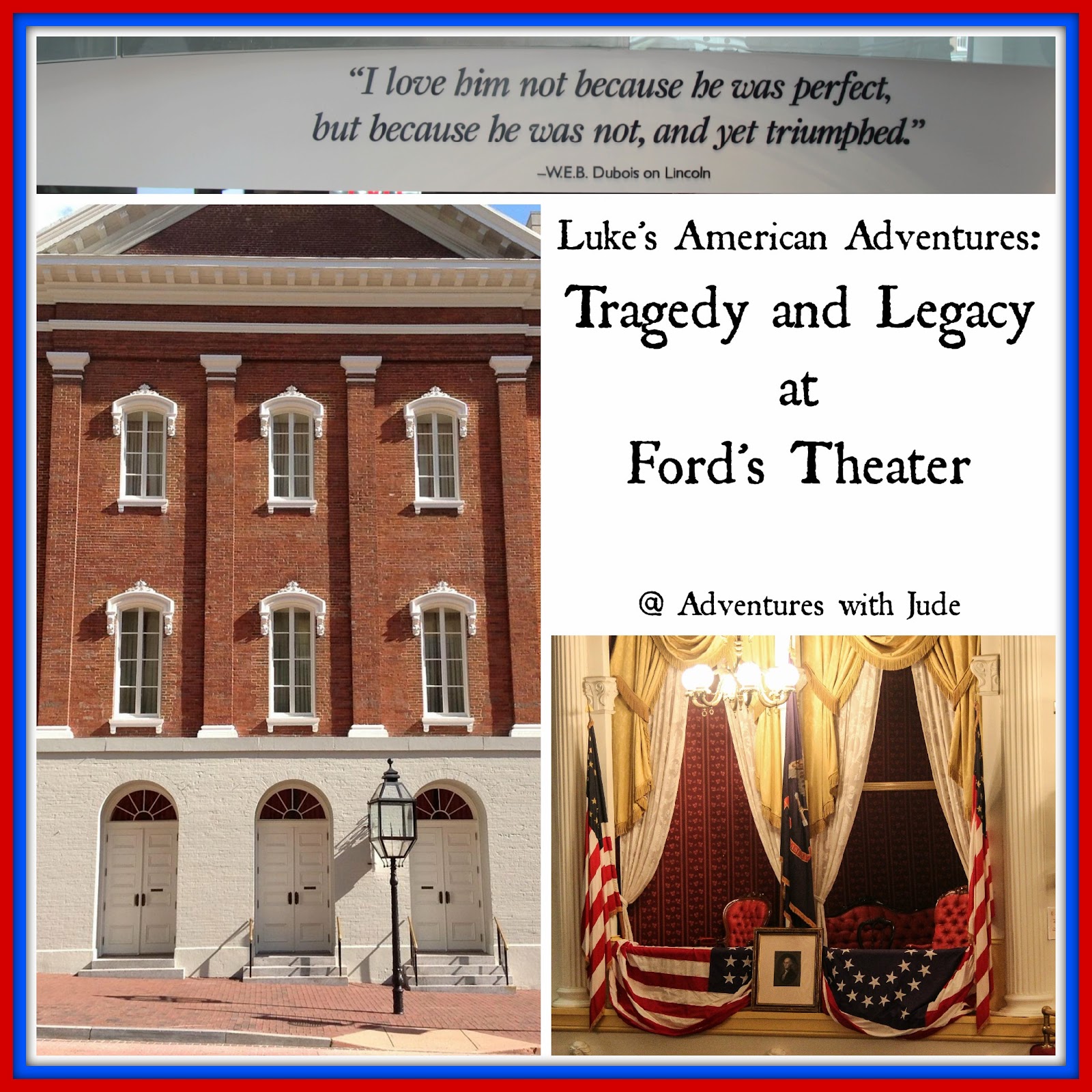
Tragedy and Legacy at Ford's Theater


Tragedy and Legacy at Ford's Theater

Have you ever had the opportunity to visit Ford's Theater in Washington, DC?  We recently did and I was really amazed at how wonderful this gem is!  It's a little bit off the "beaten trail" of the National Mall (about a 10 minute walk) but well worth the side trip.   Free timed tickets meter guest entry, allowing you plenty of time to look around without feeling overcrowded.  We visited thinking we'd only get to see the theater itself, but were very pleasantly surprised to find two full museums as well that gave us a very unique perspective on that fateful night.

When we first arrived, we were ushered into a museum underneath the theater.  This was our first surprise.  The Lincolns' guests on the evening Abraham Lincoln was shot were Miss Clara Harris and Major Henry Rathbone (who was stabbed as well).  The pair eventually married, and their son, Illinois Congressman Henry Riggs Rathbone, worked with Congress to authorize the government to purchase the Osborn Olydroyd Collection of Lincoln memorabilia, including many items from the Lincoln assassination itself. This is one of the most extensive collection of Lincoln artifacts we've ever seen!

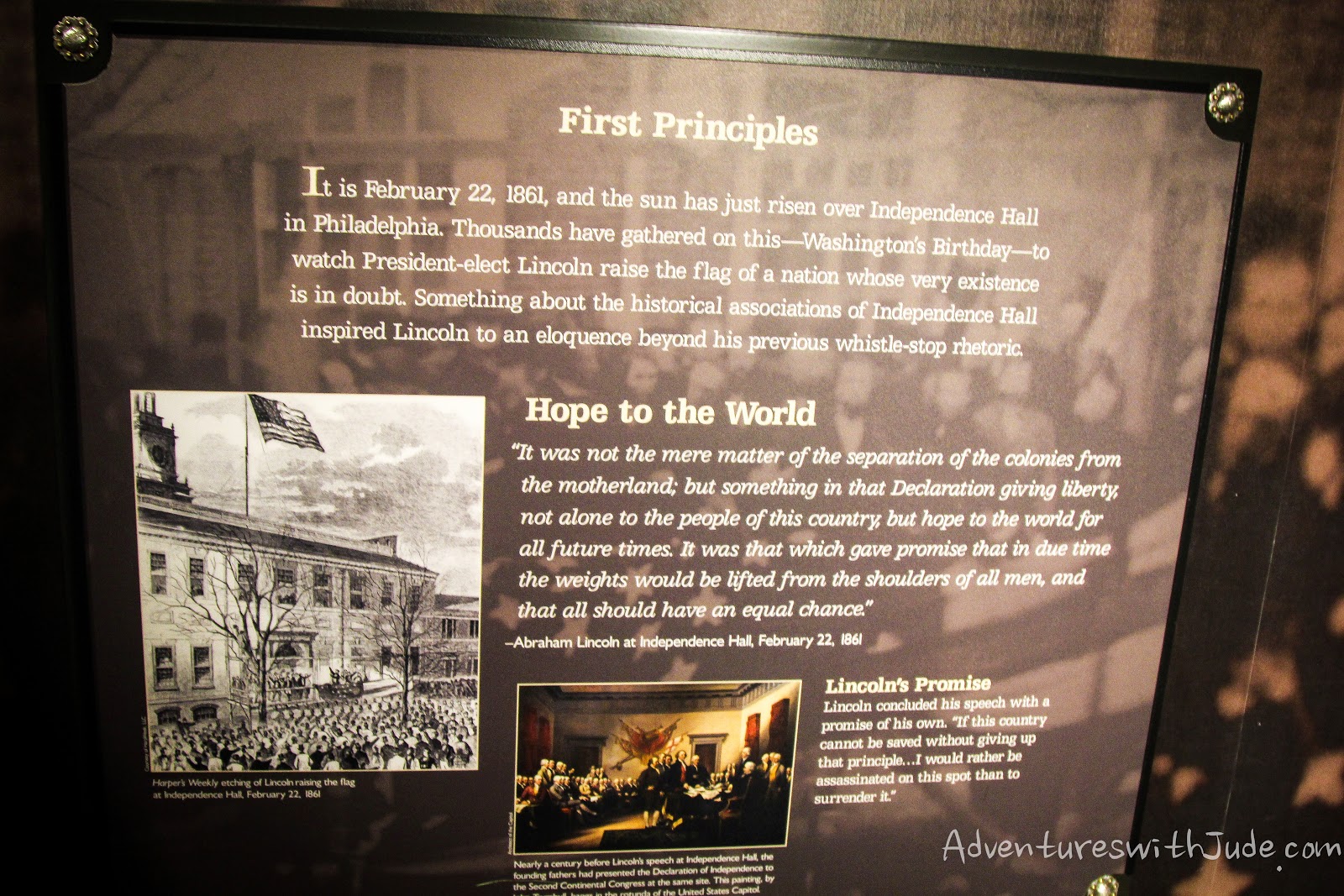
Hope to the World Abraham Lincoln

First Reading of the Emancipation Proclamation of President Lincoln
First Reading of the Emancipation Proclamation of President Lincoln by Francis Bicknell Carpenter

(Next to the painting was this legend, so we knew who was who.) 

There is an entire section dedicated to the Lincoln family during the Presidency, including this engraving by Samuel B. Waugh and William Sartain.

Waugh Sartain Lincoln family engraving

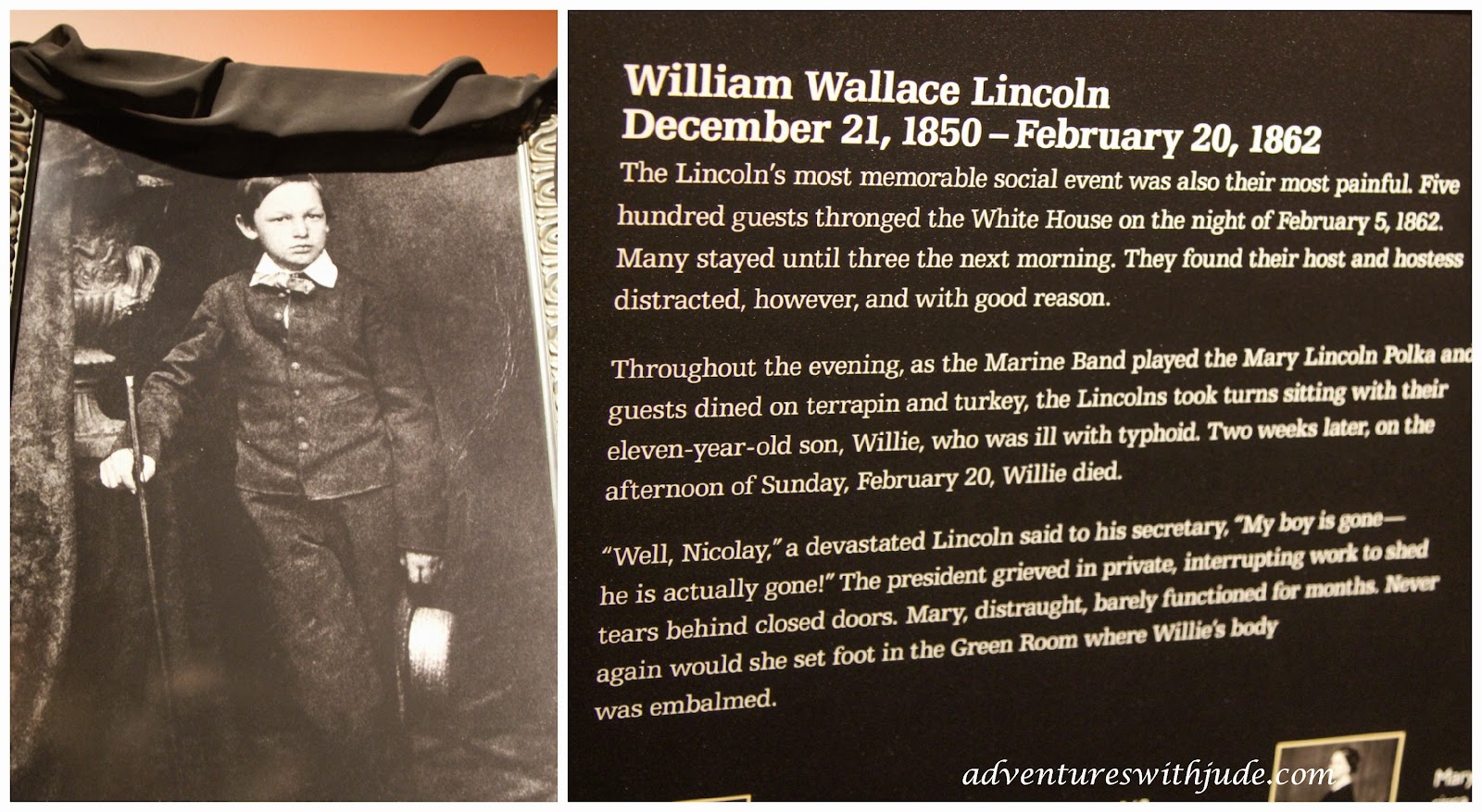
This family portrait (engraving) includes a portrait of the Lincoln's son, Willie, who died during Lincoln's first administration.  Most exhibits on Lincoln focus on his public/political persona, and we really liked seeing this glimpse into the human side of the family.  Willie's death greatly affected the family, and it was really interesting to learn about this very human side of Lincoln.

William Lincoln mourning

 (As an aside, Mom and I were even more impressed with the movie "Lincoln" that we had just watched.  Often, actors tend to get the "general appearance" of a character right, but perhaps not the finer details.  After seeing this portrait, we were shocked at the almost identical look of the actors to the family!)

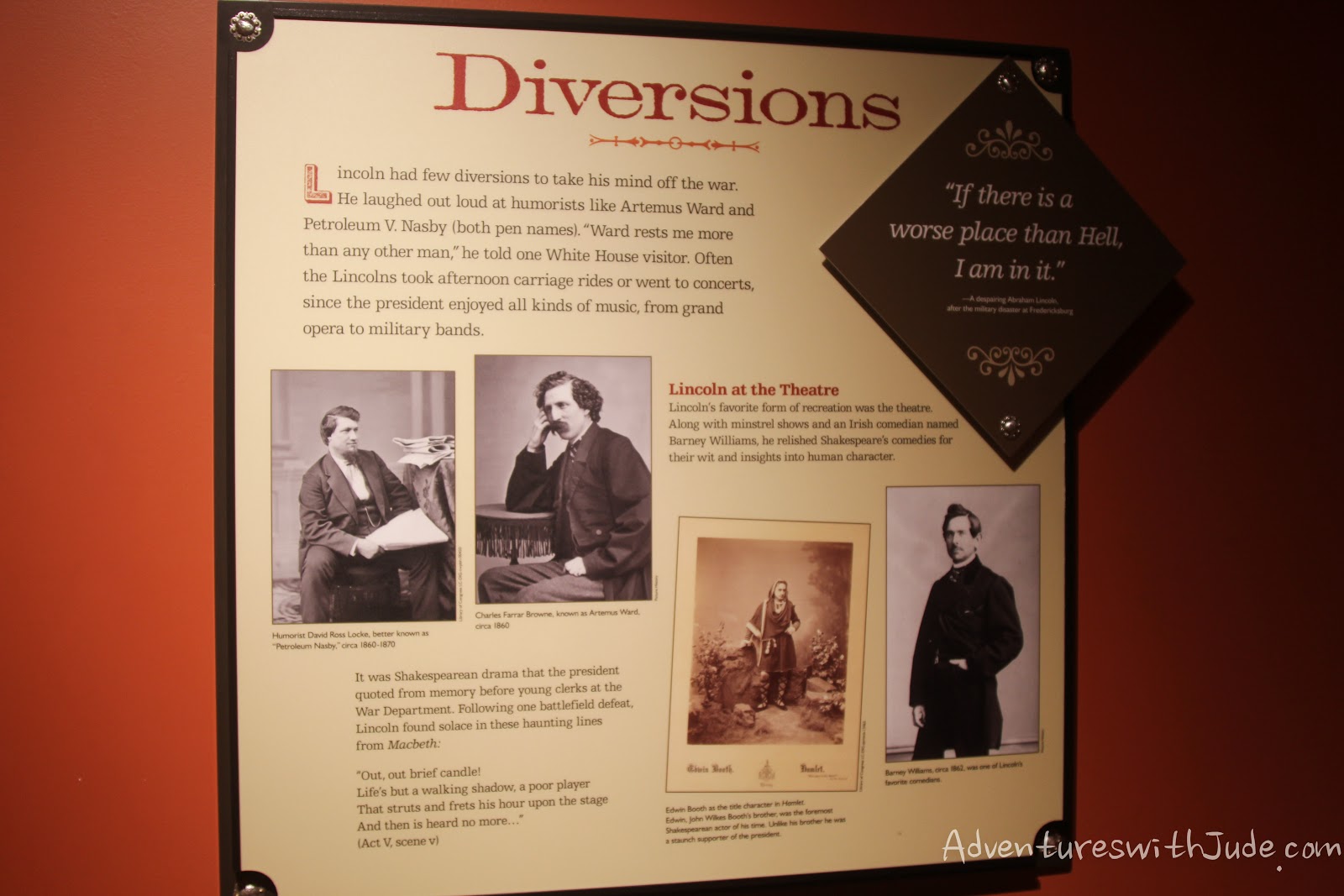
Lincoln's stress diversions

After a history of the Lincoln Administration, the museum segues into the the Assassination. 

John Wilks Booth's plans change

 There are a number of artifacts on display, including the murder weapon.

Pistol assassinated Abraham Lincoln

At the end, you move on to the theater itself.  Hanging on the walls of the hallway leading there are two timelines: placards on one side describe President Lincoln's day, and the other side outlines the assassins' activities.  We learned a major reason why Booth was able to get so close to President Lincoln -- he was an actor who worked in Ford's Theater.  He was not part of that evenings' production, but so well known to everyone that he had run of the building and nobody suspected a thing.

We found this final moment almost heartbreaking, especially after having watched the movie "Lincoln."  At the end of the movie, Lincoln jokes that his wife will be very upset if he doesn't get there before the curtain rises.  He'd have preferred to finish the task and not save it for morning, but he'd defer to her wishes and get to the theater on time.


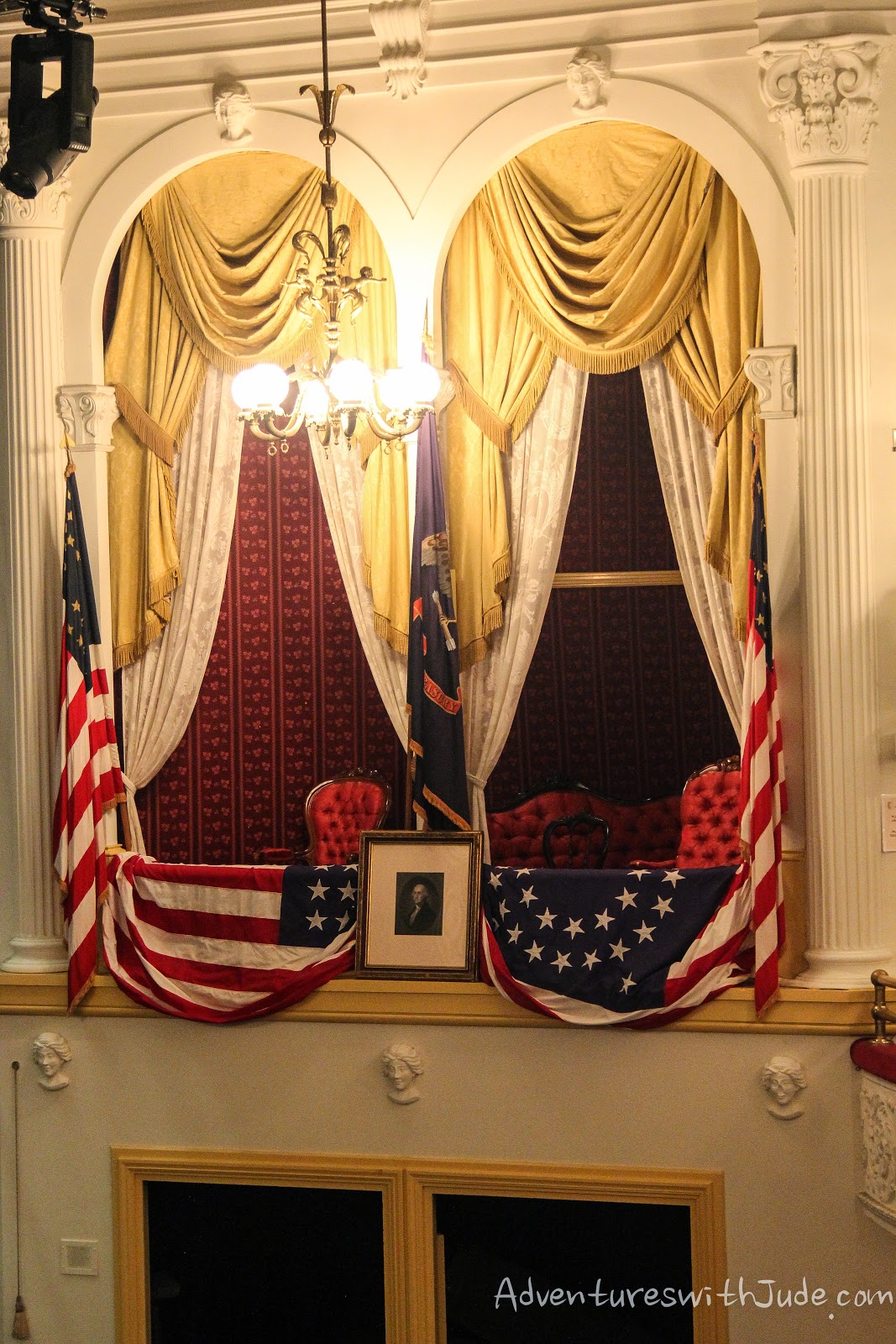
The Presidential Box, where Lincoln sat, is easily found by its stately decor. 

The Presidential Box Ford's Theater

It couldn't have been any easier for Booth to find Lincoln's seat.  The evening of April 14, 1865 was the first time it had been decorated with flags and George Washington's portrait, signifying it as the "Presidential" box. The furnishings that are there now are from the correct for the era, but not the original ones.  However, he portrait of President Washington, however, is the original portrait that hung there when the Lincolns occupied the box.


Lincoln's view Ford's Theater

This view was pretty thrilling, and one we only were able to see through the camera lens. There isn't enough space to squeeze a person behind the chair, but by holding my camera in the smaller space, we were able to get an idea of what President Lincoln's view of the play, Our American Cousin, might have been.

Today, Ford's Theater is an active theater, and the theater major in Mom was in love with the fly space.  She wished they had given backstage tours, because she would have loved to have seen all of their tech equipment. 


In addition to Ford's Theater itself, the tickets allow entry to the Petersen Boarding House across the street.  Physicians knew that Lincoln's wounds were mortal, and only palliative care was needed.  However, not knowing where Booth and his cohorts were, they were too afraid to return President Lincoln to the White House.

Abraham Lincoln death Petersen boarding house plaque


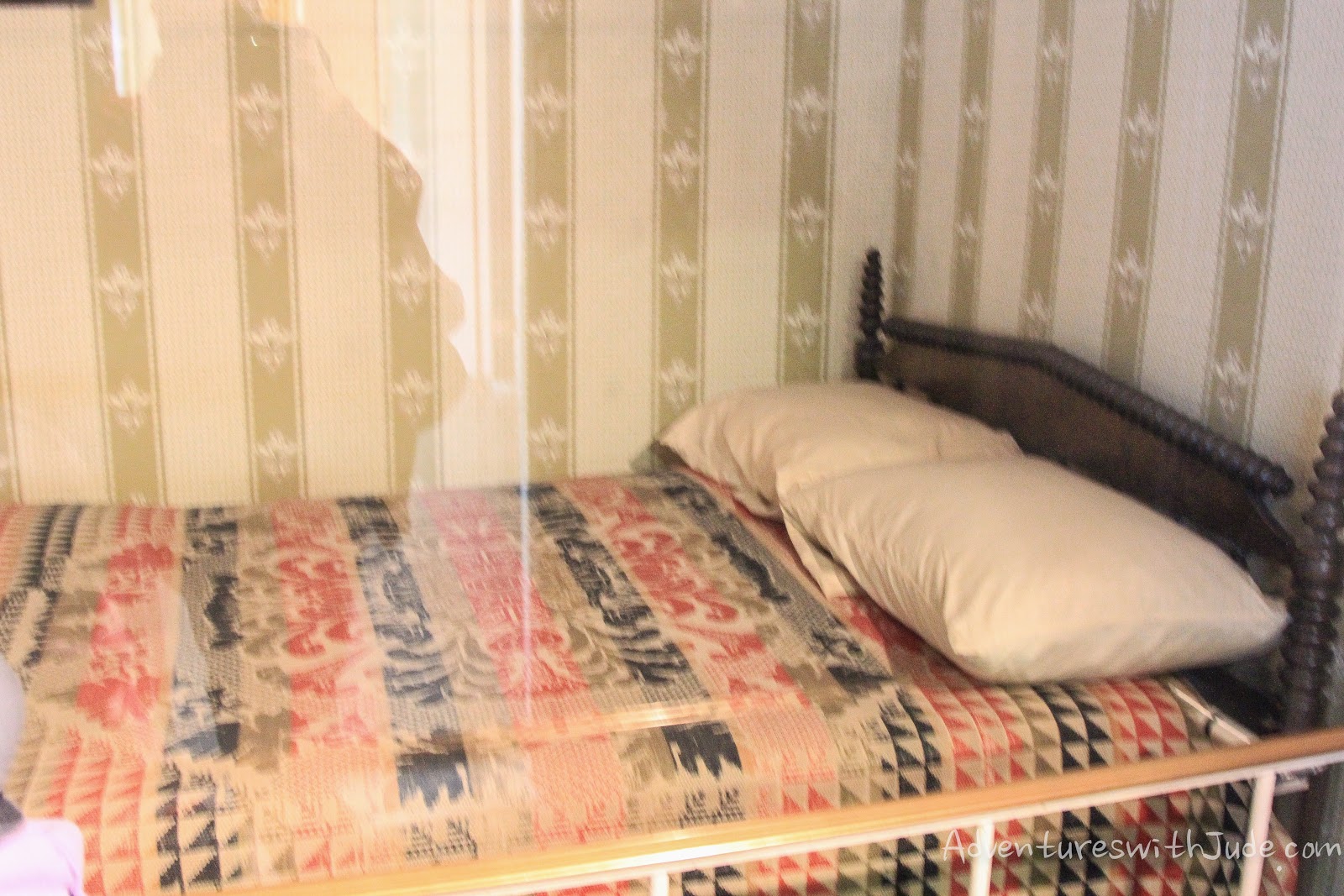
Abraham Lincoln's death bed

While again the furniture is original to the period, and this bed similar in size and design, the furniture is not original to the house.  The original bed on which Lincoln died is on display at the Chicago Historical Society in Chicago, IL.  If it looks too small for Lincoln (who was six feet four inches tall), it's because it was.  Lincoln was placed on the bed diagonally so that his entire body would fit.

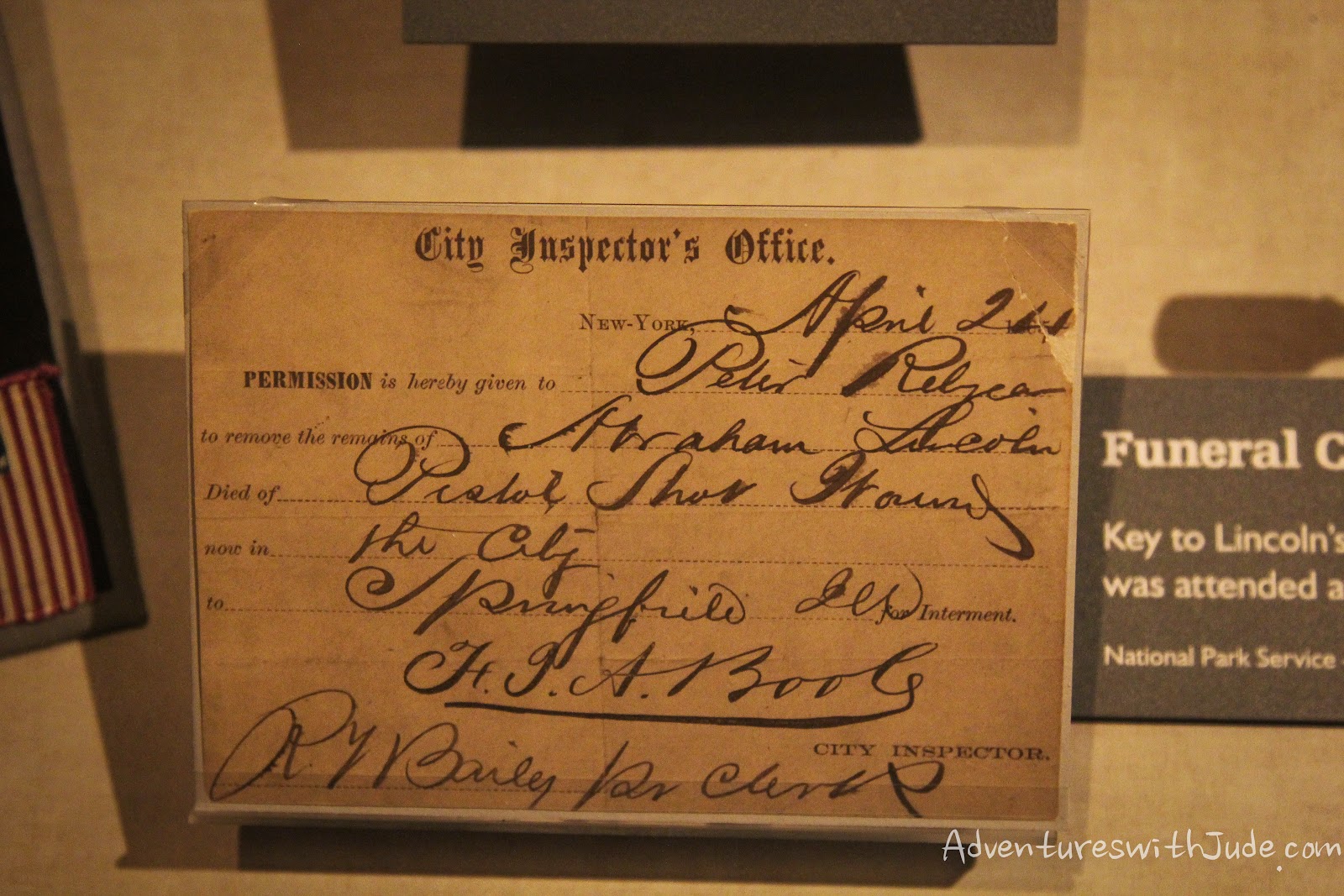
The museum continues through the house and into the building next door.  First is an exhibit on Lincoln's funeral...

permission to return Lincoln's remains to Illinois

 
Followed by an exhibit on the hunt for Booth and his co-conspirators.


It also explained the trials and sentences of those involved.  We learned that Mary Suratt, the proprietor of the boarding house where Booth, Suratt's son, John Jr., and other co-conspirators met, was convicted and sentenced to death by hanging - the first white female executed by the federal government.

Finally, there are two floors of exhibits on Lincoln's legacy.  While he's almost universally considered one of the greatest Presidents by Americans, it's interesting to see how he's affected citizens of other countries.

Lincoln belongs to mankind


Jude used to think George Washington was probably the second greatest American, behind Benjamin Franklin.  This exhibit on how Lincoln has invaded pop culture has him thinking Lincoln must have been pretty good, too, if he became a comic book superhero.


As we exited the museum, we walked down a two-story staircase, supported by a center pillar.


As we circled the tower, we noticed a few books that we own.  A particular biography of Abraham Lincoln was one of my favorite books as a child - I think I checked it out of the library at school at least three times a year, so this looked like an absolute treasure trove to me!

When most people think of visiting Washington, DC, they think of the Smithsonian museums, or the Washington Monument, or the Lincoln Memorial. We'd encourage you to head a few blocks away from the National Mall and check out Ford's Theater National Historic Site.  Explore the place where one of our greatest national heroes died, and discover his legacy to both America and the world.


©2012- 2015 Adventures with Jude. All rights reserved. All text, photographs, artwork, and other content may not be reproduced or transmitted in any form without the written consent of the author. http://adventureswithjude.com
Related Posts Plugin for WordPress, Blogger...
Pin It button on image hover