Showing posts with label unit study. Show all posts

Wednesday, August 15, 2018

Picture Book Explorers ~ Paddington (Homeschool Review Crew)

Paddington Bear has long been of my favorite children's literature characters. This adorable bear from Darkest Peru find himself in Paddington Station, London, and is adopted by the Bond Family.  I think what I love so much about him is his childlike qualities: his heart is in the right place, but when tries his hardest to do the right thing, it just turns into a disaster. When Jude studied A Bear Called Paddington a few years ago, I fell in love with him all over again, and couldn't wait for Damien's turn.  I was happy with our old study, but we had an opportunity to review a new program. I was intrigued because Paddington is a classic British lit character, and this Paddington Bear study was written by British curriculum developer Branch Out World. I was really curious to see if there were any different cultural interpretations.

Branch Out World was founded by "a home educating family" that loves books. They designed their literature-based unit studies to be infinitely tailorable.  They are recommended for students aged 5 to 10 years, with the ability to scale the activities to the child's abilities.  This means you can use any of their 20+ studies from the Picture Book Explorers series for multiple age children simultaneously, or work with the book at the child's current level and revisit it as he grows. Branch Out World also produces lapbooks which allow you to study topics from Christmas in Europe to Volcanoes.

First hurdle: Getting the Book


When we first signed up for this, I had intended to read from the set of Paddington books we already owned. However, this study uses a specific printing of the book and refers to particular pages and illustrations.  Using our other book was not going to work. You certainly could check the library, but we struck out at ours. Amazon to the rescue, but it did take the better part of two weeks to get here. As it turns out, and not surprisingly, most buying options for this specific option are from UK sellers.  If you're looking to do this study, you'll want to allow for enough time to acquire the book.

Second hurdle: Navigating the lingo.

Dear friends of ours are native Australians, and when they come to visit, there's always an adjustment period. Watching the kids try to figure things out is always fun.  Sometimes, they figure it out from context, if Auntie Jo says "Grab your jumper!" as she picks up her own sweater, but sometimes there's a bit of "Wait, what are you talking about?" (Jam, jelly, and Jello are always a "Wait, we're not on the same page." discussion.)  Working with this was no different.  The first directions are "Get a library ticket." Here in the states, we'd say "Get a library card."  Fair enough.  You're also going to be dealing with British spellings of words...like colour instead of the Americanized spelling color.  This turned into one of those "That's just how they do it there, let it go," discussions after Damien pointed out it was spelled wrong for the fifteenth time.  Thankfully, kids are reasonably adaptable.

Third time lucky: Working on the study.


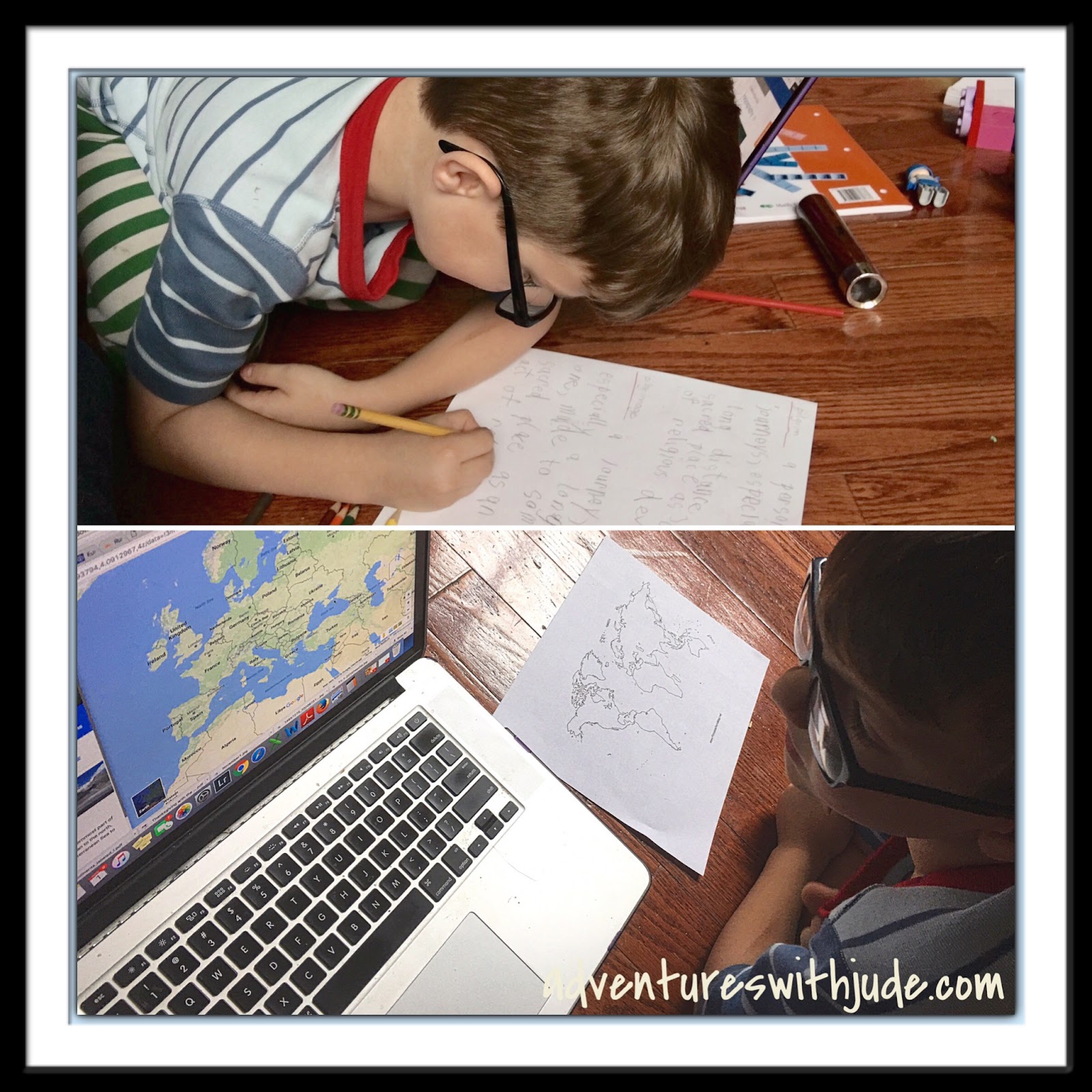
Pros: Content-wise, I think it was quite good. It covered and included maps for the areas studied.  I hate Googling randomly for maps because I invariably select the one that doesn't have something we need.  For example, this map included delineations between England, Scotland, and Wales.  Damien easily found a map that showed him specific city locations.  He also was amazed at all the town names he recognized -- Dover, DE is named for English port town, there's a Plymouth, Massachusetts, and "Old" Jersey, not to be confused with our home state of New Jersey.


It also has given us a field trip destination: the closest zoo with spectacled bears is the National Zoo in Washington DC.  We did some research on their website about the Andean bears, and learned the bears that live at the zoo like sweet potatoes and grapes, just like Damien!


Cons: If you're a family who loves lapbooks, this is going to be right up your alley.  There are tons of mini-projects to assemble into a lapbook.  If you're my kid, this is torture because you have less-than-stellar fine motor skills and it means you spend more time obsessing over having to cut stuff out than you do actually completing the program.  I also really dislike when programs make food a big deal activity.  (I don't mind learning about what foods other cultures eat, but it's hard for a kid who can't eat many foods when the directions are "make tarts and marmalade and have a tea party.") I feel like we didn't get as much out of this as we could have.

Overall, I'd rate this program a 3 out of five for our family.  It was a good unit study, but I found it lacking as a literature study - only one of the five days' activities involved studying the book as a literary work.

To read other Crew reviews of Picture Book Explorers ~ Paddington, click the banner below.


Paddington Bear {Branch Out World Reviews}


Want to keep up with all of our adventures?
Subscribe below to get Adventures with Jude delivered to your inbox.

Enter your email address:


Delivered by FeedBurner


©2012- 2018 Adventures with Jude. All rights reserved. All text, photographs, artwork, and other content may not be reproduced or transmitted in any form without the written consent of the author. http://adventureswithjude.com

Monday, April 2, 2018

Creation Illustrated Unit Study (Homeschool Review Crew)


The Crew offered us the opportunity to review two nature-based unit study programs from Creation Illustrated.  The first was called Snow and the second was Pine Trees.  They are two of eight unit studies that the company currently offers.  Snow goes with the Winter 2018 edition of Creation Illustrated magazine, while Pine Trees can be found in the Fall 2018 volume.  (Note: Links are to digital versions of the magazine.)

The Unit Studies


I have a love-hate relationship with unit studies. I love the concept.  I also have kids who tend to latch onto ideas and run ultramarathons with them.  (Sometimes I wonder how Luke could not have one the science fair in 8th grade.  They asked an Aspie child to explain the mechanics of paper airplanes. I wouldn't have been surprised if they offered him the medal just to stop talking!) I'm always excited to start a unit study and really dig into a topic. The part I struggle with is that by the end I'm usually burnt out and over the concepts, and tired from having to gather up the information and supplies we need.  I often feel very discombobulated by the end -- like we've done a lot of work, but haven't much to show for it.  I think I actually feel differently about the ending of these, for several reasons.


I opened our PDF download of Intricacies of Snow and found there were a lot of embedded links to video and text resources. YAY!!  With these links, the study is almost entirely self-contained.  The exceptions are a few physical items, like a Bible resource, the materials to make snow crystals from Borax, etc.

The studies are in a "notebooking" format.  Another point in their favor.  I've seen so many lapbooking-style studies, and I think sometimes that adds to my sense of "Aren't we done this yet?" because there's so much cutting and pasting to them.  Printing these particular studies as a whole didn't make sense because of so many hyperlinked resources, so we wound up using them from the computer and a composition notebook for the writing.  (Even if you print the PDF out and place it in a binder, you'll need some looseleaf for some of the assignments.)

The only thing to watch out for, however, is if you give your child access to the PDF, he also has access to the answer key.  Jude generally is pretty good at leaving those alone, but some of my other kiddos have not been.  It's definitely tempting having the answers right there! I do like that those pages are pink, not white. It makes them easy to find when I'm looking for the answer, and also easy for me to spot from across the room if someone is taking an unauthorized peek.

When we started this, we were coming to the end of a fairly low-snow winter. The line between "north and west" and "south and east" is generally right at the edge of our township.  When Philadelphia gets snow, we got freezing rain.  When the shore points get pounded with snow, we got more ice.  It also was nearing the equinox, when the sun angle is about the same as late September.   Snow that falls this late in the season doesn't usually stick to the ground.  But lucky for us - and to prove God has a sense of humor - as we worked we got pounded with a slightly east-of-normal nor'easter that left us almost eight inches of the white stuff! It gave us the perfect opportunity to get out there and study it first hand!


Note: A few of the activities are better if you do have some snow to study. However, if you are studying this in a warmer season or climate, you won't miss out on much, just studying some snowflakes in person. You can easily YouTube videos of snow to re-create everything except direct observation.

The purchase page says the target age is grades 3 through 8, but the Snow and Pine Trees studies each specifically said it was primarily for students in grades 5 through 8.  I think there are some things that younger students might be able to tag along with, like watching the included videos, taking turns reading the Bible verses, etc. An older elementary student might even be able to keep up with the science sections.  However, the math is definitely a bigger-kid section, as is vocabulary.   Because it's so brief, and not really something that, as a curriculum, can be revisited again and again, I'd reserve it for the older kids.

This unit study uses KJV references for the Bible section.  As Catholics, we use the NABRE translation, so when the boys need to look something up, we generally just use our Bible rather than looking up an online King James Bible.  The actual differences in word translation aren't so much of a problem... i.e., "snowy day vs. time of snow," and you get the same idea with clothing vs. raiment being "white as snow."  However, you may find that the particular chapter/verse passages may not align. Here in Psalm 57, you can find references to snow regardless of translation, just not in the exact same spot.  The study asks the student to read Psalm 51:7, which in the KJV translation is:
Purge me with hyssop, and I shall be clean: wash me, and I shall be whiter than snow.
However, Psalm 51:7 in the NABRE is:
Behold, I was born in guilt, in sin my mother conceived me.
and Jude needed to read down to verse 9 for the "snow" reference:
Cleanse me with hyssop, that I may be pure; wash me, and I will be whiter than snow. 
Theologically, it's the same concept, but it's not the same Bible location. I often need to adapt curriculum when there are Bible translations involved, so it's not something new that would keep me from using the program. However, it is something to keep in mind that I need to address, either before I hand over the packet or to remind kiddo, "If you don't find it right there, read a couple verses on either side and come get me if you can't find it nearby."

Another reason to look ahead if you're using a different translation: you also may not find the answer at all!  In Job 9:30 from the NABRE, it says:
If I should wash myself with soap and cleanse my hands with lye.
with no mention of snow at all.  We googled the KJV Version:
If I wash myself with snow water, and cleanse my hands with soap. 

The writing activity assumes your child knows how to write an essay.  Jude is working his way up to multi-paragraphs, so we focused on a single paragraph about his favorite snow activity: making snow angels.


While we've been working on the Snow unit study, I peeked ahead at the Pine Tree unit study we also received.  It is nearly the exact same roster of activities, including Bible study, vocabulary, geography, math, and writing exercises.  (Again, check the Bible verses if you're not using KJV because there's at least one that I've found (so far) that the NABRE translation differs enough that kiddo can't answer the question.)  Snow's math focuses on multiplication and fractions, but Pine Tree's math section explores the concepts of writing equations and the Fibonacci sequence.  I love that it explores so many different types of pine trees.  In our travels, we've seen everything from the white pines we planted on our property line as a windscreen to the lodgepole pines that top the mountains at Yellowstone. I think pine trees are a great way to study God -- pines are as similar yet as unique as all of His Children.  I'm looking forward to doing this one.


Creation Illustrated Magazine


Each edition of the magazine focuses on finding how creation is illustrated "In Nature,"  "In Scripture," and "In Living."  The publisher's goal is to provide a balance of mental, spiritual, and physical renewal in each month's offering.  While Creation Illustrated is appropriate for all audiences, it is very homeschooler friendly, with discussion questions at the end of the magazine for several of the articles.


Each volume also features coloring, photo, and poetry contests. The article we read for our Unit Study, "The Intricacy of Snow" by Brandy Dixon, was from the Winter 2018 edition.


I was impressed because this article used science to explain God, rather than God to explain science.   As Catholics with a belief in theistic evolution, sometimes I find that creation-based studies are almost (or sometimes wholly) bludgeoning Creationist.  Dixon's article beautifully balanced God's presence and work in all things with the scientific explanation for them.  For example, we know that at the center of a snowflake is a dirt particle that forms something for the ice crystals to seed against.  However, rather than going on about how God was so smart in how He got the snowflakes started, she compares that dust speck that to the unfortunate sinful nature of humans.  She goes on to examine this "dirty particle" that through layers and layers of something else (ice for the snowflake, God's grace for us humans), we wind up with a one-of-a-kind work of art.

One thing I noticed by reading through the magazine is that while the one article is mentioned in the Unit Study, there was an explanation of snow on page 66 that was not part of the unit study.  It described three reasons God sends snowstorms: to correct, for the land, and for mercy.  I noticed that the Bible verses Jude read and studied were among those chosen to support these reasons. I wish this article had been included as a resource.

Others have called it, "The Christian answer to National Geographic," and I think that's a fair assessment.  Articles are researched, written, and illustrated well.  The major articles center around four major topics:

  • Creation Up Close - Seeing God's work, plan, and love in a specific part of His creation
  • Re-Creation and Restoration Outdoors explores how God uses nature to bring us back to Him
  • Creatures Near and Dear to Us - God's way of designing animals mimics how He cares for us (plus, the "aww, so cute!" factor!)
  • The Creation Week - a sequential study of the earth in the context of the story of Creation.  
These Creation Week articles are more clearly Creationist and mention/discredit gaps in evolutionary theory.  However, I think it deftly handled the conversion of Antony Flew. It also prompted me to google Flew, so points for motivating curiosity!  He was a British philosopher who ascribed to an "atheist until somebody can prove God exists" mindset.  His studies converted him to deism when he realized that there may be scientific proof of evolution, but there are some principles that simply cannot be explained other than" the hand of God was involved."  I think this describes our family's philosophy well, so I'm comfortable sharing these with the kids without having to do too much "Well, this is how some think, but we believe something different..." I can just say, "This is a well-written article, read it."

After reading both issues of Creation Illustrated that we had access to, I am seriously considering a subscription for our family.  My only complaint about the digital version of Creation Illustrated is the print is tiny.  I tried to zoom in and make it easier for us to read, but then it seemed to slide all over the screen, or the page turned too easily.  Taking screenshots and enlarging was impractical as well - you can see how blurry the text got by looking back at the screenshot of the discussion questions above.  I think if you were only using the magazine to complete the unit study, it would work fine, as long as you are patient.  If you're interested in reading and using the magazine on a regular basis (it publishes quarterly),  I would really recommend springing for a subscription to the print edition. 

I'm really impressed with these two unit studies. They're not in-depth enough to teach a language arts math, science, or "how to research a topic" concept on a middle school level, but they're a well-thought, well-organized way for a child to practice any of these skills he has learned.  The Spring Edition of the magazine will be available soon and will be accompanied by a new, ninth unit study on BUTTERFLIES!  These are some fantastic creatures, and after working with these two unit studies, I'm excited about this new release.

Other crew members have been working with these unit studies.  Click the banner below to read their reviews!

Creation Illustrated Unit Studies {Creation Illustrated Reviews}


Want to keep up with all of our adventures?
Subscribe below to get Adventures with Jude delivered to your inbox.

Enter your email address:


Delivered by FeedBurner


©2012- 2017 Adventures with Jude. All rights reserved. All text, photographs, artwork, and other content may not be reproduced or transmitted in any form without the written consent of the author. http://adventureswithjude.com

Thursday, June 1, 2017

YWAM Publishing: Abraham Lincoln

I was very excited for to review the biography Heroes of History - Abraham Lincoln:  A New Birth of Freedom from YWAM Publishing because their Heroes of History series is one of our favorite history resources. In the past, Luke did the history reading, but the torch has been passed down.  Matthew currently studying American History got tapped to complete this review.


Abraham Lincoln is not a new person of interest in our homeschool. Since I was a child, I've been fascinated by him.  In my opinion, Lincoln belongs in the pantheon of men who define the American spirit -- he's the quintessential, "pull yourself up by your own bootstraps," self-made man. When Luke was studying American History, he found that much of our nations' history can be tied to Lincoln - either a foreshadowing of what would happen during his presidency, or tied back to his administration.  We both came to appreciate Lincoln's respect for justice and the laws of the land.  From the very beginning of his presidency, Lincoln was aware of the role of the executive branch of government, and what powers the Constitution gave or withheld.

"First Reading of the Emancipation Proclamation"
Lincoln Presidential Library and Museum, Springfield, IL

There are literally thousands of books written about Abraham Lincoln.  (If you ever visit the museum next to the Peterson House/Fords Theater NHS, you can see three stories' worth of books ringing a support column.) I think the only way to write a good book about Lincoln is to not try to include it all, but pick a single theme and run with it.  All of the YWAM Heroes of History books that we have studied begin with a defining moment in the subject's life that exemplifies a character trait, and then show how his (or her) life revolved around this belief, and this is the perspective on Lincoln that authors Janet and Geoff Benge have written from.  The book's opening chapter describes how his experience as a Captain in the Illinois Militia helped define Lincoln's opinion that the United States was founded on laws that were meant to be obeyed at all times, not just when convenient.  Clearly, Lincoln's understanding of the law did not begin with his election.

The story then fades back to Lincoln at age seven, when a lack of book education left men like his father ripe for exploitation.   Fancy "Philadelphia lawyers" took advantage of the practical but less-than-specific surveys of the frontier to take over homesteads, and Lincoln's family fell victim.  Despite all I had read about Lincoln in the past, I never knew that this was a major catalyst for the family's move to Indiana.  I knew that slavery had played a role in choosing Indiana but hadn't realized that a land grab had ultimately set them on the road there. Now having studied Lincoln's first inaugural address, I'd say he became as good an attorney as any Philadelphia lawyer!

Reproduction Cabin
Lincoln Presidential Library and Museum, Springfield, IL

While not a trait outlined in the opening pages, I think this book also does an excellent job of highlighting Lincoln's tenacity.  He often found himself moving on or at loose ends but managed to channel that into an opportunity for growth.  Even when running for state government for the first time, Lincoln he says that he's used to not winning, so while he wanted to be the common man representing the common man, if he's wasn't chosen, he figured he'd survive the disappointment.  Lincoln saw much tragedy in his life - uprooting, a voracious mind with little opportunity for formal learning, political defeat and the deaths of so many he loved - yet never did he simply give up.  There were some times where he might have floundered a bit, but never did he admit defeat.  While the book is not explicit in its message of perseverance,  it's hard to justify any "I'll just quit," when you see that a man who grew up in a dirt-floor cabin, writing on the ground with a stick because he had no paper or pencil, rose to become one of history's most enduring leaders through his own determination.

In addition to the biography, we also received the Study Guide that goes with the book.
While Luke spent close to three months specifically reading about Lincoln, Matthew has learned most of his knowledge over the last three summers, visiting historical sites affiliated with our 16th president's life.   We've been lucky to visit many National Park sites that are either directly tied to Abraham Lincoln, or affiliated with him. However, due to our travel itineraries, we haven't studied these places in chronological order; in fact, we visited Gettysburg over a year before we had the opportunity to visit where Lincoln was born, and it took us another year after that to visit his adult home and the cemetery where he was interred.  The Unit Study contains both vocabulary and chapter comprehension questions, but also provide ideas for essays and projects that help the student understand the man behind the almost legendary reputation.

Lincoln Home NHS
Springfield, IL
The guide also provides a cross-curricular activity foundation.  Matthew is not necessarily an avid unit-study person, but using some of the ideas helped tie things together.  For example, we adapted some of the mapping activities as a basis to show the breadth of Lincoln's lasting influence on just the National Park service.  As he organized the timeline of NPS-related sites related to Lincoln, Matthew learned that while Teddy Roosevelt and Yellowstone get the popular glory for being the first national park, the Yosemite Grant, the foundation of what would become Yosemite National Park, was signed into law by President Lincoln.  Once again, we found an imprint left by a quiet, unassuming boy from Kentucky who grew up with respect for America's laws and her lands -- one more way in which Abraham Lincoln will forever belong to the ages.


100 Crew families have been studying YWAM's Heroes of History and Christian Heroes: Then and Now. Click the banner below to read about their stories.

Christian & History Heroes {YWAM Publishing Reviews}


©2012- 2016 Adventures with Jude. All rights reserved. All text, photographs, artwork, and other content may not be reproduced or transmitted in any form without the written consent of the author. http://adventureswithjude.com

Wednesday, March 15, 2017

Circle C Stepping Stones (A Homeschool Crew Review)

Have you ever read a book series and felt you were "missing" part of the characters' lives? Up until now, the Circle C stable of books featured protagonist Andi Carter at age six in the Circle C Beginnings series, and then jumped to Circle C Adventures, where she's twelve years old.  But what about when Andi went from learning to ride to riding the range? Susan K. Marlow and Kregel Publishing have begun to answer those questions with a brand new Circle C series, Circle C Stepping Stones, where nine-year-old Andi is finally old enough to ride both without her big brother's supervision AND with a saddle.  We received the first two books of this six-book series,  Andi Saddles Up and Andi Under the Big Top.


Andi Carter is an old friend of ours. Two years ago, we reviewed Thick as Thieves, the first book in the Circle C Milestones series.  This set is for older readers (ages 9 to 12), but I loved Marlow's style of writing. Not only was it a well-paced read, but it was well written and age appropriate.  Finding books that are both are hard.  With Jude, books that are at his reading level tend to be more juvenile in content, while at the same time, higher-reading Damien isn't ready for the content of many harder books.  And, even when we do find a book that works for either boy, once he's finished, the hunt is on again.  I'm so excited to find a great series of books for kids in the 7- to 10-year-old reader range!

Chapters are a reasonable eight to ten pages long, while entire books are just over 100 pages.  Beautiful charcoal-style illustrations by Leslie Gammelgaard give concrete pictures to help anchor images in readers' minds, but they are spread out enough that they don't become the only way they "see" the action.


Now, I'm sure you're thinking, "Wait, Andi is a girl. Isn't this series for girls?" Nope.  Sure, it appeals to girls -- Celia grabbed the books and ran off before I had a chance to even say "These are for a review and I need them back!!" The protagonist is a 9-year-old horse-loving girl, so it is perfect for girls.  However, it's also a fantastic series for boys as well - Andi is a horse lover who happens to be a girl.  It's not a series "for girls" In the first two books, there's horseback riding, a boundary dispute, wild adventures (including a broken bone!), a circus, and a stolen (and returned) horse.   Damien has been reading them as well, and can't wait for the next day's reading.

Andi Saddles Up begins with birthday girl Andi, ready for her own saddle and the privilege of riding without supervision.  However, Andi learns that as much as she thinks she's now grown-up enough to do things her own way, she still needs to listen to adults guiding her -- they're not trying to be mean, but instead want to keep her safe.  She pays for her pride with a broken bone.

In Andi Under the Big Top, the circus has come to town.  There is lots to see, but most of all, Andi wants to see the bareback rider. She can't imagine anything better than being part of the circus.  However, after making a new friend and being exposed to the seedier side of the business, she finds that it's not quite all she thought it would be.

While I'd recommend the books for any child, Kregel Publications offers ways to transform these books into literature units for homeschool students.  We decided to make Andi Saddles Up into a literature study for Damien.


He's needed a little bit of help with this.  The questions aren't terribly difficult, but he's finding he does need to refer to the text.  This is new to him, so I've been showing him how to skim for what he needs.  I don't think the questions are "too hard" for him; it's just a new experience.  I think he'll be able to do the next one on his own.

Activities include the standard vocabulary and comprehension questions.  However, it also adds in other activities after these.  Lessons in creative writing, map skills, and an introduction to anatomy/science of broken bones.  The Andi Under the Big Top Activity Pages includes lessons that tie into that book -- math via calculating the cost of circus snacks, a biography of French trapeze artist Jules Leotard, etc.


They also include a "suggested calendar" - what to do on a single day, etc.  Damien found he preferred to do them in three-chapter chunks (i.e., Chapters 1-3, 4-6, etc.). He read (ok, devoured) the chapters one day, and completed the activities on the next.


Jude has read the books, but since he's already doing two literature studies, I didn't worry about him doing this one, too.  I also think that while it's perfect for a second or third grader being introduced to might be a little light on content for him (he's heading into fifth grade), but it's perfect for a second or third grader being introduced to literature studies.  If I were going to use these with Jude, I'd probably spring for the accompanying Lapbooks and use them as well.  They are a separate purchase, but very reasonably priced.  They are produced in conjunction with well-known lapbookers A Journey Through Learning. You can see samples of the lapbooks' content here.

Damien has fallen hard for Andi's adventures, and I'm excited to find a series for him to grow with. Celia was happy to find more about what has become Andi's backstory, which just whets her appetite for more of the older series books.  We're delighted to be visiting the Circle C ranch again!

For more about the Stepping Stones series, follow Kregel Publishing and/or Susan K. Marlow on social media, or click the banner below!

Twitter (Kregel Books): https://twitter.com/KregelBooks
Twitter (Susan K. Marlow): https://twitter.com/SuzyScribbles
Facebook (Kregel Books): https://www.facebook.com/KregelBooks/
Facebook (Susan K. Marlow): https://www.facebook.com/SusanKMarlow?fref=ts


Andi Series {Kregel Publications and Susan K. Marlow Reviews}


©2012- 2016 Adventures with Jude. All rights reserved. All text, photographs, artwork, and other content may not be reproduced or transmitted in any form without the written consent of the author. http://adventureswithjude.com

Friday, November 4, 2016

Homeschool Legacy: Thanksgiving with the Pilgrims (A Homeschool Crew Review)

I'm always torn between trying to keep up with "regular" school work and adding in "fun" programs.  It's tricky for us to balance new projects with our usual lesson plans, because when we digress from the routine, it can be hard for us to get back into it, but I hate to "add on" too much because then we have rebellion. One of our successes from last year was a unit study from Homeschool Legacy -- it's once-a-week format struck the right balance for us.  The boys are studying American history, so combined with the time of year, it seemed an excellent opportunity to try out their five new Once-A-Week Micro-Study offerings, Thanksgiving with the Pilgrims.


What makes a Micro-Study different from Homeschool Legacy's traditional Once-a-Week Studies? The easiest way would be to call them "Studies Light," but I hesitate to leave it at that because that connotates they are more "fluffy," with less substance.  By no means! These studies are of equal quality to the full-length ones, but the coursework is less intense.  It can be completed quickly -- each week's assignment takes about 90 minutes, either all in one afternoon or spread across three days, as compared to their regular studies that can be used daily or take a full school day to complete a single week's lesson.


The Micro-Studies are geared towards students as young as first grade and provide more of an "overview exposure to the topic" than the in-depth study of Homeschool Legacy's traditional program.  The lessons still can be spread across six weeks,  but we found that since we could complete a week's worth of tasks in a day, it was easy to do the entire program's activities in a little over a week -- perfect for us for a holiday-themed unit study! The only task we couldn't finish in a week was the suggested reading. There are three books listed (choose one, two, or all), and at 80+ pages each; since we couldn't complete even one in under a week, we opted to just continue with it as our daily read-aloud until we were finished.   However, we've been able to get back to our "regularly scheduled afternoon work" quickly -- important for boys who think that four days without their usual work list means they are done with grammar forever!

Each day's work consists of reading about a half page of information about the Pilgrims and completing an activity that goes along with the passage.  The passages are easy to read -- they score at Grade 4.4 on the Flesch-Kinkade grade level.  This puts them right in the middle of Homeschool Legacy's target of Grades 1 through 8 for these studies.  Jude (grade 4) read them easily, and even Damien (reading at a 2nd grade level) had few difficulties.  Most of his stumbles were actually over  Native American words (names) like "Tisquantum" and "Massasoit" that even I had to slow down to read.

 The activities range from practicing map reading skills to stringing popcorn and cranberries.  The popcorn and cranberries actually highlight a difference between Puritan life and modern celebrations of Christmas; we learned that the Puritans spent Christmas Day, 1620 building homes.  Why?  Because to them, it was just a Monday, and the day after the Sabbath.  They didn't celebrate Christmas as a holiday! (The boys decided they wouldn't have been so happy to leave the Netherlands -- and Sinterklass -- behind to build houses in America!)


Micro-studies from Homeschool Legacy are available as downloadable files.  This means that many of the activities are hyperlinked for easy study -- just click the highlighted text and poof! you are where you need to be.  While we actually changed what we did for the map skills activity and opted to use Google Maps, I appreciated the hyperlinked virtual field trips to Plimoth Plantation (and yes, that's now going on our "real life field trip" bucket list!)  Yes, I could have googled it and found the link, and I probably would have pinned it on Pinterest, but it was nice to not have to find it when we were up to that part - we could just click and keep on going!


 My only complaint is that there isn't quite as much "come back next year" potential as the full-length studies.  I think we could probably do another Thanksgiving with the program if I added more research to it as they got older -- for example, instead of just mapping the towns in England and the Netherlands, I would consider adding a little bit of "tell me about those countries," or "look up more about the Massasoit tribe that helped the Pilgrims."  There are several other Micro-Studies, but given the choice, I would invest in the full-length Native America study versus the Many Nations Micro-Study.  I would love to see a full-length Thanksgiving study, along the order of their Christmas Comes to America, to be able to circle back to the holiday each year and study it a little more deeply each time.

Overall, we enjoyed this short unit study. It was enough information that the boys were excited to learn, but not so much that it was overwhelming for them, and it fit into our schedule nicely.  I'd call it a success when both mom and student are happy!

For more about Homeschool Legacy, follow them on Facebook.  You can also read about the other studies the Crew has been working on by clicking the banner below.


Once-a-Week Studies {Homeschool Legacy}


Crew Disclaimer

©2012- 2016 Adventures with Jude. All rights reserved. All text, photographs, artwork, and other content may not be reproduced or transmitted in any form without the written consent of the author. http://adventureswithjude.com

Thursday, September 24, 2015

YWAM Publishing: Douglas MacArthur (A Schoolhouse Crew Review)


YWAM Publishing's Heroes of History is a favorite biography source for us.  About 18 months ago, Douglas MacArthur: What Greater Honor along with a copy of the accompanying Unit Study Curriculum Guide.  Luke reviewed their edition on George Washington, and we were hooked.  Since then, we've purchased a half dozen of them for his US History course, and they've become beloved by every big kid in the house.  (In fact, Clara Barton got "misplaced" a few times...and was found in Celia's room -- she had absconded with it and fallen asleep reading it.)  When given the opportunity to review another of YWAM Publishing's titles, Luke was just working his way through the Great Depression and on the eve of American involvement World War II.  This meant he had a fairly easy choice:  who else but Douglas MacArthur?  We chose to review Douglas MacArthur: What Greater Honor and its accompanying Unit Study program.

I have to admit, I knew very little about MacArthur beyond his infamous line, "I shall return," and honestly, I wasn't even sure what it was about, other than something he said during World War II.  Most of what I studied about WWII was centered around the European theater;  it wasn't until we visited the National World War II museum this summer that I understood the magnitude of the fight in the Pacific. After a rout by the Japanese, MacArthur had been forced to flee the Philippines; it took him three long years to methodically, island-by-island, fight his way back to the Philippines and free them from Japanese control.   Yet even after these crash yet intensive lessons about the Pacific side of the war, we still didn't know the answer to "Who was the man behind this ferocious vow?" 

What makes the Heroes of History special is that the books aren't simply a recitation of what someone did, but an exploration of the person and character behind the action. The average soldier doesn't simply re-enlist for enough years to rise to the rank of Five Star General,  so how did he get to that point?  Through the story, we learned about the tenacity and dedication of the man in the uniform.  Like the other books in the series, the bulk of the Hero's story is told in flashback. 

MacArthur's tale begins on the PT Boat as the newly appointed Pacific commander and his family are being whisked to safety in Australia. Though if he had his way he'd be fighting alongside his enlisted men, he recognized his country needed him to leave the tiny island of Corregidor in order to orchestrate the liberation of the entire Pacific. We learned how MacArthur began his military career with honor, deftly handling both incidences of brutal hazing and an inquiry into the practice at West Point, ultimately graduating first in his class.  Through his idea of the "Rainbow Division," gave the entire nation both the responsibility and the honor of defending the United States when it entered WWI. As for the Philippines, his father Arthur MacArthur, also a career military man, had helped liberate the islands during the Spanish-American war.  After graduation, the younger MacArthur was assigned to the Philippines as an engineer, and later re-assigned to be an aide-de-camp for his father. Together the two toured the Pacific, and this was when Douglas became endeared to the region. He was happy to be returned there after his war-era service on the US mainland, continuing the task of helping the Filipino people achieve independence; this time, he was help their army establish itself, one of the final steps to becoming independent nation and shedding its "US Territory" status.  After the Japanese attacked Pearl Harbor, they turned their sights on the American army in the Philippines.  It was no longer a fight between nations; it was a personal attack.

General MacArthur surveys the beach at Leyte shore
just after the American forces sweep ashore
1944
National Archives and Records Admin
(US public domain)
After so many years of MacArthur pere and fils building the Philippines toward independence, Douglas refused to allow them to become annexed to the Japanese empire without a fight.  He explained that he had followed his Commander-in-Chief's orders to extricate himself from the island to better facilitate a counter-attack, but vowed "...the primary object of which is the relief of the Philippines...and I shall return."  It wasn't simply a desire to win that fueled his island-by-island eviction of the Japanese, but a desire to see the men he fought alongside have the same measure of freedom that brought him to them.

His commitment to fairness and freedom made him the ideal candidate to become the Supreme Commander of Japan after the imperialist surrender, leading the American-led postwar rebuilding of a nation decimated by years of fighting and two atomic bombs. Yet, he was a humble man, buried in his everyday uniform, with none of the many medals he had earned pinned to his chest.

Before we even began the Unit Study, Luke and I found ourselves wondering why do we know so little about this man? Is it because he refused to play Truman's brand of politics during the Korean War? Was it was that he was eclipsed by the younger Eisenhower - the commander of the European theater - in the 1952 Presidential nomination?  These questions left us clamoring for more - and grateful for the Unit Study.  By including things such as essay prompts, activities that helped us learn more about MacArthur and his character, and additional reading resources, it helped us find the true story of the man, often reduced to an often-misfocused catchphrase, who should be celebrated for his contribution to freedom.  Though ultimately not called to do so, he was prepared to give his life in the fight to free his friends.  Scripture tells us there is no greater love than to do so.  Despite the accolades and rewards for his work, he found there to be no greater honor than being a simple soldier fighting for freedom.

Members of the Crew reviewed titles from both the Heroes of History and Christian Heroes: Then and Now series.  Click the banner below to discover the heroes they learned about. You can also follow YWAM Publishing on social media:

Facebook: https://www.facebook.com/YWAM-Publishing-482973445102/timeline/
Twitter: https://twitter.com/YWAMpublishing
Pinerest:  http://www.pinterest.com/YWAMpublishing


YWAM Publishing Review


©2012- 2015 Adventures with Jude. All rights reserved. All text, photographs, artwork, and other content may not be reproduced or transmitted in any form without the written consent of the author. http://adventureswithjude.com

Thursday, July 30, 2015

Heirloom Audio Productions: With Lee in Virginia (A Schoolhouse Crew Review)


We have become huge fans of Heirloom Audio Productions' series, The Extraordinary Adventures of G.A. Henty.  Their third release, With Lee in Virginia, was a much-anticipated edition here.  Not only did we recently study the American Civil War, but we were literally going to be "with Lee in Virginia" this summer -- we were heading to Appomattox Court House National Park.   The timing couldn't have been better!


Like the previous releases, Under Drake's Flag and In Freedom's Cause, the producers have assembled an all-star cast.  Brian Blessed returns as narrator George Henty, while a cadre of well-known Americans lend their voices to the other characters.  Actors Kirk Cameron (Maj. Stonewell Jackson) and Sean Astin (Gen. Jeb Stuart) need little introduction;  Andre Soggliuzzo, who has lent his voice to animation productions ranging from Avatar: The Last Airbender to Wolverine and the X-men, voices the titular character, General Robert E. Lee.

History tends look at war from the side of the victor, and the Civil War is no exception.  There is plenty to study about the Union generals, but the leaders of the Confederacy are often overlooked.  There tends to be an "us vs. them, winners vs. losers" mentality, especially in the current political climate.  However, it's important to remember than many of the soldiers -- from infantry on up to Supreme Commander General Lee -- were once soldiers in the Federal army.  In fact, Lee - the son of Revolutionary War hero "Light Horse Harry" Lee - graduated from West Point with an unblemished record, proved his mettle on the battlefield of the Mexican American War, and returned to West Point as an instructor.  President Lincoln even offered him the position of commander of the Union army.  I think history tends to cast Lee as a "traitor," but With Lee in Virginia shows a different side of the man.  Here, Lee struggles with the battle between his belief in Virginia's sovereignty as a state and the principles of the nation for which he has already taken three bullets.   How can he choose?  However, he must choose; he decides that the right to state government is more important and resigns from the United States Army.  However, he is still a man of honor; he fights for the Confederate States of America with the same passion and intensity he served with in the Federal army, and when surrounded at Appomattox, surrenders rather than needlessly risk more lives.  He is so regarded that General Ulysses S. Grant does the seemingly unthinkable -- he allows Lee to keep his sword after he surrenders his army.

McLean Home Parlor
Lee wrote surrender terms on the marble-topped desk on the left as Grant waited on the right.

 We also get to experience the war from the perspective of a Cavalry youth.  The hero of our story, Vincent Wingfield, is fifteen years old and a plantation heir.  Yes, he's a slave owner, but one with a conscience.  He refuses to allow another owner to beat a slave, and even does the unthinkable -- he buys that slave's wife and toddler son, to prevent them being separated, and later aids the man in escaping to Canada.  I think Heirloom has done a nicely balanced presentation.  Is slavery wrong? Absolutely.  Was there horrible mistreatment at the hands of owners and overseers?  Again, absolutely.  But Henty's story shows that while slavery is wrong, the politics of it aren't as simple as "just let them go,"  nor was every slaveholder a monster. When young Vincent is finally old enough to go off to fight, he goes not as a slaveholder, but as a Virginian fighting for his state's ability to govern itself.  He also is a bit starry eyed, like many of the boys in his regiment; patriotism runs high and they've not yet seen the blood running deep.  Almost immediately, we know the blinders come off when his dearest friends are shot down in the heat of their first battle, and by the time Lee surrenders, Wingfield yearns for nothing more but to return to home and peace.


Luke has been studying American history, and over the past two summers we've been able to visit a number of battlefields.  It's easy to leave there feeling pride in the Union's ability to hold off the Confederacy; between the near simultaneous battles at Gettysburg (PA), Vicksburg (MS), and Chickamauga (GA) and Chattanooga (TN), the Confederacy became so fractured that its fall was inevitable.  However, at each site, I've asked him to stand both on the Union territory and in the Confederate lines, and imagine feeling strongly enough about your side's beliefs that you'd volunteer to die for it.  The bulk of the story is told through Wingfield's experience as a soldier, with Lee actually playing the role of a mentor.  He teaches Wingfield that each man has to decide what is most important to him, and commit to that decision.  The honor of a man, Wingfield realizes, is not in his absolute success, but his commitment and his word.  He wasn't a traitor for intervening in his neighbor's abominable treatment of a slave; the law said the slave was a property, but his conscience said the slave was a man.  At one point, he gives a fallen Union soldier a cup of water - at that point, he was no longer the enemy, but rather another dying man in need of comfort.  That soldier, in turn, gratefully directs Wingfield away from certain capture.  Did each turn his back on his nation, or did they simply follow the greater mandate, "Love thy enemy"? When Wingfield asks Lee how he manages to balance who he's been with what he knows and what he sees, and to find the courage to take his path, Lee states, "Do your duty in all things.  You cannot do more, you should never wish to do less." At Appomattox, again, I asked Luke to place himself in each general's position.  I wanted him to realize that Lee chose his path, right or wrong by history's yardstick,  and stood firm.  Perhaps Lee should have given up sooner, but no man -- no nation -- wants to admit defeat if there was still a prayer of success.  At Appomattox,  Lee realizes that to continue to fight will only result in pointless deaths. His commitment to the Confederacy had not wavered, but his honor dictated the duty of sparing the lives of his troops.

Henty's writings have a decidedly Christian undertone that is honored in the audio drama.  Frequently, there were times where the characters were engaged in prayers for the success of their campaign and that their lives would be spared.  As we listened to Lee pray for guidance throughout the two hour story,  a slack-jawed Luke gasped and repeated this passage of Abraham Lincoln's second inauguration speech that he had studied.


At Gettysburg, we learned of the Union's prayers, especially Fr. Corby's blessing as the Irish Brigade went into battle, and it made sense that both sides were praying to the same God -- there is only one of Him.  However, to experience the prayer of the other side illustrated just how difficult war is, and how truly, "The Almighty has His own purposes."

Lee's Arlington Home, overshadowing the grave of
President John F. Kennedy
Now, it's easy to say "With Lee in Virginia is one man's story, and Henty has romanticized Lee."  I don't think he has, and neither has this production.  We listened to the story on our way to Appomattox, and our first stop there was the park's overview film, Appomattox, With Malice Toward None.  This film, released in April 2015, also cast Lee in a similar light: an honorable soldier caught in a double bind when the war broke out, and whose conscience would allow giving nothing less than his all, even if he had chosen to fight for the losing side.  For Luke, this was an important lesson:  there are two sides to every story, and the truth often lies somewhere between.  This story also showed Luke the importance of viewing history in context, and in its entirety.  Aside from the story itself, Henty's personal bias toward slavery and the War was decidedly in favor of the Confederacy. It would be easy to deride him by today's standards, but to understand Henty, one must understand the Reconstruction-era world.  Last fall, we learned that Lee lost his Virginia estate after the war.  A lien for an unpaid tax bill was placed against it, and Brig. Gen. Montgomery Meigs seized the estate for a military cemetery.  At first, we laughed.  Lee may have survived the war, but nobody can outsmart the tax man.  However,  after learning more about Lee as a man, we can't help but feel that perhaps Meigs was far more vindictive than he had ought to have been.

In addition to the two disc, two hour audio program, we received a downloadable study guide containing biographies of the real life main characters in the story, as well as historical maps, photographs, and drawings. The study guide helps facilitate discussion of challenging topics like slavery and towns and even families divided by Northern and Southern loyalties.  We decided it couldn't have been easy -- even the first family was fractured when Mary Todd Lincoln's Kentucky-born brother-in-law fought and died as a Confederate soldier.  The audio program is recommended for ages six and up, and the combination of audio plus study guide makes it a very good section of  Civil War unit study for an older student.  Politically, the Union was ultimately victorious, but With Lee in Virginia humanizes the story of the South's fight and shows Confederacy was comprised of rebels, not monsters.  One side wore blue, one side wore gray, but both bled red.


In our past editions of The Adventures of G. A. Henty from Heirloom Audio Productions, we've marveled at the feeling of being part of the action through the riveting dramas, and With Lee in Virginia was no different.  If anything, knowing that this story wasn't just "old history," but our history, made it more special and important to us.  We very highly recommend this program, and can't wait for the next in the series to be released!  You can also read other reviews by clicking the banner below, or connecting with Heirloom Audio Productions on social media.


With Lee in Virginia
Facebook: https://www.facebook.com/WithLeeInVirginia

Heirloom Audio
Facebook: https://www.facebook.com/heirloomaudio 
Twitter: https://twitter.com/HeirloomStories 
Google+: https://plus.google.com/b/114534826166314080647/114534826166314080647/posts


With Lee in Virginia Audio Drama Review


©2012- 2015 Adventures with Jude. All rights reserved. All text, photographs, artwork, and other content may not be reproduced or transmitted in any form without the written consent of the author. http://adventureswithjude.com

Related Posts Plugin for WordPress, Blogger...
Pin It button on image hover