Showing posts with label elementary. Show all posts

Thursday, September 5, 2019

Zeezok Publishing ~ Music Appreciation: Book 2 for the Middle Grades (Homeschool Review Crew)


A few years ago, we had the opportunity to review the first installment of the Great Musicians Series from Zeezok Publishing. The newly released Music Appreciation: Book 2 for the Middle Grades program picks up where the first level series leaves off. The composers are included in this music curriculum are from the Romantic era: Frederic Chopin, Robert Schumann, Richard Wagner, Stephen Foster, Johannes Brahms, Pyotr (Peter) Tchaikovsky, and Edward MacDowell. Units are divided by composer, with four or five weeks allotted to each; and each composer is a self-contained unit, so you can begin anywhere in the program, not just at the start. It makes the most sense, from a timeline perspective, to follow the sequence presented in the book. However, because they are self-contained, a family could study composers from a geographic/world history perspective. Chopin is from modern Poland, while Schumann, Wagner, and Brahms are German;  Foster and MacDowell are American composers. I think this flexibility is helpful as a homeschool parent.

Not pictured: Tchaikovsky and the Nutcracker Ballet, provided via eBook 
The program set includes (and requires) the collection of nine biographies and a consumable student book. The student book may be purchased individually if you wish to use the program with multiple students. A lapbook program and coloring pages are also available. (We did not receive them for review, and I opted not to purchase them because our family does not really enjoy lapbooking.)

Most music appreciation courses focus on music styles, and students listening to pieces from to hear the differences between each era: Renaissance vs. Classical, Baroque vs. Modern.  I don't think this is a bad thing to learn, because each style is a reflection on its position in history. Last year, Matthew completed a (different) music history course that taught these nuances, and even just after eavesdropping, I can now easily tell the difference between epochs when I hear a "classical" composition.  However, I think what can happen then is pieces within a genre start to sound homogenous. Celia will play a violin piece, and I couldn't tell you the difference between Handel and Bach. I've learned to listen for what makes a piece inherently Baroque vs. from the Romantic era, not what makes each composer different. I also know little about what motivated each man. Zeezok provides music study from a different perspective.

These biographical studies focus not only on the composers and their music but also on their family lives and character.  For example, Schumann's courtship and marriage to Clara Wieck are discussed.  Wieck, a lauded pianist in her own right, was a fundamental inspiration to her husband, and, like her husband, a champion of other composers.


Often, it is the salacious or scandalous stories of composers that endures, so I appreciate the perpetuation of the good character traits. I also appreciate that the program does not shy away from them, either; while highlighting Tchaikovsky's closeness to family and generous nature, it does include a note about his troubled relationships with Désiree Artôit and Antonina Milyukova. However, it presents them in a concise, factual manner, with no little color commentary (and no discussion, outright or inferred, to modern biographists conclusions about Tchaikovsky's struggles with his sexuality).

The student book includes comprehension questions that correlate to the biographies, as well as information about other facets of the composers' lives and related music theory information.  Journaling opportunities (prompts are provided; students will need a journal notebook or could use a word processing program) are also liberally offered, allowing students to work on writing skills (short answer, self-reflection, creative writing, etc.). Each unit ends with an overview quiz.


For some families, grades are unimportant. However, since Celia requires a graded transcript to apply to college, I appreciate having the checkpoints and quizzes to help me generate grades for her.  They were short but well-detailed, and easy to adapt to requiring extra effort from a high school student.


A significant difference between Level 1 and Level 2 series is the use of QR Codes.  In the first series, we received a case with several CDs containing music selections. As the student reads each composer's biography, musical selections are woven in. This meant every time we reach a composition, we'd have to hunt down the CDs, find the player, etc. It also made it difficult to take with us if we were doing schoolwork at a doctor's office or the karate dojo.  Having QR codes that linked to an online (YouTube) music library was far more convenient; all kiddo needed was to borrow a phone or iPad with an internet connection.


Additional QR Codes are peppered throughout the book for if the student wishes to learn further about a person or topic. Additionally, related topics and (optional) suggested activities are included with each composer study. While each student requires his own consumable workbook, this makes the program suitable for multiple grade levels.  The publisher notes that while Book 1 is written for grades K-6 and Book 2 is for grades 5-8, they are easily adaptable across a range of educational abilities. A younger student could complete the program solely based on what is contained within the biographical texts and added information, with assistance as necessary, while an older student can work independently and has resources immediately at his fingertips for further research.


One of Celia's favorite "added information" bits was about the conductor.  She has played in a local youth orchestra for several years now and has become used to following a conductor.  Using context clues from the tenor of the music, she has learned what the conductor is trying to convey, but she had an "aha!" moment when she read about how conducting isn't just arm movement but body language as well. Now, the mantra, "Always look back to the conductor!" makes so much more sense; just watching his arms from the corner of her eye as she reads the music in front of her only gives a fraction of the information she needs.


Here, Celia is playing with her summer camp's String Orchestra (she is seated in First Chair, Violin). Dr. Erwin is leaning toward the violins, to pull vibrancy and strength from that instrument section.  Her movements are purposeful, not over articulated or dramatic "feeling the music." 

 
Zeezok includes a planning outline for each composer, allotting four to five weeks for each unit as written.  I think it makes the program a more-than-adequate full-year program for an upper elementary or middle school student. However, with the addition of further research and/or a more accelerated pace, this program could be combined with Music Appreciation 1 to create a full high school credit.  Due to time constraints and for review purposes, Celia worked on the program as written, with little additional study. She completed two units in a little over six weeks.  However, she plans to go back to the beginning and spend another six or eight weeks exploring things in more detail and adding in writing assignments.  While we are using this program to round out an "independent study" program for a multiple-instrument musician, it is certainly adequate for even for a non-music student. Since the focus is more on the composers and less about being able to identify musical pieces, I think it also plays to the strengths of a student who is less musically inclined but has an interest in people or history. As we get close to history buff Jude's high school planning, it is a top contender for a music credit for him.  We are really excited to work with this new program from Zeezok. 

For more about our experience with Level 1 of this series, click here: 


For more information about the Music Appreciation: Book 2 for the Middle Grades program, click the banner below to read other Crew reviews. 

Music Appreciation Book 2: for the Middle Grades {Zeezok Publishing Reviews}


Want to keep up with all of our adventures?
Subscribe below to get Adventures with Jude delivered to your inbox.

Enter your email address:


Delivered by FeedBurner


©2012- 2018 Adventures with Jude. All rights reserved. All text, photographs, artwork, and other content may not be reproduced or transmitted in any form without the written consent of the author. http://adventureswithjude.com

Wednesday, August 1, 2018

WriteBonnieRose: Learning About Science (Homeschool Review Crew)

Finding a good Elementary Science program is something that I have always struggled with. Either it's over-simplified and almost a "throwaway" course, or it's written for a wide age range and fits none well.  Jude is finally getting close to grade-leveled middle school science, but since I need something to stress over, my concern is he's going to be under-prepared because he has limited formal science exposure. Since nature abhors a vacuum (there's a science lesson, for you!), I'm hoping to have something different to stress over by the time Damien reaches middle school.  He's been working with the Learning About Science Collection Level 3 (Cursive) from WriteBonnieRose.


WriteBonnieRose is an aggregation of curricula written by Bonnie Rose Hudson.  I've been a fan of hers for some time now.  If you're familiar with the "Build Your Own Bundle" program, she is frequently featured there, which is how I first learned of her writing and history programs. They are generally short and to the point, which is good for younger students.  (I'm not sure I'd call them a "Charlotte Mason" program, but perhaps "CM flavor" -- there is little "twaddle" added.  Let's go with "Enough material to learn, but not so much that you lose a student with ADHD mid-stream.")  The Science collections are leveled one through three; Levels One and Two are print (manuscript) based, while Level Three has both print and cursive options.  Since Damien is already proficient in cursive, we opted for that version.

We received the Complete Collection, which includes seven downloadable PDF unit studies.  (Each unit is also available for individual purchase.) Topics fell under both earth and life science, and across several sub-genres.

  • What's Going on Inside Plants? 
  • Life in the Ocean's Hidden Zones  
  • Kinds of Animals and How They Live
  • Forecasting and Understanding the Weather 
  • Exploring the Earth's Landforms 
  • Energy and Its Many Forms 
  • Discovering Rocks, Minerals, & Crystals
For our review, Damien specifically worked on the plant, ocean, and energy studies.

The studies are about fifteen to twenty pages long, and each took us about two weeks to complete.  As I looked to break them down into assignments, it was a little tricky at first, because there is no visual cue of "stop here for today." The thoughts from one page flow smoothly into the next.


I found I needed to go in and delineate where we needed to stop for the day.  Sometimes, one page was sufficient. For example, the page pictured above right was enough information for Damien for one day.  (The next page began a sub-section of vascular vs. non-vascular plants and their properties.) However, the page above left was actually page three of the section on photosynthesis. One page wasn't enough information for one day -- stopping after page one or two of the section gave him only part of the information, so he was left with an incomplete picture.

This isn't a dealbreaker for the program for me; I include this opinion because if you're a mama reading this and wanting to try it, you'll know to read the study first and figure out what you'll want to cover in a session. If you are only "doing science" once or twice a week, you don't want that many days go by with just half an idea of how photosynthesis works.  I found we were able to divide the lesson into seven sessions (including the review across two days).  He worked three or four days a week, so the entire program took two school weeks.  The same held true for the oceanography unit (nine work days), while the energy unit took three school weeks (twelve work days).   If you're planning across a school year, I would expect the entire Level Three program to take 14-18 weeks at a 4-ish days/week pace, at 2-3 days per week, closer to a full semester.

Black and white graphics accompany most of the concepts. At first, I was kind of unimpressed, and thought "He's going to hate this -- the only way to make a lesson take more than three minutes is by coloring!"  However, Damien really enjoyed this part. It wasn't necessarily the "coloring task" that he liked, but being able to look up and further explore a topic. He particularly liked this with the oceanography unit -- after all, there's only so much excitement that a leave can incite, but a Portugues man-of-war is pretty cool!


My only complaint is there isn't a "blank line" option for any of the studies.  For Damien, tracing is something that becomes more about "staying in the lines" than "writing the word neatly."  I would prefer an open space option, where he could write in the vocabulary words (they're easily identified by bold print in the text) freehand. I think this would help cement ideas better for him (plus allow him to work on his penmanship skills.)


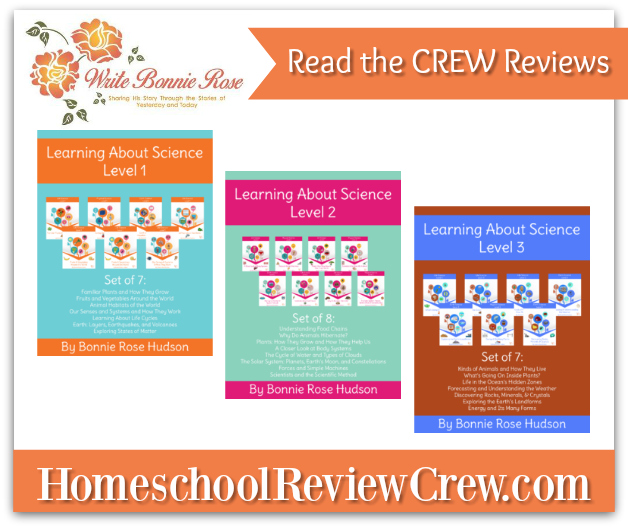
I don't have any personal experience with the lower levels, but in looking at some of the other Crew Reviews for them, they look reasonably appropriate for Damien as well.  While some topics have some overlap (i.e., Level 1 and 3 both have zoology units), there seems to be enough diversity that if I went back to the Level 1 programs, there would be sufficient new information for Damien to do those as well.  I think a slower pace (1-2  lessons per week) might be good for a younger child, but since Damien is in third grade and beginning the "late" elementary phase, I think the three levels combined might make an appropriate full-year program for him.  I'll definitely be checking the Level One and Two reviews carefully (clicking the banner below, of course) to see if the complete Learning About Science program combines to create the science curriculum I'm looking for.

If you're interested in using these for your student, save 50% on the bundled Learning About Science, Levels 1, 2, and 3 with coupon code REVIEWCREW50 through August 15.  This brings the Complete Sets to $6 each! 


Learning About Science collections {WriteBonnieRose Reviews}


Want to keep up with all of our adventures?
Subscribe below to get Adventures with Jude delivered to your inbox.

Enter your email address:


Delivered by FeedBurner


©2012- 2018 Adventures with Jude. All rights reserved. All text, photographs, artwork, and other content may not be reproduced or transmitted in any form without the written consent of the author. http://adventureswithjude.com

Wednesday, July 11, 2018

Bible Study Guide for All Ages (Homeschool Review Crew)

We're no strangers to Bible Study Guide for All Ages.  A few years ago, Celia got to test the program out and really enjoyed working with it.  This time, it was the boys' turn.  New third grader Damien got the Intermediate (3rd & 4th grade) while rising sixth grader Jude had a chance to try the Advanced (5th & 6th grade) program.  Each boy's workbook allowed them to complete the first quarter of each level: Lessons 1 to 26. In our kit was also a pack of large-format Bible Book Summary Cards and a Teacher Key for each program.


Bible Study Guide for All Ages also has programs for students as young as PK3, the elementary levels, and then teens and adults as well.  The program is laid out so that traditional homeschoolers can work on this a little bit each day over the course of a week, but it is short enough that the program used in a co-op, cottage school, or Sunday school setting that only meets for a short time each week. (Note: the workbooks are designed to be consumable products, so if you use them in a group learning setting, each child will need to purchase his own workbook.)

While the Primary level runs independently of the rest of the curriculum, the Beginner, Intermediate, and Advanced levels run in the same sequence, only at different levels.  (Ok, I know that seems like a sentence filled with redundancies, but bear with me.)


The first few lessons center on Joseph of the Old Testament. Lesson 1 in both levels teaches the story of Jacob and the tribes of Israel, focusing on Joseph's Coat of Many Colors (Genesis 35:23-26; 37:1-11), Lesson 2 segues into Joseph's Dreams (Gn 37:12-36), and Lessons 3 through 14 take learners through Joseph's experiences in Egypt and then Jacob's death.  We then jump to study the Book of Daniel, and the Babylonian capture, and more dreams - this time, Nebuchadnezzar's dreams and the promise of a King.  In Lesson 21, we fast-forward to the Gospels of Matthew (Mt 1:1-17) and Luke (Lk 2:23-38) and begin learning about the family of the King of Kings, Jesus.

Notice I didn't say "Jude learned," or "Damien learned."  Despite different workbook activities, each week, the lessons focus on the same stories. If you're Mama reading the passages aloud, it makes reading times simple: everyone can sit and listen together.  By focusing on the same stories in a two-year cycle, it is presented soon enough that there is some familiarity ("I remember that story!") but enough elapsed time that the older student is ready to delve a little deeper.  It also means that in group activities, a family actually becomes a group.


Each of these activities would be difficult to do with just a parent and child.  In the first one, two people don't make a very large web of lies.  In the second, it becomes an "aha!" moment when we realize "telling the truth" isn't just disobedient to adults, but hurtful to their peers as well.

What learning style is your homeschool? It doesn't matter! We're what most would call "eclectic" homeschoolers; I think the term I'd use is "Crew-led." However, there are bits of many learning styles within the program that make it accessible to many.  For example:

Classical Method? Repetition, repetition, repetition.  Not only do you revisit the same stories, but each lesson has a review of the what is learned.

Charlotte Mason? Active and applied activities in lessons are focused, and I'm not sure there's a more "living" book than the Word of God!

Unit Study? You're taking a topic and finessing it until there isn't much left to learn.

Group Setting? If you did this is a group learning setting where you only had 60-90 minutes to work together, I would focus on reading the Bible story, the Memory Workout, map or timeline activities, and the Get Active and Apply It! sections.  The latter two are probably the most suited to a group setting, and the reflection and prayer at the end of the Apply It! makes a naturally good ending.

The Teacher Key is a suggestion at most levels for homeschools but highly recommended for group teachers. I agree with this; how much you will need it will depend on how independently your student is working. Primary Level is the only one where a teacher's key is required, due to the more visual vs. language-based program.


Private Homeschool with multiple children?  There are a few options.  There are a total of 416 lessons for each level, so you have a significant amount of ground to cover in the two years, especially if you're keeping to a "traditional" 180-day school schedule.

The first option is to divide the activities across two days. This would allow for 5 lessons every two weeks.
  • Day 1:  Read the Bible passages as a family, and have each student complete the Guess What... and Map activities.  Do one level of Get Active and Apply It! activities as a group.
  • Day 2: Complete Remember It and Memory Workout sections together, allow students to complete the "paraphrase the story" cartoon activity on page 2, and then regroup for the alternate level of Get Active and Apply It! activities.


The other option would be to do a lesson a day, and just alternate whose "turn" it was for the two group-like activities.  You also may want to double up some days, to keep within that two-school-year range. However, the levels do have some flexibility, so you could start a younger student a little early, or run a little later ending the level, without overwhelming or boring a student.

If you have only one child working on the program, working one-on-one with them to complete activities is an option.  Again, I'd recommend the Teacher Key if you have an independent student, especially at the Advanced level.  I didn't feel I was missing anything by not having the Intermediate Key; most of the answers were quickly figured out by knowing the story. I was glad to have it with Jude because I don't remember the "chapter-and-verse" locations of things through the Bible, so it saved me having to look up if his answers were correct or not.


What Christian denomination are you part of? Again, it doesn't matter.  Because this provides the passages for a story, not the story itself, you are free to use whatever Bible translation you prefer.  So many Bible programs are focused on the King James Version of the Bible, and it is frustrating as a Roman Catholic.  (To us, the KJV is also missing books, but that's another story!) I like that we are able to use our family Bible to read from.


The Bible Summary Cards are full-sheet, full-color, heavy cardstock cards with pictures on one side and written summaries of the topic on the back.  They address most books from Genesis to Revelation -- you will not use them all in a quarter, but rather over the course of the entire program. The pack as a whole works with all levels, so with proper care, they will last through several students. I may consider laminating them since they will have so many hands on them.

I still like this program. (I also can't believe that it's been five years since we used it last!) I think I will be checking out the Teen level as well because it's a program that would simplify Bible study to fit our wide range of ages.  Jude and Damien are enjoying the "easy" work, but I like that it's not just "busywork" but encouraging them to think about the lessons of the Bible.


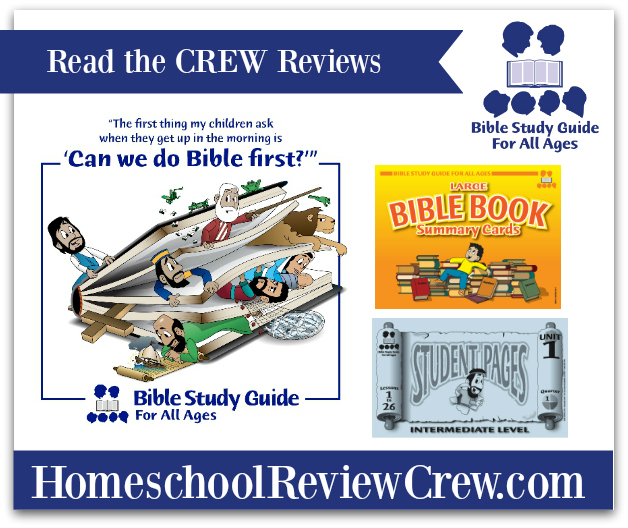
The Crew received materials for students in PK3 through 6th grade.  Click the banner below to read their reviews of the Beginner, Primary, Intermediate, and Advanced levels, as well as the Bible Study Guide for All Ages Timeline program.


Bible Study Guide For All Ages {Reviews}


Want to keep up with all of our adventures?
Subscribe below to get Adventures with Jude delivered to your inbox.

Enter your email address:


Delivered by FeedBurner


©2012- 2018 Adventures with Jude. All rights reserved. All text, photographs, artwork, and other content may not be reproduced or transmitted in any form without the written consent of the author. http://adventureswithjude.com

Wednesday, June 13, 2018

ARTistic Pursuits: Building a Visual Vocabulary (Homeschool Review Crew)

"Art class" is one of those things that always seems to get back-burnered.  My kids enjoy creating art on their own, but it is something that we never seem to have time for instruction in.  I've had plenty of art history courses, but I am not an "artist," so my instructions generally are "Get your markers and draw something." We have used art curriculum books from ARTistic Pursuits, Inc in the past, and while I found them to be high quality, they were a bit overwhelming, because it was still mom having to take the lead as the teacher when it was time to create art projects.  (I like to think of myself as more of a facilitator; that means sometimes, I'm the best teacher for a subject, but other times it is better for me to find somebody more knowledgeable.)  The company has a new program for early elementary students (K-3), titled ARTistic Pursuits Art Instruction Books with DVD and Blu-Ray. This program divides their K-3 program into six hardcover volumes:

  • Art for Children, Building a Visual Vocabulary 
  • Art of the Ancients 
  • Art of the Middle Ages 
  • Artists that Shaped the Italian Renaissance
  • Art of the Northern Countries, Renaissance to Realism
  • Art of the Impressionists

Each book is intended to be a one-semester study, presented approximately at a rate of one lesson a week.  The set is available as individual volume purchases, or as a complete set.  For our review, we received the first book in the series, Art for Children, Building a Visual Vocabulary


This text and video art instruction contained 18 lessons in total; 12 text-based lessons featured works of master artists, while the remainings six were video-based instruction on using art materials.

The book teaches are the concepts of "what artists do."  It begins with "Artists compose."


This foundational book contains material featured in the larger Early Elementary Volume 1 book.  (You can read our review of that here.)  However, length notwithstanding, it is not precisely the same program. I feel that new book is almost "ARTistic Pursuits Lite." This book uses the same hands-on learning projects but has fewer questions that examine the individual pictures.


 (The current text is on the left, the older book is the spiral bound volume to the right.)  While I appreciate the larger photography, I was surprised to see the lesson to have less opportunity to dig into the picture.

I also was shocked to discover the photo has been mistitled in both books. When we reviewed the program in the past, I took it at face value. This spring, Neal and I experienced an incredible vacation that included a guided, "Highlights of the Dutch Masters" tour of the Rijksmuseum in Amsterdam.  As I flipped to this page, I thought "Wait, I think we saw this!" (When you only have two hours to see as much as you can cram in, paintings and titles, unfortunately, start to meld in your head.)


Eh, not quite.  But it was a house in Delft.  This 1670 painting, entitled View of the Houses in Delft, Known as "The Little Street" is by Johannes Vermeer, a contemporary of Pieter DeHooch.  Homeschoolers love rabbit holes, so as I started down this one, I learned from the UK's National Gallery that the painting pictured below is actually The Courtyard of a House in Delft.


Public domain via Wikimedia Commons
The painting featured is actually entitled Courtyard with an Arbour. I began spot-checking all the book's Masters reference works to make sure titles and artists aligned. I didn't find any further discrepancies, but I feel like this is something that should not be wrong.  I know -- it didn't bother me before, and I accepted it at face value.  But now, I can't, and between the lighter study and wrong title really overshadowed everything for me. I felt like I had to check everything before we worked on it.

One of his favorite lessons was about observation - just going outside and looking around, and painting what you see.


Here, he combined what he remembered from the lesson on imagination (our house doesn't quite have this color palette) with a newer lesson on observation, and painted a bird flying over the sunny field in front of our house. (It's convenient that we have an Incredible Hulk willing to act as painting stand, isn't it?)

This book contains mostly Masters paintings, and the activities revolve around drawing and painting. There are sculpture choices, including Boy with Bagpipes and Young Bear, that instigates a discussion of form. Instead of painting, construction paper pieces are layered to create paper forms.


A helpful, detailed materials list is included so that the parent/teacher can procure the supplies at the start of the course, and not have to put off instruction because she doesn't have something on hand.  The program suggests specific brands of materials. While these brands are not mandatory, you should try to purchase similar quality items. If you've ever been tempted to buy the cheaper, no-name crayons instead of Crayolas to save a few cents, you've seen how art supplies are something where you truly "get what you pay for." The items they suggest are not cheap, but they aren't expensive either.  Let's call these supplies what they are -- an investment in your child's education.


ARTistic Pursuits also offers a "complete" supply pack kit for each level if you'd prefer everything in one box.  It is independent of the book order, so you can easily increase or restock your supplies if you wish to use the curriculum with more than one child.

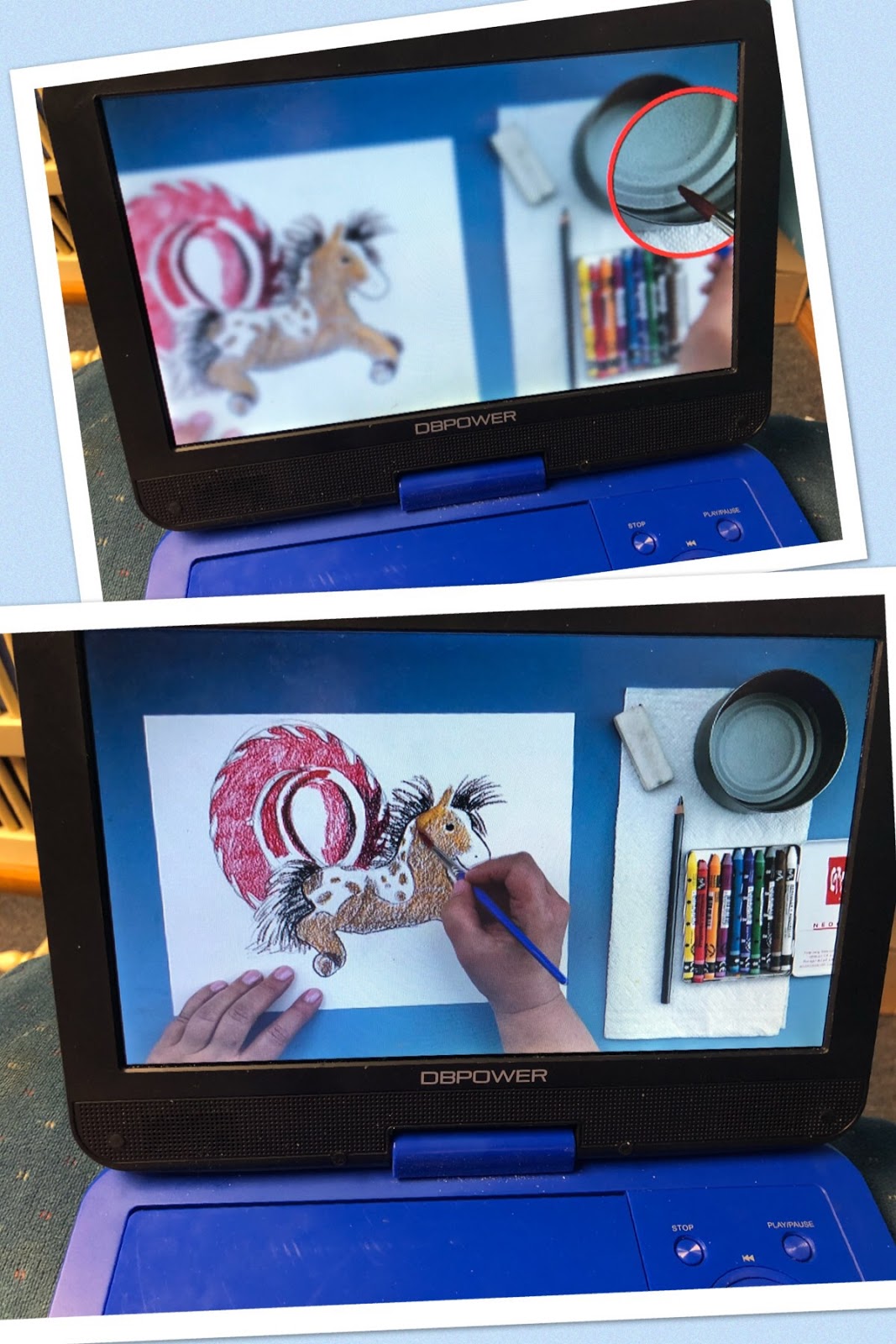
The DVD set was a welcome addition to the program.  Included are a standard DVD disc and a Blue-ray version.  (Matthew tells me that if you don't have an actual Blue-Ray player, Sony Playstations  (PS3 and higher) and North American-purchased Microsoft XBox One video game consoles should be able to play Blue-ray discs. I was unable to check this as we do not have either device.) The DVDs added both vocabulary concepts, as well as demonstrated how to use the art materials in the program.  While I have an arts degree, my background is in performing arts, not visual arts; the scale required for theater set design doesn't lend itself to the same techniques used for small paper and canvas works. One of this volume's favorite mediums is watercolor crayons, so the first lesson of the DVD showed students how to create works with these and pencils.

It began with a study in visualizing what you want to draw/paint and then segues into a discussion of composition, line, and color.  As the video completes the drawing, it shows how to use watercolor crayons to re-create the colors of your composition.


It also teaches painting techniques, starting with "how to have just enough water on your brush," and how to properly use the brush.


The instructors also recognize students in this age bracket may be a bit enthusiastic in their painting, and show how to fix a painting that may get a little flooded.


It concludes with a reminder of how to clean up after you're done and store your paints and brushes.  I honestly think that sometimes it takes outside influence to get a kiddo to clean up properly. Somehow, they accept it as "how it must be done" and not as  "mom nagging again." I definitely appreciated this!

Damien hunted the house and looked for items he could compose to create his own picture.  He chose his favorite fruit, strawberries, arranged in a bright blue bowl.


The second DVD lesson showed color mixing.  For some kids, this will be a reminder (as Damien reminded me, he was in third grade!), but it's a good review of what colors combine to secondary and tertiary colors, but it also shows the technique of how to mix them. As Celia looked over his shoulder, I hear her gasp, "Oh!  THAT'S how it works!"  No, she wasn't shocked that red and yellow made orange, but she had an "aha" moment watching the mechanics of how the on-screen artist blended them.  I wouldn't necessarily recommend the program for middle or high school students- the language and perspective are geared toward the younger student - but if you had older art students, the few minutes on technique in each lesson would be worth sitting in on.


These DVDs are only available with the new book series. I wish they were available as a stand-alone item, especially for those who may already have the older ARTistic Pursuits books and would welcome a video-based supplement.

Overall, this is a good program.  I like that it takes only a few minutes a week for me to sit with Damien and read about/discuss a piece of art, and then it allows him near free-reign over the creative process. This makes it more convenient to fit into our week, and more likely that we will be able to keep up with it.

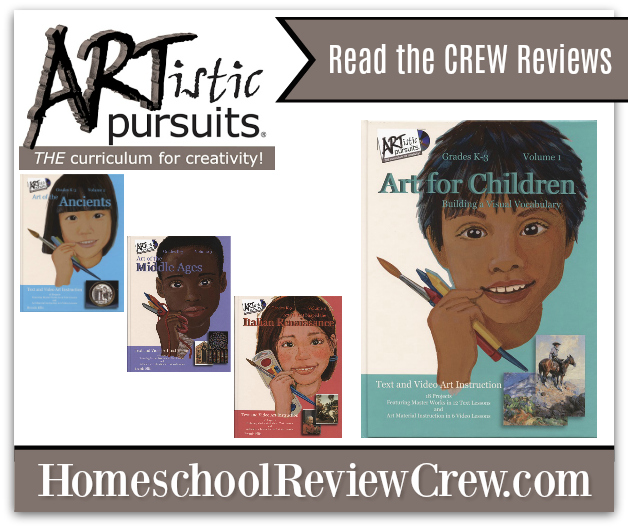
Crew families have been studying art with the first four books in the series,
  • Art for Children, Building a Visual Vocabulary 
  • Art of the Ancients 
  • Art of the Middle Ages 
  • Artists that Shaped the Italian Renaissance
Click the banner below to read their reviews!

Artistic Pursuits Full Video Lesson Grades K-3 {ARTistic Pursuits Reviews}


Want to keep up with all of our adventures?
Subscribe below to get Adventures with Jude delivered to your inbox.

Enter your email address:


Delivered by FeedBurner


©2012- 2017 Adventures with Jude. All rights reserved. All text, photographs, artwork, and other content may not be reproduced or transmitted in any form without the written consent of the author. http://adventureswithjude.com

Wednesday, October 25, 2017

Kid Niche: Weave Your Word in Me Bible Study (Homeschool Review Crew)

When Luke and Matthew began homeschooling, we continued on with theology studies where they had left off -- both were in upper grades so much of the foundation had been laid by their schools.
For the little boys, it's been a completely different process because of my own admitted struggles -- after our experiences with our Catholic parish and diocese, I'm caught between a few rocks.  My belief in God has remained strong, and despite exploring other denominations, I realize that I'm Catholic by faith to the core.  While I'm still working toward forgiving those who have wronged us, I want to teach my children my faith.  Bible studies have been a thorny issue for us.  Most Bible studies are aligned to the King James Version of the Bible, and the viewpoints presented are slightly different than ours.  Catholic programs seem to be few and far between and finding a good Bible program that fits both our faith and the boys' learning styles has been challenging.  I was intrigued by Weave Your Word in Me - Part 1 from Kid Niche Christian Books, which is designed to be translation-neutral.


"Translation neutral"? What does that mean? Well, in a nutshell, Kid Niche takes the core lessons of the Bible and uses them to guide the user's reading, but refers the reader back to the chapter-and-verse passages in his own Bible, rather than providing the scripture passages printed within the study.  This allows multiple faith denominations to use the same core guide, but approach the Bible from their points of view.  It works with any of the most popular translations: KJV, ESV, NKJV, NIV, NASB, and our preference, the NABRE.  Where there is a difference in where to find things, it will indicate this, so that the student is studying the correct Bible verse for the lesson.


Weave Your Word In Me takes the prayer Jesus taught his disciples (and therefore us) and unravels it in a way that children can learn the "great God-truths Jesus has woven within the Lord's Prayer."  I really like this approach - as a child, I learned my prayers by rote, without really understanding them.  This program combines both learning the lessons of the Bible and learning to have a relationship with God.  It's a very different approach from Jude's past studies, which have been more historical in nature than personal.


The program is geared toward later elementary students (grades 4 to 6), and I think this is an appropriate target age.  I think this study does a good job of helping support the emerging thinking and faith of children in this bracket without becoming "too" anything -- it's not too simple for the almost-teens, but not too deep for the younger end of the age range.  It's a program that I think could be used for students slightly younger and older; a student could start with it at 8 or 9, and then revisit at 12-turning-13, and as their thinking matures, their answers will change.  I notice that Jude is still in a more "literal" phase, while I think Celia would be beginning to find more philosophic/theologic answers.  I liked that while some answers are very literal, and basically "if you find the correct verse, you just need to fill in the blank," there are also places where the student needs to read and then parse the readings to find the correct answer.  It's not a huge leap from "what it says" to "the answer you need," but it's just enough to help encourage "figuring it out from context" rather than a purely literal reading.


On a practical note, I liked that this arrived as a pre-printed, pre-punched packet that just needed to be popped into a binder.  It's also on a heavy-weight paper, which means it holds up to erasing misspellings.  Each of the 36 lessons is only one to four pages; lessons take Jude no more than about fifteen minutes.  Each day is short, but still fully teaches him the core lesson of the day.  There is also an "answer key" provided, so if your child is working independently, the parent can easily check answers.  While Weave Your Word in Me - Part 1 is the first "half" of the program, there is a Part 2 available, as well as a full 80-lesson version.  I think if I were to purchase this myself, I would get the full 80-lesson program.  I think if you had a relaxed approach or another religious study program going on simultaneously, once-a-week might be sufficient, but at our two-to-three-a-week pace, we will finish this in the "first quarter" of our school year.


Jude liked this study and wants to continue past the review period.  Subject aside, it's always a good thing when he says "I don't want to be done."  He enjoyed the seek-and-find aspect of the program - each "question" referred to a different book and/or verse of the Bible.  He was proud of himself when he remembered whether a specific book was Old Testament or New Testament, too.  His prior Bible study courses were more chronological -- beginning with "In the Beginning..." and continuing from there.  I like how this pulls verses from the Old and New Testaments, showing how the lessons God shares through Scripture are timeless - from the beginning of Genesis to the writing of Revelation and right on through until today.

For more reviews about this program, click the banner below.

Weave Your Word in Me {Kid Niche Christian Books Reviews}


Want to keep up with all of our adventures?
Subscribe below to get Adventures with Jude delivered to your inbox.

Enter your email address:


Delivered by FeedBurner


©2012- 2017 Adventures with Jude. All rights reserved. All text, photographs, artwork, and other content may not be reproduced or transmitted in any form without the written consent of the author. http://adventureswithjude.com
Related Posts Plugin for WordPress, Blogger...
Pin It button on image hover