Showing posts with label Lukes American Adventures. Show all posts

Monday, June 13, 2016

From Montgomery to Equality: The Civil Rights Movement


From Montgomery to Equality: The Civil Rights Movement

The modern period of civil rights reform can be divided into several phases, each beginning with isolated, small-scale protests and ultimately resulting in the emergence of new, more militant movements, leaders, and organizations. The Brown v. Board of Education case overturned the Plessy v. Ferguson decision and demonstrated that the activist litigation strategy could undermine the legal foundations of southern segregationist practices. However, the strategy only worked when blacks, acting individually or in small groups, assumed the risks associated with crossing racial barriers. Thus, even after the Supreme Court declared that school segregation was unconstitutional, black activism was necessary to compel the federal government to implement the decision and extend its principles to all areas of public life rather than simply in schools. During the 1950s and 1960s, an increasingly massive and militant social movement of African-Americans brought about a broad range of social changes.

From a Montgomery Bus to the Lincoln Monument


The initial phase of the black protest activity in the post-Brown period began on December 1, 1955, in Montgomery, Alabama. Rosa Parks refused to give up her seat to a white bus rider, thereby defying a southern custom that required blacks to give seats toward the front of buses to whites. When she was jailed, a black community boycott of the city’s buses began in response. The boycott lasted more than a year, demonstrating the unity and determination of blacks in the city, and inspiring blacks elsewhere.

Rev. Dr. Martin Luther King, Jr.
Public Domain, via Wikimedia 
Martin Luther King, Jr. emerged as the boycott movement’s most effective leader. As a Baptist minister with unique conciliatory and oratorical skills. He understood the larger significance of the boycott and quickly realized that the nonviolent tactics used by the Indian nationalist Mahatma Gandhi could be employed by southern blacks. “I had come to see early that the Christian doctrine of love operating through the Gandhian method of nonviolence was one of the most potent weapons available to the Negro in his struggle for freedom,” he explained. Although Parks and King were members of the NAACP, the Montgomery movement led to the creation in 1957 of a new regional organization, the clergy-led Southern Christian Leadership Conference (SCLC) with King as its president. King’s efforts would eventually be acknowledged with the 1964 Nobel Peace Prize.

King remained the principal spokesperson for black aspirations, but, as in Montgomery, it was little-known individuals who initiated most counter-culture movements. On February 1, 1960, four freshmen at North Carolina Agricultural and Technical College began a wave of student sit-ins designed to end segregation at southern lunch counters. These protests spread rapidly throughout the South and led to the founding of the Student Nonviolent Coordinating Committee (SNC), in April 1960. This student-led group, even more aggressive in its use of nonviolent direct action tactics than King’s SCLC, stressed the development of autonomous local movements in contrast to SCLCs strategy of using local campaigns.

"I Have A Dream"
Public Domain, via Wikimedia Commons
The SCLC protest strategy achieved its first major success in 1963 when the group launched a major campaign in Birmingham, Alabama. Highly publicized confrontations between nonviolent protesters, including schoolchildren, on the one hand, and police with clubs, fire hoses, and police dogs, on the other, gained national sympathy. The Birmingham clashes and other simultaneous civil rights efforts prompted President John F. Kennedy to push for passage of new civil rights legislation. By the summer of 1963, the Birmingham protests had become only one of many local protest insurgencies that culminated in the August 28 March on Washington, which attracted at least 200,000 participants. King’s address on that occasion captured the idealistic spirit of the expanding protests. Standing on the steps of the Lincoln Memorial, he began his speech like the Gettysburg Address and referred to the Declaration of Independence and Emancipation Proclamation. Like Lincoln’s great speeches from a century before, he also uses Biblical references to connect with the listeners. Some say that the iconic “I Have A Dream” speech vaulted him alongside Jefferson and Lincoln as one of America’s greatest orators.

Although some whites reacted negatively to the spreading protests of 1963, King’s linkage of black militancy and idealism helped bring about the passage of the Civil Rights Act of 1964. This legislation outlawed segregation in public facilities and racial discrimination in employment and education. In addition to blacks, women and other victims of discrimination benefited from the act.


Selma to Montgomery


SCLCs protest strategy and SNCC’S organizing activities were responsible for major Alabama protests in 1965, which prompted President Lyndon B. Johnson to introduce new voting rights legislation. On March 7 an SCLC planned march from Selma to the state capitol in Montgomery ended almost before it began at Pettus Bridge on the outskirts of Selma when mounted police using tear gas and wielding clubs attacked the protesters. News accounts of “Bloody Sunday” brought hundreds of civil rights sympathizers to Selma.

Many demonstrators were determined to mobilize another march, and activists challenged King to defy a court order forbidding such marches. Reluctant to do anything that would lessen public support for the voting rights cause, King abandoned a second attempt on March 9 when he saw police blocking the bridge. That evening, a group of Selma whites killed a northern white minister who had joined the demonstrations. In contrast to the killing of a black man, Jimmy Lee Jackson, a few weeks before, the Reverend James Reeb’s death led to a national outcry. After several postponements, a court order to allow them to proceed, and the backing of President Johnson, the 54-mile Selma to Montgomery March began on March 21.

March to Mongomery 
This Selma to Montgomery march was the culmination of a stage of the African-American freedom struggle. Soon afterward, Congress passed the Voting Rights Act of 1965, which substantially increased the number of southern blacks able to register to vote. However, it was also the last major racial protest of the 1960s to receive substantial white support.

By the late 1960s, these first organizations faced increasingly strong challenges from new militant organizations, such as the Black Panther party. The Panthers’ strategy of “picking up the gun” reflected the sentiments of many inner-city blacks. A series of violent riots (termed “rebellions” by sympathizers), erupted during the last half of the 1960s. Often influenced by the black nationalism of Elijah Muhammad and Malcolm X, proponents of black liberation saw civil rights reforms as insufficient because it did not address the lingering poverty issues. Severe government repression, the assassinations of Malcolm X and Martin Luther King, and the intense infighting within the black militant community caused a decline in protest activity after the 1960s.

King and Malcolm X awaiting a press conference, 1964
Public Domain, via Wikimedia Commons 
The African-American struggle for equality left a permanent mark on American society. Overt forms of racial discrimination and government-supported segregation of public facilities came to an end. In the South, antiblack violence declined. Black candidates were elected to political offices in communities where blacks had once been barred from voting. Southern colleges and universities that once excluded blacks began to recruit them. However, despite the civil rights gains of the 1960s, racial discrimination and repression remained a significant factor in American life. Civil rights advocates acknowledged that desegregation had not brought significant improvements in the lives of poor blacks, but they were divided over the future direction of black advancement efforts. Without a clear path forward, most of the efforts of the 1970s and 1980s activists were devoted to defending previous gains or strengthening enforcement mechanisms.

The modern African-American civil rights movement transformed American democracy. Nearly 100 years after the Emancipation Proclamation, African Americans in Southern states still inhabited a starkly unequal world of “Jim Crow” laws. In 1954, the U.S. Supreme Court struck down the “separate but equal” doctrine, and in the turbulent decade and a half that followed, civil rights activists used nonviolent protest and civil disobedience to bring about change, including legislation such as the Voting Rights Act of 1965 and the Civil Rights Act of 1968. Many leaders from within the African American community and beyond rose to prominence during the Civil Rights era, including Martin Luther King, Jr., Rosa Parks, Malcolm X, and others. They risked—and sometimes lost—their lives in the name fulfilling the promise of the Declaration of Independence: “We hold these truths to be self-evident: that all men are created equal.”

The Civil Rights Memorial
Engraved with the names of 41 people of all races who lost their lives fighting for equal rights
Mongomery, Alabama


©2012- 2016 Adventures with Jude. All rights reserved. All text, photographs, artwork, and other content may not be reproduced or transmitted in any form without the written consent of the author. http://adventureswithjude.com

Friday, June 10, 2016

The End of Camelot

Luke's American Adventures: The End of Camelot John Fitzgerald Kennedy

Few events in the postwar era of America have cast such a long shadow over our national life as the assassination of President John F. Kennedy. The murder of a handsome and vigorous president shocked the nation to its core. In their grief, Americans were inclined to take to heart the legends that emerged during the immediate aftermath. Though the assassin was a communist and an admirer of Fidel Castro, many insisted that President Kennedy was a martyr to the cause of civil rights and deserved a place of honor next to Abraham Lincoln as a champion of racial justice. Others held him up as a great statesman who labored for international peace. But by far the most potent element of Kennedy’s legacy was the idea of Camelot.

The legend of Camelot was well-known to the era. “Camelot” was Lerner and Loewe's musical adaptation of T.H. White's popular novel, "The Once and Future King." While the plot of the musical is rather dark, focusing on the forces set out to destroy the kingdom, the musical begins with Arthur extolling the perfection of the kingdom, and how something as arbitrary as the weather is controlled for the inhabitants’ convenience.


It was also one of President Kennedy’s favorite musicals. Just after her husband was buried, Jacqueline Kennedy agreed to a magazine interview. Sitting down with Theodore White from Life Magazine, Mrs. Kennedy reflected on her husband. The television once was a blessing; Kennedy’s youthful and poised appearances during debates with Richard Nixon played a significant role in his election. Now, just a few years later, it would broadcast news of his death and his funeral. Only the most hard-hearted person could be left unaffected by their son’s salute of his father’s coffin. By today’s jaded standards, we’d call her interview “damage control,” and in a way it was. However, what she wanted was for her husband to be remembered as passionate and an idealist. Smartly, Mrs. Kennedy shared JFK’s affection for the musical, particularly the closing lines of the title song. Arthur shares them with Tom, the new knight who has come to take up the mantle for a new generation:


She added, “There'll be great presidents again ... but there will never be another Camelot." One could forgive a grieving wife for believing her husband to be a singular man, but does the political idea hold up to the passage of time?

In current public opinion polls, Kennedy consistently ranks among Thomas Jefferson and Abraham Lincoln as one of the most popular American presidents, agreeing that he was young and full of progressive ideas. Historian Arthur Schlesinger Jr. wrote it was "as if Lincoln had been killed six months after Gettysburg or Franklin Roosevelt at the end of 1935.” The 1964 Civil Rights Act was a posthumous accomplishment, and many wonder what a second term would have accomplished. Conversely, critics have derided Kennedy's womanizing and laissez-faire attitude, arguing he was more style than substance. Perhaps, with what we’ve learned over time, Camelot is not an exact explanation of the early 1960s in America, but an appropriate metaphor: a time seemingly perfect yet filled with underlying tribulations, and an unanticipated end that still holds out hope for the future. 


©2012- 2016 Adventures with Jude. All rights reserved. All text, photographs, artwork, and other content may not be reproduced or transmitted in any form without the written consent of the author. http://adventureswithjude.com

Wednesday, June 8, 2016

America's Game: Star Sluggers

America's Game: Star Sluggers

When the Great Depression struck, many baseball owners feared the worst. They expected the fans would have trouble affording tickets, and fans they did draw would not have enough for extra souvenirs or food concessions. To their surprise, many people would still come to the ballpark if only to forget about their own troubles for a while. Attendance was down in the 1930s, but none of the sixteen franchises ever folded or moved as a result of the Great Depression. While some of the games’ lasting stars said goodbye, others said hello. A new era of baseball had begun.

The 1930s also saw two immortal aspects of the game arrive. The first was arrival of the All-Star Game. Originally, played in Comiskey Park in 1933, the managers and the fans selected the players. The game was thought up Chicago Tribune sports editor Arch Ward and to be a part of the celebration of Chicago’s Century of Progress Exposition. This mid-summer classic now features the best players of baseball as voted in by fans, and every team has at least one player to represent them. The American League teams’ best play against the stars of the National League, and the winning league has the “home field advantage” in that season’s World Series.

The second was the Baseball Hall of Fame. It would not be until 1939 that the Hall was built, but its first five inductees would be Babe Ruth, Ty Cobb, Honus Wagner, Christy Mathewson, and Walter Johnson in 1936.

First Hall of Fame Inductees
L-R: Ty Cobb, Babe Ruth, Honus Wagner, Christy Mathewson, Walter Johnson
Public Domain, via Wikimedia Commons


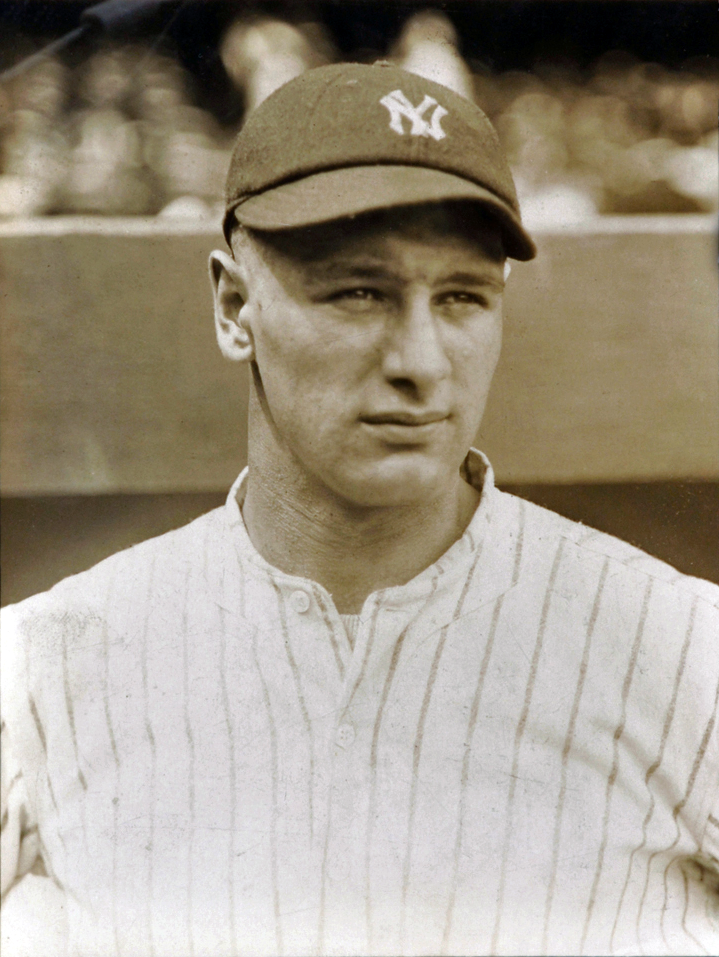
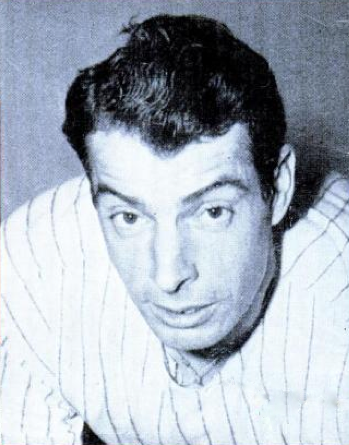
The 1930s also saw its fair share of stars on the field. Babe Ruth retired from the Yankees, letting Lou Gehrig have a chance to step into the spotlight. Joe DiMaggio arrived to roam center field for the Yankees in 1935, stealing some of Gehrig's spotlight. He stood alone when Amyotrophic Lateral Sclerosis - known informally as “Lou Gehrig’s Disease” - forced him to retire at the end of the 1939 season. Gerhig’s uniform number, 4, was the first player number retired in Major Leage baseball. In the rest of the league, Jimmie Foxx dominated the decade at the plate. In 1933, Foxx hit .364 with 58 Home Runs and 168 Runs Batted In. Five years later, he was just as strong; during the 1938 season, Foxx hit .349 with 50 HRs and 175 RBIs. The 1930s also saw the introduction of a 17 year old Bob Feller, Lefty Grove, Power Hitters Hank Greenberg and Mel Ott, and a Young Ted Williams arrived in 1939.

Lou Gehrig
Public Domain, via Wikimedia

Dynasties rose and fell. While Connie Mack and the Philadelphia Athletics started out the decade by winning two AL Pennants in a row, their back to back run of 29-30 came to a close in 1931. The “Gas House Gang” arrived in St. Louis in 1934. Led by Dizzy Dean and Leo Durocher, the Cardinals were constant rivals to the Cubs and Giants. This team helped the Cardinals win the National League pennant several times in the 1930s, along with a World Series title in 1934. Much like the 1920s, the Yankees dominated the second half of the decade. Led by manager Joe McCarthy, the Yankees won four World Series in a row to close out the 1930s.

Joe Dimaggio
Public Domain, via Wikimedia Commons
The game took a backseat while the boys of summer became “the boys overseas.” The “girls of summer” emerged with the formation of the All-American Girls Professional Baseball League. The war ended in August, 1945, during the second half of the season. Teddy “Ballgame” Williams would soon be seen patrolling Fenway; “Jolting” Joe DiMaggio would return to his rightful place in Yankee Stadium. Many others would return to the game after serving their country, though some moved on to new careers. Once the boys were back on the field, the mega-watt stars, another New York dynasty, and a new kind of player transformed the post-war game.

The New York Dodgers were still in Brooklyn, the Giants were still in Manhattan, and the Yankees. In the post war era, 12 World Series were played in the city that never sleeps. With star players on each team - Mickey Mantle and Yogi Berra were the new stars for the Yankees, Dodgers pitcher Johnny Podres, and the Giants’ slugger Bobby Thompson, the three teams passed League and World Series championship pennants around the city from 1946-1959. However, bigger news than their lock on the top place in the standings was their newest players: Jackie Robinson and Willie Mays.

Jackie Robinson and Willie Mays
Public Domain, via Wikimedia Commons
Besides breaking the color barrier, Robinson had an exceptional 10-year baseball career. He was the recipient of the inaugural MLB Rookie of the Year Award in 1947, was an All-Star for six consecutive seasons from 1949 through 1954, and won the National League Most Valuable Player Award in 1949—the first black player so honored. During his career, Mays also won two National League Most Valuable Player (MVP) awards and shares the record of most All-Star Games played (24) with Hank Aaron and Stan Musial. He ended his career with 660 home runs, third at the time of his retirement, and currently fifth all-time.

Baseball’s Golden Age brought new life to home plate, with new ways to acknowledge great players, such as annual All-Star Game and the Hall of Fame. The 40-year span was the prime for many star sluggers, both veteran and rookie. Damn Yankees, a 1955 Broadway musical, was a nod to the dominance of the New York teams. However, the league's most enduring accomplishment was the inclusions of players from all races.


Click here to read other posts in the Series!


©2012- 2016 Adventures with Jude. All rights reserved. All text, photographs, artwork, and other content may not be reproduced or transmitted in any form without the written consent of the author. http://adventureswithjude.com

Friday, June 3, 2016

Roadwork Ahead: Eisenhower Highways


Luke's American Adventures: Roadwork Ahead: Eisenhower Highways


On June 29, 1956, President Dwight Eisenhower signed the Federal-Aid Highway Act of 1956. The bill created a 41,000-mile “National System of Interstate and Defense Highways” that would, according to Eisenhower, eliminate unsafe roads, inefficient routes, and traffic jams that got in the way of “speedy, safe transcontinental travel.” But did the highway get in the way of itself?

Since before the founding of the nation, Americans have always been looking for more efficient means of transportation around the country. During the colonial era, the only practical way to travel and trade across long distances was along the nation’s natural waterways. A few roads connected major cities, but travel on them was challenging and time-consuming. Large ships moved passengers and freight across the oceans, and smaller boats plied the nation’s rivers, lakes, and canals. The first “National Road,” established a few years after the Revolutionary War ended, evolved from a need to get supplies and people beyond the frontier. While much of the road’s alignment is followed or overlapped by US Route 40, many of the routes original aspects, such as toll pikes, stone bridges, and inns, are preserved to this day.

The National Road Recapturing Glory

This “Main Street of America” was soon followed by wagon trails. The Oregon Trail, the Santa Fe Trail, and the Natchez Trace told travelers the destinations of the paths.


“Stagecoach stops” were settled and often run by settlers along the trails, such as the Mahaffie Farmstead in Kansas City. Though times have progressed since the 18th century, original towns and villages can still found along the routes of these original “highways.”

One hundred years later, the country had doubled in size, and there was a need to get people and goods across the nation faster. New steam-driven trains sped along thousands of miles of track, providing fast, reasonably reliable, and relatively direct transportation from coast to coast and points in between. When the “Golden Spike” of the Transcontinental Railroad was hammered into the ground in 1869, what used to take months of gruesome travel by ship, wagon, or stage could be traversed in under a week!

American innovators sought out an even more efficient means of transportation, one not limited to places a horse could negotiate or a track could be laid. At first, personal cars were fragile luxury items, but Henry Ford’s new “assembly line” mass manufacturing quickly made them reliable and affordable.

By the post-WWII years, the end of gasoline rationing and owning your own “set of wheels” seemed the bonus of the American dream: the freedom to come and go as you pleased, and without being reliant on a schedule.

1950 Ford Country Squire
Credit: Josephew  via Wikimedia Commons

However, a major problem was that these modern cars were traveling across antebellum roads. Stagecoach trips often ended outside the town saloon; you could almost consider the Oregon Trail a pub crawl. Towns settled as people decided they just didn’t want to go any farther; more sprang up when the Railroads came by and needed depots. The first cross-country car roads followed the familiar wagon trails. Unfortunately, these routes were made of terrain more suitable for a horse-drawn wagon than a self-propelled automobile. The routes often traversed marshes; while a horse and its rider could cross the mud, cars ran the risk of losing traction completely.

The routes also often conformed to the land and were full of steep hills and sharp turns. They followed the topography, rather than being a straight path, often increasing the driving distances. For example, Baltimore, MD to Washington, PA - the “eastern” portion of US 40, is over 300 miles long. The Eisenhower System highways cut that distance to under 250 miles. That’s a lot of gas saved! Limited access and higher speed limits make the Eisenhower roads more time efficient, too. Interstate-95 is the “Eisenhower Equivalent” of US 1. The drive from Houlton, Maine to Miami on US highways is a 42 hour, 2000 mile trek. The same journey on Interstate 95 is only 8% shorter in distance - 1842 miles - but the drive time is a mere 27 hours.


When the Interstate Highway Act was first passed, most Americans supported it. Building the Interstate Highway system would get people where they wanted to go more quickly on newly-built modern roads. However, progress doesn’t come without a price.

Wide rights-of-way consumed thousands of acres of land. The county’s natural mountain ranges, forests, rivers, and natural routes were excavated into and either partially or fully removed or bypassed. Community battles were waged to save historical landmarks. Most significantly, the coming of the Interstate Highway dramatically affected the flavor of America. These roadside colonies connected travelers to the communities through which they passed. The construction of Interstate Highways fundamentally altered this pattern of commercial development as long-distance travelers abandoned those former routes. Once-vibrant towns faded into obscurity leaving the roadside stores and restaurants struggling to make ends meet. With the coming of Interstate, whole architectural genres and local businesses were driven to extinction by abandonment. Disney Pixar’s Cars touches upon this “death by interstate” ideal. In the film, race car rookie Lightning McQueen learns that Radiator Springs, the town the majority of the movie is set in, used to be a popular stopover along the old U.S. Route 66, but with the construction of an interstate bypassing it, the town literally vanished from the map. The demise of the fictional Radiator Springs mirrors the path of many small towns across the nation; what once built up around pioneer trails and railroad lines fell into obscurity with this new highway system.

However, as these little roadside towns fell by the wayside, the same “if you build a road, they will come” phenomenon occurred near these new highways. Gas stations were built at these exits - after all, the cars needed fuel. With mini-towns popping up at each exit, exponentially shorter intervals - as frequent as every mile or two - meant drivers no longer needed to “tank up” every time they saw gas over the fear of running out because the next town was twenty or thirty miles away. Competition made travel more affordable; if a driver feels one exit’s gas prices are “on the high side,” he can easily take a chance that there will be lower prices at the next exit.


Since people were already stopping for gas, they might as well eat, so next came the quick-service restaurants. Instead of a relaxing meal to enjoy sitting still, these restaurants prided themselves on getting people their food quickly so they could get back on the road. One of the most famous of these “fast food” eateries is a little burger joint named McDonalds from San Bernardino, California that eventually expanded to an international chain. What made these restaurants so popular was the standardization of menu and ingredients. Customers knew that whether they drove through California or the Carolinas, they’d have the same meal, and at the same speed -- fast.

While the prevailing thought in American industriousness is, “If there is an easier, more efficient way, we will find it,” many realize that retaining natural beauty is just as important as progress. Thankfully, agencies like the National Park Service dedicate themselves to the restoration and preservation of historical and natural landmarks and beauty. On our summer road trip last year, my family had the privilege of traversing one of these protected “scenic highways”. It was an amazing ride through the Great Smoky Mountains along the Cherohala Skyway, and well worth spending eight hours traveling to an area that an interstate could have gotten us to in less than three.


However, there is no way we would have been able to see as much of the country that we did without the interstate system. Simple math says interstate speeds averaging 70 mph get travelers to their destinations nearly twice as quickly as the 40 mph average of the “local” route. In under four weeks, we traveled from New Jersey to Texas, visiting 30 venues in 16 states. Both types of highway have their place.

The Dwight D. Eisenhower National System of Interstate and Defense Highways was an innovation that changed America. The highway system, the greatest public works project in American history, made travel faster, easier, and safer and revolutionized the American economy. However, there were serious adverse effects of the highways; they affected the environment and led to the demise of many small towns. The Interstate System has both supporters and critics, but all agree that President Eisenhower was right when he said the Interstate System would “change the face of America.”


©2012- 2016 Adventures with Jude. All rights reserved. All text, photographs, artwork, and other content may not be reproduced or transmitted in any form without the written consent of the author. http://adventureswithjude.com

Wednesday, June 1, 2016

America's Game: Stadium Traditions


America's Game: Stadium Traditions


From the first pitch to the ace reliever’s last out, baseball, like America, is rooted in tradition. Some traditions are unique to one team or ballpark, while others are observed all throughout the leagues. This list contains seven of my favorite traditions.

1. Ceremonial First Pitch


In a tradition over 100 years in the making, a notable person will often throw out the first pitch of the ball game. Usually, it's a local celebrity or hero. The tradition began in 1910 when President William Taft threw out the first pitch at the Washington Senators game. After the Senators folded, other teams took turns hosting the President on Opening Day. Now that Washington again has a team, the incumbent president usually throws out the ceremonial pitch at the Nationals’ first game.

President Ronald Reagan, ceremonial opening pitch, Wrigley Field, 1988
President Ronald Reagan, 1988 opening game
Chicago Cubs/Wrigley Field
Public Domain, via Wikimedia

Over the years, the first pitch tradition evolved. Taft tossed the ball to a single specific player, but subsequent Presidents threw it into a group of players who fought over it in a scrum, much like bridesmaids battling over the bouquet at a wedding. In the 1970s, scrumming gave way to the much tamer and safer first infield-to-plate pitches we see today. Today, the ceremonial pitches’ receivers are usually either the team’s mascot or catcher, and nearly every game has a ceremonial pitcher or two.

2. Hot Dogs, Peanuts, and Cracker Jacks


What constitutes baseball food, or stadium food, if you prefer? Peanuts, Crackerjacks, and beer are some of the most traditional games foods. Peanuts and popcorn are easy to eat while you’re distracted by the play on the field, and a cold one with the boys on a hot summer day was easily gotten away with because the wife was at home. But what if you are hungry for more than a snack? Just raise your hand when the hot dog man comes by.

But how did hot dogs become synonymous with baseball? Waves of German immigrants in the 1800s brought both their traditional sausages to America, along with their dogs. Legend says sausages on rolls - easy to eat one-handed while watching the game, and more substantial than popcorn to slow the effects of all of those beers - became familiar stadium fare, with sellers carrying insulated bags filled with piping hot sandwiches walking up and down the aisles announcing “Red hots! Get your red hots!” Along the way, someone noticed that the sausages on the bun looked like the long-bodied dachshunds and said the sandwich looked like a hot dog. Newspaper cartoonist Thomas Aloysius "TAD" Dorgan immortalized the comment in a 1906 cartoon, and the name stuck. Today, nearly 35 million pounds of hot dogs are served at baseball stadiums.


Many stadiums also serve local specialties as well.  A fan can eat a lobster roll, a New England favorite,  while the Red Sox play at Boston’s Fenway Park, while Anaheim's concessions include “Angel Wings,” the home team's twist on buffalo chicken wings. Nationals Park serves Teddy's Barbeque, a concession featuring images of Theodore Roosevelt and a signature food item—a 13 inches (33 cm) beef short rib called the "Rough Rider. Citizen’s Bank Park, home of the Philadelphia Phillies, resides in not only the “City of Brotherly Love,” but also the “Land of Cheesesteaks and Hoagies,” making these hometown foods a signature game meal.

3. Take Me Out to the Ballgame


While on the subject of peanuts and Cracker Jack, the anthem of the ballpark, "Take Me Out to the Ball Game," is one all baseball fans know. Few know the full song, but everybody who's seen a ball game knows the chorus.

This tradition started with Harry Caray. During a mid-inning break, he began singing it to what he thought was a “dead” booth, when White Sox announcer Bill Veeck turned his mic on, broadcasting live to the crowd. When Caray moved to the Cubs and Wrigley Field, it became a tradition and is sung during the 7th inning stretch. After his death in 1998, Wrigley Field continued the sing-along tradition, inviting celebrities to lead the song in Carey’s place.

The traditional words to the song are:

lyrics to "Take Me Out to the Ballgame"

Some fans rearrange the words to reflect their teams’ performances. After their recent losing seasons, it’s not uncommon to hear Phillies fans belt “...if they don’t win it’s the same!”

4. The 7th inning stretch


After sitting through 6 and a half innings, you start to feel a little tired; if you haven't gotten up for food (likely since concessions are brought to your seat), then you'll feel like you need to stand up. Legend says that during a 1910 game, the portly President Taft got up to stretch his legs in the middle of the seventh, and out of respect, the crowd stood up, too. Then the rest of the fans realized this little bit of exercise was a pretty good idea, and a tradition was born. In early games, a military band would often be on hand to play a patriotic song -- why the band was ready to strike up The Star Spangled Banner during the 1918 World Series.

After getting up and singing "Take Me Out to the Ball Game," people either sit back down or run to grab their final snacks; the 7th Inning Stretch has become the “last call” for food and alcohol purchases.

seventh inning stretch

5. “Hey, Beer Man!”


At any other place of business, if you’re handing over money, it’s a one-on-one transaction. You keep an eye on the recipient and count your change along with him. All that is thrown out the window in baseball.
To let you watch the game instead of spending half of it in food queues, vendors walk around the stadium, hawking their wares. When one comes by with what you want, you put your hand up (as if hailing a taxi) and holler “Hey ____ Man!” When he stops, you hold up your fingers for how many. The vendor shouts the total as gets your order out, and completing the transaction becomes a group activity.

Total strangers will pass money and food to each other. Your food gets handed to the person sitting on the aisle, who in turn passes it down the row, while you start passing the money up the row.  If you're due any change, that follows your food. You’d never do this outside of a stadium, but everyone’s trustworthy at a ball game.

6. Watch out for foul balls!


If there's one thing kids will bring to the game, it's their baseball gloves. It doesn't matter if you're sitting at the foul line, behind home plate or in the nosebleed sections—the glove comes to the park. After all, you never know where those foul balls might end up, and who doesn’t like a genuine souvenir? Usually, it’s a popped-back foul ball that you’ll catch. If you’re exceptionally lucky, you’ll nab the home run ball knocked out of the park from your home team.

Catching a home run from the opposing team, however, feels wrong. Often, the home-run ball from the visiting team gets caught and “thrown back” to the field. The tradition began at Wrigley Field, where so many balls are hit out of the park that it’s not totally crazy to say “I’ll wait for another.” Most fans will keep opposing team balls unless it’s been hit by an arch-rival. Then it becomes almost a greater honor to toss it back than to keep it, even if you never catch another ball in your life.

7. Mascots


If you were to see a picture of a team’s uniform, would you know what team it represented? Maybe, if you were familiar with team logos. The odds are pretty good, though, if you saw a team’s mascot, you’d know right away who he belonged to.

Phillie Phanatic and his hot dog launcher
The first baseball mascot was literally “a kid in a chicken suit.” In 1974, a San Diego college student was working a radio gig, promoting the station while dressed in a chicken suit. He enjoyed his first assignments and offered to promote the station at the San Diego Padres games. For five years, he advertised the radio station at games, and while The Famous Chicken eventually parted ways with the radio station, becoming the Padres’ full-time mascot, he was the catalyst for many of the mascots we know today. The next major team to have a mascot was the Philadelphia Phillies. The “Galapagos Island-born” green guy first arrived in Philadelphia in 1978, and is one of the most easily identified Philadelphians -- sometimes being recognized faster than Ben Franklin!

Baseball mascots interact with the players and fans, serving as both entertainment and a “goodwill bridge.” Often, the mascots appear at local events; their popularity often guarantees a good turn out. While mascots in and of themselves embody tradition, sometimes they can make traditions themselves. The fourth inning of Washington Nationals home games features the Presidents Race. Caricature and team-uniformed versions of permanent mascots George (Washington), Tom (Jefferson), Abe (Lincoln) and Teddy (Roosevelt), along with a “President of the Year” race around the field and entertain fans.  When the Phillies pack for Spring Training, the Phanatic's three wheeler and hot dog launcher are given reserved seating alongside the bats, balls, and uniforms in the truck.


What is your favorite part of attending a ball game?


Click here to read other posts in the series!


©2012- 2016 Adventures with Jude. All rights reserved. All text, photographs, artwork, and other content may not be reproduced or transmitted in any form without the written consent of the author. http://adventureswithjude.com

Monday, May 30, 2016

Truman the Human


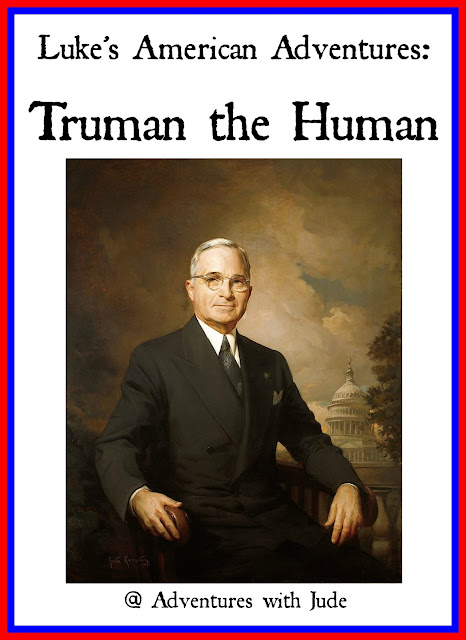
Luke's American Adventures: Truman the Human  @ adventures with Jude

Born on May 8, 1888, in Lamar, Missouri, Harry was the first of three children born to John Anderson Truman, a farmer and mule trader, and his wife, Martha Ellen Truman. When his parents chose his name, they decided on “Harry,” to honor his maternal uncle, Harrison Young, but could not decide on a middle name. After more than a month of discussion, they settled on an initial, instead of a second name. “S” was a tribute to both his maternal grandfather, Solomon Young, and his paternal grandfather, Anderson Shipp Truman. A shy, bespectacled Truman grew up a farm in Independence, Missouri. He entered a Kansas City business college after graduating high school -- his second choice because poor eyesight precluded a chance for a commission to West Point Military Academy. Finances forced him to drop out after only one semester, and he took up a number of jobs to help the family. He first was a timekeeper for a railroad construction company, and then a clerk and a bookkeeper at two separate banks in Kansas City.


From Shy Child to Confident Soldier


After five years, he unhappily returned to the farm as its bookkeeper. As a child, an overbearing mother kept Harry from becoming friends with other boys. Seeking male camaraderie, he joined the National Guard and found himself well-liked and respected. He found time amidst it all to court Elizabeth “Bess” Wallace, a high school classmate. She refused to marry him, but they continued their courtship.

Harry Truman, WWI
Public Domain,
via Wikimedia Commons
When World War I erupted, thirty-three-year-old Harry was two years older than the age limit for the draft and eligible for exemption as a farmer. However, he volunteered for active duty, helping to organize his National Guard regiment to join the 129th Field Artillery and serve in the French theater. While in France, the newly promoted Captain Truman found himself assigned Battery D, known for being the most unruly battery in the regiment. Despite a generally shy and modest temperament, Truman captured the respect and admiration of his men and led them successfully through heavy fighting during the Meuse-Argonne campaign, and turned the regiment one of the most respected units of the Army.

When the war ended in 1918, Truman returned home to Bess. When he was sent off to France, she had realized that there was no man for her but Harry. However, he refused to marry her before he left, fearing the war would leave her a widow. They were married in 1919, and their only child, daughter Mary Margaret, was born four years later. That same year, he and a military buddy, Eddie Jacobson, set up a haberdashery shop in Kansas City. However, when the business failed in 1922, Truman owed $20,000 to creditors. A man who believed in never taking the easy way refused to declare bankruptcy and insisted on paying back all the money he borrowed. It took him over fifteen years to fully repay the debt.

A Political Career


While looking for a new job after his menswear shop closed, he was approached by Democratic boss Thomas Prendergast. They had a mutual connection through Prendergast’s nephew James, who had served with Truman during the war. Pendergast appointed Truman to a position as an overseer of highways, and after a year, chose him to run for one of three county judge positions in Jackson County. Truman was elected to an administrative judge position but was defeated when he ran for a second term. Undaunted, Truman ran again in 1926 and was elected as a presiding judge, a position he held until he was elected to the United States Senate in 1934.

Truman's campaign "sound" car, 1934
Public Domain, via Wikimedia Commons

In his freshman term, Senator Truman was appointed to two Senate committees: the Appropriations Committee, which was responsible for allocating tax money for Franklin Delano Roosevelt’s New Deal projects, and the Interstate Commerce Committee, which oversaw railroads, shipping, and interstate transport. Along with Senator Burton Wheeler, Truman began investigating railroads. In 1940, he initiated legislation that imposed tighter federal regulation of the railroads, which helped him establish his reputation as a man of integrity, earning him his notorious nickname, “Truman the Human.”

By the time Truman was up for reelection in 1940, Thomas Pendergast had been convicted of tax evasion and associated with voter fraud. Many predicted Truman’s connection to Pendergast would result in defeat. However, Truman didn’t try to hide or distort his relationship with Pendergast. His reputation as a frank and ethical man helped him win reelection. In his second term, Truman chaired a special committee to investigate the National Defense Program. With World War II waging in Europe, Franklin Roosevelt was quietly beefing up the military, and Truman’s committee’s role was to prevent war profiteering and wasteful spending in defense industries. He gained public support and recognition for his straightforward reports and practical recommendations, and again his lack of pretense earned him the respect of his colleagues.

Path to the White House


In 1944, President Franklin D. Roosevelt decided to run for an unprecedented third term. FDR deemed his acting vice president, Henry Wallace, unacceptable. Instead of a figurehead, FDR wanted to revolutionize the office and staff it with someone who could truly be second in command. Though Wallace was committed to FDR’s New Deal principles, he was too socially liberal and politically insensitive to gain congressional support. However, to replace Wallace, FDR had to find a steady leader who would be a stronger ticket mate.

Truman’s popularity, as well as his reputation as a fiscally responsible man and a defender of citizens’ rights, made him FDR’s choice. Truman had represented his constituents’ wishes in voting for isolationism, but he personally realized that US involvement in WWII was inevitable. A simple man, even after his time in Washington, he spoke of his evolving position, saying, “ We are facing a bunch of thugs, and the only theory a thug understands is a gun and bayonet.”
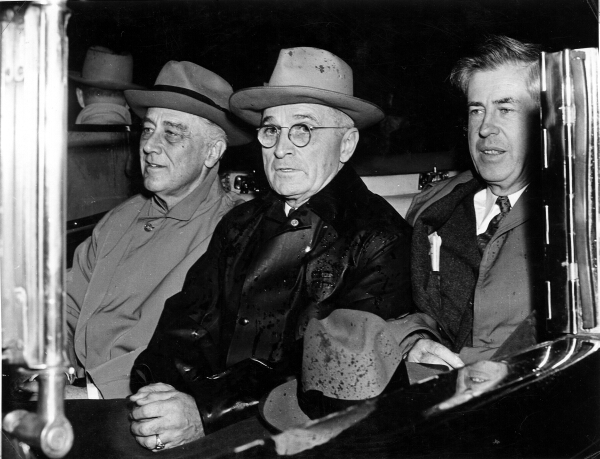
President Franklin D. Roosevelt, Vice-President-elect Harry S. Truman, and Vice-President Henry Wallace
Public Domain, via Wikimedia Commons

Truman was initially reluctant to accept the candidacy, preferring the modest job of Senator. However, true to his character, he took the nomination seriously and campaigned vigorously. Roosevelt and Truman were elected in November of 1944, and Truman took the oath of office on January 20, 1945. He served as vice president just 82 days before FDR suffered a massive stroke and died. An urgent summons brought him to the White House, where he was greeted by the newly widowed Eleanor Roosevelt, who broke the news by saying, “Harry, the President is dead.” The once-reluctant vice president was sworn in as the thirty-third president on April 12, 1945. With no prior experience in foreign policy, Truman was thrust into the role of Commander-in-Chief. In the first six months of his term, he announced the Germans’ surrender, dropped the atomic bombs on Hiroshima and Nagasaki that ended World War II, and signed the charter ratifying the United Nations.

In spite of these early successes, Truman’s diplomatic situation was beset with challenges. The Soviet Union had been a powerful ally to the United States during the war, but international relations deteriorated quickly when it became apparent that the Soviets intended to remain in control of Eastern European nations. These countries were expected to be returned to their pre-Hitler governments, and in response to these actions, the USSR was excluded from both NATO and from profiting in the reconstruction of Asia, beginning the Cold War. Republicans won both houses of Congress in 1946, which was seen as a judgment of President Truman’s policies, and polls indicated that reelection in 1948 was all but impossible. Polls were so lopsided that there was little reason to believe that New York Governor Thomas Dewey would not win the general election. The Chicago Tribune famously went to press with the headline “Dewey Defeats Truman” before the final votes were counted. The early polls were wrong; the final outcome was a win for Truman with 49.5 percent of the vote. Seventy years later, this is still considered one of the greatest upsets in the history of American elections.

"Dewey Defeats Truman"
By Museum claims ownership [Public domain],
via Wikimedia Commons

The Little White House


In November 1946, President Truman had finished 19 months in office but was physically exhausted. His doctor ordered a rest in a warm climate. In 1912, President William Howard Taft used Key West, Florida’s naval base as a layover en route to Central America to inspect construction of the Panama Canal. Recalling this, Truman decided to decamp to there for the winter. Despite the distance, Bess, who abhorred the public eye and the scrutiny given to the First Lady, stayed behind in Missouri.
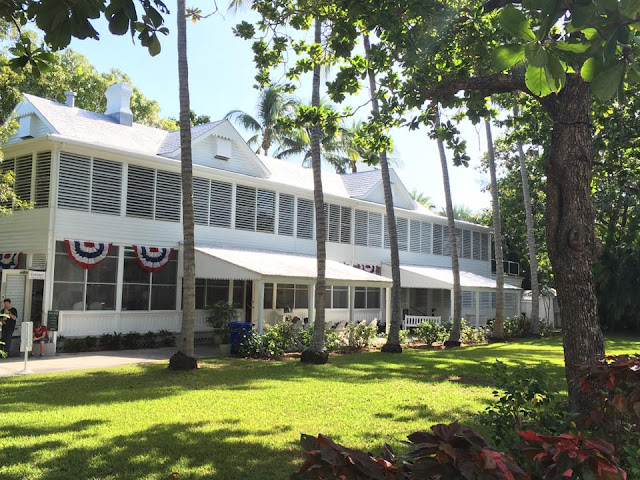
The Little White House, Key West, Florida  
This Key West retreat gave Truman a restorative atmosphere, but he realized that with new technology, where the President was, so too the White House could be. Only a three-hour flight from Washington, DC, an early morning telephone call could summon people for an afternoon meeting. While serious work was done here, the laid-back, Caribbean-like atmosphere permeated proceedings. At first, President Truman adhered to the standard business dress code. Then, the down-to-earth spirit came to life, and Harry decided that if the locals dressed in casual clothes, then who was he to wear a suit to go fishing? Khaki pants and tropical print shirts - the louder, the better - became the “Key West Uniform.” Despite the holiday atmosphere, serious business took place there. Truman began using the property as his “winter White House,” and spent 11 working vacations here, frequently meeting with high-ranking officials to discuss significant legislation such as the Marshall Plan and his fifth Civil Rights Executive Order.

He continued to visit after his presidency ended in 1953. To date, six American presidents have used it as the functioning White House of America and as a retreat and summit meeting location. The house remains on standby for Presidential use to this day.


A Third Administration?


During his second administration (first elected) as president, Truman announced his domestic policy initiative, the “Fair Deal” program, in his 1949 State of the Union address. Building on Roosevelt’s “New Deal,” it included universal health care, an increase in the minimum wage, more funding for education and a guarantee of equal rights under the law for all citizens. The program was not an independent success. In 1948, racial discrimination had been banned in federal government hiring practices, the military was desegregated, and the minimum wage had gone up. National health insurance was rejected, as was more money for education.

President Truman initiating Korean involvement
Public Domain, via Wikimedia Commons
The Korean War broke out in June of 1950, and Truman swiftly committed U.S. troops to the conflict. He believed that North Korea’s invasion of South Korea was a challenge from the Soviets, and that, if left unchecked, it could escalate to another world war and to further communist aggression. He initially endorsed a rollback strategy and encouraged General Douglas MacArthur to breach the 38th parallel, bringing forces into North Korea in order to take over the government. However, when China sent 300,000 troops to the aid of North Korea, a pragmatic Truman changed tactics. He reverted to the containment strategy, focusing on preserving the independence of South Korea rather than eliminating communism in the north. However, MacArthur publicly disagreed. A general openly contradicting his Commander was insubordination, and MacArthur was dismissed from his position in April of 1951. MacArthur was a popular general, so dismissing him only made Truman’s already-weak approval rating decline further.

Truman’s challenges were not limited to international affairs. On the home front, he was struggling to manage a labor dispute between the United Steel Workers of America and the major steel mills. The union demanded a wage increase, but the mill owners refused to grant it unless the government allowed them to increase the prices of their consumer goods, which had been capped by the Wage Stabilization Board. Unable to broker an agreement and unwilling to invoke the Taft-Hartley Act, which was passed in spite of his veto in 1947 and would have allowed him to seek an injunction that prevented the union from striking, Truman seized the steel mills in the name of the government. The steel companies responded by filing a suit against the government, and the case, Youngstown Sheet & Tube Company v. Sawyer (sometimes referred to as "The Steel Seizure Case") went before the Supreme Court. The Court found for the steel mills and forced Secretary of Commerce Charles Sawyer to give the mills back to the owners. Truman's handling of this dispute further tarnished his reputation with the American people. In March of 1952, Truman announced that he would not run for reelection.

A quiet and simple man, Harry S. Truman’s childhood was not very indicative of who he’d become as an adult. He believed in hard work, keeping promises, and taking responsibility; while his nickname was Truman the Human, he’s more famously quoted as saying, “The Buck Stops Here.” A reluctant vice president, he steered the country and the world through the end of World War II and its aftermath, and after handing over the reigns to President Eisenhower in January of 1953, Truman returned to Bess and a quiet life in Independence, Missouri. There he wrote his memoirs and oversaw the construction of his presidential library. He died on December 26, 1972, and is buried in the courtyard of the Truman Library.


©2012- 2016 Adventures with Jude. All rights reserved. All text, photographs, artwork, and other content may not be reproduced or transmitted in any form without the written consent of the author. http://adventureswithjude.com

Wednesday, May 25, 2016

America's Game: A Field of Dreams

America's Game: The Negro Leagues

Baseball was originally played by men in rival athletic clubs for recreation, and in 1864, immediately after the Civil War’s resolution, baseball’s popularity increased dramatically.  At this early time, it was still an amateur sport that attracted all races.  Reflective of society at large, there were both single-race as well as integrated teams.  However, on December 11, 1868, a casualty of the formation of the National Association of Baseball Players was a silent "gentleman’s agreement" barring black players.

In the early years of the 20th century, there were two attempts to establish leagues for black teams.  The first was in 1906 when the International League of Independent Baseball Clubs was formed in the Philadelphia area. This league was an integrative league, as it was initially composed of one white American, two Cuban, and two African American teams. The championship game pitted two black teams against each other and attracted 10,000 fans to Columbia Park, then the home of the Philadelphia Athletics. The league was planned to continue with a 1907 season, but it never happened. Four years later, there was an attempt to start an independent black major league with teams across the country; unfortunately, the league died before any sanctioned games were played.

The 1887-88 Cuban Giants
Public Domain, via Wikimedia Commons
The first nationally-known black professional baseball team was founded in 1885 when three clubs, the Keystone Athletics of Philadelphia, the Orions of Philadelphia, and the Manhattans of Washington, D.C., allied to form the Cuban Giants. The newly-formed black teams played as independent but allied ball clubs until the organization of the first black league in 1920.  That same year, Rube Foster, now known as the father of black baseball, founded the Negro National League.  In 1923, Ed Bolden formed the Eastern Colored League.  These two leagues thrived in the beginning years, but eventually declined because of financial difficulties.  In 1933, a new Negro National League was formed, and the Negro American League was chartered in 1937.  These two leagues, bankrolled by black businessmen, prospered until the color line was broken by Jackie Robinson.

Jackie Robinson made history in 1947 when he broke baseball’s color barrier to play for the Brooklyn Dodgers. A talented player, Robinson began his professional career in the Negro League before being selected by Branch Rickey, the Brooklyn Dodgers’ president, to help end segregated Major League Baseball. With the number 42 embroidered on his jersey, Robinson won the National League Rookie of the Year award his first season and helped the Dodgers to the National League Championship – the first of Robinson’s six trips to the World Series.  In 1949, Robinson won the league MVP award, and he was inducted into the Baseball Hall of Fame in 1962.

Jackie Robinson in his 1950 Brooklyn Dodgers Uniform,
By United States Information Agency
[Public domain], via Wikimedia Commons

Despite his skill, Robinson faced a barrage of insults and threats because of his race. The courage and grace with which Robinson handled the abuses inspired a generation of African Americans to question the doctrine of “separate but equal” and helped pave the way for the Civil Rights Movement. On April 15, 1997, his jersey number was retired throughout all of Major League, an unprecedented and still unrepeated tribute to the man who returned his race to the mainstream games.

Hank Aaron, 1960 Milwaukee Braves
Public Domain, via Wikimedia Commons
While Jackie Robinson became the man who broke the color barrier, and essential the “first strike” against segregated baseball, the Negro Leagues did not immediately strike out when Robinson took the plate.  Dwindling finances as more players opted for the integrated MLB was strike two; the NNL disbanded in 1948 while the NAL lasted until 1960 before shuttering. A few teams of the Negro League teams continued independently beyond this, though. The last team to play was the Indianapolis Clowns, who mixed comedy with baseball. The Clowns were the lineal descendants of the Ethiopian Clowns of the 1940s, who had outraged many fans by wearing grass skirts and painting their bodies in a cartoonish version of cannibals. But the latter-day Clowns played serious baseball until the team’s end in 1973; home run king Hank Aaron made his professional debut with them in 1952.  The folding of the team was the last strike against segregated baseball, ending the era of the Negro League's games.

Just a few years after they learned to play baseball while fighting alongside white soldiers in the Civil War, blacks became quietly forbidden from Major League Baseball.   In the Jim Crow era, the formation of the Cuban Giants association, followed by the Negro National and Negro American Leagues, gave black players a chance to make their big league dreams come true.  The Leagues were especially successful during World War II and in the years after when black urbanites, flush with cash from well-paid defense jobs, crowded into stadiums across the nation to see players like Hank Aaron play.  After Jackie Robinson had broken into the “white league”, some proposals were floated to bring the Negro leagues into "organized baseball" as developmental leagues for black players, but that was recognized as contrary to the goal of full integration.  Negro Baseball Leagues provided African Americans their own “field of dreams,” while Jackie Robinson and his cohorts proved that baseball wasn’t a white man’s sport, but America’s game.


Cover Image credit:  David King, [Public Domain], via Wikimedia Commons


Click here to read other posts in the series!


©2012- 2016 Adventures with Jude. All rights reserved. All text, photographs, artwork, and other content may not be reproduced or transmitted in any form without the written consent of the author. http://adventureswithjude.com
Related Posts Plugin for WordPress, Blogger...
Pin It button on image hover