Showing posts with label curriculum. Show all posts

Thursday, September 5, 2019

Zeezok Publishing ~ Music Appreciation: Book 2 for the Middle Grades (Homeschool Review Crew)


A few years ago, we had the opportunity to review the first installment of the Great Musicians Series from Zeezok Publishing. The newly released Music Appreciation: Book 2 for the Middle Grades program picks up where the first level series leaves off. The composers are included in this music curriculum are from the Romantic era: Frederic Chopin, Robert Schumann, Richard Wagner, Stephen Foster, Johannes Brahms, Pyotr (Peter) Tchaikovsky, and Edward MacDowell. Units are divided by composer, with four or five weeks allotted to each; and each composer is a self-contained unit, so you can begin anywhere in the program, not just at the start. It makes the most sense, from a timeline perspective, to follow the sequence presented in the book. However, because they are self-contained, a family could study composers from a geographic/world history perspective. Chopin is from modern Poland, while Schumann, Wagner, and Brahms are German;  Foster and MacDowell are American composers. I think this flexibility is helpful as a homeschool parent.

Not pictured: Tchaikovsky and the Nutcracker Ballet, provided via eBook 
The program set includes (and requires) the collection of nine biographies and a consumable student book. The student book may be purchased individually if you wish to use the program with multiple students. A lapbook program and coloring pages are also available. (We did not receive them for review, and I opted not to purchase them because our family does not really enjoy lapbooking.)

Most music appreciation courses focus on music styles, and students listening to pieces from to hear the differences between each era: Renaissance vs. Classical, Baroque vs. Modern.  I don't think this is a bad thing to learn, because each style is a reflection on its position in history. Last year, Matthew completed a (different) music history course that taught these nuances, and even just after eavesdropping, I can now easily tell the difference between epochs when I hear a "classical" composition.  However, I think what can happen then is pieces within a genre start to sound homogenous. Celia will play a violin piece, and I couldn't tell you the difference between Handel and Bach. I've learned to listen for what makes a piece inherently Baroque vs. from the Romantic era, not what makes each composer different. I also know little about what motivated each man. Zeezok provides music study from a different perspective.

These biographical studies focus not only on the composers and their music but also on their family lives and character.  For example, Schumann's courtship and marriage to Clara Wieck are discussed.  Wieck, a lauded pianist in her own right, was a fundamental inspiration to her husband, and, like her husband, a champion of other composers.


Often, it is the salacious or scandalous stories of composers that endures, so I appreciate the perpetuation of the good character traits. I also appreciate that the program does not shy away from them, either; while highlighting Tchaikovsky's closeness to family and generous nature, it does include a note about his troubled relationships with Désiree Artôit and Antonina Milyukova. However, it presents them in a concise, factual manner, with no little color commentary (and no discussion, outright or inferred, to modern biographists conclusions about Tchaikovsky's struggles with his sexuality).

The student book includes comprehension questions that correlate to the biographies, as well as information about other facets of the composers' lives and related music theory information.  Journaling opportunities (prompts are provided; students will need a journal notebook or could use a word processing program) are also liberally offered, allowing students to work on writing skills (short answer, self-reflection, creative writing, etc.). Each unit ends with an overview quiz.


For some families, grades are unimportant. However, since Celia requires a graded transcript to apply to college, I appreciate having the checkpoints and quizzes to help me generate grades for her.  They were short but well-detailed, and easy to adapt to requiring extra effort from a high school student.


A significant difference between Level 1 and Level 2 series is the use of QR Codes.  In the first series, we received a case with several CDs containing music selections. As the student reads each composer's biography, musical selections are woven in. This meant every time we reach a composition, we'd have to hunt down the CDs, find the player, etc. It also made it difficult to take with us if we were doing schoolwork at a doctor's office or the karate dojo.  Having QR codes that linked to an online (YouTube) music library was far more convenient; all kiddo needed was to borrow a phone or iPad with an internet connection.


Additional QR Codes are peppered throughout the book for if the student wishes to learn further about a person or topic. Additionally, related topics and (optional) suggested activities are included with each composer study. While each student requires his own consumable workbook, this makes the program suitable for multiple grade levels.  The publisher notes that while Book 1 is written for grades K-6 and Book 2 is for grades 5-8, they are easily adaptable across a range of educational abilities. A younger student could complete the program solely based on what is contained within the biographical texts and added information, with assistance as necessary, while an older student can work independently and has resources immediately at his fingertips for further research.


One of Celia's favorite "added information" bits was about the conductor.  She has played in a local youth orchestra for several years now and has become used to following a conductor.  Using context clues from the tenor of the music, she has learned what the conductor is trying to convey, but she had an "aha!" moment when she read about how conducting isn't just arm movement but body language as well. Now, the mantra, "Always look back to the conductor!" makes so much more sense; just watching his arms from the corner of her eye as she reads the music in front of her only gives a fraction of the information she needs.


Here, Celia is playing with her summer camp's String Orchestra (she is seated in First Chair, Violin). Dr. Erwin is leaning toward the violins, to pull vibrancy and strength from that instrument section.  Her movements are purposeful, not over articulated or dramatic "feeling the music." 

 
Zeezok includes a planning outline for each composer, allotting four to five weeks for each unit as written.  I think it makes the program a more-than-adequate full-year program for an upper elementary or middle school student. However, with the addition of further research and/or a more accelerated pace, this program could be combined with Music Appreciation 1 to create a full high school credit.  Due to time constraints and for review purposes, Celia worked on the program as written, with little additional study. She completed two units in a little over six weeks.  However, she plans to go back to the beginning and spend another six or eight weeks exploring things in more detail and adding in writing assignments.  While we are using this program to round out an "independent study" program for a multiple-instrument musician, it is certainly adequate for even for a non-music student. Since the focus is more on the composers and less about being able to identify musical pieces, I think it also plays to the strengths of a student who is less musically inclined but has an interest in people or history. As we get close to history buff Jude's high school planning, it is a top contender for a music credit for him.  We are really excited to work with this new program from Zeezok. 

For more about our experience with Level 1 of this series, click here: 


For more information about the Music Appreciation: Book 2 for the Middle Grades program, click the banner below to read other Crew reviews. 

Music Appreciation Book 2: for the Middle Grades {Zeezok Publishing Reviews}


Want to keep up with all of our adventures?
Subscribe below to get Adventures with Jude delivered to your inbox.

Enter your email address:


Delivered by FeedBurner


©2012- 2018 Adventures with Jude. All rights reserved. All text, photographs, artwork, and other content may not be reproduced or transmitted in any form without the written consent of the author. http://adventureswithjude.com

Friday, August 9, 2019

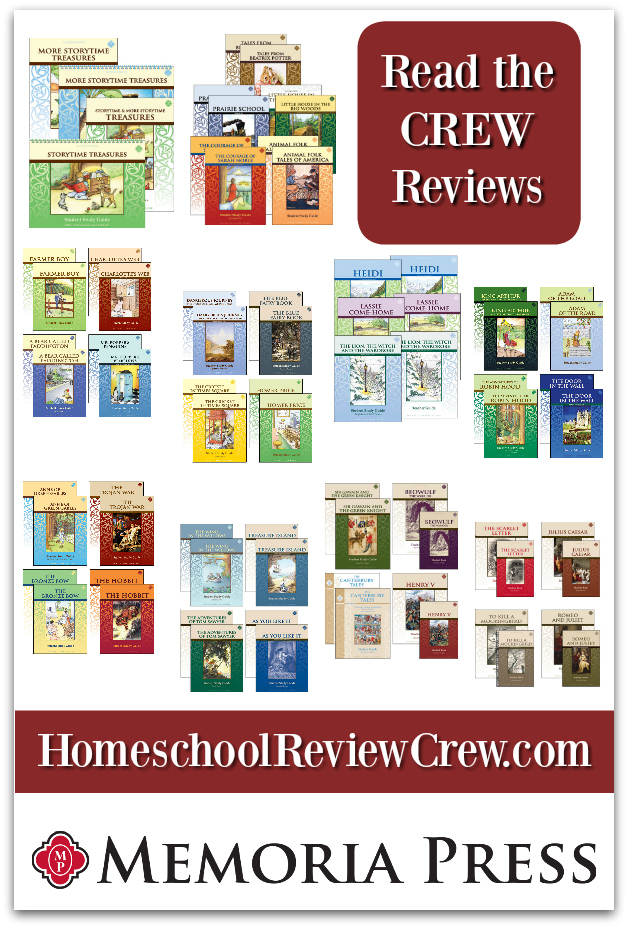
Memoria Press Literature (A Homeschool Review Crew Review)

Memoria Press has become a go-to company for our family.  Several years ago, I found that our family did well with their classical education model, and we have consistently returned to Memoria Press' curricula, especially for literature. After trying several literature programs, I have determined that Memoria Press programs are the most consistent performers for us; returning to a Memoria Press study feels like a homecoming.  Our family had the opportunity to work with the Seventh Grade Literature Set.  While this is available as part of Memoria Press' seventh-grade program package, the guides are available as a set and rated for students in grades six through eight.  The collection includes student and teacher guides for
The 4-volume set we received contained a Student Guide and a Teacher Guide for each book. (While the literature books are available with the individual sets, the four-title set does not include the novels.) We used this program in a unique way, assigning two books to students now (rising 7th grader Jude and rising 10th grader Celia) and saving the other two for later.

The Trojan War


Allow me a moment for a bit of background information, please. As some readers may recall, when Jude worked on the Second Grade Memoria Press literature program, he really struggled. Although the program was marketed for second graders, his skills at the time were not quite on par with Memoria Press' expectations.  I have long felt that the program's expectations are higher than average. Combined with Jude's early struggles with reading, I have intentionally used levels that are below his chronological grade level. In fact, for his sixth-grade year, we began with literature guide for A Cricket in Times Square, part of Memoria Press' fourth-grade program. To my surprise, he easily completed this study, as well as the one for Homer Price, so we skipped ahead to fifth grade's The Chronicles of Narnia. I felt that if he could manage this book, we'd move on to sixth grade; if not, we'd complete the rest of the "fifth-grade" literature. Jude proved to me that he really was beginning to mature in his thinking process, so this summer, we moved up to sixth-grade literature. There was an added benefit: while these books were still a year behind Jude's chronological grade level, they were high-interest for him. I felt this interest would be the ridge between "want to read" and "hard to read."

When offered the opportunity to try the 7th-grade package, I was a little hesitant to try anything intended for an even higher level student. However, hope springs eternal and I figured maybe the challenge would be good for him.  If worse came to worst, we could set it aside after the review period and try again later.  When the books arrived, I gave him the choice of reading any of the three options besides Anne... because I knew that set was going to Celia. As he is an avid reader of all things Greek, Roman, and Norse mythology, I was not surprised when he opted for The Trojan War


I think this was a wise decision. Jude usually does better with literature studies when the story is familiar to him. If he already has a grasp of the plotline, he can follow details better, because he's not trying to figure out too many things simultaneously.  And again, high interest became the bridge between desire and ability.
While each chapter follows the elementary school-level framework that his previous literature studies have been patterned in, The Trojan War has a lot of information to absorb.  Jude is simultaneously reading Adam of the Road and completing the 6th-grade workbook, and generally manages a chapter every other day. However, we are finding it is taking us a full week to do each chapter for The Trojan War.

However, I don't think the reason is the material is too hard. I think most of it is a battle of wills. In the past, I've never fussed if Jude's answers weren't precise when compared to the Teacher's guides. As long as I could tell that he had the main idea, I let half-sentences slide. I think part of what is slowing us down is, since he's now officially in "middle school," I am no longer letting three-word ideas pass for answers. Much to his chagrin, I'm marking his book where he only has half-answers, or poorly written thoughts, and making him go back and rework them. This then adds another day to the lesson.  He also wasn't particularly happy when I told him I expected (gasp!) actual paragraphs for answers to the Enrichment questions instead of a few sentence fragments. 

Clearly, his brain is capable, even if his willpower isn't quite as strong.

 If you are familiar with the Memoria Press Classical Studies program, then you know that students begin by studying Greek Myths in the first year of the program, and then continue on to learn about Ancient Rome and Greece. While The Trojan War is included in the literature program, it is also part of the Classics Year 4 Program.  While you might be tempted to skip it, especially if you intend to continue through and have your child study The Iliad and The Odyssey in Year 5, this retelling by Olivia Coolidge is an excellent introduction to the epic.  It provides enough details to draw the reader in, but not so much that he gets lost in the minutiae of them. I think Jude will be well prepared for studying these two epics in depth next year.

At our current rate of a chapter a week, it will take Jude a full semester to complete this guide. I'm comfortable with this pace for two reasons. First, this work sets the foundation for something he will study again, so I'd rather him understand what is going on well so that when he studies The Iliad, he will again be "adding on" rather than "starting new." Secondly, I want him to begin to have better study habits. Jude only likes change when it is his idea, so I have a feeling it is going to take some time before he realizes that he wants to make the changes.

My only complaint about the set is that the tests and quizzes are only in the Teacher's Guide. I know that some parents do not administer tests, but I find them helpful to assess what Jude is retaining as he transitions to working independently. However, doing so is not a smoothly integrated process.
First, the parent/teacher needs to plan out where the tests need to be taken; it's easy for a student to "forget" that there is one coming at the end of each part of the book.  (We found writing reminders at the bottom of the last page before a test to be helpful.  Not only did it remind Jude to ask for the test, but it also helped me factor in study/review days when writing his daily assignment sheets.)  Secondly, the copyright notes in the guide state that no part may be reproduced.  This means that I either break the rules (and with a very literal rule follower child, that's not a good plan!) so he has his own copy, or Jude is writing in a book that I would otherwise have no need to replace (plus, he has temptation in the form of the Answer Key at his fingertips!). We've compromised by him answering the questions in his literature notebook, with the Answer Key paperclipped closed.


I wish the Student Guide had the Student's tests, either interspersed or in an Appendix at the back of the workbook, or that there was a separate (reproducible or consumable) Test Booklet, and that there was a reminder/test placeholder for to help the newly independent student not to race ahead.

Anne of Green Gables


Ah, Anne-with-an-E...I think Miss Shirley is one of my favorite literary ladies. I was probably in middle school when I found my first kindred spirit (Anne), my first Book Hero (Matthew Cuthbert), and my first Book Boyfriend (Gilbert Blythe).  Anne has been on Celia's reading list for quite some time, so this was a perfect opportunity for her.  While Celia was finishing 9th grade during the review, so technically "older" than the program's intended age, she has had a literature-heavy year. I decided to substitute Anne for Henry V for the last of her 9th-grade reading.  Do I think this made it too "easy" for her? Not at all.


L. M. Montgomery may have only written books on paper, but her character's words bring them to life. I think anyone who has read any of the Anne books knows Anne's grandiose imagination supports her flair for the dramatic while providing a foil for the prosaic Matthew and Marilla Cuthbert.  In addition to Vocabulary, Comprehension, and Enrichment exercises,  each chapter explores Expressions for Discussion. These could easily be done as an oral discussion, but I asked Celia to write her interpretations of what the expressions meant.  


While some might think that the answers are obvious, making it "too easy" for a high schooler, I think L.M. Montgomery was brilliant. How many times has a parent/teacher tried to help their student learn to write "less bland, more exciting" essays? Writing exercises always talk about using more specific words, more detailed words, more descriptive words...in other words, stop saying "very"! Perhaps Anne has a tendency to be a bit over-the-top, but she's a shining example of careful word choices. Which pulls your heartstrings more, "I'm used to being disappointed," or "My life is a perfect graveyard of buried hopes"?  I think Anne of Green Gables is a book that all students should read so that they can become better writers!  I love how Memoria Press chooses to really dig into the expressions in the book - rather than selecting a quote or two, there are as many as seven or eight to explore. The program does full justice to the book by really allowing Anne (and the Avonlea residents) to have their say.

Classics become classics because they are enduring, but it would be easy for a book published in 1908 and set in the late 1800s, to contain archaic vocabulary.  I can remember doing vocabulary studies myself and wondering, "When am I ever going to use these words?" However, Memoria Press has focused on words that remain pertinent today. 


Comprehension questions include both literal "what happened here" and critical("What did Anne mean...") queries.  In addition to studying the book itself, the program provides writing opportunities for literary interpretation, opinion/persuasive writing, and exploring Anne's interests (Shakespeare) and tribulations (geometry as compared to Waterloo).  


While Memoria Press offers the literature books for sale, the literature sets do not include them. While some of their studies do require specific editions of books, we found this was not the case with this program.  Last Christmas, Celia received a box set of the Anne series and used the edition that was included.  In this case, page numbers did not need to match, as the program is sectioned by book chapter.

Celia has been working at a rate of a chapter every other day.  On Day 1, she does vocabulary, reading, and the expressions for discussion; on Day 2, she finishes the comprehension questions and completes the enrichment. It could easily be done at a slower pace (one workbook section a day over the course of a week), but I'm hesitant to recommend doing a full chapter a day.  It is possible if your child is a fast reader, but it would take close to 90 minutes a day just for literature.  I have done this with Memoria Press literature when we are in a time crunch (trying to get to a logical stopping point before an extended vacation, or when Luke or Matthew was trying to finish a study guide in the countdown to graduation), but it's not necessarily sustainable long term.  At a rate of 5 chapters per week plus review sections and two exams (also only available in the Teacher's Guide), it will take about 8 weeks, or one academic quarter, to finish the book.  I think that's reasonable for a high school student. 

The Hobbit and The Bronze Bow

When my students were younger, I was more focused on the "grade level" of the program.  Now that we have entered into the middle and high school years, I've learned to focus less on the grade a program is assigned to and more on its content, because middle school books begin to be less about a numbered grade level and more about the individual's literacy level and abilities. Knowing that Jude likes to binge on book series, I will likely keep The Hobbit set aside for another year or two until he is ready for the entire The Lord of the Rings series. Like Anne, I think this is a book that transcends grade level.   I think 7th grade is about the youngest age that a student can truly wring all the finer points out of it, but there is no point where a student "ages out" for exploring the book.  The Bronze Bow is set in 1st Century Israel, so it could be studied as part of the "pre-set" 7th-grade program, or it could be moved to 9th grade and part of an Ancient/World History program. While the lower grade programs involve exposure to literary concepts, the study guides at this level of the program use that familiar framework to explore and apply those ideas to the corresponding novels. I think the studies at the middle school level have the flexibility to help prepare a middle schooler for high school expectations as well as provide a relaxed but not too simple study for secondary level students. Once again, Memoria Press has proven why it has become my favorite literature program.


Crew families with students from first through tenth grades have been reading with Memoria Press. Click the banner below to read their reviews of the books they've been studying!   You can also learn about other Memoria Press programs we have worked with by clicking the links to those reviews.

Memoria Press:

First to Tenth Grade Literature Guides {Memoria Press Reviews}


 Crew Disclaimer

Want to keep up with all of our adventures?
Subscribe below to get Adventures with Jude delivered to your inbox.

Enter your email address:


Delivered by FeedBurner


©2012- 2018 Adventures with Jude. All rights reserved. All text, photographs, artwork, and other content may not be reproduced or transmitted in any form without the written consent of the author. http://adventureswithjude.com

Wednesday, July 11, 2018

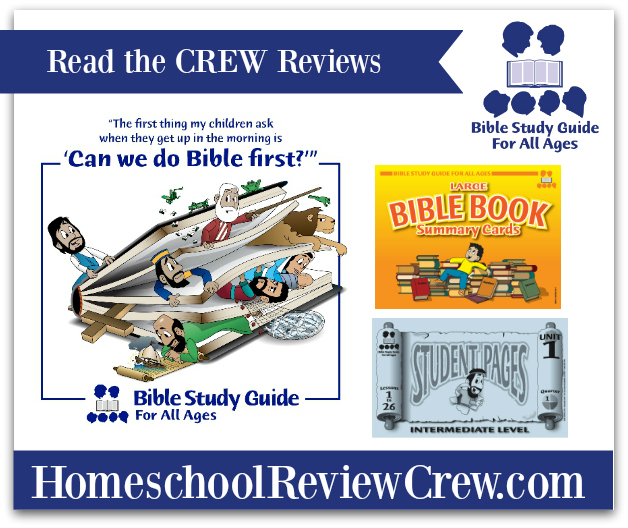
Bible Study Guide for All Ages (Homeschool Review Crew)

We're no strangers to Bible Study Guide for All Ages.  A few years ago, Celia got to test the program out and really enjoyed working with it.  This time, it was the boys' turn.  New third grader Damien got the Intermediate (3rd & 4th grade) while rising sixth grader Jude had a chance to try the Advanced (5th & 6th grade) program.  Each boy's workbook allowed them to complete the first quarter of each level: Lessons 1 to 26. In our kit was also a pack of large-format Bible Book Summary Cards and a Teacher Key for each program.


Bible Study Guide for All Ages also has programs for students as young as PK3, the elementary levels, and then teens and adults as well.  The program is laid out so that traditional homeschoolers can work on this a little bit each day over the course of a week, but it is short enough that the program used in a co-op, cottage school, or Sunday school setting that only meets for a short time each week. (Note: the workbooks are designed to be consumable products, so if you use them in a group learning setting, each child will need to purchase his own workbook.)

While the Primary level runs independently of the rest of the curriculum, the Beginner, Intermediate, and Advanced levels run in the same sequence, only at different levels.  (Ok, I know that seems like a sentence filled with redundancies, but bear with me.)


The first few lessons center on Joseph of the Old Testament. Lesson 1 in both levels teaches the story of Jacob and the tribes of Israel, focusing on Joseph's Coat of Many Colors (Genesis 35:23-26; 37:1-11), Lesson 2 segues into Joseph's Dreams (Gn 37:12-36), and Lessons 3 through 14 take learners through Joseph's experiences in Egypt and then Jacob's death.  We then jump to study the Book of Daniel, and the Babylonian capture, and more dreams - this time, Nebuchadnezzar's dreams and the promise of a King.  In Lesson 21, we fast-forward to the Gospels of Matthew (Mt 1:1-17) and Luke (Lk 2:23-38) and begin learning about the family of the King of Kings, Jesus.

Notice I didn't say "Jude learned," or "Damien learned."  Despite different workbook activities, each week, the lessons focus on the same stories. If you're Mama reading the passages aloud, it makes reading times simple: everyone can sit and listen together.  By focusing on the same stories in a two-year cycle, it is presented soon enough that there is some familiarity ("I remember that story!") but enough elapsed time that the older student is ready to delve a little deeper.  It also means that in group activities, a family actually becomes a group.


Each of these activities would be difficult to do with just a parent and child.  In the first one, two people don't make a very large web of lies.  In the second, it becomes an "aha!" moment when we realize "telling the truth" isn't just disobedient to adults, but hurtful to their peers as well.

What learning style is your homeschool? It doesn't matter! We're what most would call "eclectic" homeschoolers; I think the term I'd use is "Crew-led." However, there are bits of many learning styles within the program that make it accessible to many.  For example:

Classical Method? Repetition, repetition, repetition.  Not only do you revisit the same stories, but each lesson has a review of the what is learned.

Charlotte Mason? Active and applied activities in lessons are focused, and I'm not sure there's a more "living" book than the Word of God!

Unit Study? You're taking a topic and finessing it until there isn't much left to learn.

Group Setting? If you did this is a group learning setting where you only had 60-90 minutes to work together, I would focus on reading the Bible story, the Memory Workout, map or timeline activities, and the Get Active and Apply It! sections.  The latter two are probably the most suited to a group setting, and the reflection and prayer at the end of the Apply It! makes a naturally good ending.

The Teacher Key is a suggestion at most levels for homeschools but highly recommended for group teachers. I agree with this; how much you will need it will depend on how independently your student is working. Primary Level is the only one where a teacher's key is required, due to the more visual vs. language-based program.


Private Homeschool with multiple children?  There are a few options.  There are a total of 416 lessons for each level, so you have a significant amount of ground to cover in the two years, especially if you're keeping to a "traditional" 180-day school schedule.

The first option is to divide the activities across two days. This would allow for 5 lessons every two weeks.
  • Day 1:  Read the Bible passages as a family, and have each student complete the Guess What... and Map activities.  Do one level of Get Active and Apply It! activities as a group.
  • Day 2: Complete Remember It and Memory Workout sections together, allow students to complete the "paraphrase the story" cartoon activity on page 2, and then regroup for the alternate level of Get Active and Apply It! activities.


The other option would be to do a lesson a day, and just alternate whose "turn" it was for the two group-like activities.  You also may want to double up some days, to keep within that two-school-year range. However, the levels do have some flexibility, so you could start a younger student a little early, or run a little later ending the level, without overwhelming or boring a student.

If you have only one child working on the program, working one-on-one with them to complete activities is an option.  Again, I'd recommend the Teacher Key if you have an independent student, especially at the Advanced level.  I didn't feel I was missing anything by not having the Intermediate Key; most of the answers were quickly figured out by knowing the story. I was glad to have it with Jude because I don't remember the "chapter-and-verse" locations of things through the Bible, so it saved me having to look up if his answers were correct or not.


What Christian denomination are you part of? Again, it doesn't matter.  Because this provides the passages for a story, not the story itself, you are free to use whatever Bible translation you prefer.  So many Bible programs are focused on the King James Version of the Bible, and it is frustrating as a Roman Catholic.  (To us, the KJV is also missing books, but that's another story!) I like that we are able to use our family Bible to read from.


The Bible Summary Cards are full-sheet, full-color, heavy cardstock cards with pictures on one side and written summaries of the topic on the back.  They address most books from Genesis to Revelation -- you will not use them all in a quarter, but rather over the course of the entire program. The pack as a whole works with all levels, so with proper care, they will last through several students. I may consider laminating them since they will have so many hands on them.

I still like this program. (I also can't believe that it's been five years since we used it last!) I think I will be checking out the Teen level as well because it's a program that would simplify Bible study to fit our wide range of ages.  Jude and Damien are enjoying the "easy" work, but I like that it's not just "busywork" but encouraging them to think about the lessons of the Bible.


The Crew received materials for students in PK3 through 6th grade.  Click the banner below to read their reviews of the Beginner, Primary, Intermediate, and Advanced levels, as well as the Bible Study Guide for All Ages Timeline program.


Bible Study Guide For All Ages {Reviews}


Want to keep up with all of our adventures?
Subscribe below to get Adventures with Jude delivered to your inbox.

Enter your email address:


Delivered by FeedBurner


©2012- 2018 Adventures with Jude. All rights reserved. All text, photographs, artwork, and other content may not be reproduced or transmitted in any form without the written consent of the author. http://adventureswithjude.com

Wednesday, June 27, 2018

The Master and His Apprentices (Homeschool Crew Review)

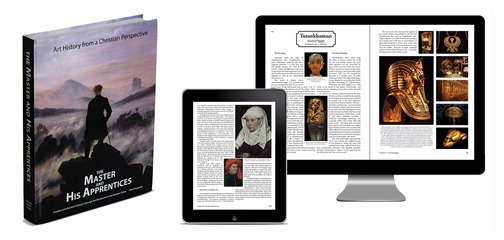
Public school students in our state have relatively strict curriculum requirements, including one year of a "visual or performing arts" curriculum.  On the one hand, homeschoolers do not have to follow the same "mandated curricula" rules - thank heavens for that flexibility! However, I feel that, to have a transcript that is competitive with their peers and not feel like we have to reinvent wheels, it makes sense to use the state's list as a "things we ought to cover" guide. We hoped that one option for fulfilling this "requirement" could be  The Master and His Apprentices: Art History from a Christian Perspective,  a one-year high school art history curriculum published by The Master and His Apprentices.


Initial Thoughts

The Master and His Apprentices is a Christian-viewpoint program.  It is arranged in a manner that helps coordinate Biblical and historical timelines.  This is not unlike a few other of our courses, and I like this perspective.  My school experience was learning things in "parallel universes." Cognitively, I knew that there is overlap in multiple civilizations, but I never tied it all together. When Jude started working on a particular history program, I discovered the idea of teaching "within a timeline" and discovered how much easier it is to understand how civilizations segue from one to the other.  I liked the idea of starting at the beginning (Creation) and then studying art's progression through time.


For our review, we received a Digital Edition of the curriculum, which included the Textbook ($34.99 retail) and Teacher Guide ($19.99).  This is a downloadable PDF file that can be viewed on (ideally) a computer screen or a large-format tablet. The file is also formatted for printing; the appropriate margin has been left for a 3 hole punch binder or comb binding.  While it took a considerable amount of time and ink, Matthew preferred a printed copy of the text, which would allow him to mark it for studying.


  The guide includes a single-student license; there is $2 "recopy" fee for use with each subsequent student. (Reviewers received unlimited household recopy rights.)  I can understand the company's view - this program is an investment in their intellectual material - but I don't like the idea of having to go back to the company every time I want to re-use a digital program.  As a parent, I'd rather pay a few dollars more at the beginning for an unlimited single-household license, rather than feel "nickel-and-dimed" over time.

There is also a pre-printed materials option. This includes a 380-page hardcover Textbook ($149.99) and softcover, perforated-page, 120-page Teacher Guide ($24.99).  The teacher's guide is intended to be a consumable material, but digital student reprint rights are available as well ($2 per student).  Again, this feels clunky. I can understand the workbook being consumable. However, if I'm purchasing something pre-printed, it's because it's more cost-effective (either financially or time-wise) than printing it myself.  If the paper guide were less expensive, I'd be more inclined to just purchase multiples of those and be done.

I can understand a per-student charge for non-family group settings (one suggested use of this is with co-op programs), but perhaps that should be a different "call us for pricing" category since the photocopy rights only apply to the workbook; each student still needs to purchase a textbook. I'm also not sure about the textbook and re-printing capability for later students.


Working with the program

I think this should be retitled Western Art History from a Christian Perspective, or even "Western History Through Art".  I had expected this to cover art from around the world, not just the Middle East and Latinized areas.  There is a single 8-page chapter devoted to "the rest of the world," with an explanation that "In a collegiate setting, the study of Western art and non-Western art are quite often divided into separate classes." (p. 314)  That makes sense to me because there is no way that the entirety of art history, when presented in this timeline-based manner, could be done adequately within a single semester.  However, neither the company's website nor samples indicate that there is little attention given to non-Western art.  A mere eight pages are included and meant to point out other cultures; it feels like an "oh yeah, there's this other stuff" afterthought.  I think it would be better to omit it entirely and advertise this program as a history of western art.

The book also mentions "Through Modern Times" in the title.  However, it ends with the Baroque era and covers from Rococo (the 1700s) to current times in 8 pages.  Impressionism - with the greats such as Renoir, Monet, Rodin, and Sargeant - gets a full page, while post-impressionist Van Gogh earns a small example picture and half a sentence.  Again,  if it had advertised itself as "Through the Baroque Era," I would be fine with that.  But if it says "Through Modern Times," then I expect to find at least a mention of artists such as John Singer Copley and Charles Wilson Peale, and discussion of the establishment of the Pennsylvania Acadamy of Fine Arts, the oldest art institution in the United States and one of the first to allow women to receive an arts education equal to their male peers.

This curriculum is meant to be worked over the course of a 36-week school year.  If time is an issue, some lessons may be combined or omitted (the Teacher Manual gives directions for this.)  Matthew worked each week's assignment or two over the course of a few days - reading the chapter one day, and completing the (as many as 30+) questions over a second or third day.


The program also includes four written research papers and four exams.  I appreciated the clear "What to do each week" layout.  I'm not certain what semester the dates included were from -- my guess is this was used with a co-op in a particular year, and these are the corresponding dates.  Practically speaking, it was not a big deal to cross out the printed dates and re-mark the ones that aligned with our work.  There is a note in the corner that this is a sample and there is an editable document available, but that just was an extra step that really seemed more than needed.  (Plus, it involved printing another page.) However, it made the guide seem less "professional" and more "I'll just sell copies of my notes."


The teacher's guide heavily weights "discussion" - I think this works better in a group setting than a single student.  The manual discusses how to use the program in both a one-hour class setting or a longer meeting period. However, for the single-student, it's awkward.  The only person Matthew had to discuss things with was me, and he would look at me and say "I answered the questions, I don't have anything to really add." I think having a group of people with different perspectives would make a difference in how engaging the material could be.


"No Nudity" 

One of my primary concerns with the program is it explicitly advertises "No nudity!"  I felt that Ancient Greece, often filled with nude statuary, could focus on draping, and how artists and sculptors skillfully used light and shadow to create movement in folds of robes.  But how does one effectively teach Renaissance art without using any nudes?  There are nudes on the ceiling of the church where the Pope is elected!  How does any Art History course worth its salt gets around Michelangelo's David?

By picturing only his left foot.


This was just ridiculous. This is a high-school level program.  I'm not an advocate of gratuitous nudity, but nudity in art serves a purpose.  In the Renaissance, it showed not only the skill of the artist in creating work but also reflected the emerging understandings in math and science of both the body itself and how to arrange it on canvas or in stone proportionally and realistically.  (Later in the Baroque era, it reflects the changing attitude of the times.)  David is probably one of the premier specimens of this Renaissance knowledge, as well as an incredible example of general line, movement, and the dynamic Renaissance contrapposto. At the very least, showing David's face and upper body would demonstrate these principles.  Without any of these tenets discussed, my thinking that this is more a "history with art" rather than "art history" course were solidified.

The curriculum also mentions Michelangelo's Sistine Chapel paintings and presents a close-up of God and Adam's hand.


Ok, I could allow this one as a "Christian view," but it is the only illustration of this magnificent work.  Why bother? The program has lost an opportunity to discuss Michelangelo's skills as both a sculptor and painter.

There is a single page discussing Flemish master Peter Paul Reubens.  One of the paintings chosen, The Raising of the Cross is an excellent example of his skill with line, color, light, and movement.  However, never is the term Rubenesque - a name for his iconic, allegorical paintings of voluptuous figures - even mentioned.  How does one study Reubens and never say what he is famous for?

I knew that this program advertised "no nudity," but I had hoped it would be handled differently - perhaps with a lighter touch and more deft cropping.  Yes, I can tell Matthew, "Go Google the David statue," or "Find out what does Rubenesque refer to," but if I'm purchasing a complete curriculum, I shouldn't feel like I need to add to it to provide a complete education.

Other content

The Textbook

I have mixed feelings on this as well.  For example, Chapter 9's Early Christian and Byzantine section features an introduction and four work foci from this period.  However, most some of the topics only encompass two pages! The Hagia Sophia, first a Christian basilica, then a Muslim mosque, and now a state-owned museum, has about a page and a half of text, and a few photographs. Other sections are equally skimpy.  Leonardo da Vinci, arguably the greatest man of the Renaissance era, greater than even Michelangelo, has a mere three pages (including photographs) dedicated to him.

For much of the early medieval period, the Church was the patron of the arts, and it shows in the Romanesque and Gothic Cathedrals.  Reading this book,  you get the sense that a cathedral is just a big church in a big town. (p. 174) However, any big town could have a big church; what makes a cathedral special is it is the center of an (arch)diocese and the seat of the Bishop.  The introduction to "Gothic" comes closer, mentioning that Bishops were, often, political appointees.  But it never identifies the cathedrals as the centers of their domains.  But while it discusses the basic architecture, it never really goes into detail, even about the stained glass and statuary that depicted stories of the Old Testament, Gospels, and saints.  The church building was a way for the illiterate to "read" the Bible - one would expect this to be mentioned in a book with a Christian teaching base.

Kölner Dom/Cologne Cathedral


Additionally, one page is dedicated to the Cologne Cathedral.


 Nowhere does the text mention that the Cologne Cathedral, included part of the unit on Gothic style, is a UNESCO World Heritage site.  The text is copyrighted 2017, and UNESCO added the Cathedral to its roster in 1996. This is a crucial thing to understand about the Cathedral. The book mentions how it was completed in the 1800s with "modern" iron roof girders, but not that all repairs now - including current restorations -  must be made using the original materials.  Few of the current restorations are because of WWII damage; it is wear and tear from age and pollution that cause the need for repairs. Residents of Köln say, "We know the world goes on, because the Döm is being refurbished. If it no longer has scaffolding, life is over." 


The text mentions "ornated" flying buttresses, but none of the photographs show them.  It talks about how the cathedral is very "dark." I can attest from a personal visit that while the vestibules are dim, the central nave glows from the sunlight streaming in during Sunday services.


Student Activities

Even adding in the four assigned papers (five pages each), I don't feel the program will give a particularly good breadth of knowledge.  These explicitly assign the student to choose one artist, piece, or style to research.


To make this course more generally in-depth, I think I would assign more frequent (monthly vs. quarterly) but shorter papers (2 pages each) so a student would have a better opportunity to study a more extensive range of topics. Here, I think quantity is preferable to "quality" because it would broaden his knowledge of art and its place in history.

Closing Thoughts

I really wanted to like this program, because I feel, even transcripts aside, a well-rounded education should include the arts.  I have another option for Matthew waiting in the wings, but it is a program I will have to build myself in order to reach content and time requirements to count it as a full credit.  I admit that it would have been ideal to have something I could just hand him and say, "Do this, please," especially this year as I have a new student transitioning into our homeschool.  Perhaps in a group setting, this might be an appropriate course -- each student in the group could take work/period and bring a short presentation to contribute to a discussion.  A single-focus five-page paper does allow a student to get in deep with a single idea, but it means risking learning something out of context with the rest of an era of history.   Ultimately, I think that this program is more history than art, omits quintessential works under the guise of modesty, and is inadequate for a single student art history course.

The Master and His Apprentices: Art History from a Christian Perspective {The Master and His Apprentices Reviews}


Want to keep up with all of our adventures?
Subscribe below to get Adventures with Jude delivered to your inbox.

Enter your email address:


Delivered by FeedBurner


©2012- 2017 Adventures with Jude. All rights reserved. All text, photographs, artwork, and other content may not be reproduced or transmitted in any form without the written consent of the author. http://adventureswithjude.com

Thursday, June 21, 2018

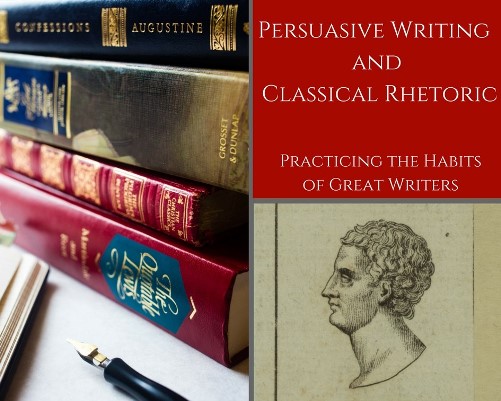
Silverdale Press: Persuasive Writing and Classical Rhetoric (Homeschool Review Crew)

Most students begin learning writing schools in elementary or middle school.  Often, they learn a basic skeleton of how to write an essay, and just keep practicing it, repeating the same frame with new topics and supporting ideas.  But while I think this is adequate for fledgling writers, students can become stuck in the process.  Some people are naturally good writers, but for some -- like Matthew -- good writing isn't an inherently strong skill.  As he enters his senior year, I feel like a clock is ticking on getting him to become a good writer.  We were happy -- ok, Mama was happy -- to be chosen to review Persuasive Writing & Classical Rhetoric: Practicing the Habits of Great Writers from Silverdale Press LLC.


Persuasive Writing & Classical Rhetoric: Practicing the Habits of Great Writers is a year-long (36 week) writing course for high school students. This digital curriculum presents iconic speeches and essays for study, where students learn not only to dissect the persuasion but have models of exemplary writing to model their own after.  This is helpful for the student who understands the basics of writing and grammar but struggles with varying sentence structure.  (Matthew is one of those types -- I've lost track of how many times I've said to him, "Ok, I understand what you're trying to say, but this is boring me.  You need to reword that, so you're not writing every sentence subject-verb-object.") I think it really helps students to see a way to get the same point across but in a more engaging manner.

What is Rhetoric, Anyway? 


"Rhetoric" is one of those words that has lost its identity over time.  In recent times, the word is tossed around to demean or dismiss an opposing and often political, viewpoint.  Like the word "ignorant" coming to be a word mis-defined in its substitution for rude, the common use of the word "rhetoric" has come to be synonymous with stereotype and euphemism, implying the speaker is entrenched in "the wrong side." However, a staple of classical education since the time of Aristotle, true rhetoric is probably one of the most eloquent of written and oratorical skills.   For all their human faults, I doubt one would accuse the writings of St. Augustine, Benjamin Franklin, or Winston Churchill, as the rantings of "idiots."

True rhetoric is the art of persuasive speech, supported by skillful discernment, study, and presentation, that logically lays out an argument.   Yes, the writer hopes that he has convinced you to see his side and agree, but rhetorical writing lays out a clear case to support his point regardless of the final outcome.  For example, included in this study is one of my favorite speeches, JFK's "We Choose to Go to the Moon" speech given at Rice University in 1962.  He begins his argument that Americans have never shied away from the difficult, asserting William Bradford stated the same back in 1630 when the Puritans first founded the Plymouth Bay Colony. Kennedy continues,   discussing the benefits of space exploration, and builds a case for the benefits to winning the Space Race.  He acknowledges that it is going to be financially costly, and seems an impossibility. However, he skillfully rallies the crowd to his side, bringing his speech to a conclusion:

Many years ago,  the great British explorer George Mallory, who was to die on Mount Everest, was asked why did he want to climb it. He said, “Because it is there.”

Well, space is there, and we’re going to climb it, and the moon and the planets are there, and new hopes for knowledge and peace are there.

Well, while it might take a fair bit of experimentation, I don't think rhetoric isn't quite as difficult as launching a "flying thermos bottle," as 3-time astronaut Walter M. Schierra, Jr. called it. 

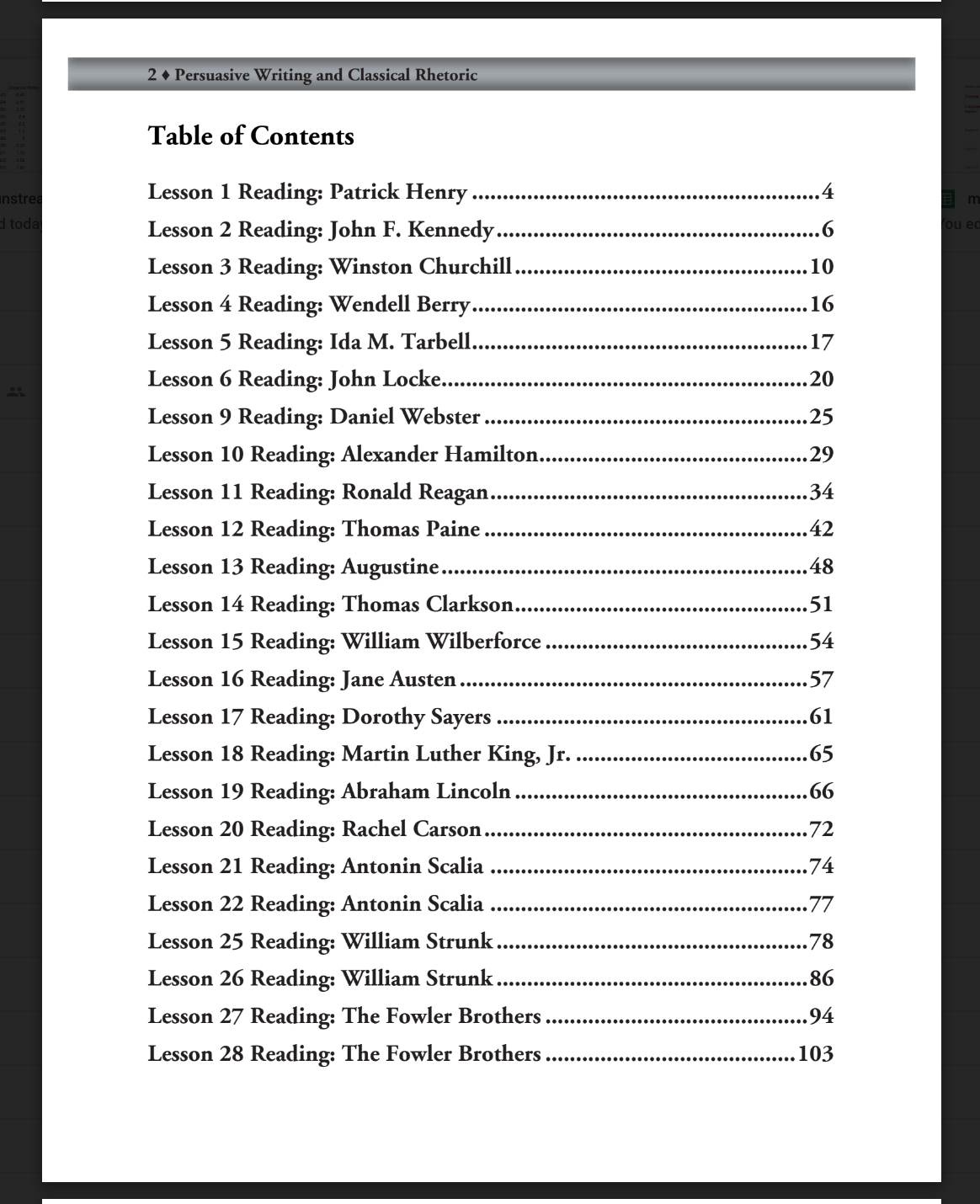
The program's Table of Contents reads like a "Who's Who" of great writers:


Every writer has a preferred writing style, but he also brings his own voice to his writings.  I like that this program includes so many sample writers! The essays chosen for study have been written by a wide variety of authors.  Some are iconic: what American student is unfamiliar with Patrick Henry's emphatic speech that ends, "Give me liberty, or give me death!"? But while other samples are from famed orators, they may be lesser known speeches: Abraham Lincoln is represented not by those proclaimed as President, but the 1854 speech he presented at Peoria.  This speech pointed out the flaws in slavery and ultimately began the path that led him to the presidency.  Seeing the variety of styles gives a student the opportunity to meld different ideas, makes his writings more authentic and persuasive.  He becomes able to develop his own voice, instead of relying on a single-model mold.

Scope and Sequence


This 36-week program introduces a new topic each week.  It is divided into sections:

  • Introduction - about Rhetoric and good writing habits
  • Invention - Researching and creating rhetorical essays
  • Arrangement - Structuring the essay
  • Style - Examining the four qualities that rhetoric must contain to be considered "good" 
  • Conclusion - The student's personal development as a writer
By the end of the program, the student should have the skills to write classically-influenced persuasive essays suitable for publication.

Implementing the Program


The curriculum consists of three  PDF "books." The first document is the Rhetoric Lesson book. This 235-page document is the textbook. Each week, the goal of the lesson is outlined, along with project assignments.

Because it is a digital program, you have the option of working paperlessly or printing only parts you need.  Our printer was the victim of a power surge just as we began this review,  so we started working with a combination of reading the PDF documents and a Google Docs file for answers.  (Google Docs is fantastic for this because it allows Matthew and I to simultaneously log into the work, to keeping both printing and email inbox clutter to a minimum.)


The program is laid out so the student can work nearly independently.  It's set on a 4-day-per-lesson cycle; we have opted to keep to one lesson/week, which gives him extra time ("Day 5") to work on his essays. The lesson plan generally follows the same weekly pattern:

Day 1:  Read the lesson text.  Define any vocabulary and answer comprehension questions about lesson contents.
Day 2:  Read the writing sample, and answer questions.
Day 3: Complete workbook exercises that help understand and use the lesson concept.
Day 4:  Write a 500-word, prompted-topic essay.

This is most definitely a writing-intensive course -- "500 words" is approximately two double-spaced pages.   The writing is the most time-intensive part of the course as well.  So far, Days 1-3 have taken Matthew about 30 minutes a day.  He has worked on each writing piece total of about three hours, including research and editing.  (This is probably at the lower end of time I would expect for this length of assignment.  Luke regularly writes 500-word essays for his college classes, and they usually take him at least double that.)  Spreading it over two days -- about two hours to research and draft, and an hour or so the next day to revise -- helps make the assignment both fit into his day better and not become so overwhelming.  I think seeing something the next day "with fresh eyes" really helps writing skills develop because the "cold" reading helps the writer see places where he needs to be more explicit or fix a spelling/grammar error that he may have glossed over before.

The reader, for Day 2, is a 111-page document, containing the sample writings. Samples range from Patrick Henry's not-quite-two-page essay Liberty or Death to Ronald Reagan's 1964 monologue entitled A Time for Choosing.    The consumable workbook is 202 pages long, but is probably the one that could most easily be used on a screen instead of printed, if you're using Google Docs like we are for entering answers.  (My kids tell me there is a way to turn a PDF into a file you can add the answers to, but I couldn't figure it out.  It was easier to just use a separate document.)

There is also a Teacher Answer Key.  YAY!!  As much as I often will skim the kids' textbooks, it's just that -- a skim. I appreciate having answers in front of me so I don't have to figure them out, or if I'm not as far in my reading as a kid is.

First, there is a clear rubric to help guide grading essays.  I like rubrics because they clearly outline expectations.  Some things do maintain subjectivity, but when you say "I'm docking this for grammar," the student sees it is an essential component and not the grader nitpicking for mistakes to sabotage his grade.

Obviously, not every answer will be in the key - there are some opinion-based answers, but it gives me a good idea of if Matthew has actually read the text, or if he's skimming, too.


Speedbumps We Hit


While we're on the subject of what do good writers do -- they read, they think, and they write. One of the exercises in the program is to compile a specific reading list of books. Matthew is still considering the last "Recommended by someone" title but has created a pretty solid reading list for himself.


I require each child to read for half an hour a day, so he now has a list of books to work through, instead of staring at the bookcase and saying "I don't know what to choose."  Because this is a writing-only program, he still needs a literature component for a full English credit, so we are taking a few of those and doing literature studies on them.  One of them, The Hound of the Baskervilles, will actually be credited towards a "Read a Sherlock Holmes book" requirement in his Forensics course.  This course has so much work that I have no qualms about counting the reading towards another class.

However, I really think the core course is worth more than a single credit.  At 36 weeks, yes, it can fit into one "school year." However, the program is really intense at this speed. Unless the student works faster in the early part of the week and condenses lessons, doing lessons x.1, x.2, and x.3 in only a day or two, it means he's writing a research essay in two days or less.  It certainly has Matthew spitting out a large quantity of writing, but I'm not sure that it's quality writing.

As I said, grammar is an essential element of writing. I have found using online grammar scorers to grade both helps me determine the level of skill mastered and avoids me seeing what I'm "supposed" to see rather than what is actually there.  However, is also an independent, algorithm-based program.  There are some things I might ignore (if a passive voice sentence makes sense, I don't have an issue with it), but generally, it helps me decide if the essay is worth reading for content or if I hand it right back to Matthew and say, "Try again." 


I think in the interest of time and being able to get all of his work done, Matthew is taking less time than he should.  Noted homeschool writing instructor Sharon Watson recommends allocating a minimum one hours' worth of work for every 100 words expected. At two or three hours total effort, Matthew is definitely not using that full expectation, and his writing shows it.  It has become more about "just get something to turn in" and less about crafting a well-written essay. 

While I believe college-prep courses should prepare students for college expectations, I think this may overshoot the expectations that should be put on a high school student.  For comparison's sake, Luke's full-semester college writing assignments have hovered at 200- to 250-word single-topic essays each week. (He is a Business Administration major, so his courses have included Marketing, Management Principles, and Business Law.)  His particularly writing-intensive, six-week session Psychology class involved one 250-word original essay each week (there were also two 150-word each responses to others' essays expected), with one 500-word essay and one five-to-seven page research paper (Luke's clocked in at exactly seven full pages containing 1,750 words.) Silverdale Press recommends Persuasive Writing and Classical Rhetoric for students as young as first-year high schoolers but quickly pulls ahead of even an accelerated pace college-level class. I'm sure there are young students out there who are able to keep up,  but I think the average or even above-average underclassman will feel overwhelmed at this pace. The content is appropriate for a 9th grader, but I think this program is better undertaken by a student who is at least at a Junior (grade 11) level.
 One reason I love homeschooling is we don't have to do 11-hour days, and trying to get the entire essay done - and still not done well - at one time puts Matthew precariously close to doing nothing in a day but schoolwork.  If I had a student who was able to keep to this curriculum's pace and completed it in a single academic year, I would definitely award an honors designation on a transcript. However, I really think it would be best completed over two years.  Due to the volume of writing, I think it could even be appropriate transcripted as "Classical Rhetorical Writing I and II"  and two earned credits.  

After I started reading through the particulars of the program, I found I really liked its scope, its essay choices, and its general organization of topics. I had intended to tuck this away to be Celia's 12th-grade writing program.  However, after seeing how much effort needs to be put in to do it well, I think starting in 11th grade would be a better plan. Alternating weeks will give her three school days to work on the texts and allow the 5-hour minimum for writing/editing to be spread across several days.  

Final Thoughts

Overall, I think this is a well-crafted writing curriculum. Rhetoric has gotten a derogatory connotation in recent times because formally presented essays, editorials, and speeches are often manipulative, rather than persuasive.  Many have lost the art of persuading others to see their side using facts and logic, and instead become appeals to one's base that entrench the opposition in their views.

However, while one may consider rhetoric and politics near-synonymous, rhetorical writing isn't a skill that can only be employed in politics!  Consider the need for an inventor to persuade venture capitalists to invest in his product.  A tradesman would employ rhetoric when pitching his company in a bid. While one might be mounting an informal solicitation, when an individual wants to raise money for a charity, just saying "I'm running for this cause, please donate!" requires a deftly handled appeal to get more than just your immediate friends to open their wallets. When paced appropriately,  Silverdale Press' Persuasive Writing and Classical Rhetoric is a good choice for upper-class high school students to learn and practice writing skills that will benefit them throughout their lives.


Some Crew families have been studying Rhetoric, while others have been studying Silverdale Press' White House Holidays Unit Studies.  To read their reviews, click the banner below.
Persuasive Writing & Classical Rhetoric: Practicing the Habits of Great Writers & White House Holidays Unit Studies {Silverdale Press LLC Reviews}


Want to keep up with all of our adventures?
Subscribe below to get Adventures with Jude delivered to your inbox.

Enter your email address:


Delivered by FeedBurner


©2012- 2018 Adventures with Jude. All rights reserved. All text, photographs, artwork, and other content may not be reproduced or transmitted in any form without the written consent of the author. http://adventureswithjude.com
Related Posts Plugin for WordPress, Blogger...
Pin It button on image hover