Showing posts with label Memoria Press. Show all posts

Friday, August 9, 2019

Memoria Press Literature (A Homeschool Review Crew Review)

Memoria Press has become a go-to company for our family.  Several years ago, I found that our family did well with their classical education model, and we have consistently returned to Memoria Press' curricula, especially for literature. After trying several literature programs, I have determined that Memoria Press programs are the most consistent performers for us; returning to a Memoria Press study feels like a homecoming.  Our family had the opportunity to work with the Seventh Grade Literature Set.  While this is available as part of Memoria Press' seventh-grade program package, the guides are available as a set and rated for students in grades six through eight.  The collection includes student and teacher guides for
The 4-volume set we received contained a Student Guide and a Teacher Guide for each book. (While the literature books are available with the individual sets, the four-title set does not include the novels.) We used this program in a unique way, assigning two books to students now (rising 7th grader Jude and rising 10th grader Celia) and saving the other two for later.

The Trojan War


Allow me a moment for a bit of background information, please. As some readers may recall, when Jude worked on the Second Grade Memoria Press literature program, he really struggled. Although the program was marketed for second graders, his skills at the time were not quite on par with Memoria Press' expectations.  I have long felt that the program's expectations are higher than average. Combined with Jude's early struggles with reading, I have intentionally used levels that are below his chronological grade level. In fact, for his sixth-grade year, we began with literature guide for A Cricket in Times Square, part of Memoria Press' fourth-grade program. To my surprise, he easily completed this study, as well as the one for Homer Price, so we skipped ahead to fifth grade's The Chronicles of Narnia. I felt that if he could manage this book, we'd move on to sixth grade; if not, we'd complete the rest of the "fifth-grade" literature. Jude proved to me that he really was beginning to mature in his thinking process, so this summer, we moved up to sixth-grade literature. There was an added benefit: while these books were still a year behind Jude's chronological grade level, they were high-interest for him. I felt this interest would be the ridge between "want to read" and "hard to read."

When offered the opportunity to try the 7th-grade package, I was a little hesitant to try anything intended for an even higher level student. However, hope springs eternal and I figured maybe the challenge would be good for him.  If worse came to worst, we could set it aside after the review period and try again later.  When the books arrived, I gave him the choice of reading any of the three options besides Anne... because I knew that set was going to Celia. As he is an avid reader of all things Greek, Roman, and Norse mythology, I was not surprised when he opted for The Trojan War


I think this was a wise decision. Jude usually does better with literature studies when the story is familiar to him. If he already has a grasp of the plotline, he can follow details better, because he's not trying to figure out too many things simultaneously.  And again, high interest became the bridge between desire and ability.
While each chapter follows the elementary school-level framework that his previous literature studies have been patterned in, The Trojan War has a lot of information to absorb.  Jude is simultaneously reading Adam of the Road and completing the 6th-grade workbook, and generally manages a chapter every other day. However, we are finding it is taking us a full week to do each chapter for The Trojan War.

However, I don't think the reason is the material is too hard. I think most of it is a battle of wills. In the past, I've never fussed if Jude's answers weren't precise when compared to the Teacher's guides. As long as I could tell that he had the main idea, I let half-sentences slide. I think part of what is slowing us down is, since he's now officially in "middle school," I am no longer letting three-word ideas pass for answers. Much to his chagrin, I'm marking his book where he only has half-answers, or poorly written thoughts, and making him go back and rework them. This then adds another day to the lesson.  He also wasn't particularly happy when I told him I expected (gasp!) actual paragraphs for answers to the Enrichment questions instead of a few sentence fragments. 

Clearly, his brain is capable, even if his willpower isn't quite as strong.

 If you are familiar with the Memoria Press Classical Studies program, then you know that students begin by studying Greek Myths in the first year of the program, and then continue on to learn about Ancient Rome and Greece. While The Trojan War is included in the literature program, it is also part of the Classics Year 4 Program.  While you might be tempted to skip it, especially if you intend to continue through and have your child study The Iliad and The Odyssey in Year 5, this retelling by Olivia Coolidge is an excellent introduction to the epic.  It provides enough details to draw the reader in, but not so much that he gets lost in the minutiae of them. I think Jude will be well prepared for studying these two epics in depth next year.

At our current rate of a chapter a week, it will take Jude a full semester to complete this guide. I'm comfortable with this pace for two reasons. First, this work sets the foundation for something he will study again, so I'd rather him understand what is going on well so that when he studies The Iliad, he will again be "adding on" rather than "starting new." Secondly, I want him to begin to have better study habits. Jude only likes change when it is his idea, so I have a feeling it is going to take some time before he realizes that he wants to make the changes.

My only complaint about the set is that the tests and quizzes are only in the Teacher's Guide. I know that some parents do not administer tests, but I find them helpful to assess what Jude is retaining as he transitions to working independently. However, doing so is not a smoothly integrated process.
First, the parent/teacher needs to plan out where the tests need to be taken; it's easy for a student to "forget" that there is one coming at the end of each part of the book.  (We found writing reminders at the bottom of the last page before a test to be helpful.  Not only did it remind Jude to ask for the test, but it also helped me factor in study/review days when writing his daily assignment sheets.)  Secondly, the copyright notes in the guide state that no part may be reproduced.  This means that I either break the rules (and with a very literal rule follower child, that's not a good plan!) so he has his own copy, or Jude is writing in a book that I would otherwise have no need to replace (plus, he has temptation in the form of the Answer Key at his fingertips!). We've compromised by him answering the questions in his literature notebook, with the Answer Key paperclipped closed.


I wish the Student Guide had the Student's tests, either interspersed or in an Appendix at the back of the workbook, or that there was a separate (reproducible or consumable) Test Booklet, and that there was a reminder/test placeholder for to help the newly independent student not to race ahead.

Anne of Green Gables


Ah, Anne-with-an-E...I think Miss Shirley is one of my favorite literary ladies. I was probably in middle school when I found my first kindred spirit (Anne), my first Book Hero (Matthew Cuthbert), and my first Book Boyfriend (Gilbert Blythe).  Anne has been on Celia's reading list for quite some time, so this was a perfect opportunity for her.  While Celia was finishing 9th grade during the review, so technically "older" than the program's intended age, she has had a literature-heavy year. I decided to substitute Anne for Henry V for the last of her 9th-grade reading.  Do I think this made it too "easy" for her? Not at all.


L. M. Montgomery may have only written books on paper, but her character's words bring them to life. I think anyone who has read any of the Anne books knows Anne's grandiose imagination supports her flair for the dramatic while providing a foil for the prosaic Matthew and Marilla Cuthbert.  In addition to Vocabulary, Comprehension, and Enrichment exercises,  each chapter explores Expressions for Discussion. These could easily be done as an oral discussion, but I asked Celia to write her interpretations of what the expressions meant.  


While some might think that the answers are obvious, making it "too easy" for a high schooler, I think L.M. Montgomery was brilliant. How many times has a parent/teacher tried to help their student learn to write "less bland, more exciting" essays? Writing exercises always talk about using more specific words, more detailed words, more descriptive words...in other words, stop saying "very"! Perhaps Anne has a tendency to be a bit over-the-top, but she's a shining example of careful word choices. Which pulls your heartstrings more, "I'm used to being disappointed," or "My life is a perfect graveyard of buried hopes"?  I think Anne of Green Gables is a book that all students should read so that they can become better writers!  I love how Memoria Press chooses to really dig into the expressions in the book - rather than selecting a quote or two, there are as many as seven or eight to explore. The program does full justice to the book by really allowing Anne (and the Avonlea residents) to have their say.

Classics become classics because they are enduring, but it would be easy for a book published in 1908 and set in the late 1800s, to contain archaic vocabulary.  I can remember doing vocabulary studies myself and wondering, "When am I ever going to use these words?" However, Memoria Press has focused on words that remain pertinent today. 


Comprehension questions include both literal "what happened here" and critical("What did Anne mean...") queries.  In addition to studying the book itself, the program provides writing opportunities for literary interpretation, opinion/persuasive writing, and exploring Anne's interests (Shakespeare) and tribulations (geometry as compared to Waterloo).  


While Memoria Press offers the literature books for sale, the literature sets do not include them. While some of their studies do require specific editions of books, we found this was not the case with this program.  Last Christmas, Celia received a box set of the Anne series and used the edition that was included.  In this case, page numbers did not need to match, as the program is sectioned by book chapter.

Celia has been working at a rate of a chapter every other day.  On Day 1, she does vocabulary, reading, and the expressions for discussion; on Day 2, she finishes the comprehension questions and completes the enrichment. It could easily be done at a slower pace (one workbook section a day over the course of a week), but I'm hesitant to recommend doing a full chapter a day.  It is possible if your child is a fast reader, but it would take close to 90 minutes a day just for literature.  I have done this with Memoria Press literature when we are in a time crunch (trying to get to a logical stopping point before an extended vacation, or when Luke or Matthew was trying to finish a study guide in the countdown to graduation), but it's not necessarily sustainable long term.  At a rate of 5 chapters per week plus review sections and two exams (also only available in the Teacher's Guide), it will take about 8 weeks, or one academic quarter, to finish the book.  I think that's reasonable for a high school student. 

The Hobbit and The Bronze Bow

When my students were younger, I was more focused on the "grade level" of the program.  Now that we have entered into the middle and high school years, I've learned to focus less on the grade a program is assigned to and more on its content, because middle school books begin to be less about a numbered grade level and more about the individual's literacy level and abilities. Knowing that Jude likes to binge on book series, I will likely keep The Hobbit set aside for another year or two until he is ready for the entire The Lord of the Rings series. Like Anne, I think this is a book that transcends grade level.   I think 7th grade is about the youngest age that a student can truly wring all the finer points out of it, but there is no point where a student "ages out" for exploring the book.  The Bronze Bow is set in 1st Century Israel, so it could be studied as part of the "pre-set" 7th-grade program, or it could be moved to 9th grade and part of an Ancient/World History program. While the lower grade programs involve exposure to literary concepts, the study guides at this level of the program use that familiar framework to explore and apply those ideas to the corresponding novels. I think the studies at the middle school level have the flexibility to help prepare a middle schooler for high school expectations as well as provide a relaxed but not too simple study for secondary level students. Once again, Memoria Press has proven why it has become my favorite literature program.


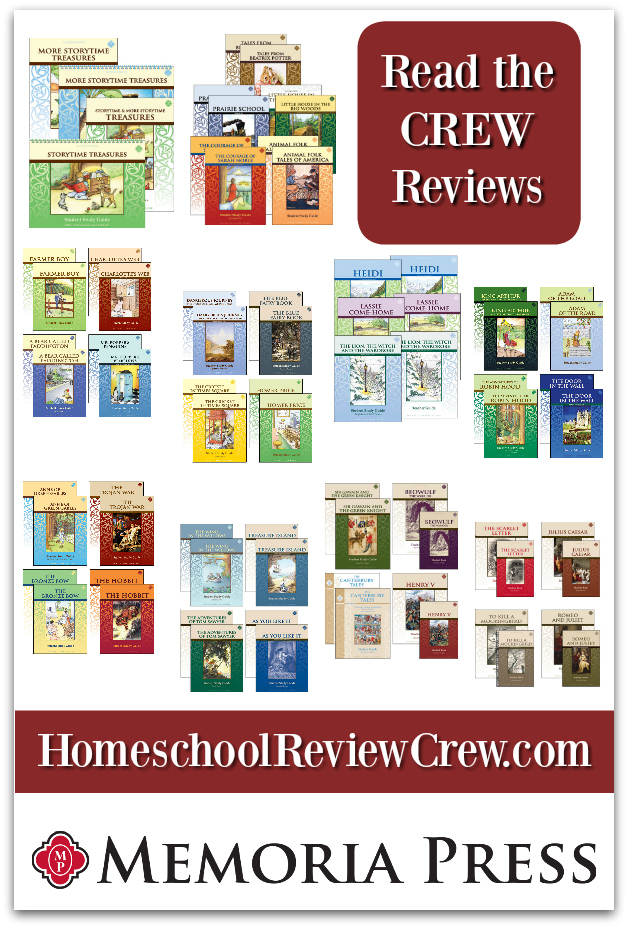
Crew families with students from first through tenth grades have been reading with Memoria Press. Click the banner below to read their reviews of the books they've been studying!   You can also learn about other Memoria Press programs we have worked with by clicking the links to those reviews.

Memoria Press:

First to Tenth Grade Literature Guides {Memoria Press Reviews}


 Crew Disclaimer

Want to keep up with all of our adventures?
Subscribe below to get Adventures with Jude delivered to your inbox.

Enter your email address:


Delivered by FeedBurner


©2012- 2018 Adventures with Jude. All rights reserved. All text, photographs, artwork, and other content may not be reproduced or transmitted in any form without the written consent of the author. http://adventureswithjude.com

Thursday, June 7, 2018

Memoria Press: Traditional Logic (Homeschool Review Crew)

Memoria Press has become a go-to favorite for us; as time has gone on, I've come to appreciate the Classical approach to education. We have done several reviews with them in the past, as well as purchased many of their curriculum programs.   This time, we had the opportunity to study their Traditional Logic I and II programs. Even though we would only have time to actually study with one program, Memoria Press generously sent us both semesters' curriculum, Traditional Logic I Complete Set and Traditional Logic II Complete Set, to review. Each contains a Textbook, Student Workbook, Quizzes and Tests, Teacher's Key (with answers to both the workbook and the quizzes/tests), and instructional DVDs. The program was written and presented by Martin Cothran.

Mr. Cothran has compiled an impressive curriculum vitae in the classical field. He holds a B.A. in Philosophy and Economics from the University of California at Santa Barbara and an M.A. in Christian Apologetics from the Simon Greenleaf School (Trinity University).  Currently, he is the director of the Classical Latin School Association and editor of Memoria Press' quarterly Classical Teacher magazine.  Mr. Cothran was a Latin, Logic, and Rhetoric Instructor at Highlands Latin School in Louisville, Kentucky (also part of the Memoria Press family of educational opportunities).  Local (Cincinnati Enquirer, Louisville Courier-Journal, and The Lexington Herald Leader)  and National (New York Times, USA Today) outlets have published his writings on current issues, and he has appeared on nearly all major US national television networks.  This program is presented by an educator who is both well-versed and well-respected in his field.


This is a program intended for advanced middle schoolers (grades 7-8) or high school students.  (Memoria Press places it in their 9th-grade curriculum package.) This is meant to be a two-semester program (one high school credit) program.  While it is a language-based program, I don't intend to count it under "language arts" on either child's transcripts and plan to mark it as a humanities elective credit instead. Regardless of which high school year it is completed in, this program will nicely fill that "fourth-year social studies" space.


Matthew recently completed a Logic and Critical Thinking course that I pieced together from various resources, so my original plan was for him to work on the program for the review period, and then pass it on to Celia. Since the Student Workbooks are single-student consumables, I'd purchase a new Logic I workbook, and continue with the unused Logic II books. Much to Matthew's chagrin, I'm changing the rules.  He's now going to complete both semesters' courses, and his sister is getting her own set of student books.

Why?  Well, I could say "Because I'm Mom, that's why," but that wouldn't be a constructive review, would it? After the first few lessons, I have realized that this Logic course is different from what he has already done.

About Traditional, Formal Logic


Those critical thinking courses were based on modern, material logic that taught him to evaluate arguments based on math, science, and truths provable by independent confirmation.  Think of it as making your arguments "fact-checker proof," or being the fact-checker seeking the flaws in another's argument. Traditional Logic is completely different and based on Aristotelian logic. I think the best way to describe the difference is to share this comparison from the article "Zombie Logic" by  Mr. Cothran:

Traditional logic is not a calculus by which we can “solve” for the truth. Modern logic speaks the language of the computer, which was created by men; traditional logic speaks the language of men, who were created by God. While modern logic is how computers think, traditional logic is how human beings think. We are not computational beings and our language is not some kind of mathematical calculus. When we think and speak and write, we do it not as human machines, but as logocentric (language-centered) creatures. 

Aristotelian logic does not seek confirmation from outside truths, but rather uses deductive reasoning to create arguments where there is no choice but for a statement to follow itself to a truthful conclusion. To quote Mr. Cothran again, this time from his article Thinking Logically About Logic"It is not the purpose of formal logic to discover truth. That is the business of everyday observation and, in certain more formal circumstances, empirical science. Logic serves only to lead us from one truth to another."

Formal logic goes back to the foundation, or form, of creating an argument.  It's not "formal" in the sense of "fancy" vs. not, but "form" as defined by construction or appearance.  Traditional Logic I builds to the creation of syllogisms, the concept of "If A is B, and B is C, then A is also C." The course includes the Porphyrian Tree, the four logical statements, how they can be opposites or equivalent, and the seven rules for statement validity. Traditional Logic II builds upon the basic syllogism, introducing complex and oblique syllogisms and hypothetical reasoning.  Here, the student begins to build logical arguments. Early examples are theological and philosophical, but later arguments are more "relevant to current events," touching on political and social themes.

The Traditional Logic program


The program is easy to use.  The program was designed originally to be used in a "cottage school" format, where students met for in-person instruction one day and completed the rest of the work at home.  On the first day of the Traditional Logic class' school week, there would be a teacher presentation.  Here, this presentation, with instruction by Martin Cothran, is provided by a DVD video. Each lecture is about twenty minutes long.


Both sets of videos are professionally recorded.  I can't tell you how much I appreciate this.  We have had some programs where the videos are just of such poor production quality that it ruins the program; no matter how good the content  The sound is clear and crisp, Mr. Cothran's voice is well modulated, and the in-lecture slides are well-presented.  So far in Traditional Logic I, there has only been one thing that has been difficult for us to understand, and that may have been because we are using a small portable DVD player to watch the lectures.  If you were using a larger screen (a computer monitor or TV), it may not be an issue.

Instead of a split screen, Traditional Logic II makes the slides full screen. It has edited the presentations to alternate between Mr. Cothran visage and the slides. The slides have significantly more written content, so I think this is a wise choice.


The programs also have different visual appearances. The books in the first part of the Traditional Logic program are predominantly blue; the text has a blue cover and the other books and the DVDs labeled with blue font.  The books for latter half of the course have red as their dominant color.  I appreciate this because it makes it easier to tell at a glance which books go together.  The slides as well are different colors; even though the first semester books and second-semester slides are both blue, I don't think these have any bearing on identification.

One thing that was a slight bother was the text and workbook pages referred to in the video were not the same place where the materials were in our books. For example, Chapter 2, Day 3's workbook sections began on page 15, not page 21 as indicated.  It is something I mention because we had a "Wait, where is he saying?" if we tried to open to the page, but Mr. Cothran is very clear about what material he is referring to.  We just stick a pencil or a post-it note at the beginning of the chapter as we start the DVD.


(Based on the copyright dates, the DVDs are from 2003, while the Workbook is a Second Edition, copyright 2016 and the text is a 3rd edition, copyright 2017.  Traditional Logic II has a similar incongruency, with 2005, 2nd Ed/2017, 2nd Ed/2017, respectively.  The videos account for their anticipated longevity in discussions.)

The "bookwork" days are numbered One through Four.  Day One expects the student to quickly skim the entire textbook chapter - four to eight pages, including graphics, and then return to the beginning to carefully read the Introduction section.  Days Two through Five involve going back to read other specific sections of the chapter more carefully, and then answer accompanying questions in the student workbook.  These days take him about the same amount of time.


Daily work in Traditional Logic I is brief yet comprehensive and mastery-based. Traditional Logic II adds on weekly writing assignments.  The program acknowledges this imbalance, and suggests beginning the second program before the end of the first "calendar" semester; if this is impossible, it also suggests sections that can be skipped without losing any overall quality from the course. I think that if time was an issue, one could comfortably do the first semester at two lessons per week without it becoming overly time-consuming and displacing the rest of the day's work.  In the second semester, Case Studies for each chapter and a Weekly Analysis writing assignment are added to the workload.


Celia is new to homeschooling this year, so we're still figuring out what sort of schedule works best for her.  I might consider keeping the same timetable, with the Analysis being assigned on Monday and due on Friday, allowing her to figure out how to spread the work out.  Matthew, however, tends to have a more "out of sight, out of mind" mentality.  Traditional Logic II might be better planned with doing the video plus Day 1's workbook on Monday, Exercises for Days 2 and 3 on Tuesday, Day 4 and the Case Study on Wednesday, and then leaving Thursday and Friday to complete the Weekly Analysis Assignment. It does increase the daily workload, but it gives him clear beginning and ending points for his daily tasks.  As a 9th grader, if she takes longer, I'm not as concerned, but if Matthew wants to finish 12th grade on time, he will have to stick to a firmer schedule.

Once again, Memoria Press has filled a need we didn't think we had.  Critical thinking skills are, sadly, a skill that many lack in today's society.  This is a credit-worth program I would recommend to all homeschooling high schoolers, and I would even suggest that non-homeschoolers consider it as well.   I intend for Celia to do a similar "modern logic" program like Matthew did (instead of repeating his program, I have my eye on Memoria Press' Material Logic: A Course in How to Think,  also written by Martin Cothran) but I think having this traditional, formal program first will help her develop her reasoning skills better.  (I'm not sure if arming a teen girl with better-crafted arguments is a good thing or not, but it will serve her well into adulthood, right?) Despite going "backward" in presentation, I can see where this will still help Matthew craft better arguments going forward; when your truths follow logically, there is less opportunity for gaps for the "other side" to refute.  The first semester sets a foundation, and the second applies this knowledge to practical situations, making this nearly 2400-year-old thought process very contemporary.

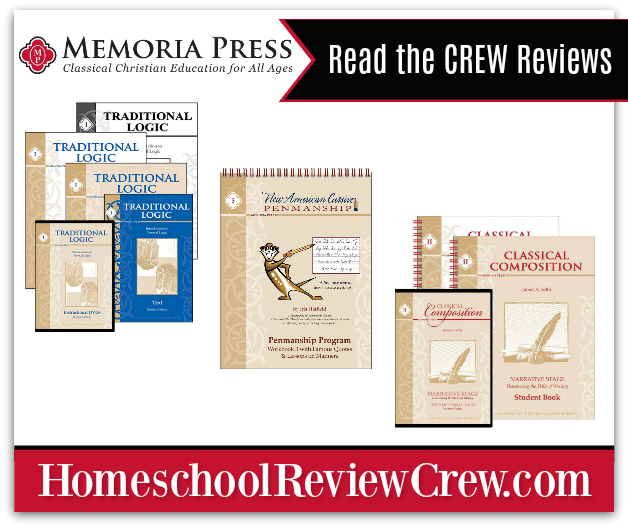
Click the links below to read our past reviews of other Memoria Press curricula.  For this round of reviews, in addition to Traditional Logic,  Crew families have been studying Composition and Penmanship with Memoria Press. Click the banner below to read their reviews.

First Start Reading
Second Grade Literature
The Iliad and The Odyssey
Prima Latina


New American Cursive & Traditional Logic {Memoria Press Reviews}


Want to keep up with all of our adventures?
Subscribe below to get Adventures with Jude delivered to your inbox.

Enter your email address:


Delivered by FeedBurner


©2012- 2017 Adventures with Jude. All rights reserved. All text, photographs, artwork, and other content may not be reproduced or transmitted in any form without the written consent of the author. http://adventureswithjude.com

Wednesday, June 7, 2017

Memoria Press: Prima Latina (Homeschool Review Crew)

Jude has wanted to learn a foreign language for a few years now.  We tried French, but it was impossible for him. The biggest issue was that it's definitely not a phonetic language. There were too many "can't-sound-out" letter combinations that it left him frustrated and dejected. After watching Matthew study Latin, both he and Damien thought that might be interesting.  After all, if it was good enough for big brother, then why not them? Prima Latina is Memoria Press' absolute entry-level Latin course. It's geared for students in first through fourth grade, which made it not-too-hard for Damien (he's just finishing first grade) but also not too simple or babyish for finishing-fourth-grade Jude.   We received a Prima Latina Complete Set to review, which includes a consumable spiral-bound Student Book, a Teacher Manual,  DVD instruction, and an audio CD of Latin hymns.  The set also contains a set of Latina Christiana I flashcards.


(Note: though most of the items can be used for multiple students either simultaneously or sequentially, the Complete Set contains only one Student Book.  So that the boys could work together,  I purchased a second Student Book for Damien.)

Why learn Latin? Isn't it a "dead" language? Well, for starters, it's a phonetic language, and both the sounds and alphabet are very close to what the boys are used to.  There are a few changes, but it wasn't a "learn a whole new way of speaking" thing.  Most of the time, it's them needing to be aware of the differences between English and Latin vowels (where "e" makes an "ay" sound, rather than "eh").  There are a few different consonant sounds, but again, it's more a matter of being mindful than having to learn a whole new phonemic grouping.   Jude sometimes struggles to recreate sounds that he hears; often he doesn't process the sound correctly, and what goes in isn't always what comes back out.   Leigh Lowe, the magistra teaching from the DVD, speaks carefully and enunciates sounds slowly and thoroughly, making it easy for him to process.  However, be aware that she does have a very pronounced US South accent. Damien, who has always had a good ear for accents, now also speaks Latin with a bit of a twang.


Each lesson is between 15 and 20 minutes long, which is a perfect time for this age/level. It's long enough that the boys feel they've actually learned something by the end, but it doesn't go on for so long that it becomes overwhelming.   There are four pages within the student workbook for each lesson: two are "follow along" pages for the video, and then two are practice pages to be completed after the lesson is completed.

Memoria Press is a classical-style curriculum, and I have become very impressed with how well the boys have done with this style of learning. Structured lessons and repetition seem to work well for them, and Prima Latina follows a very set routine.

After the first lesson (where students are taught a simple greeting), each lesson begins with "Salvete!" or "Hello!" and ends with "Valete!" (Goodbye!).  Following the greeting are words to create simple phrases (Salve, Magistra -- "Hello, Teacher!", etc.). As lessons go on, there is an interactive section, where Mrs. Lowe will greet her class with "Salvete, discipuli!" and then she pauses for the students to reply "Salve, Magistra!"  Jude prefers to compartmentalize his schoolwork for during school, while Damien now greets even the checkout clerk with a cheerful "Salve!" Neal and I went out to dinner one night, and he waved us off with, "Vale, magister! Vale, magistra! Valete, parents!"


Next comes a brief review of what was taught in the prior lesson(s). This is a hallmark of a classical education - revisiting and repeating until you can't help but have it all in your head.  (It's not unlike being able to sing a pop song from your high school days after twenty years have passed -- you've heard and repeated it so often that it's just permanently etched into your brain.)  The repetition of key things helps a student remember them long after they first learned them.


The new material starts with a short grammar lesson.  I think that while this program is listed for students as young as first grade, I think waiting until Damien was closer to a grade-two level has helped.  I think having had a year of English grammar has helped him understand when learning verbs; to learn both the vocabulary and grammar simultaneously might be a bit overwhelming. He's very clear on what is a verb vs. what is a noun, etc., so when Mrs. Lowe talks about "invisible" verbs, he understands the difference between types of verbs rather than still trying to figure out that a verb is an action word. As we get further into grammar, I think having a good foundation of English grammar will help the boys not feel so overwhelmed as they are expected to understand more of Latin's conventions.

Next, new vocabulary words are introduced.  There are five words in each lesson.  This section of the lesson focuses on learning the Latin and English words, and then the English derivatives that a student might know.


Here is my second reason for opting for Latin over a language like Spanish, which is also phonetically spoken. Latin is the base for a large number of English words.  Prima Latina shows this from the very beginning of the program.  Mrs. Lowe leads the students in discovering these words, and finding their Latin roots within them.

 I have very few overall complaints with this program, but I want to point out that there may be a few derivatives that aren't pre-printed in the book. In theory, this isn't a big deal; you can see we just added them to the list. However, if you have a student who thrives on routine and everything being just so...well, be prepared for moments of slight panic and re-focusing.


I also wish the derivatives were not printed after the Prayers.  Again, for students who like to follow things in order, having to jump over the Prayer for the derivatives was another "Oh no!" moment.  After a few lessons, the boys usually relaxed, knowing they weren't missing anything, but every time they remind each other "Don't forget, we'll go back!"

The final section of each lesson is the Prayer. Each lesson, a new line was introduced, allowing the student to learn a line and practice with it between lessons before adding the next, rather than feeling overwhelmed by a huge amount of memorization all at one time.  I was definitely impressed by their skills!  They've since learned the remaining lines of the Sanctus, but I'm impressed at how much they had memorized and how good their pronunciation was only about three weeks into the course.


The next two workbook pages are completed without the video.  They provide a short review of prior lessons and practice with the current words.

I admit, we haven't had much use for the flashcards yet.  They do contain Prima Latina words, but the set contains far more than is in the program. It's actually part of the Latina Christiana set, and the Prima Latina words are mixed in, meaning I'd have to sort through the entire pack to find "this week's" words.  I'm also not a huge fan of pre-printed flashcards.  I think for cards to be effective, there needs to be some sort of student involvement, and studies show how the tactile input of writing something helps cement it to memory.  For lesson reviews, each boy is probably going to be making his own study cards.  The Prima Latina CD is an additional resource for the new student.  On this disc are a pronunciation guide, Latin hymns, and prayers. While you don't use it during the lessons themselves (at least as far as we have gotten), it does provide added support for the student, and the hymns are beautifully sung.  (They remind me of attending High Masses, where the Latin was the vernacular.)

I'm pleasantly surprised and impressed with Prima Latina.  When Luke first wanted to learn Latin a few years ago,  I purchased the First Form Latin set, and it just didn't seem to click.  We went on to use a different program, which Matthew later used as well.  I admit that after the French disaster, I was a little gun-shy.  However, I think this has been the perfect pace for the little boys -- and maybe even a good review for Matthew.  I've noticed him listening in as well from time to time.  We had a quiz-bowl style vocabulary study session recently, and there were a few times where Matthew couldn't resist chiming in.  (I think I've hit on a way to get Jude to focus. He was struggling to remember when I was quizzing him from the list, but as soon as I pulled out a bag of pennies to use as point chips, he suddenly was remembering things at lightning speed, including random words from in the middle of the Sanctus!) Often when we review products, the boys' interest fades over time, but they are still as excited now as they were when we started a few months ago.  This is a program we are planning to continue with until the end, and maybe into the next levels!

In addition to Prima Latina, crew families were also working with:
Latina Christiana
First Form Latin
Second Form Latin
Third Form Latin
Fourth Form Latin
The Book of Trees
Nature's Beautiful Order

Click the banner below to read their reviews.


Latin, Nature and Trees {Memoria Press Reviews}


©2012- 2016 Adventures with Jude. All rights reserved. All text, photographs, artwork, and other content may not be reproduced or transmitted in any form without the written consent of the author. http://adventureswithjude.com

Tuesday, April 4, 2017

Memoria Press: The Iliad & The Odyssey (Homeschool Review Crew)


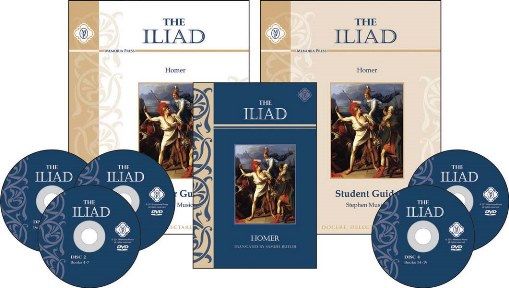
Back when we withdrew Matthew from private school, if you had asked me, "How does your kid learn?" I'd have said, "I have no clue, but I can say that whatever he's doing in school isn't working."  I think we've tried nearly every "method" out there in the last three years. It seems that video-based vs. read-the-textbook presentations have been better for him, but when it comes to literature, there's really not a way to get around reading the book.  After a lot of trial and error, we've found that Jude has really taken to a classical style of learning; he responds well to the structure and pattern of the style. Memoria Press has become a favorite of ours for literature studies, and we were given the opportunity for Matthew to work with their Iliad and Odyssey Complete Set.  This package contains a copy of the literary work as translated by Samuel Butler, a Student Guide, a Teacher's Guide, and a DVD lecture series set for each work.  I decided it was worth trying. With luck, it would turn into a credit-worthy literature study; at worst, we'd know that this style wasn't for him.  Our plan was to begin with The Iliad and then eventually move on to The Odyssey if the first program worked for him.  I skimmed ahead to be able to review the series, but in the interest of him keeping plots straight, he stuck to one program.


I suppose since he and Jude are very much alike, I shouldn't be too surprised by how well he's taken to Memoria's style,  but since literature studies have been a nightmare for him, I wasn't sure how well it would go. This particular program combines the literary work, a Student Guide workbook, and a video lecture that helps explain the highlights, lowlights, and important points of the story.   Memoria Press recommends this program for students in grades 7 through 12; I think most students, especially older high schoolers,  could do this study with minimal parent assistance.  However, although Matthew is in 10th grade, he isn't "most" students.  He has pretty severe ADHD and needs very frequent redirection.  I've sat with him to work on this, partly because it was a review program, but mostly because I wanted to make sure he was fully engaged in the lessons.  He has done well with the routine and structure, but still sometimes needs guidance staying on task.

The Iliad (and The Odyssey) is divided into "books" rather than chapters.  Instructor Sean Brooks explains during one of the videos that this is because the original epic was not divided into chapters, but was too long for a single scroll.  The story was broken into what fit on each scroll, with each scroll being called a "Book." Memoria Press uses a translation by Samuel Butler, and each Book is about 15 to 25 pages.  For Matthew, that's a lot of reading at any one time.


When we first started reading, based on his answers in the Student Guide, he obviously was merely flipping pages and not absorbing anything.  I know Jude and Damien understand books more readily if they are read aloud. When I need to be sure that they are actually reading and not skimming, I make them read aloud, but sometimes it's better if I read aloud because then they can focus on the content and less on the decoding.  We began reading out loud, taking turns with pages, until I realized his reading skills are not what I believed they were.  I began doing all the reading so he could focus on content.  After three books of reading aloud, he started reading on his own, because he wanted to know what happened next and he was tired of waiting for me.  (He works independently earlier in the day, while I'm helping the younger boys, and then we tend to work later in the afternoon or into the evenings.)  I think once he got into the story, he realized he was beginning to enjoy it.  Based on the answers to his questions and discussing the book with him, it's clear that he's reading for content, not just to say "Yeah, I read it," and has barely skimmed the text, and he's retaining what he has read.  We've continued working together with the DVD lecture, but, after reading aloud from three or four books each day for the younger boys, my voice appreciates being able for each of us to read quietly.  I  must admit, though, after the first few books, I'm eager to find out what happens next.

I think the video has made a real difference for Matthew in what he's been able to understand. The lecture series is divided by the corresponding books, and each one runs about 30 to 45 minutes.  It usually takes us closer to twice that to work through a video, because he's often stopping to take notes (he can't write and catch the next bit of information), or stopping to underline key passages in his book.  Mr. Brooks does a thorough job of explaining the story, helping to clarify not just the "what's going on," but the why and the back stories of the culture. As Matthew takes notes and highlights passages, it's definitely helpful that he isn't jumping back and forth with ideas.


Additionally, there are pen-and-ink drawings interspersed through the book.  Often when discussing a passage, a nearby illustration appears on the video screen.  Matthew and I both appreciate this because it helps give a visual cue of where in the book the discussion is focused.  Matthew isn't wasting time trying to figure out where in the story the discussion is, and then trying to go back and forth between book and video.


Rather than leaving Matthew to try to figure out everything from context clues, it has been a benefit for him to have a teacher pointing out key ideas, passages, events, etc.  I think the video lectures have made a big difference in how he has learned to like the story.  He's been working on another Memoria Press literature study (Poetry and Short Stories: American Literature) and asked me if there was a video to go with it.  I wish there were!  I definitely notice a difference in his ability to connect ideas - once he has been given one concept from the lecture, he has been able to find that repeats of it relatively easily, because he understands how Homer presents that idea.  Even though he wishes there was a video guide for that study, he has gotten better because he's gained confidence in his ability to discern ideas from the text.  He's starting to pick up ideas from The Iliad, and when they are confirmed in the video, he visibly puffs up that he got it.  I think it's allowing him to let himself try with the other study -- he doesn't feel like he's completely inept.

The Student Guide workbook contains a lot of guidance for learning beyond the questions.  Principal characters in that specific book, specific quotes, and both comprehension and discussion questions are part of each section.  Also, Appendix tables containing summaries of main characters, military vocabulary, etc. help the student understand the players in the story.  As a parent/teacher, I appreciate the way the Teacher's Guide is arranged.


It mirrors the Student Guide, so there's no flipping around looking for corresponding pages.  There are notes to help guide discussions with the students, but also to help the students prepare for the included quizzes and exams.  I think if you have a student that remembers lots of information and can sort through it easily when presented with an exam, then just reading/studying the Student Guide is sufficient. However, Matthew definitely needs help focusing. Knowing that there were ten characters in a book but only four that he'd have to know exactly who they are for the test helped him not be so overwhelmed.  I appreciate being able to check his answers for each portion, and then saying, "Ok, now make your index cards, using question numbers 1, 4, and 9, and the characters <name, name, and name>.  It makes studying for the cumulative tests (answer keys provided, thank you!) less overwhelming for him.


I've been allotting about five school days for each book.  On Day 1 and/or 2, Matthew reads the assigned book.  On Day 2, we watch the DVD and take notes/highlight passages in the book.  On Day 3, he does the accompanying questions in the student guide, which we review on Day 4.  He then works on creating a study guide for characters, questions, and quotations that are pertinent to upcoming quizzes and tests.   Day 5 has become a "what's left?" day; sometimes he's working on finishing the workbook/notecards; sometimes it has become a test/quiz/write essays day.  If he's managed to get things done a little faster, he gets a day off.  (There's motivation, eh?)  In all, we spend about 5-6 hours on each book.

In the interest of keeping his brain from exploding, we opted to do one work at a time.  Therefore, since he hasn't gotten to working on The Odyssey, I read a little of the book, looked through the guides, and watched a few of the videos.  I'm really looking forward to when we get to this one. The guides and videos repeat the same patterns/content as those for The Iliad.


Although the set is "only" two literary works, between the material presented and the time/effort involved, I'm comfortable considering this set equivalent to a full literature credit for Matthew. Since he hs already nearly completed his 10th-grade literature course, I'm planning on continuing on with the curriculum and crediting it as Grade 11 literature. Having worked through the program for several weeks now, I really think that this particular program is better suited to high school students.  After running several sections of the text through an online scorer, it averages to an 11th-grade reading level.


While I think a younger student could manage the program, I think that just reading this particular translation/text with an average middle school/junior high student could be overwhelming.  Celia is in 7th grade, and while she's an above-average reader, she's definitely not anywhere near ready for this!  If she chooses to be homeschooled for high school, I would definitely consider this again for her as a sophomore or junior literature course, but I certainly wouldn't choose it for right now. The student workbooks are consumable, so to re-use this set with her, I'd need to purchase at least those items.  We'd also need to buy another copy of The Iliad (and presumably, The Odyssey) since Matthew marked this one up with his notes.  This isn't too much of a re-investment; the complete set costs $135, and re-purchasing the student's books needed would run about $48 for both.

I know, $135 seems kind of steep, compared to the cost of just the books, but honestly, I really think the videos are crucial.  I think these make the difference in the program from being "just another read the book" study.  They definitely have helped Matthew, but I've even found them helpful for me personally. While I know the basic stories of The Iliad (and The Odyssey) from "picture-book-ized" retellings, I can't say I've ever said to myself, "Hey, why don't you sit down and read the full stories for fun?" The books are at times overwhelming, and Mr. Brooks even admits when there is something coming up that is going to be a bit of a chore to read.  I think after Book II I'd have given up.  However, the content of the lectures has really made them seem more accessible and enjoyable. These epics were originally meant to be recited as part of Greek history so there would be an understanding of glory, honor, and the role of the Greek gods.  I think it's probably akin to the different between reading a Shakespearean play and seeing it on stage - it just is so much more understandable when it's not just words on a page.  I wish Memoria Press had more studies like this!

It's been interesting working with Matthew; upon learning about Achilles' weak spot, he remarked, "So...you can shoot him in the head or chest, and he's fine, but if he steps on a Lego, he's done."  Having stepped on a few Legos in my day, I could only laugh and (mostly) agree.  I asked Matthew what did he think of the program, and he said, "Pretty good."  Thanks, kid...could you give me a few more words?  He decided on, "I like it because the DVDs give me more depth on the Greek history.  All I remember from history is the Trojan horse, so I kind of like learning about what happened before the horse invaded.  I like that it tells me what's going to be on the tests, so I know what to study.  I don't mind learning about other stuff, because it's important, but it's a lot to remember, so it's good to know what's super important and what's normal important.  I think the instructor's pretty funny, too.  He's not boring, and I feel like he really likes what he's talking about."   I think we've finally found at least one program that will count for 11th grade that won't lead to tears on either part. I call that a win.


Crew members have been exploring three programs from Memoria Press: The Iliad and Odyssey (Complete Set),  First Form Greek (Complete Set), and The Story of the Thirteen Colonies and the Great Republic Complete Set/200 Questions About American History Set.  To read reviews of these, click the banner below.

First Form Greek, Iliad/Odyssey and American History {Memoria Press Reviews}


©2012- 2016 Adventures with Jude. All rights reserved. All text, photographs, artwork, and other content may not be reproduced or transmitted in any form without the written consent of the author. http://adventureswithjude.com

Thursday, April 16, 2015

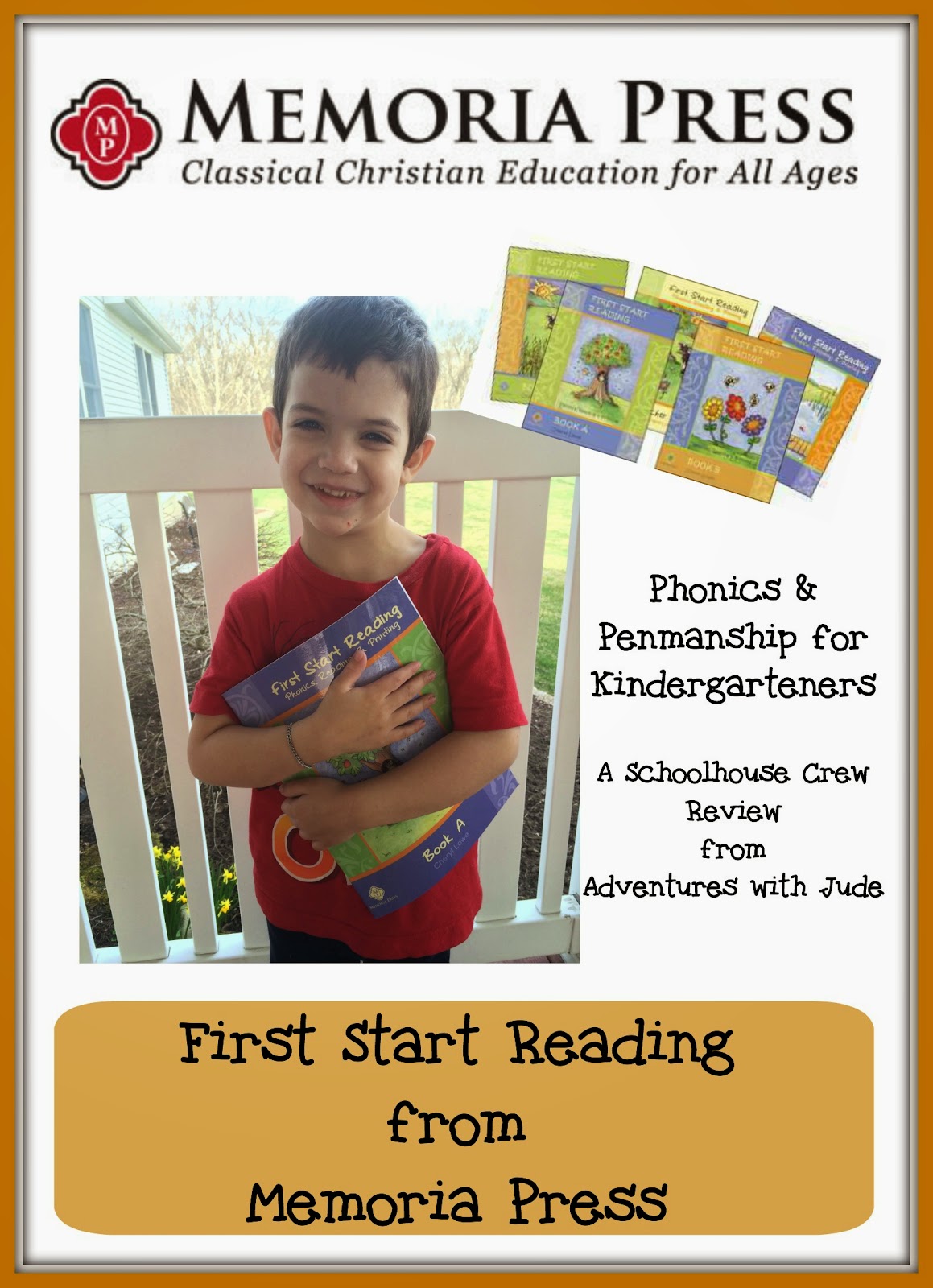
First Start Reading from Memoria Press (A Schoolhouse Crew Review)


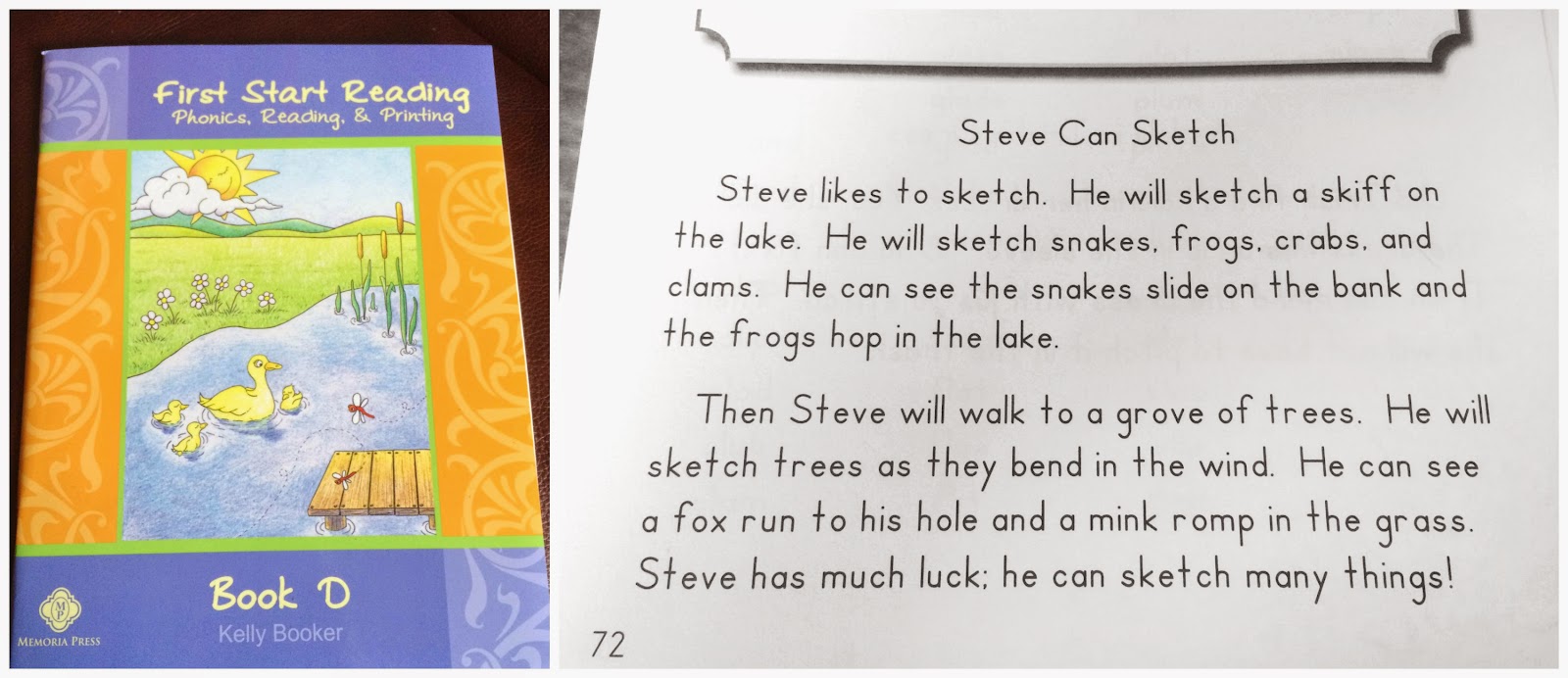
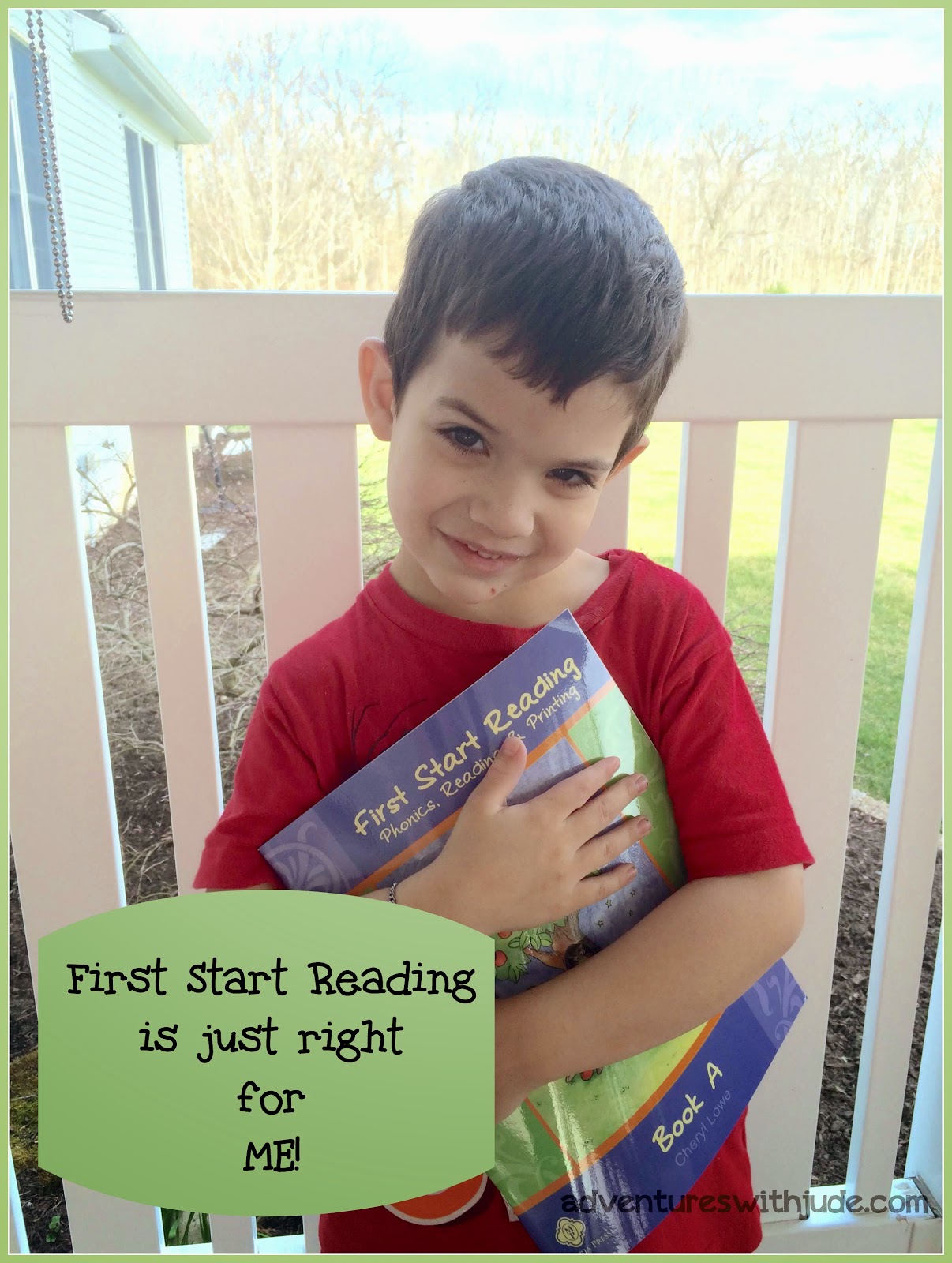
Jude is plodding along reading, and Damien is showing signs of being ready to start something more sophisticated than Super Why! videos.  When the Crew gave us the chance to review the complete  First Start Reading  program from Memoria Press, I thought it would be perfect for us.  Since we would receive the Teacher Guide and and one complete set of student books A-D, I thought Damien could start at the beginning, and Jude in the middle.

Memoria Press is well known for their classical-style homeschooling programs.  This curriculum teaches:
  • consonants
  • short and long vowels
  • 45 common words
  • manuscript writing (printing)
Though Jude's penmanship skills are actually pretty good (copywork is a staple here), I really thought reading-wise that he'd be ready for Book D, given all he had been "taught" were short vowel sounds.  (Book D adds long vowels, diagraphs and common blends into learning to read.)    I glanced through the very introductory Book A, just to see what it was like, before handing Jude Book B.  I was sure this was below his level, but I wanted to just take the five minutes to be certain he didn't have any holes in what he knew, plus I wanted to give him the confidence of "I'm too smart for that book." Apparently, he's picked up enough other rules and patterns in reading/being read to that he just started and kept on going!  The books also contain a total of 31 short stories to practice reading skills.  He read a few passages and then the final passage easily, so I handed over Book C...and then D...and then asked him to read the final passage.  When he read that with reasonable ease for a cold reading, Neal and I looked at each other in amazement. 


While he's figured out all of the sounds in Book D on his own, it put Jude in a really awkward spot with several of the other programs that we have.  I'm not certain where he actually is, but basing placement from "knows everything in Book D" is very difficult with all of the programs we do have.   I'm not overly familiar with the rest of Memoria Press' offerings, but at a quick glance, it looks like Memoria Press' first grade complete curriculum includes phonics work that would build on what is learned in Kindergarten level First Start Reading.  However, since we are not doing a complete packaged curriculum with Jude because of his skill range, I found it a bit awkward to transition to higher levels of the other programs we already have.

So...my first bit of advice is if you're a brand-new-to-phonics student, this is a good choice. Lucky Damien now gets the entire program to himself!


I like the simplicity of the program.  The teacher’s manual and student books (along with pencils and crayons) are all that you need -- I don't have any prep work to do.  Additionally, we've tried a lot of different programs with Jude, and they've run the gamut from literal bells and whistles (for online programs) to other paper-and-pencil ones that were exceptionally austere.  While I prefer a simpler program where the focus is on language and not guessing from the pictures, I liked that this had a little bit of picture to help engage Damien's interests (the program is for Kindergarteners, after all), but not so much that he became focused on the program as a coloring book, or that the child starts to be able to decode from the pictures and not the words.


 We worked in Book A three, sometimes four, days each week - not every day. First, though we are dipping our toes into kindergarten work, Damien is still only four.  The opposite of his brother (of course!), he's doing well with phonemes but struggling a bit with fine motor skills.  Because of this,  we're working on pre/non-writing skills as well. I think a lower-key approach for younger children is better - I'd rather go more slowly and build confidence than try to push through and have him in frustrated tears.

In addition, in the teacher's manual there is a comprehension guide with questions.  I have a separate comprehension book for Jude, so after he showed he could read the passages, I didn't go back to see if he could read them for content.  However, I liked that comprehension was part of the program, because it doesn't really matter much that you can read a story if you can't figure out what is going on in the story!

 I'll admit that it's not my favorite program - but then again, if I was an average homeschooling parent who had only tried one or two programs, it likely would be.  (We are a bit odd here -- how many parents need three hands to count all the phonics programs they've attempted in search of THE ONE that will work for their child's abilities?)  Overall, I think this is a good program, and one we will likely continue to use with Damien.

Click the banner below to read more reviews about Memoria Press' First Start Reading, or follow them on social media:

Facebook: https://www.facebook.com/memoriapress   
Twitter: https://twitter.com/MemoriaPress
Pinterest: https://www.pinterest.com/memoriapress/
Google+: https://plus.google.com/u/0/+Memoriapress1/posts
Instagram: https://instagram.com/memoriapress/


Memoria Press Review


©2012- 2015 Adventures with Jude. All rights reserved. All text, photographs, artwork, and other content may not be reproduced or transmitted in any form without the written consent of the author. http://adventureswithjude.com
Related Posts Plugin for WordPress, Blogger...
Pin It button on image hover