Showing posts with label Pre-K. Show all posts

Wednesday, October 18, 2017

Reading Eggs (Homeschool Review Crew)


When Jude was learning to read, we tried a whole mess of programs, and by the time I heard about Reading Eggs, he finally seemed to have a grasp of things.  Damien flew through learning to read before I could do more than remember it existed.  When this opportunity came up with the Crew, I finally did a little investigating. I discovered that the company's offerings were a series of leveled programs, including one for both emerging and proficient readers, called "Reading Eggspress."  We signed up for their standard two-week trial before I volunteered for the Crew review, to see if it was suitable for my "older" readers.

For our review, we received a six-month subscription to the full program that includes three levels of Reading Eggs plus their MathSeeds program. The complete program spans the entire pre-to-middle school gamut: Reading Eggs Junior is for the preschool set (ages 2-4), Reading Eggs introduces phonics and early reading (ages 3-7), and Reading Eggspress (ages 7-13) helps readers grow their reading and comprehension skills.

Time for a commercial plug: if you sign up using the following link before NOVEMBER 30, 2017, you can receive a FOUR WEEK FREE TRIAL (no credit card required):

READING EGGS FOUR WEEK FREE TRIAL

If you're considering Reading Eggs, I would highly recommend giving it a try for the more extended period.  I think two weeks in, we were still in a honeymoon period...a month in, we felt very differently about the program, especially for Damien.

Each level has a placement test. When we did our early trial, Damien started with the eponymous Reading Eggs program.  Although he has been reading for quite some time, I wanted to make sure he wasn't missing foundation skills.  (Not impossible, because he raced so quickly through learning to read.)  Since Jude was going to work on this the entire six weeks, I didn't push him to move on, thinking he would be a "bonus" kid in this review, and he took the Reading Eggspress placement test when we began our "official" month-long review period.  (Jude took the Reading Eggspress test during our trial, tested into and continued on with it)  The placement test measures literal understanding, inferred understanding, critical thinking, and vocabulary.

However, while Damien has maxed out for Reading Eggs, I think he is in over his head here.  He placed into level 141 - the beginning of the "Year 5" level of the program.  I was shocked -- I expected him to be closer to 3rd-grade level (which is still a year older than his chronological 2nd grade). While he did well with the testing (the only support I gave him was reminding him to slow down, to read all of the answers before choosing one, etc.), he is really struggling with the program. He's been working for about a month, and he's only moved up through eight lessons because he's often repeating passages over several days.  I like that if a student hasn't proved proficiency with a passage that he isn't permitted to just move on, but he's getting frustrated with repeating the same sections over and over.  His scores are also not all that great.  Our family standard of "successful" is 85%.  I think a "B average" is well within my kids' capabilities, and in my experience, knowing 85% of something seems to be the cut-off between a reasonable foundation that periodic review will firm up and one that is closer to the precipice of crumbling.  Damien's scores, even after repeats, are far lower than that 85% threshold.  He tends to start with scores in the 60s, and then slowly build up after several repeats to the 70s. We have far more frustrated tears than we ought to. I think he would do better to move back down closer to a year 3 level, and then build up confidence.


Jude, on the other hand, is doing fairly well, when he pays attention.  Jude has ADHD and takes medication to help support his focus.  Reading Eggs is a program that we have found needs to be done early, while the meds are in full force.  He also often needs someone to sit with him and remind him to slow down, pay attention, follow directions, etc.  When he's ON, he has 100% scores. When he's struggling to hang onto the ability to find details, he bombs.


While his scores are below our "accepted averages" in several areas, I'm comfortable with letting Jude stay at the level he's at and continuing to move forward because his scores fluctuate so widely. When he struggles, he's in the 60s, but when he's focused, he gets 100s on the first go.  While I was hoping that this would be a program he could work on independently, I'm not surprised that he needs extra help staying on task.

There are a few things I wish were different within the program.  First, while I like that each lesson includes a vocabulary section for the passages, the student is expected to choose three words from a list of five.

The dictionary placement, pronunciation, part of speech, roots and derivatives, using the word, etc. are presented, giving a substantial word study.
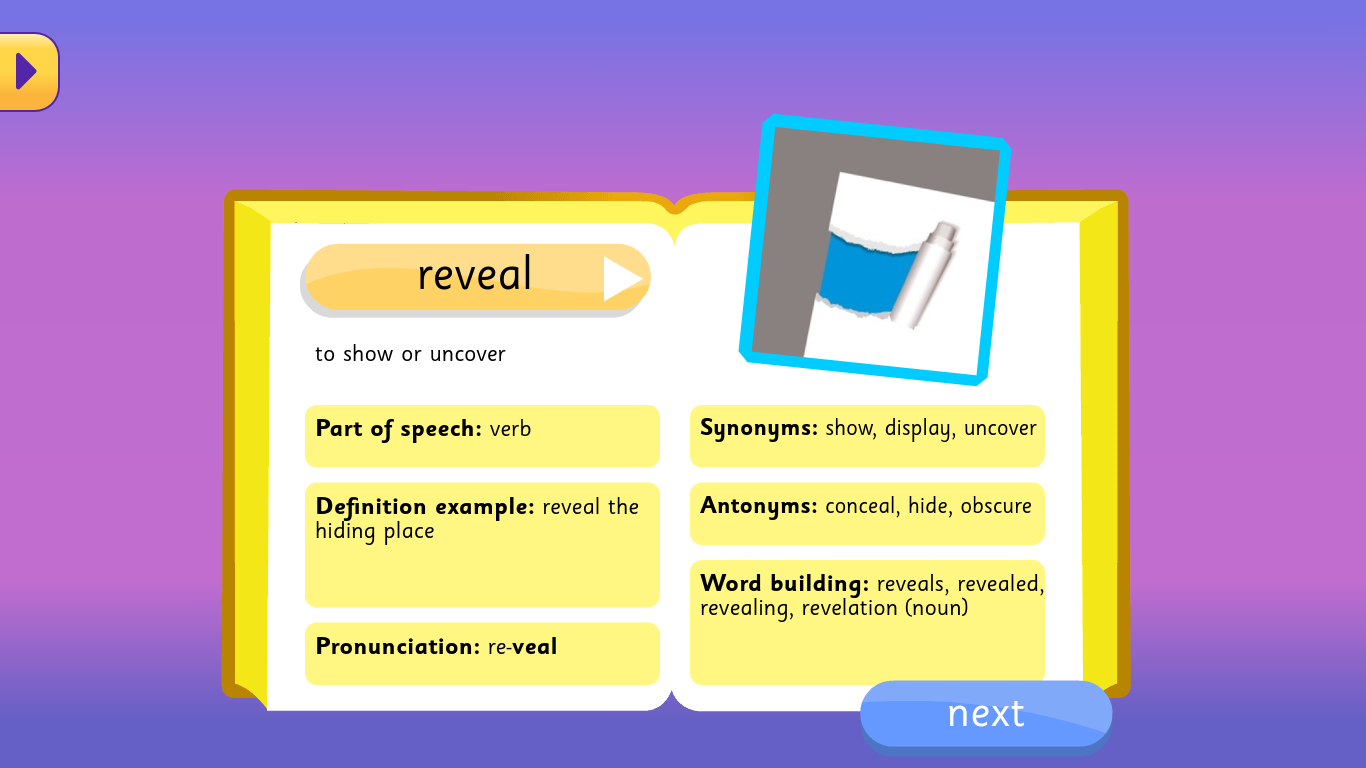
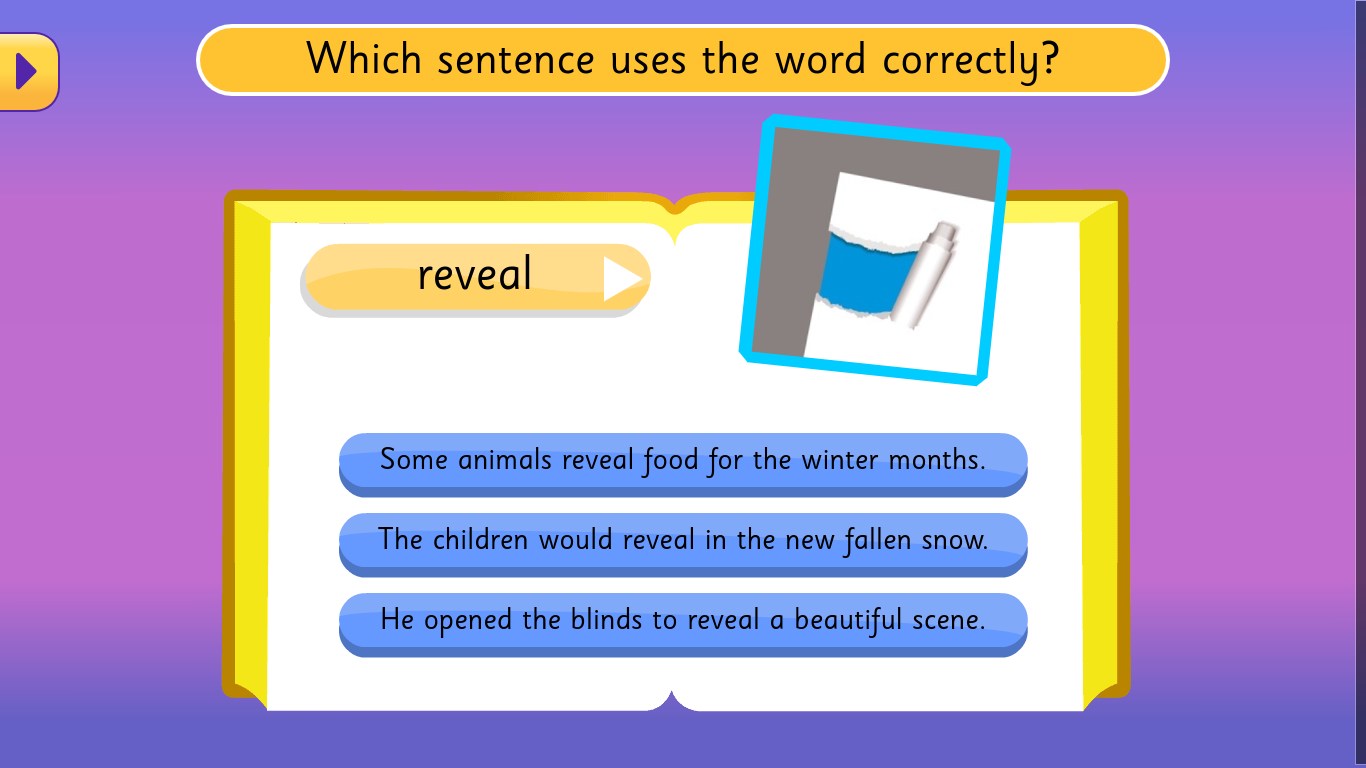

However, ALL of the words are included in the passage, and in later sections, the student may be left guessing what a word means if he didn't choose that word during the vocab section.  Here, Jude chose quell, reveal, and sorbet, but that left him to have to go look up the other two to continue the next section.


I think three words at one time is a reasonable number to study, so I'd like to see a second vocab section visit so that the student gets exposure to all of the words.  It was hard to fault either boy for incorrectly answering questions that hinged on the extra words -- he didn't know the word because it wasn't one he chose!  Yes, kiddo can go grab a dictionary (and often did), but then that defeats the purpose of a self-contained program.

I also wish that it was easier to win trophies.  It takes 1000 eggs earned in one calendar week.  Doing one numbered lesson a day (10 tasks) during a typical school week gives them only 450 eggs; even adding a lesson on each of Saturday and Sunday would still leave them short.  It takes the boys about 30-45 minutes to do a lesson; doubling up just isn't an option.  While it's not a huge deal to me if they win a trophy or not, they are disappointed that they always seem to fall short.

The last part of our subscription, MathSeeds, is a program for students ages 3 to 9.  We didn't do any work beyond the placement test. It includes some geometry (plane and solid), addition, subtraction, and very early multiplication.  Damien tested into level 131 of 144, but since he is already working at a 3rd-grade level, I skimmed ahead to see what else was being presented.  His normal math program is skills-based, and he is already proficient in adding/subtracting through three and four digit numbers, which is what the program tops out with.  I felt that this wouldn't be worthwhile for him to focus on -- review is never bad, but it just wasn't efficient for us.  Though he's a  just-turned-10, Jude is already working at a 6th grade level, so he didn't even attempt the placement.

I was excited to finally try the Reading Eggs reading program.  However, I'm not sure if we will extend our membership.  I think that there are some tweaks we can try (adjusting levels, looking things up on our own, working together) but it's not what I had hoped it would be.  I was really hoping that it would be a compromise between "I want to play on my computer" and "I don't want you vegging out for hours with YouTube videos."  It's possible that with some adjusting it may turn out to be a success, but at the moment, it's not really filling the space I had hoped it would.

75 families are working with Reading Eggs. Click the banner below to read their reviews.

Reading Eggs


Want to keep up with all of our adventures?
Subscribe below to get Adventures with Jude delivered to your inbox.

Enter your email address:


Delivered by FeedBurner


©2012- 2017 Adventures with Jude. All rights reserved. All text, photographs, artwork, and other content may not be reproduced or transmitted in any form without the written consent of the author. http://adventureswithjude.com

Wednesday, August 23, 2017

Veritas Press: Phonics Museum (Homeschool Review Crew)


We discovered Veritas Press several years ago, and love their self-paced history and Bible courses. I've heard about their Phonics Museum course when the little boys were learning to read but hadn't really explored it because there is so much other stuff out there.  I'm always looking for ways to reinforce educational ideas through app-based programs, so I was excited when we had the opportunity to test-out their new, virtual version of it, the Phonics Museum App.  I downloaded it from iTunes onto my phone, and we set off on our adventure with William, Percival, and Miss Biddle.

William is a child whose parents are "forcing" him to spend a day at an art museum.  He is pretty sure there is nothing in the building that will interest him, and it's going to be a wasted day.  Percival,  a suit of medieval armor come to life, engages with him and shows him lots of great things he can learn about art.  We meet his friend, Miss Biddle, a little further into the program.  She's quirky museum curator who becomes our teacher.  Together they lead William through the museum as he learns to read and write through the museum's collection.


If you're a family who has used Veritas Press' self-paced programs, this premise might sound familiar.  It echoes the presentation by a teacher, learner, and animated sidekick.  (Miss Biddle toggles between live person and animated character, depending on the activity.)  Each lesson is ten to fifteen vignettes that encompass one day's lesson.   Finally, although it's not called a "memory song" here, there is an interactive "learn your phonics sounds set to music" song that repeats with each day's lesson. (Memory songs work...I can still sing the Old Testament Bible song from Jude's lessons two years ago!)

Phonics Museum is suggested for students as young as three (up to age seven), which makes it a great option for little brothers and sisters who want to do "schoolwork" like the big sibs but aren't really ready for a formal "sit down and do" program. It can be used as "learn through play" reinforcement for a student using a traditional pen-and-paper phonics/writing program, but it's one I would generally only use with the youngest of students or ones who really weren't grasping the fundamentals and needed a wholly different approach.  It starts with the absolute basics, with "choosing a hand to write with" and other prewriting skills.  I can see these activities making the program seem "too babyish"  for kids who already have a grasp of basics.


That said, I think it might be ok for ESL learners because it is so basic. The short lessons wouldn't feel overwhelming, and many ESL students don't know the "Latin" alphabet so it would give them experience in working with a new shape.  (I recently tried to learn Greek, and an app to work on tracing letters would have been really helpful!)  Instead of clip art graphics, art used for demonstration the program ranges from Ancient Egyptian sarcophagi to Warhol, giving it a "not preschoolers only" feel.


 Even though he wasn't sure of the name of the painting (Jude named it from another children's show they watch that highlights art and music), Damien recognized Van Gogh's Starry Night lurking in the background.


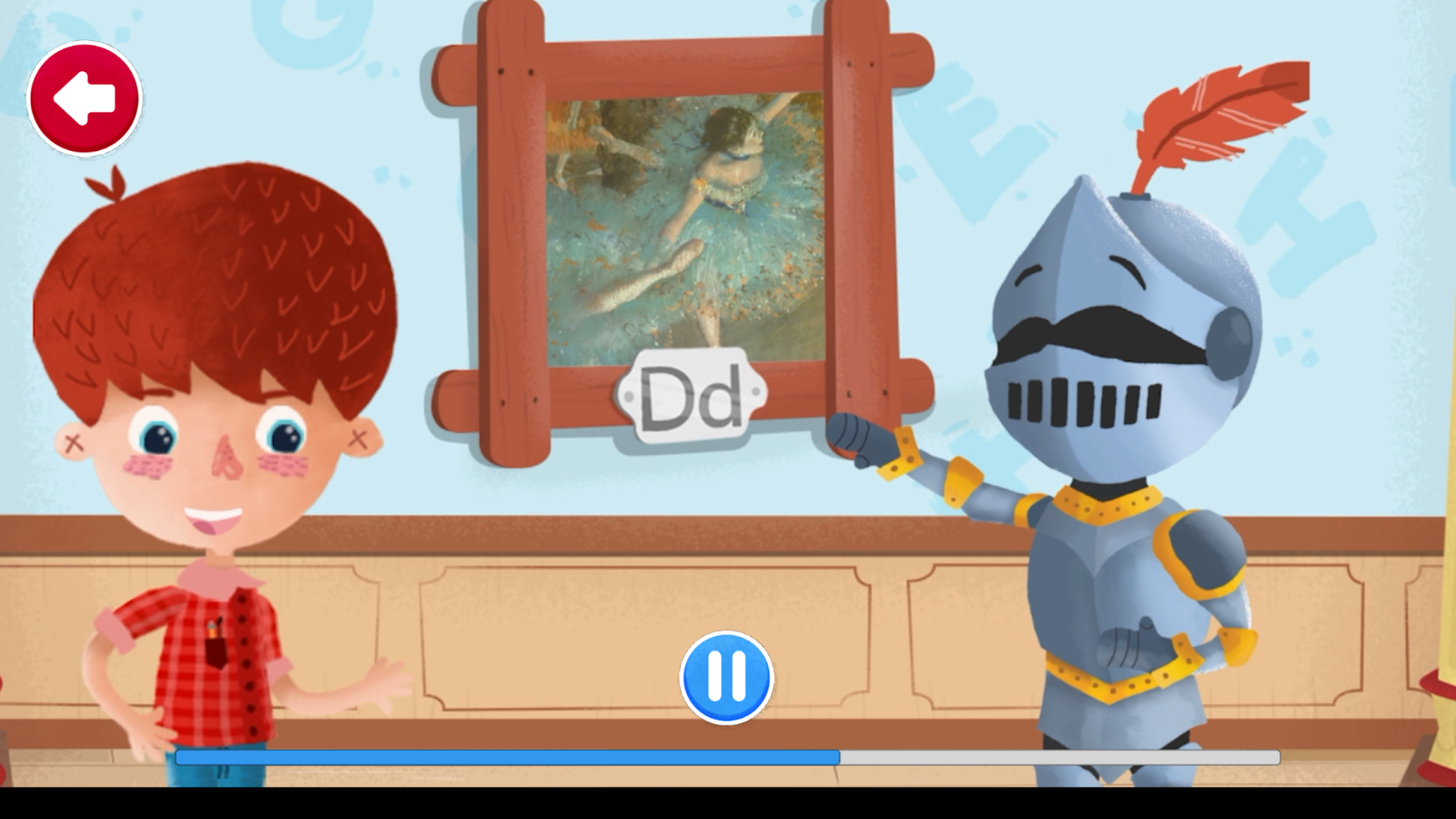
Specific and well-known works of art are on display and highlighted.  For example, a and apple are depicted by Cezanne's Four Apples, while an archetypal Degas ballerina illustrates d and dancer.


As an app, the program works beautifully.  It's pretty seamless, with little lag between activities - necessary when you're dealing with short attention spans. The curriculum teaches the student to form letters via tracing on the screen. While the tracking is very smooth, it does require the user to keep a steady hand and follow the lines being traced.  This on-screen drawing allows a student who may not yet have the fine motor skills for pencil-and-paper writing to still succeed and learn to read and form letters.


 I liked that each scene/activity starts with the user tapping on it, rather than automatically segueing.  An entire lesson takes about fifteen minutes, but if your child has a shorter attention span, you can do two or three activities and take a break.  You can also go back and re-do activities, either in the lesson or in a special game zone.

It's also very intuitive.  There are minimal directions in the beginning: tap the elevator to go to a museum floor,  tap the number to go to the floor you'd like, tap left or right to go in that direction. When you "exit" the elevator, there is a sign that shows you what letters are on that level. You may need to tap different numbers if you don't recall what  "floor" something is on (they're not in ABC order, but rather grouped by usability/frequency/difficulty of writing), but you don't have to slog through screen after screen to work on writing a specific letter.  It's also difficult to get "lost" -- prior lessons are framed with one color, the current lesson with another, and future lessons are locked off until you're ready for them.


The one major shortcoming I think this program may have is purchaser perception.  When I first explored the program on iTunes' App Store, I saw it was a free download, but requires an in-app purchase to fully use.  This didn't really bother me, as it's a pretty standard business model for lots of apps.  However, pricing is $9.99/mo (billed to your iTunes account) for up to three children, with a "pre-pay for a year" option of $99. I remember thinking "WHOA!  That's a lot of money for an app!"

Now that I've had a chance to use it, I realize it's not your generic "something productive to play with on Mom's phone." It's really just an app-based presentation of a full curriculum, with pricing on par with their other self-paced programs. If you're approaching this app as a curriculum choice from Veritas Press' catalog pages, you'll easily see the value.  If you're coming from the iTunes App Store, this isn't clear and any mention of it being based on the traditional curriculum is buried at the bottom of the description after a lot of scrolling and after the sticker shock. I would encourage Veritas Press to try to revise the information in the "details" section of the App store page to highlight this is an e-version of a tried-and-true curriculum.

Overall, this app is a quality program, and exactly what I'd expect from Veritas Press.  It's  developmentally appropriate for a young child, without becoming insipid. While its focus is on learning phonics and writing, the exposure to so many artists and their works helps broaden a child's perspective on what art can be.  I'd definitely recommend this to mom and dads of young children who want something that will entertain their child yet still provide a good educational foundation.


Phonics Museum App {Veritas Press Reviews}

Saturday, September 24, 2016

You've Got Me from Sara Lovell (A Review)


I've been a mom for over eighteen years, which means I've listened to thousands of hours of kids' music.  There are many tunes I wish I could delete from my memory, but there are some songs from as far back as Luke's infancy that I find myself seeking out digital downloads of (now that time and technology have rendered the cassette tape from the player once attached to his crib obsolete). You've Got Me from independent recording artist Sara Lovell, available in both CD and digital download formats, has the potential to be one of those albums that you're still humming long after your child has grown up.

When Luke was born, I swore we were not going to be one of those families whose child took over the radio and everything you heard was "The Wheels on the Bus." I think music appreciation needs to be cultivated just like that of literature: always provide quality works that are approachable but challenging, and while "Itsy Bitsy Spider" has its place, it shouldn't be the pinnacle of what a child hears. We played everything from Bing Crosby to the Beatles to Billy Joel -- mainly what we liked is what he heard.   When he was four or so, Luke received a copy of a Wiggles CD from Australian relatives. He fell in love with the group (and so did we) because the songs were kid-friendly themes and lyrics but with grown-up musical arrangements. As the years have gone on, we've carefully curated our collection, adding artists such as Laurie Berkner and Trout Fishing in America, who also specialize in kid-friendly songs that won't make Mom and Dad want to duct tape their ears shut. You've Got Me may be a brand new release, but its combination of youthful topics and adult melody and rhythms launches it into the realm of these classic artists.


I love how You've Got Me mixes different genres of music. The first track, "We Get Up in the Morning," is an acapella gospel rhythm that starts your toes tapping right away. "Dance Like There's Music Music In Your Pants", track five, is a classic samba beat that I dare you to resist dancing and shimmying with. (Is it terrible to admit I put this one on repeat for a 20-minute car ride...and I was the only person in the car?) The set list follows the natural balance of a day, interspersing upbeat melodies with gentler arrangements, allowing for a natural flow that becomes neither frantic nor stagnant. Lovell's songs, filled with smoky 1920s jazz, lilting calypso, and bluegrass-style harmonieseasily flow from one to the next. "Off to Bed We Go" has a classic Fred and Ginger foxtrot feel, and the disc ends with "Night Night Golden Sun," where a classical-style piano and strings ensemble gently smooth the end of the day.

Though the titles and lyrics are kid-friendly, they are not insipid.  Sara puts words to the world of imagination where children live, but without cutesy wording.  Track two, "Furry Alligator Puppy," is a silly song recounting the "night before's" dream, but uses grown-up phrasing, such as "It was something really strange, a really crazy adventure," and ideas like "I was flying like I was swimming."   Fanciful themes such as the play world of a beloved stuffed rabbit and a sock puppet monster party are explored, and balanced with  gentle yet brief reminders of what is off limits ("Don't play the piano with your nose...") or expected ("Give it lots of exercise, give it lots of love and your body will be happy..."). I also appreciate how Sara enunciates the words clearly -- it's frustrating when you sing along to a record and later find out the artist isn't singing the "right" words, isn't it?

Because of its balance, it would be a perfect baby shower or new baby gift -- it won't wear out its welcome before Baby is big enough to dance along. Its rhythm will bring out the natural musicality that younger children have, making them dance along almost involuntarily. Slightly older Damien has taken to belting out lines between math problems, and even Celia and Matthew were caught grooving along in the backseat as we drove home from karate. (A flustered Celia said, "What?? She's saying "¡Bailamos en la calle!" and that's what I'm doing!") I think this is going to be one of my favorite albums, no matter how old they grow!


©2012- 2016 Adventures with Jude. All rights reserved. All text, photographs, artwork, and other content may not be reproduced or transmitted in any form without the written consent of the author. http://adventureswithjude.com

Tuesday, May 3, 2016

The Pencil Grip, Inc: Kwik Stix (A Schoolhouse Crew Review)

Solid Tempera Paint Sticks; Paint with bright colors, no brush, no mess

We've done close to two hundred of reviews over the last few years.  Some have been well-loved while others have had a countdown clock until we could put them away.  However, before now I've never had a review product disappear from my hands before the delivery truck had even left the driveway!  As I picked up the box from the doorstep and waved to the "Package Man," I saw it was from The Pencil Grip, Inc. and knew it contained our Kwik Stix 12 pk.  I had the carton mostly open when the little boys elbowed their way in to see what was in the box. Before I could finish saying, "They're painting crayons!" they had run off to the basement with them.  By the time I tossed the outer box in the recycling bin and caught up to them, Jude and Damien already had put them in action!


Kwik Stix are solid tempera paint sticks -- think "poster paint meets glue stick."  They are chunky enough for small hands but easily manipulated to create thinner lines with the edges of the stick.  (After 15 years of slogging to occupational and speech therapy appointments, my first thought was, "Wow, I wonder if they have these at duPont!")  As you use what's at the end, just "turn up" the bottom to expose more paint.


Suggested media for painting with these includes poster- or cardboard, wood, and canvas.  The paint applied with the same feel as watercolor crayons, so I offered to let the boys use the "good" art paper (Canson Cold Press 140 lb for watercolors) for their drawings.  (Usually, we just use basic copy paper for "just feel like drawing" artwork.)


The colors are brilliant and intense, just like traditional tempera/poster paints, and Kwik Stix dry in an astoundingly fast 90 seconds!  If you're impatient but like to layer colors, this helps speed things along. Fast drying also means that the chance for smearing across sleeve cuffs and shirt fronts is significantly reduced. (These have a distinct advantage over the watercolor crayons here!)

The 12 pack comes with primary, secondary, and neutral colors, so there's plenty of variety.  There are also six-stick packages of primary/neutrals, neon colors, and metallic colors; for classroom or big family use, there is a 96 pack that includes eight each of twelve colors. Normally when I buy paint, I stick to primary colors, because we can usually make secondary and tertiary colors with them.  However, because these are sticks, you can only blend the layered paint, not pre-mix them to create a uniform second color.  You also need to work very quickly, because they dry so quickly.  I found that sometimes it helped to go over the blending with the white stick, to help "re-wet" and smudge the paint, but generally, you can't mix colors - only gently smooth sharp edges.


I can't say how excited I am that these are not messy like regular paint. Even purposely smudging the paint, my fingers stayed relatively clean.  The little bit of paint that did transfer onto my hand washed off easily with generic hand soap and water. No technicolor fingers!


Generally speaking, except for Celia's acrylic paints for Art Club and a few random Sharpies,  I don't buy art supplies that are not labeled "Washable."  Damien has even tried to pick out a new box of crayons at the store, and turned around and put them back -- without being told -- because he realized the box didn't say they were washable.  These paints technically aren't "washable," but I was willing to give them a chance because they dry so quickly.  I figured with pushed up or short sleeves and quick drying time, they might not be so bad.

As I passed by the craft supplies in the basement, I spied a piece of muslin and had an idea.  Now, I would hope that the boys wouldn't be purposely wiping paint on their shirts.  However, with these boys, you never really know!  So, in the name of laundry science, I smeared and I scrubbed.


Not bad.  With dish detergent (Dawn, to be precise) and some scrubbing, most of the color came out. Some of the more intense colors had remnants, though. I'm comfortable letting the boys use these with indirect supervision (me in the room, but not hovering), and if they happen to get a little on them accidentally, immediately washing the garment.  I can't guarantee it will come out, but I don't think they're like Celia's paints where once the paint is on the shirt, it's done for.


We are thrilled with Kwik Stix from The Pencil Grip, Inc.  Even after several uses by artists with heavy hands, there is still plenty of paint left in the tube.  While they are not the same as a traditional pot-and-brush painting style, they're a less-messy way to work on fine motor skills. I'm not surprised that these are a great occupational therapy tool -- after all, The Pencil Grip, Inc. is known for their ergonomic pencil grips that have been a OT staple for nearly 25 years! These paint sticks are going to become a permanent addition to our art supply box!

To find out more about Kwik Stix, follow the Pencil Grip, Inc. on social media, or click the banner below to read more Crew reviews!

Facebook: https://facebook.com/thepencilgrip
Pinterest: https://pinterest.com/KwikStixPaint/
Twitter: https://twitter.com/ThePencilGrip


Kwik Stix The Pencil Grip, Inc. Review


©2012- 2016 Adventures with Jude. All rights reserved. All text, photographs, artwork, and other content may not be reproduced or transmitted in any form without the written consent of the author. http://adventureswithjude.com

Thursday, November 12, 2015

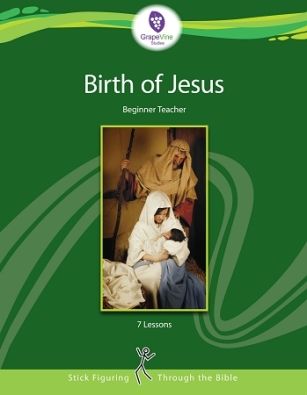
Grapevine Studies: Birth of Jesus (A Schoolhouse Crew Review)

Note: This post may contain affiliate links.  For full information, see here for full disclosure

Grapevine Studies the Birth of Jesus A Schoolhouse Crew Review from Adventures with Jude

 Bible instruction is important to me, but Bible studies for young children can sometimes be difficult.  We've tried a few Bible study programs in the past, but they've not been a good fit for us.  One was better suited to a group setting, and one was just too much memorizing for Jude to be able to handle.  When the Crew gave us the opportunity to try Grapevine Studies' program, we decided to try a different perspective.  Rather than starting "In the beginning..." with Genesis, we decided that fall was a good time to begin studying the story of the Nativity instead.  For the last few weeks, we've been "stick-figuring though the Bible" with The Birth of Jesus (Beginner Level).  Jude has been working with the drawing his own pictures with the Beginner eBook, while Damien has been working with the Traceable for Beginner eBook.


I like that Grapevine Studies is adaptable for all faith traditions.  It does not focus on a single interpretation of the Bible, but instead employs a framework of chapters and verses that allows the parent/teacher to choose the translation to be used.  I think this makes the program as unique as its stick-figure approach.  I've found that most Bible studies that I have looked at rely on the King James Version of the Bible.  There are differences in the translations, and while many would say "Isn't the Bible the Bible? Does it matter?" I would answer that yes, it does matter.  On a practical level, I want to use the Bible I already have and that the boys' catechism studies use, but on a theological level, there are differences and I want to use the translation (NRSV) that my Catholic faith uses.


Have you ever considered at a program that outlines the ages that it's for, and then when you get it find yourself saying, "What?  There is no way this is appropriate for this age!"  Sometimes, it's too easy, but often in my experience, curricula tends to run "ahead."  Programs are labeled for a specific grade, but often the average student for that grade will probably have a struggle with it.  Grapevine's program really is doable for the intended student age range.  The Beginner level is for ages 5 through 7, or students on a K-2 grade level.  Jude's abilities are about at a first grade level, and he had no trouble with this level.  While one could argue "the Nativity story itself isn't that difficult," study guides can sometimes complicate things.  This guide breaks the story of the Nativity down into manageable chunks, and the review questions are simply worded.  This curriculum did not overwhelm Jude at all.  He became excited to hear the next day's reading, because it gave him small bits at a time - enough to keep him interested, but not so much that it became a dreaded subject.  Learning about God should never be a chore!

The curriculum also divided the story by "characters in order of appearance." This really helped explain the Nativity story because we're focused on one person at a time and his or her role in the Nativity.  This curriculum can be worked on one "person" at a time, or one mini-story at a time.  There are 7 (weekly) lessons that can officially be broken down into fourteen daily lessons.  However, we opted to got at an even slower daily pace.  We opted to do one person over the course of a week, so that we were able to break down the story into very small groups of verses to reflect on.  We would read the verses listed in the corner of an illustration box, Jude would draw a picture to help him visualize the story, and then I would dictate the verse(s) for him to write into a notebook.  I think Jude could easily have handled a semi-weekly schedule, but we went at a slower rate because of Damien.

The Traceable for Beginner level is geared to ages 3-6 who many not have the motor skills to draw figures but are able to trace over lines.  It coordinates with the "blank" Beginner level that Jude used, and allowed Damien to be part of our study.  Because he's only 5, he doesn't really have the concrete thinking to be able to listen and then draw what he heard.   Having a picture already present gave him visual clues as he listened, helping him understand what he heard. However, because he still had the the extra tactile sensory input from drawing the picture by tracing it, it helped reinforce the story.

Luke 1:38

We also received a Teacher's Book that includes lesson notes/goals/key points, example stick figure drawings, the memory verses, and answers to review questions.  One of the lesson plan directions is for the teacher to model the story with stick figure drawings.  I did not do this, because I know Jude has a tendency to want to just copy what he sees.  Instead, I used the drawings to help me guide his thinking if he got stuck.  I really wanted to see how he interpreted the stories he heard.  I was really impressed by some of his drawings. Although some of his figures were a bit unpolished, I was really happy to see his level of comprehension.

Luke 1:38

So much for Mary's eloquent, "I am the handmaid of the Lord..."  God doesn't need us to stand on ceremony; a cheerful "Shoor" (sic) works as an agreement to His plan.


Jude explained this one to me: St. Joseph has a smile even though he's sleeping because the angel helped him decide what to do.

Luke 2:1-3

In this scene, the "official" picture is a man holding a scroll, presumably with the King's edict.  Jude's interpretation was to show people going and being counted.  I think he's clearly grasped the content of the Decree, and is more likely to remember this passage because this is what he naturally associated with the text.

Some of his pictures had me laughing.  In this one, he was insistent that Mary have flowers -- because all girls have flowers when they get married -- and the "guy in the middle needed that wedding book."

Matthew 1:24

Here, he asked me, "Does she look round enough to be having a baby?"

Luke 2:4-5

I think so.  Mary even looks ready to topple over...not much unlike I did when I was at the end of pregnancy.

There is no writing "required" with the program.  Although there are discussion questions at the end of each section, they can be completed orally.  Jude wrote answers to them because I wanted him to have an opportunity to work on both his penmanship and writing sentences.  Jude isn't so great at memorizing things just yet, so instead of trying to memorize a weekly Bible verse, he wrote the verse(s) that went with each day's lesson.   I think the Beginner level was actually a little easier for him than I expected it to be, so adding dictation/penmanship to the activity was a good way to challenge him. 

Matthew 1:24

We really are enjoying this study!  It has been a really good way to formally introduce the true Christmas story, without it feeling overwhelming for either of them.  It's easily adaptable for different abilities, even within the "recommended" K-2 grade level, making it a good option for families with multiple young students.  (Note: It is a simplified version of their elementary Birth of Jesus program, and not inherently compatible with the multi-level program.)  I think Grapevine Studies has become our new favorite Bible study program!

Luke 2:7


The Crew has been stick-figuring their way through the Birth of Jesus and the Old Testament.  Click the banner below to read their reviews, or follow Grapevine Studies on social media:

Facebook: https://www.facebook.com/GrapevineStudies
Twitter: https://twitter.com/grapevinestudy
Pinterest: https://www.pinterest.com/grapevinestudy/
Google+: https://plus.google.com/u/0/+Grapevinestudies/posts
Periscope: @Grapevine Studies


Grapevine Studies Review


©2012- 2015 Adventures with Jude. All rights reserved. All text, photographs, artwork, and other content may not be reproduced or transmitted in any form without the written consent of the author. http://adventureswithjude.com
Related Posts Plugin for WordPress, Blogger...
Pin It button on image hover