Showing posts with label co-schooling. Show all posts

Wednesday, August 23, 2017

Veritas Press: Phonics Museum (Homeschool Review Crew)


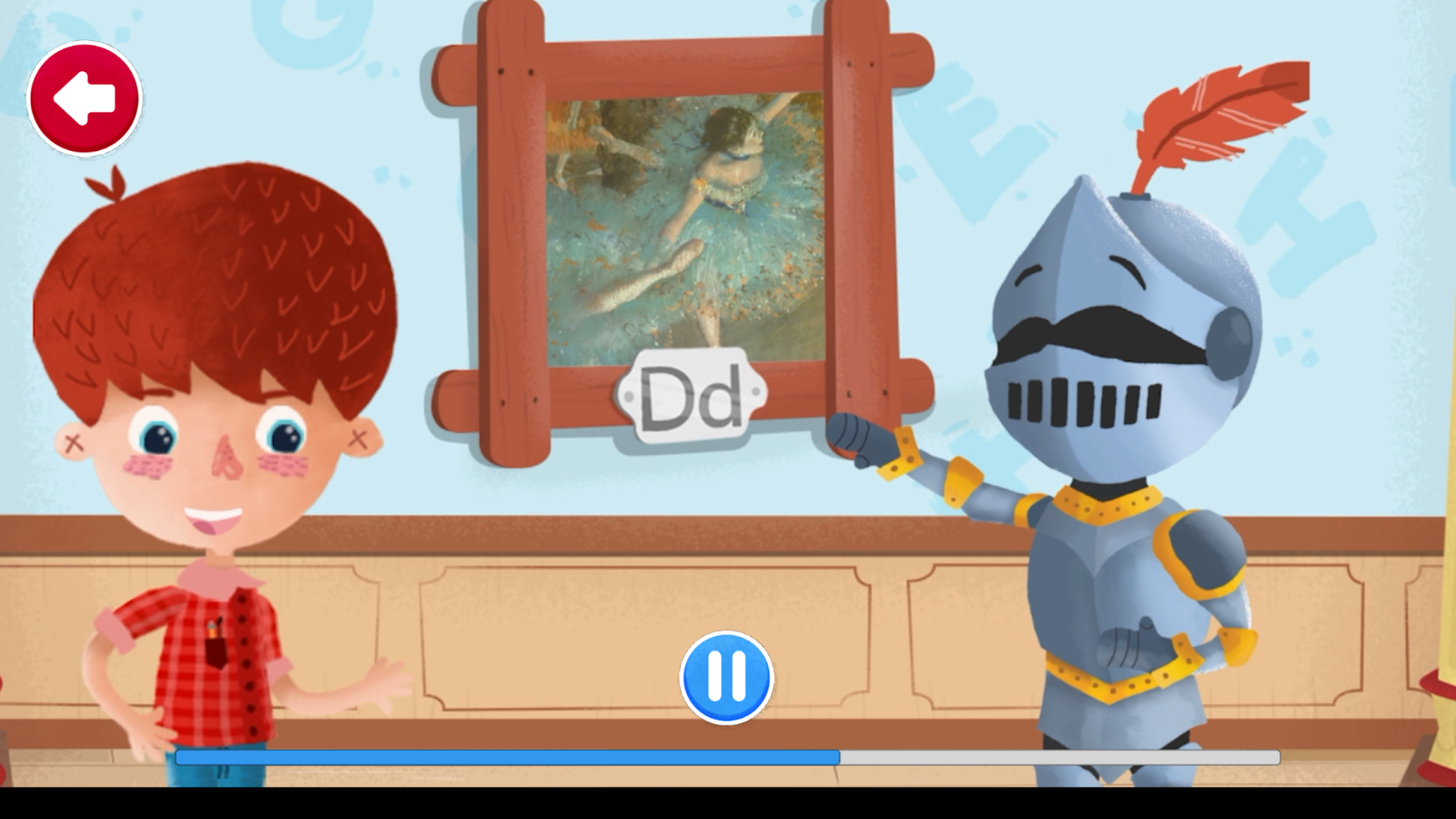
We discovered Veritas Press several years ago, and love their self-paced history and Bible courses. I've heard about their Phonics Museum course when the little boys were learning to read but hadn't really explored it because there is so much other stuff out there.  I'm always looking for ways to reinforce educational ideas through app-based programs, so I was excited when we had the opportunity to test-out their new, virtual version of it, the Phonics Museum App.  I downloaded it from iTunes onto my phone, and we set off on our adventure with William, Percival, and Miss Biddle.

William is a child whose parents are "forcing" him to spend a day at an art museum.  He is pretty sure there is nothing in the building that will interest him, and it's going to be a wasted day.  Percival,  a suit of medieval armor come to life, engages with him and shows him lots of great things he can learn about art.  We meet his friend, Miss Biddle, a little further into the program.  She's quirky museum curator who becomes our teacher.  Together they lead William through the museum as he learns to read and write through the museum's collection.


If you're a family who has used Veritas Press' self-paced programs, this premise might sound familiar.  It echoes the presentation by a teacher, learner, and animated sidekick.  (Miss Biddle toggles between live person and animated character, depending on the activity.)  Each lesson is ten to fifteen vignettes that encompass one day's lesson.   Finally, although it's not called a "memory song" here, there is an interactive "learn your phonics sounds set to music" song that repeats with each day's lesson. (Memory songs work...I can still sing the Old Testament Bible song from Jude's lessons two years ago!)

Phonics Museum is suggested for students as young as three (up to age seven), which makes it a great option for little brothers and sisters who want to do "schoolwork" like the big sibs but aren't really ready for a formal "sit down and do" program. It can be used as "learn through play" reinforcement for a student using a traditional pen-and-paper phonics/writing program, but it's one I would generally only use with the youngest of students or ones who really weren't grasping the fundamentals and needed a wholly different approach.  It starts with the absolute basics, with "choosing a hand to write with" and other prewriting skills.  I can see these activities making the program seem "too babyish"  for kids who already have a grasp of basics.


That said, I think it might be ok for ESL learners because it is so basic. The short lessons wouldn't feel overwhelming, and many ESL students don't know the "Latin" alphabet so it would give them experience in working with a new shape.  (I recently tried to learn Greek, and an app to work on tracing letters would have been really helpful!)  Instead of clip art graphics, art used for demonstration the program ranges from Ancient Egyptian sarcophagi to Warhol, giving it a "not preschoolers only" feel.


 Even though he wasn't sure of the name of the painting (Jude named it from another children's show they watch that highlights art and music), Damien recognized Van Gogh's Starry Night lurking in the background.


Specific and well-known works of art are on display and highlighted.  For example, a and apple are depicted by Cezanne's Four Apples, while an archetypal Degas ballerina illustrates d and dancer.


As an app, the program works beautifully.  It's pretty seamless, with little lag between activities - necessary when you're dealing with short attention spans. The curriculum teaches the student to form letters via tracing on the screen. While the tracking is very smooth, it does require the user to keep a steady hand and follow the lines being traced.  This on-screen drawing allows a student who may not yet have the fine motor skills for pencil-and-paper writing to still succeed and learn to read and form letters.


 I liked that each scene/activity starts with the user tapping on it, rather than automatically segueing.  An entire lesson takes about fifteen minutes, but if your child has a shorter attention span, you can do two or three activities and take a break.  You can also go back and re-do activities, either in the lesson or in a special game zone.

It's also very intuitive.  There are minimal directions in the beginning: tap the elevator to go to a museum floor,  tap the number to go to the floor you'd like, tap left or right to go in that direction. When you "exit" the elevator, there is a sign that shows you what letters are on that level. You may need to tap different numbers if you don't recall what  "floor" something is on (they're not in ABC order, but rather grouped by usability/frequency/difficulty of writing), but you don't have to slog through screen after screen to work on writing a specific letter.  It's also difficult to get "lost" -- prior lessons are framed with one color, the current lesson with another, and future lessons are locked off until you're ready for them.


The one major shortcoming I think this program may have is purchaser perception.  When I first explored the program on iTunes' App Store, I saw it was a free download, but requires an in-app purchase to fully use.  This didn't really bother me, as it's a pretty standard business model for lots of apps.  However, pricing is $9.99/mo (billed to your iTunes account) for up to three children, with a "pre-pay for a year" option of $99. I remember thinking "WHOA!  That's a lot of money for an app!"

Now that I've had a chance to use it, I realize it's not your generic "something productive to play with on Mom's phone." It's really just an app-based presentation of a full curriculum, with pricing on par with their other self-paced programs. If you're approaching this app as a curriculum choice from Veritas Press' catalog pages, you'll easily see the value.  If you're coming from the iTunes App Store, this isn't clear and any mention of it being based on the traditional curriculum is buried at the bottom of the description after a lot of scrolling and after the sticker shock. I would encourage Veritas Press to try to revise the information in the "details" section of the App store page to highlight this is an e-version of a tried-and-true curriculum.

Overall, this app is a quality program, and exactly what I'd expect from Veritas Press.  It's  developmentally appropriate for a young child, without becoming insipid. While its focus is on learning phonics and writing, the exposure to so many artists and their works helps broaden a child's perspective on what art can be.  I'd definitely recommend this to mom and dads of young children who want something that will entertain their child yet still provide a good educational foundation.


Phonics Museum App {Veritas Press Reviews}

Monday, July 10, 2017

Home School in the Woods: Composers Activity Pak (A Homeschool Crew Review)


Home School in the Woods is a familiar curriculum provider for us. We've used them for multiple students in the past, including Celia.  My young musician was happy to work on this review of their HISTORY Through the Ages Hands-On History Activity-Paks: Composers, one of five Activity Paks that the company offers.  These programs are multisensory curricula that provide hands-on learning.

The Composers Activity-Pak studies 42 composers across seven musical eras.  By the time she's finished, Celia will have an extensive background in music history.  Studies begin with the Middle Ages and end with 20th Century/modern composition.  It's a "Who's Who" of musical history, starting with Guido of Arezzo, the father of Benedictine chant and continuing to the great American composer Leonard Bernstein.  There is also a section on music vocabulary, teaching students about various types of compositions.


This vocabulary section is the only place where the "answers" are supplied.  Rather than being a complete program with biographies of the composers, it is more of an "explore and fill in the blank yourself" program, where the student needs to research each of the composers.  There is also a section on orchestral instruments, which is also a cut-and-paste situation.

There are also 28 pieces of music to listen to for the "Music Appreciation" section. The pieces average two to three minutes in length.  Some composers, like Wagner and Mendelssohn, have one iconic passage each to listen to (Wagners "Bridal March" and Mendelssohn's "Wedding Recessional") while others have two; there are even three for Vivaldi and four for Bach.  Celia and I agreed that she would do one written report per composer; for the composers that had multiples, she could choose one piece to listen to.  (The exception was Bach, because included was his Concerto in C minor for violin and oboe; as she is a violinist, I wanted her to definitely study a piece that was specifically written for that instrument.)


This is a program that requires significant amounts of patience, paper, and printer ink.  Unlike most lap book style programs that are "open the file and click print," Home School in the Woods programs need to be printed one page at a time.  You'll need to regularly change paper weights and colors for each page.  We received the download version, and while it is saved on my computer's hard drive, launching the program used the Firefox browser.  Some pages we were able to open from the files and print directly, while others we had to re-download as PDF files so that the fonts maintained their integrity.  With limited hard drive space, this was annoying -- and we didn't figure it out until pages printed, so it meant either having funky printing OR using more paper and ink.


All told, I think it took me about two hours to print everything out.   Having used these in the past, I knew what I was going into and how much work it would be to get started.  However, if you're a lapbooking family and are used to "print and go," you're going to be in for a big surprise.  This is one that I think could be printed on just white copy paper, but it is more impressive if you use the different papers.  We had some leftover from our last review, so that helped keep the cost down a little.

The Timeline project was something that really made things click for Celia. She plays both piano and violin and has had juried exams for both.  She was confused when choosing her repertoire pieces for her upcoming piano jury.  She needed to pick pieces that contrasted mood and tempo but struggled to understand where different composers fit into the general timeline of music.   The Activity Pak has helped her understand that while composers like Dvorak and Debussy have very different styles of composition, they are still both Impressionists, based on the time they lived and worked. Now seeing composers laid out on a timeline based on when they wrote, rather than all jumbled together in her lesson book based on the difficulty of the piece, she can more easily choose where she needs to fill in repertoire gaps.


The entire project is meant to be assembled into a lap book, but that doesn't happen until you're done.  Celia was frustrated because it meant she had a lot of papers to keep track of. We did put them in a zip-top bag, but she would have preferred to have assembled as she went along. If nothing else, it would have given her a folder to keep her composer papers tidy.  Of course, it is possible to do it as you go if you're not following the directions precisely, but that doesn't work when the directions say to make it at the end.  (I finally shrugged and told her she had to decide which way she wanted to do things -- the "right" way or the "way that worked for her."  She's waiting for the completed program to build the lap book.) Secretly, I agree that "along the way" would have made more sense, but literal kids...

I'm going to sound like Goldilocks searching for a good music station here, but bear with me.

When we have used Home School in the Woods programs in the past, I've felt there is more cutting and pasting than learning.  It becomes less about absorbing the contents of the definitions and more "match them up and glue them down." In assembling the timeline and composition study pages, Celia spent much of her time cutting and pasting. She even had reprint some pages because they required some complicated cutting.  As she put it, a few got severe haircuts and "Mozart got a nose job!" as she was trimming to fit.  It would have been simpler if there had been more space around the composers and where they needed to go; she could have left more white space with a less detailed cut.  It was "too much busywork."  I could justify some of it as she veered off into art-land as she created her "music stand" and worked on what she told me was her "never-ending quest to actually do a good ombre."


On the other hand, I'm thinking an 8th grader shouldn't be spending six hours coloring and cutting out pieces to glue together.

Despite this, Composers is probably the program I have liked best because while the definitions were pre-printed when studying the pieces (and the composers themselves in another section), it was up to the student to find information about them. Celia is entering 8th grade, so she was able to surf the internet and research on her own, so these parts were an independent project for her.  (This program is meant for students in grades 3 through 8, so I probably would have felt differently if it was Jude working on it and I needed to do more guiding.)


She's spent a lot of time working on one composer and the accompanying musical pieces, and then hunting through my iTunes playlists looking for the full-length pieces to listen to, or for more selections by a given composer.  Sometimes I've had to say, "It's time to move on."

 Hint - we found these two albums to have the widest variety of composers from the timeline, along with a few others that are not included in the Activity Pak.   They do include longer pieces from the excerpts included in the program.


Did we find a "just right" with this program? I guess so, in the sense that Celia isn't ready to abandon this mid-way.   We've used Home School in the Woods in the past, with mixed results.  Celia enjoyed the 20th Century In America Hands-On Lap Pak,while the little boys were less enthusiastic about the Ancient Greece World History study.  I wouldn't have called this round a "tiebreaker" so much as me thinking "They're different kids, so different perspectives."  Having used the Time Traveler and the World History studies, I'm wondering if it's that they have different perspective.  The two histories seem to be facts fast-and-furious, while the two Celia has worked on (both Activity-Paks) have much more leeway for student-led study.  Composers is working for her, providing a framework for independent learning.

I would be more inclined to use this for not just upper middle school but also for high school as an art history course because of all the research and writing involved with the music passages and the composers; to use with a younger student I'd be hunting down books about the composers rather than letting a third or fourth grader loose on the internet.  I think if I had an older student and a younger student working together, it would be doable, but not for a younger child solo.  I'm going to say that because of all the "busywork", it is not my favorite program, but I can see us continuing with it as a summer project.

Crew Members have been working with a broad range of Homeschool in the Woods programs.  Click the banner below to read their reviews about:

Time Traveler American History
New World Explorers
Colonial Life
The American Revolution
The Early 19th Century
The Civil War
Industrial Revolution through Great Depression
World War II

Activity-Paks
The Old Testament
The New Testament
Composers
Artists
Make-a-State

Lap-Paks
U.S. Elections
20th Century in America
Wonders of the World
Benjamin Franklin
Knights

Timeline Trio


Hands-on History {Home School in the Woods Reviews}


©2012- 2016 Adventures with Jude. All rights reserved. All text, photographs, artwork, and other content may not be reproduced or transmitted in any form without the written consent of the author. http://adventureswithjude.com

Wednesday, May 3, 2017

ArtAchieve (Homeschool Review Crew)

ArtAchieve is a web-based curriculum that strives to help everyone believe they can draw. John Hofland, the program's creator, firmly believes drawing is a skill, not necessarily an innate talent - that anyone can hone and strengthen.  Celia has been working with Entire Level III package for this review - you may recall last summer that she completed the Level II program. (Make sure you read to the end to catch an update on those projects.) New lessons build on skills taught in prior lessons, with the goal being a student's project looks like what they intended. It's not about learning to copy the inspiration piece but learning to re-create it with individual flare.


Overall, ArtAchieve is a program is recommended for aspiring artists aged kindergarten (about age 5) to adult.  Because this is a skill-based program, if you're new to drawing, ArtAchieve recommends that you start at Level I, regardless of your age, so that you build a strong foundation for later levels.   ArtAchieve recommends the Level III program specifically for students age 9 and up because the program requires some motor and planning skills that younger students may not have the maturity for just yet.  (They offer a free sample lesson, The Czech Cat, for students to test skill level against. If you have an older/slightly experienced student, I recommend completing this project before choosing a level.)

Celia craves the arts like air: she plays two instruments, is the first chair violin in a local string orchestra, is both an actor and set builder in the school musical, and attends every after-school art club meeting she can.  When I add the fees for all of that up, my checkbook cries.  It's worth every penny, but that doesn't mean I don't cringe when I see a lot of pennies flying out every semester. One thing I love about ArtAchieve is that at only six dollars (plus materials) for an individual lesson, it's also an affordable lesson source.  However, if you purchase the entire level as a bundle, ArtAchieve will give you a 25% discount, effectively making each lesson only $4.50.  I can handle this with only a bare grimace.


However, don't let yourself be fooled by the price.  These aren't "cheap, don't expect much" lessons!  Each lesson includes about 70 minutes of drawing instruction time. We started with the first lesson, Hawaiian Frog.  Celia found that while the drawing lesson itself could be completed in an afternoon, the entire unit took closer to two weeks! ArtAchieve provides suggestions for cross-curricular content as well, making the lesson not just "draw a frog, and use color and line to make it artistic," but places the original piece in the context of its source, as well as providing additional ways to explore the topic.


Each lesson contains instructions in both video and PowerPoint formats.  Celia loves having both options.  She begins with the video, which explains not only the mechanics to draw/color her picture but also includes instruction on art theory.  For example, the Crane explores color, including the basics of complementary and analogous colors and using color in a painting.  Students are given the option to paint their pictures in colors that mimic nature or evoke emotion.  I like how ArtAchieve gives instruction in both and allows the student to personalize her work.  This is a crucial step in the development of an artist's personal style.  Realism in art is important -- the finely corded muscles of Michaelangelo's Creation in the Sistine Chapel help underscore the perfection of God's work, but there's certainly a place for the unique coloring of many of Picasso's works.


However, after watching the video (about 30 minutes), she will go back to use the PowerPoint instruction.  These provide step-by-step instruction without the frustration of trying to listen, draw/paint, and stop/start a video precisely. (She can also hit the arrow-over button with the back of a pencil or brush, limiting the potential for paint to get on the computer.  Definitely appreciated.)

If you're a full-time homeschooler that likes the Unit Study approach, you could probably do a lesson in about a week's time.   Since Celia is working on this "after homework and on weekends," it's taken her a few weeks for each lesson, especially since she wants to explore all of the "extras" in order to grow as an artist.  The lessons use different media - oil pastel, acrylic paint, watercolor, etc., and that has an effect on how long things take.  For example, her oil pastel frog itself took her about two hours, because she could go from area to area without waiting for anything to dry.  It also was small - drawn on letter-sized paper.


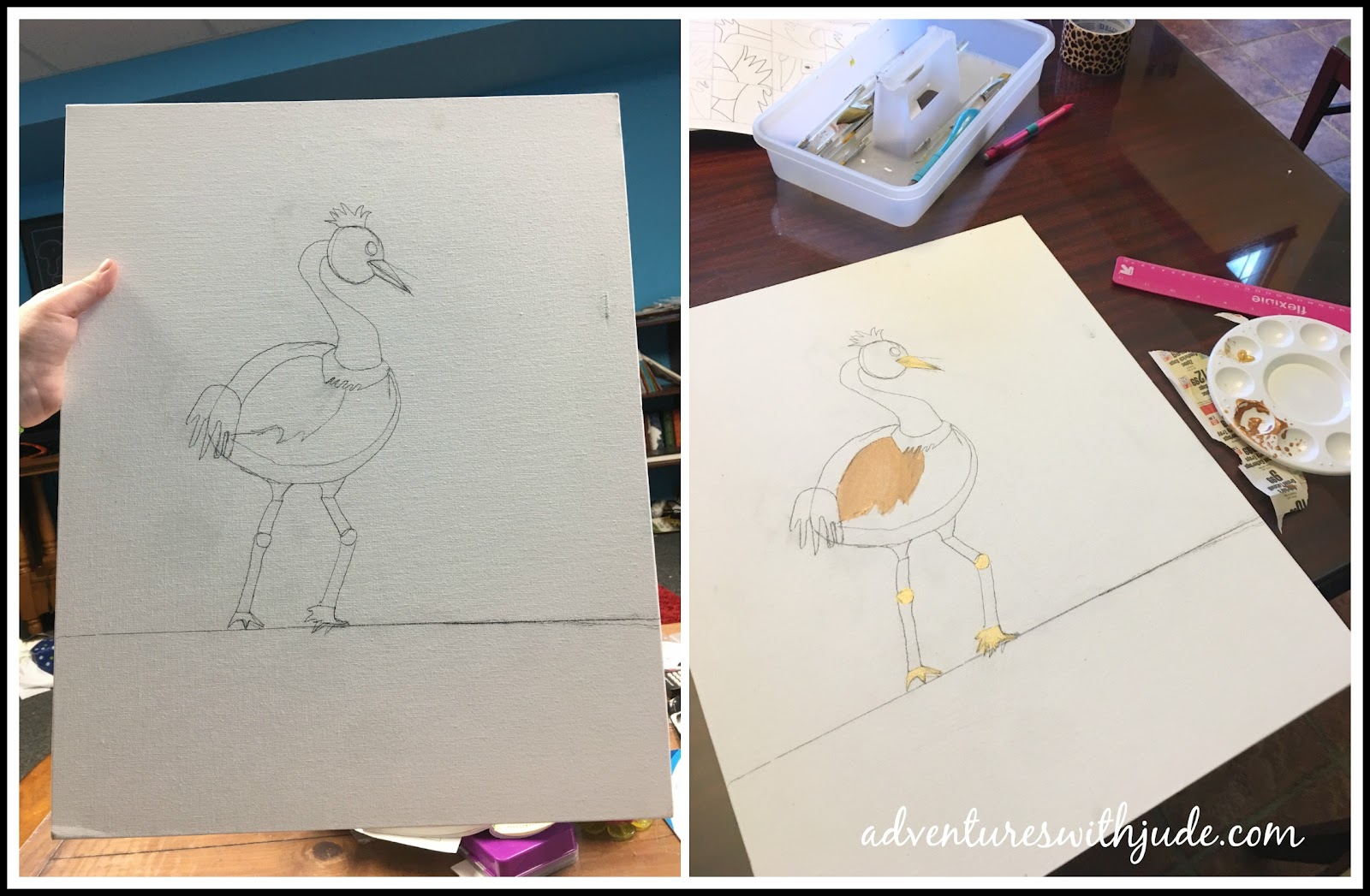
 However, her African Crane is currently on Day 11 since she began her line drawing exercises. She likes how the program doesn't say "OK, here's our canvas, let's go!" but instead breaks it down into smaller pieces that she can practice.


In addition, she's using an 11x16 canvas and acrylic paints for her finished piece.  She also did several test drawings on smaller paper,  working to scale parts up to a larger painting,  Now that she has begun,  the actual painting itself is taking several days. - choosing colors, layering paints, etc.


Finally, she's moving at a slow speed since her "studio" is also my dining room table.  She tends not to work on acrylics until she knows she has enough time to leave her paints out for several hours at a time, and the table has been in heavy use recently for non-painting endeavors.  However, both the program and the works being created are easy for her to stop and start working over several days' time without losing her place -- something that has frustrated her with other online art lessons.


If you're in a state that requires you to meet specific educational goals, you'll appreciate that the lessons are designed with National Coalition for Core Arts standards.   The lessons provide thorough instruction as both a fine arts course and in creating a well-rounded student.  These are the standards that the African Crowned Crane (III-lesson 2) meet:


If you have a student like Celia, looking for extra-curricular instruction, standards may not matter as much.  However, I like knowing that the program holds itself to these standards.  Whether she becomes a famous painter or just dabbles as a hobby, it's good to know that this program is laying a strong foundation.   I also like that it uses models from around the world to show that things like line, color, and indeed art, are universal.

Now, an update on Level II.  Celia worked on this last summer and took her portfolio to school last fall to show her art teacher.  She was impressed at the variety of subjects that Celia had worked with, including a Korean Wedding Duck and a Dala Horse.  (Celia has been updating her about the Level III subjects as well.)  This spring, Celia was invited to submit her Korean Wedding Duck to the school's art show, and it was chosen from show submissions to be part of a county-wide art tour.  Not bad for an "internet art program." 


She's looking forward to using Level III to broaden her portfolio for next year!

100 Crew members have been creating with ArtAchieve.  Click the banner below read their reviews.


Art Lessons Inspired From Around the World {ArtAchieve Reviews}


©2012- 2016 Adventures with Jude. All rights reserved. All text, photographs, artwork, and other content may not be reproduced or transmitted in any form without the written consent of the author. http://adventureswithjude.com

Wednesday, March 1, 2017

Math Mammoth Blue Series (Homeschool Crew Review)

We've been through several different Math curricula, and finally seem to have settled on one that works for Jude and Damien.  I like it's philosophy and approach to learning, but it doesn't necessarily present topics is as timely a manner as they might need.  I'm happy we had the opportunity to review the Blue Series from Math Mammoth and begin filling in these gaps using the U.S. Money, Measuring 1, and Clock worktext units.  They are available as both PDF downloads, which we received, and pre-printed booklets.  The PDFs can be printed multiple times for use in an individual family. I appreciate this because it meant both Jude and Damien could work with these.


Note: Math Mammoth is a Common-Core aligned program.  Honestly, I have mixed feelings on the philosophy of it, but I do periodically refer back to the standards to make sure that the boys have met expectations.  I like these single-topic programs because they do help me see where any gaps may be, especially since we use a task-level, not grade-level program for our usual Math lessons.

After I had downloaded the PDFs, I started printing.  We were planning to work on the programs from start to finish, but I appreciated the detailed Table of Contents and Introduction.  If I was looking for a small unit geared to a specific grade, I could use these to avoid printing the entire book at one time. During the review period, we completed the Money unit, and have gotten about a third of the way through Measuring 1. These are for students in grades 1 through 3.  Jude's math learning is a bit uneven, and I know there are some gaps to fill in, so I wasn't concerned with him being above (a fifth-ish grade level).  Damien is just starting second grade (we work year round in our homeschool), so he's middle-ish of the intended age bracket.

Money


While we had three programs to choose from, I decided that the most immediately useful one for us would be the unit on Money.  I printed this in its entirety for each student. When we first were chosen, Damien had zero experience with money, and Jude had a decent grasp on bills and the idea of counting coins, but still struggled with identifying coins accurately.   The program begins with identifying and counting coins and then segues into computing purchases and change.  We generally worked on one lesson each day and completed the 18-lesson worktext in about a month.  For this book, I would highly recommend printing in full color, because it makes it easier to identify the coins in the book.


Jude needed help at first identifying coins.  By the end, though, he was a pro, even successfully counting in half dollars.  I feel like by now he's got a good handle on counting money, especially being able to identify nickels and dimes -- forever his nemesis.  Pennies are a different color, and quarters are large -- plus they have his two favorite presidents on the front.  They've always been easier for him, but nickels and dimes have been a struggle.  By now, I can plunk a fistful of change in front of him and say, "Hey, can you count this for me!" and he's accurate.

Damien (second-ish) was faster to catch on, but he is younger. He struggled with some of the need to "think quickly and change gears" that comes with counting money, and then with the vocabulary of money -- total, change, etc.  There were some areas where Jude was able to work faster because he was older and had more practice in an area.  A child needs to be able to skip count by 5s (nickels) and 10s (dimes) at the very beginning, and the lessons quickly add in skip-counting with quarters and half dollars.  At first, Damien was slow, and instead of counting 25-50-75, etc., he would have to add quarters in the margin.  With enough practice, he was able to memorize how to "count by quarters" and pick up speed, but it was a little slower going at the start.

 The coins are a good size and easy to identify.  Our only real complaint is the coins only showed one face; for the nickel it was the "tails" side. While most nickels do have Monticello on the back, Damien found several nickels in the "laundry change" bucket that had depictions from the Lewis and Clark expedition.  He was completely clueless on what these coins were.  I appreciate the quarters all had George Washington on the front -- even though the Mint has issued State and Presidential Quarters series, George has been a constant.  Since there are different backs, I would have liked to see at least some nickels with the "heads" side of Jefferson.   (Also, I'd like to see images of FDR on the front of a dime - only the tails side was shown in illustrations, so when given a handful of dimes to count, he had to turn all of them over so he could identify them.)

The Introduction page of the worktext does sub-divide by grades; counting coins is a first-grade expectation, while the lessons beyond are appropriate for second and third-grade students.  If I were using this as a supplement to regular lessons, I would consider printing out just the topics that I was reviewing/introducing that were for my child's particular grade level. Truthfully, I'm not sure where on a "traditional" trajectory skip-counting comes in, but to be successful, skip counting and the ability to "change skips" (i.e., counting 10-20-30-35-40-41-42) is a must.  As we went further into the book, we also discovered that knowing how to borrow and double-borrow in subtraction were also required.  Damien caught onto these pretty quickly, and there are plenty of opportunities to practice this skill.  We appreciated the nice-sized squares for helping to accurately align columns.


And just to show there's always "one of those kids" -- who usually is mine -- who is extra literal.  This task required him to choose three things from the cafeteria, and he has such severe food allergies that he can only safely eat about ten foods, none of which were pictured.  He looked at them, then looked at me and said, "I can't do this problem because I can't have three things.  I can only have water, and I'm not that thirsty."  We finally settled on picking something for him and then choosing items for Mom and Dad. He decided on coffee and an apple, since he didn't think those were "our kinds" of bread or pizza, and there was no ingredient label on the soup.  Smart allergy kid!


Measuring 1

Again, this book is for students in grades 1 through 3.  The introduction again breaks the lessons by grade level.  Note: it does say that the lessons for this book come from the Math Mammoth Light Blue Series full curriculum, so if you're a Math Mammoth family needing extra practice with new problems, this might not be a good fit.  We're about a third of the way through this one, and enjoying it.  It is very hands on.

It begins by using objects to measure items, not a ruler.  It isn't concerned about precision measurement, but rather the relationship of "How big is this compared to that?"  At first, we started with measuring length with shoes.  Matthew got roped into this one -- or at least coerced to hand over his sneakers since we needed "big shoes" and "little shoes" (supplied by Damien).


Then we used paper clips to measure.  The directions said to measure small items, then something "more than four paper clips long." Jude was surprised that Slimer was four (large) paperclips big!  He borrowed Matthew's government textbook and found it was six paper clips long.  Whew.


The program it moves on to discussing volume -- small cups vs. larger, and their relationships to larger containers.  We used one of my favorite coffee cups.


Two boys and a pot of water are only for those who have dry socks waiting in the wings!

A post shared by mama2lmcjd (@mama2lmcjd) on

We've begun working farther into the program, measuring lines and shapes.  For the most part, a 6" ruler is sufficient, but there are some places where a 12" ruler is needed.  Since the boys are working at the same time, there is always a panicked search for the big ruler...and it's usually in the other brother's hand.  I spend most of that time passing it back and forth -- on my agenda is a second 12" ruler.   There is also some fraction work, adding halves.  Jude is working on fractions in his regular math program, so it's easy for him.  Damien has skipped over that part, for now.  It includes lessons in both English and Metric measurements.  I don't expect these will be too difficult for them because they are used to working in both.  While we may measure most things in inches and pounds, kids and tube feedings in our house are measured in centimeters and kilograms and milliliters, because that's how the hospital does it.

Clocks 

We haven't had an opportunity to work with this one yet.  I'm thinking we will probably wait until after Easter, if not until summer.  Again, this divides into grade level expectations, but also notes that the student can go from start to finish without too much trouble.  It begins with reading time to the half hour (grade 1), to the closest five minutes (grade 2), and to the exact minute (grade 3).

Overall, I'm very pleased with these programs from Math Mammoth and would recommend them.  I'm actually looking into purchasing the Division 1 and 2 worktexts for Jude. He has the concepts of division down well but could use some practice in mechanics (lining up columns, turning word problems into number problems, etc.) I also think it would be appropriate for review or additional practice for a public/private school student. I'm definitely going to be checking out the other Crew reviews of Math Mammoth's Blue series, and hope you will too.


Affordable Quality Math {Math Mammoth Reviews}


©2012- 2016 Adventures with Jude. All rights reserved. All text, photographs, artwork, and other content may not be reproduced or transmitted in any form without the written consent of the author. http://adventureswithjude.com

Wednesday, May 11, 2016

Zeezok Music Appreciation (A Schoolhouse Crew Review)

Music Appreciation for Elementary Students


Celia is passionate about music.  She began violin lessons at age seven after a successful lobby to both her school's principal and her parents.  Five years later, she's added piano lessons, dabbles in guitar, is giving serious consideration to a conservatory-style program for high school.   This child lives and breathes music!  I had a feeling that she was going to love Zeezok Publishing LLC's Music Appreciation Book 1: for Elementary Ages.  It's nice to know that sometimes, even with a "tween," Mama was right.  It was like Christmas when the box arrived!


The Music Appreciation Book 1 Collection consists of a student Activity Book, music CDs, a printable lapbook, and composer biography texts. Seven Baroque and Classical era composers are included in this music curriculum:  Bach, Handel, Hayden, Mozart, Beethoven, Paganini, and Schubert. Units are divided by composer, with four weeks allotted to each.  Zeezok has composed this program to meet national Music Appreciation standards for kindergarten through sixth grade.   Each composer is a self-contained unit, so you can begin anywhere in the program, not just at the start. However, Celia eagerly started at the beginning with Bach.


The Student Activity Book is the "tour guide" of the program.  It begins by breaking the lessons down into a manageable syllabus.  Activities for each week are outlined, with about seven to ten activities for each week.  Activities that are "required" to meet the national standards are marked, making it easy to scale the program from a "highlights to fulfill a state requirement" to an "in-depth unit study."  A sixth grader and fairly strong reader, Celia found that she could complete a "week" in just about two hours.

The first lesson each week is to read the accompanying composer biography, and then complete the activities in the workbook.  It contains comprehension questions and supplemental activities, ranging from music-focused instrument identification and music theory to cross-curricular activities. When appropriate, the activities are leveled for different age ranges: manuscript vs. cursive copy work, drawing a picture vs. writing a paragraph, etc.

Workbook divided by grade level

Note: it ALSO contains the answer keys at the end of each unit.  I have mixed feelings about having it in the middle of the student book.

Being a music student, Celia is familiar with several of Bach's compositions.  I loved that the biographies included playable passages of selected pieces.   After discussing one of Bach's minuets, the text asked, "Can you play this?" and showed the notation for the piece.  After quickly scanning it, Celia laughed out loud and said, "Actually...Yes!"


A more in-depth comparison and she realized it was her recital piece from last spring!


However, if your student is not a musician, it won't stop her from learning.  The musical compositions presented in the biographies are recorded onto the included ten CD set.  Music is such a multi-sensory experience. I think it's very smart to have the sheet music to follow along with listening.  Zeezok wants the program to be a multi-sensory experience, and this helps.  Sure, hearing a piece is one sense, and reading the biographies uses sight, but I believe that to be fully appreciated, music needs to be experienced using multiple senses simultaneously.  (I think that this is a reason that symphony concerts are often considered "boring" -- just listening doesn't provide enough sensory input for many people.)  Even if a student can't read individual notes, following along with the written composition can see when the music goes up in pitch or changes fervor, and the visual and tactile experience enhances the auditory portion.

Finally, there is an accompanying lapbook that coordinates with the textbook activities.  Celia enjoys the creativity of most lapbooks, but she was not as excited about this one as I thought she would be.  She enjoyed assembling the folders, and even broke out her "good" music note duct tape!

accompanying lapbook assembly

For the first activity, she got to work "compose music" on a staff, but then was disappointed that the rest of the activities, as she put it, seemed very "Glue tab A into slot B." The color PDF-sourced printouts were beautiful, but she would have preferred the ability to decorate/color the covers. She also thinks it would have been nice to have a way for her to write definitions, rather than just gluing pre-printed ones to booklets and then gluing the booklet to the folder.  She thought that pre-printed made sense for younger kids, but this sixth grader seemed almost insulted that she wasn't getting the opportunity to do them herself.  She thought there were great things to learn from the content, but the assembly part was boring for her.

Lapbook complete

Celia couldn't wait to share what she learned with her music teachers! She is excited to be working on the unit about Handel because one of her current repertoire pieces is from his oratorio, "Judas Maccabeus." She feels like she has learned a lot about Bach, which has helped her interpret the minuets and musette that she has been performing.  She hopes learning about Handel will help her with this piece as well.

To learn more about Zeezok's Music Appreciation courses, follow them on social media, or click the banner below.

Facebook: https://www.facebook.com/Zeezok-Publishing-LLC-208441035019 
Pinterest: https://www.pinterest.com/zeezok/

Music Appreciation for the Elementary Grades {Zeezok Publishing LLC Review}


©2012- 2016 Adventures with Jude. All rights reserved. All text, photographs, artwork, and other content may not be reproduced or transmitted in any form without the written consent of the author. http://adventureswithjude.com
Related Posts Plugin for WordPress, Blogger...
Pin It button on image hover