Showing posts with label math. Show all posts

Thursday, July 12, 2018

Math Essentials: Math Refresher for Adults (Homeschool Review Crew)

Math Refresher for Adults is a product that fell into my students' laps.  When Math Essentials offered this product for review, my first thought was "LUKE!" He graduated high school two years ago, had good enough grades and placement scores that he was able to skip several pre-requisites and jump into middle and upper-level math courses for this coming fall.  That said, it's obviously been quite some time since he had any formal math.  Because the advertises itself as "The Perfect Solution" for adults who need to brush up on their math skills, I thought this would be perfect for him to work with so that he had a re-solidified foundation.


Once we got the book in our hands and I was able to flip through it, I realized that while it wouldn't hurt him to work with the book, it was probably a little bit basic for his needs.  It focuses on skills such as:

  • General Math
  • Geometry
  • Problem Solving
  • Pre-Algebra
  • Algebra

While all of these are foundational for his courses, this book got re-assigned to Celia. She started Algebra I, but when she took the readiness test for her usual program, she felt she was shaky on some of the basics.  She knew them, but not as well as she would like. She also is transitioning from private school to homeschool, so this was a perfect opportunity for me to assess her skills. Since that was the more pressing need, she found herself the proud short-term owner of the book.

Not Just For Adults 

Since Celia was just beginning Algebra, we started with General Math.  This book puts you in the "way back" machine, starting with fairly basic computation - two- and three-column adding, with regrouping.  (If you're an adult working on this, you'll probably be calling it "carrying.")
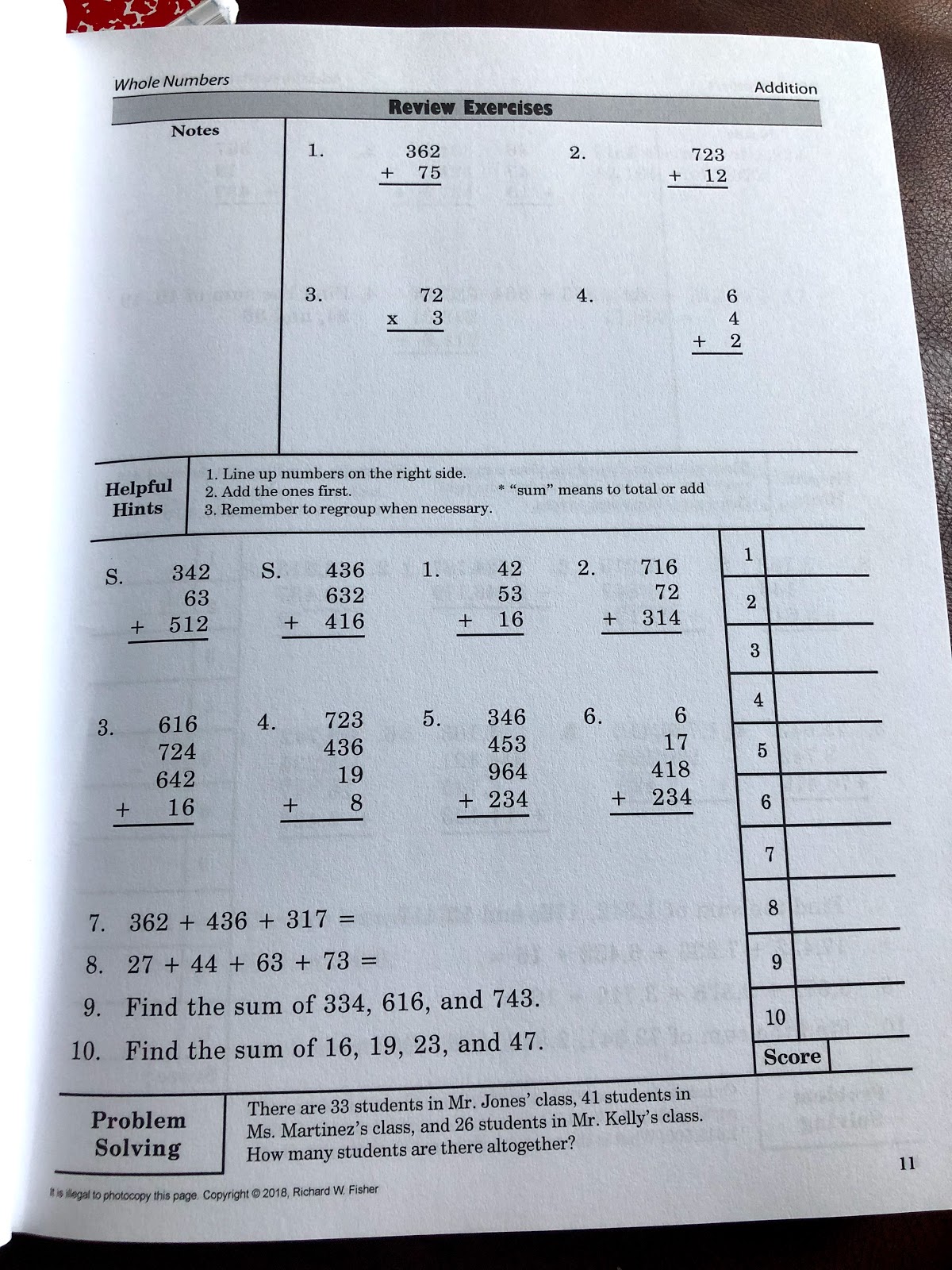


Each lesson starts with four "review" problems.  At the very start, it doesn't seem like "review" - just more of the same.  As you get further into the book though, they pull from prior lessons.  I like how this keeps presenting opportunities to practice skills.  Let's face it, if you're doing a refresher course, it's because you know "one-and-done" re-exposure isn't going to be sufficient.


Celia felt she was ok with basic math; fractions, decimals, and percents were where she felt weak.  Each page has only about fifteen problems (four review, ten on-topic, and one word problem), so while thirty problems a day sounds like a lot, it only took her about thirty minutes each day to work through them.  She began by doing a page each of Fractions and Decimals, followed by Percents and Integers, alternating groupings each day.  She decided that this would give her the opportunity to review several topics quickly, but also allow her to keep looping back, so it was constant repetition rather than a "topic blitz."

While this is a softcover workbook, it functions better as a textbook.  While you could work some of the problems in the white space, you'd need exceptionally small and neat handwriting for some of them.  Author Richard W. Fisher suggests copying problems onto a separate piece of paper -- which actually helps with understanding, because you're working from start to finish -- and then completing the problem.  Rather than a bunch of scrap paper that could easily get lost, we opted for a copybook.  I laughed when I saw the front of Celia's book, indentifying which Celia the book belonged to -- the "classroom experience" is still active in her mind. Last I checked, we only had one Celia in our school!


As I said, this was an excellent way for me to assess her skills.  This problem showed a couple of weaknesses.


Math isn't just about getting the "right answer." You have to get the process right because otherwise, the correct answer is luck, not skill.  Here, her first try didn't align her numbers correctly.  I followed her thought process, but there were two issues -- either she missed squaring off the problem with a decimal place (and therefore a step in her work), or she wasn't lined up correctly. Her second try fixed the place issue -- but then her computation was off because she "brought down" her decimal point, as if she was adding, rather than "counting over," which definitely affected her answer.  She realized what she did wrong, and got both the correct process and answer on the third go.  While it seems like not a big deal when you're "just" multiplying in a single-step problem, this can become an issue as you move into multi-step problems.  Forget algebra, let's just consider finding a discount and then adding sales tax to determine if you can afford a purchase: when you calculate that 7% add-on, you definitely want to make sure you're figuring based on the correct price!

Heading into Algebra, the extra practice with Integers was helpful.  Again, we found that "setting up" was a weak spot.  Celia wanted to jump right to calculation and answers.  Many times, I had to say "COPY first, THEN work."  Or, show how you get from one calculation to the next.  While I can appreciate when I'm adding multiple numbers I tend to just go across the line in my head, when you're learning to add and subtract integers, it is crucial to do one step at a time until the skills have solidified.


We also learned that she tends to rush, leading to "stupid mistakes."  When you get to upper levels of math, you have to take your time and do problems one step at a time. When I asked her how to solve this problem, her answer was to rush across the line, "Order of Operations, negative seven plus three is negative five, plus eight is three...Oh. Wait a minute."  I pointed out that by trying to do it all at once, one mistake meant the entire thing was wrong. By doing it in steps, she had a chance to see where her mistake was and then an opportunity to fix it. Unfortunately, this is a habit that she didn't learn in school, so it's one we need to set up.


Again, it's not that she doesn't know her times tables -- when I said to her, "um...what is six times three?" she answered, "Eighteen!"  Apparently, she just had a total brain fart here.  Or she was rushing.  (Very likely.) Learning this was as important as actually knowing her times table.  As a parent/teacher, it tells me she needs reminders to slow down. 

Celia will likely continue working through the book to the end.  While she is continuing forward with Algebra 1, it won't hurt her skills to keep practicing basics and making sure she is rock-solid in them. 


Quirks of the Book and Program

One thing I did not like was how the program alternated how it indicated multiplication during algebraic sections.  Here, the answer key in the back was a definite help.  We determined that the x in this problem meant "times," not "the variable x."  That makes a big difference in solving. (Even if you do have to go back and slow down on the times table part.


There were several problems written like this, so when she came to one, I made her stop and ask me which way to do it, but just looking up the answer then primes the student to work backward from the answer, rather than seeking the path to get to the answer.

I also wish the answer key had more detail than "just" the final answers.  For example, there are problems labeled as "muti-step," yet the Answer Key only gives the final answer.  The page's Helpful Hints lists "Decide which operations to use and in what order" but there is no way to check if the student has chosen the right plan of attack.  Yes, this book is supposed to be a refresher course, but I think it's really just providing practice, not actual "how to" refreshing.


It would really be helpful for both the teacher and the independent student to be able to see&nbspnot only that it IS wrong, but WHY the answer is wrong. This might make a single book exceptionally voluminous, but perhaps the program could be converted to a two-volume set that includes a student workbook + answer key.

While I agree with Math Essentials that it is helpful for parents who want to help their children but need a refresher, there were sections where I just looked at the problem and said, "Hmmm...how about YOU show me, and then I'll check it."  Yes, I was hoping that seeing how Celia did something might jog my memory.  (Yes, I could sit and watch the videos, but, like many parents trying to juggle multiple kids, I was looking for the most expeditious route possible.)

Also included with the program book is access to Math Essentials web-based video instruction.  An access code is included in the book for advanced Algebra tutorials.  However, there is no direct correlation for this book -- you'll have to sort through topics from the prior volumes.  The book cover advertises itself as "Excellent for English Language Learners" and for returning students, but I think these are is particular populations that may need extra hand-holding. It's not impossible to find the videos, but locating them definitely less "user-friendly" for this book than for other books.  At first, we didn't even realize that the videos correlated, because we were looking for lessons for this book. It is sensible to use the previously produced videos, but it would have been nice to have a landing page for this volume that leads specifically to the correct videos, or even just a statement saying "Math Refresher students: choose the links that refer to the corresponding Refresher book section."  Yes, we were able to figure it out, but no mention of the book at all makes Math Refresher feel like an afterthought.

Not Just for Crash Review!

Now that we've completed our official review period, I am going to also assign Jude to work in the book, too. He's just finishing elementary math and moving into Pre-Algebra, but looking ahead at his regular math program,  I can see some areas where he would benefit from a few extra "basic math" problems each day. His usual program does build upon what the student has already learned in the Elementary program, but it will be a while before he returns to multiplying fractions. Knowing his strengths and weaknesses, I think it would be better for him to do a few problems of that here and there to keep practicing rather than hoping he can pull it from the depths of his brain a few months from now.  Math Refresher will give him opportunities for extra practice without feeling like he's doing a "baby" workbook or a second curriculum.  While I don't think ten or fifteen review problems a day is excessive for high schooler Celia, I probably will opt to have Jude do half a page each day -- odds on Day 1, evens on Day 2, which will both lessen the burden and extend the exposure. As for poor Luke, who had the book literally ripped from his hands...he's been taking short-session business law, economic theory, and English composition summer courses, so math review has been pushed to the side for now.  He plans to start his math courses in the fall without a review, but keep this book handy if he finds there are things he's just not entirely clear on.

75 Crew Families have been brushing up on their math skills. Click the banner below to read their reviews.

Click here to read our review of Math Essentials: No-Nonsense Algebra.


Math Refresher for Adults {Math Essentials}


Want to keep up with all of our adventures?
Subscribe below to get Adventures with Jude delivered to your inbox.

Enter your email address:


Delivered by FeedBurner


©2012- 2018 Adventures with Jude. All rights reserved. All text, photographs, artwork, and other content may not be reproduced or transmitted in any form without the written consent of the author. http://adventureswithjude.com

Wednesday, June 6, 2018

The Critical Thinking Co.™: Understanding Pre-Algebra (Homeschool Review Crew)

Ok, so I want to know how Jude is ready for middle school math.  I remember sitting at the kitchen table using crayons as manipulatives to get him to be able to add up to ten. Now he's mastered elementary math and is ready to review a book titled Understanding Pre-Algebra? STOP THE CLOCK.


Mama is so not ready for this.

Understanding Pre-Algebra is a full-course worktext style math offering from The Critical Thinking Co.™  This is a standards-based program for students in grades 6 through 8.  However, what makes it different is its organization. Unlike many other programs that just teach how to get the answer, this text stresses critical thinking about the problem's process.  Rather than just learning the steps for how to get from problem to solution, Understanding Pre-Algebra teaches the student to think about the choice of steps and why he's using those strategies.


This "learn why, not just how" is why I like programs from The Critical Thinking Co.™ We've used so many things from their line up.  In the past, we've reviewed their Sentence Diagramming book (I'm very happy to have that still on my shelf for when Celia begins homeschooling later this month!), as well as Pattern Explorer, another math program.  We've even branched out and used several other items: Matthew has worked with their Critical Thinking and US History curricula, and Jude and Damien completed grade-appropriate levels of Mathematical Reasoning this past school year.  This company is a favorite here!


I am not a math person, and I freely admit it.  I survived high school Algebra by the grace of God and the unwavering patience of and tutoring by a dear friend.  He now holds a Ph.D. in math and is a college math professor; clearly, he completely gets math.  For whatever reason, the rules of Algebra just did not click for me.  My last homeschool forays into Algebra were with kids who came with Pre-Algebra "already installed."  Matthew started with Algebra I, while Luke had already completed Algebra I.  Their further higher-level maths have been self-contained, online courses because I've always felt it would be better to have people who specialize in math teach them, the same as if they had gone to a brick-and-mortar high school.  I have been grateful to hold my own through elementary maths with the boys. Teaching a higher math is new territory for me.  I took a deep breath and dove in.

 Chapter 1 focuses on the Family of Numbers...ah, let's just start with a longtime nemesis.  Joy.  (Can't you just feel the radiating enthusiasm?)


I mostly understand Whole numbers when you're talking "How many slices does this cake make?"  I know numbers are a Real pain and think all math is Irrational.  Already, I fear I'm over my head -- how can I explain what I don't understand?

Ah, but here's were "learn why, not just how" makes the difference.  The way number groups are presented is in a logical fashion.  They start with Natural numbers.  They're the ones that come "naturally" to kids...1, 2, 3.  Next come the Whole numbers...the Natural numbers plus the number 0.  Then it adds Integers...which is really just all the numbers you know so far AND their opposite. It made sense to Jude, and it made sense to me. I was getting excited -- I've made it through page 1, and I think I get it.  Yes, I was doing the happy dance in the living room.

Page 2 explains Odds, Evens, and Prime numbers -- all familiar concepts to me.  Jude struggled a little bit, however.  I think it was because his regular math program explained these in a slightly different manner, and he couldn't quite reconcile that they were the "same idea, different words."

I would say that this "Got some, lost some," was prevalent throughout what Jude did. I know this is supposed to be a full curriculum, but the lessons are presented as reading and explaining, not showing how to do.  Jude understood the concept of integers, but the whole "plus and minus" thing right now is a struggle.  The book does include a cute story that he's copied and hung by his desk to help him remember what signs change or carry through:


As a non-mathy person, I really appreciate when it clearly writes out things that you need to know.  (Did my school textbooks do this? I have no idea.)  I think we will be copying this to hang up as well, as a checklist to refer to until the process becomes ingrained.  I wonder if I had thought to copy this order and keep it in front of me (rather than trying to simultaneously memorize and work with it) if later concepts would have come more easily? Chalk one up for second chances.


Comparing this book to the Algebra I text I just got for Celia, I think this book will do a good job of preparing a middle-schooler for Algebra I.  The 15 chapters cover:

  • Family of Numbers
  • Working with Integers, Rational Numbers,
  • Ratio and Proportion, Percents, Probability and Statistics
  • Algebraic Expressions, Equations, Word Problems
  • Inequities
  • Square Roots and Irrational Numbers
  • Geometry: 2 Dimensional, Volume & Surface Area, Transformation & Congruency
  • Graphing: Coordinate Planes
  • Functions


I'm impressed with the content.  I feel that a person who is not naturally mathematically inclined will be able to master the topics and build a strong foundation for higher maths.  However, I don't think we are going to switch and use this for Jude's main math program, for several reasons.

First, this is a text-only book.  It is a lot of reading and trying to comprehend, and Jude is a very auditory or kinesthetic kind of learner.  This is a book that he struggles to do independently -- he often needs me to read things aloud so he can focus on the content, not decoding.  In what we have accomplished, there was only one non-reading based activity - creating integer dice and practicing adding positive and negative integers.


I also think it teaches very quickly.  This book is 367 instructional pages, including an eight-page final exam.  Students need to average a lesson a day to complete the book in a typical 180-instructional day year. However, each lesson has 20 to 30 problems for each lesson.  I think this quantity of problems is a good number to master a concept, but this book is asking him to do as many as 30 problems in a single day.


I think it's too much "all at once" -- he seems to get overwhelmed, and I wind up having to sit with him and refocus him frequently.  I would rather do the lesson plus three 10-problem practice days to allow time for the ideas to sink in, rather than what feels like hour-long cram sessions. However, to keep to the "year-long" schedule, slowing down isn't an option.

If I were going to use this book as my primary teaching option, I would slow it down and take closer to 18 months to complete the course.  I think if you had a younger child, like Jude, who is just entering middle school at an advanced math level, it might be a good way to help him "slow down" his pace by taking the time to build a solid foundation for Algebra, Geometry, etc.  Even if it took Jude two years to complete Pre-Algebra, he'd still start Algebra 1 in 8th grade. If you had an 8th grader who needs to do Pre-Algebra to get to high school maths, I'd be hesitant that it would be too much, too fast and leave him floundering through the levels that build upon these skills.

There also is no cumulative review.  The final exam after Chapter 15 includes questions from Chapter 1, but there is no real opportunity to practice Chapter 1 information once you move on to Chapter 2.  You'd have to make up your own review/enrichment/practice pages.

There is an answer key at the back of the book, which is helpful.  However, it only gives the final answer, not the process. This doesn't help me help him if he's stuck on where he went wrong.  (Dude, we're paddling in the same leaky boat.)


We are going to go back and use Jude's regular math program to teach Pre-Algebra. However, we will continue to use this one for extra practice; since my original plan to have him work on the next level of Math Reasoning, we will just stay with this instead. I think it's good that he is being asked to explain WHY he's choosing to answer in a particular way. Figuring out where a hypothetical student went wrong will hopefully help him be more mindful and avoid them himself. These are something that his usual program doesn't ask him to do, and I think something he would greatly benefit from practicing.


As a person who has learned this stuff before (a VERY long time ago) and still suffers from sweaty palms when it's time to use what I should know, it is an excellent review of concepts and practice. I wouldn't go so far as to say I love algebraic concepts, but I think this book has helped negotiate a truce.

I might even consider their Understanding Algebra I book as enrichment for Celia, who starts this math level soon.  I like the Pre-Algebra book, and The Critical Thinking Co.™ has generously offered to share a coupon with my readers -- FREE SHIPPING plus 15% OFF any order when they use the code TOSCREW18. (It will expire 12/31/2018.)


Crew families have been working with several products from The Critical Thinking Co.™ Click on the banner below to see what others thought of both Pre-Algebra and the other programs!


Critical Thinking, Understanding Math & Vocabulary {The Critical Thinking Co.™ Reviews}


Want to keep up with all of our adventures?
Subscribe below to get Adventures with Jude delivered to your inbox.

Enter your email address:


Delivered by FeedBurner


©2012- 2017 Adventures with Jude. All rights reserved. All text, photographs, artwork, and other content may not be reproduced or transmitted in any form without the written consent of the author. http://adventureswithjude.com

Thursday, March 15, 2018

NatureGlo's eScience (Homeschool Review Crew)

NatureGlo's eScience is a STEAM curriculum program presented by NatureGlo. The program is comprised of both live and self-paced courses, making it accessible to students with both fixed and variable schedules.  For our review, we received a subscription to the self-paced version of the  MathArt Online 4-Class Bundle, which consists of four 6-week courses:

  • Math Connections with the Real World
  • MathArt in Ancient Cultures
  • MathArt in the Arts and Sciences
  • Math Art: Patterns in Nature 
Note: As of 3/2018, only the first two programs listed are available in their entirety.  Two lessons for each of the second two are available, with others being uploaded on a weekly basis.


We began with MathArt in Ancient Cultures.  The program is suggested for ages 10 and up, so I thought this might be an opportunity for Matthew.  He has completed nearly all of his core high school requirements, and his transcript is heavily tilted toward math and science -- he just seems to enjoy their black-and-white aspect.  He does have an art credit already, but he struggled with it.  The art history program he took focused more on the actual history of art and where the pieces fit into history, and less about the works themselves and how they were examples of that era (i.e., the use of color, line. shading, etc.)  I thought a cross-curricular, unit-study approach program might be a way to add art instruction in a way that played to his interests and strengths.  Because Matthew is almost in 12th grade, he works mostly independently.  I gave him the login credentials and told him "Go to town!"

He got himself organized downloading the first study guide and began working his way through the first lesson on Babylonian Mathematics. I liked the organization of the webpage - the current activities were in the body of the page, with an easily navigated task list in the margin.  As you completed a task, the list struck itself.  This made it easy for me to keep track of where he was in a course with just a glance.


 Following the directions, he began to read the slideshow and fill out the interactive guide.  It's well laid out and makes the information easy to locate.  (Perhaps too easy for a high-school student, but I can appreciate that this is meant for early middle-schoolers who may be just beginning to learn to take notes.)


The next step was to watch the NatureGlo videos.  If this had been something I had gotten for Matthew to do, I would probably have just let him loose. Since it was a review, we sat down to watch the video together.

What we were watching were the same activities he had already done, just this time with the NatureGlo and other children reading aloud.  It was jarring at first, because NatureGlo is inviting kids to take turns, and asking them questions.  I think I was expecting a self-placed class to be presented as a pre-recorded lecture series, rather than just a recording of a live class.

 Also, the sound was a bit "off." At first, I thought it was our connection causing the distorted sound.  After listening a few more minutes, I realized the reason.  NatureGlo is a full-time RVer, and conducts classes from her home on the road. I think this, unfortunately, limits the quality of the recordings.  We have done many online/streaming programs, but they have had professionally recorded lectures, including sound mixing, which is what I was expecting.  These sound like what I overhear when Celia is talking to her violin teacher during her lessons (they take place via Skype). It appears only the built-in microphone and camera from her computer are being used as recording devices.  Between the sound and the interactions, I felt like we were always just a little "behind" -- kind of like watching live TV on a tape delay.  It was rather disconcerting!


As a mama with lots of homeschoolers, I always like it when we can share products across students. I also like when publishers offer bundled prices!  I rarely comment on the actual prices, because as a small business owner, I understand there are so many hidden "behind the scenes" costs. I also know that quality high school-level classes can be expensive. We are not rich by any means, but since we are unexpected homeschoolers we are also coming from the mindset of "high school tuition that we budgeted for is far more than we're paying to homeschool." I also am willing to pay for something that my kid loves and really learns from -- I genuinely believe education in something a child is passionate about is an investment.  (Please remind me of this when Celia's violin tuition comes due!) However,  when I review, I do try to look at programs from the perspective of "How would I feel if I had paid for this?" and not just automatically love it because I don't have any financial investment. The bundle cost for the four-class group is over $500 (an individual program is priced at $149), and I just don't feel as if the recording quality or content justifies the cost.  (And that's even ignoring any costs for recommended or added projects.) It is also only a one-year subscription, and because my kids are far enough apart in age that they can't double up, that means paying that again as each child is ready.   I can't imagine paying that times four! II have to say that if this weren't a program we had received in exchange for a review, I would have been quite upset and even a bit angry.

From a content perspective, I think this is more appropriate for younger students - maybe the 5th-to-8th grade set. It is too little content for a reasonable high school credit. (A high schooler certainly isn't too old for the information, but it would be a recreational course, not something to count for a transcript.)   First, the first two lessons of each unit are basically the same. He could skip the first PowerPoint-based task and glean the information from the disappointingly short 10-minute video. I was expecting the video part to be 30-45 minutes (given the live classes meet weekly) with the other activities as "homework" during the "week" between classes. However, there's not enough content in the rest.  Doing the program "as is," he could complete the entire lesson in under two hours.  My general rule is there needs to be at least 80-100 hours worth of work, between lectures and independent work. I had expected to throw in an extra project or book here and there with each of the four programs, to round them out, but found I was looking for "more" to bulk up each "week." It also slowed us down in working through the program.  My initial plan for Matthew to work on the 6-week course, and possibly add on one reading/project selection at the end as a "final project," where I would have had the 6 weeks to acquire the extra books/materials for that final part. Instead, we have taken almost four weeks for our first lesson,  and I've been scrambling to gather materials (quickly but without obscene shipping fees!) so we're not constantly looping back to "completed" topics.  Again, it's an added expense to make an already pricey product work for us -- I just can't in good conscience not say, "Be prepared for the added costs."

Thinking that maybe it was just the course we had chosen that was short (given there's only so much information known about the ancient cultures), I began looking through Math Connections in the Real World, which includes topics like the Fibonacci Sequence and it's use in not just "art" but in architecture and engineering.  Again, the lessons are short and not as deep as our needs.  They are a good introduction to the topic, but not enough for an older student.


Overall, I don't think this is a bad program, and what content it does contain is good. For example, the further reading for the Babylons includes an article published in The Mathematical Association of America, as well as a second article with a detailed explanation of how the Babylonians used the sexagesimal system.  Matthew really lit up when working with a third printout, manipulating numbers himself and seeing how both base six and base ten arrived at the same answers but from very different paths. I'm not quite sure I understood it all, but he clearly did.


Overall, NatureGlo's eScience just didn't do what we needed it to do, which was fill an educational gap for a high school student.  To find out how it worked for other Crew families, click the banner below. 


MathArt Online 4-Class Bundle {NatureGlo's eScience Reviews}


Want to keep up with all of our adventures?
Subscribe below to get Adventures with Jude delivered to your inbox.

Enter your email address:


Delivered by FeedBurner


©2012- 2017 Adventures with Jude. All rights reserved. All text, photographs, artwork, and other content may not be reproduced or transmitted in any form without the written consent of the author. http://adventureswithjude.com

Monday, October 9, 2017

CTCMath (Homeschool Review Crew)

When Jude first started doing math, it was a huge struggle.  We went through several programs before finding CTCMath and found that it checked quite a few boxes for us. It was online; one of Jude's favorite ways to learn - tick.  It was comprised of short lessons followed by a few practice problems, so it ticked the "short and sweet" box. Most importantly, it was not a Common Core program.  I know opinion on Common Core is varied, but for us, it was practical. Jude got frustrated repeating the same concept in six different ways.  He's more of an "I know how to do this, why am I doing it again?" type of kid, so learn and move on was right up his alley.  Tick.


CTCMath is it is not only homeschooler friendly but also large family friendly.  We received a One-Year Family Membership, but it really covers the entire family.  The company's founder is a homeschooling dad of a large family, so he gets the frustration of "Family" plans that only cover two or three kids.  Homeschoolers also always receive a 60% discount! CTCMath has also given me a link to provide with my readers; by using it, you'll receive the 60% discount PLUS a Bonus 6 months Free.

This is our third time reviewing CTCMath - you can read our prior reviews by clicking the following links:

June 2015
April 2014

How does our experience this time compare to the past?

I think the quality of the program is as good as ever.  The lessons are short but thorough and well presented.  The concept is introduced and reviewed, and then the student is sent off to do the practice problems.  Note: the instructor is from Australia, so he does have a bit of an accent. He speaks very clearly, so it's not an impediment, but if you're not expecting it, it may be a bit of a surprise.  It's also still flexible - we've worked in Chrome, Safari, and Firefox, on both a Mac and a Chromebook, and on an iPad.  (CTCMath runs in HTML5, no Flash required.)  Nobody can say, "I can't get online and do my math!"  It continues to not be aligned to the Common Core -- you student will learn everything he needs to know, but it's not tied to the methods of that curriculum style.

However, what once was a pro -- online containment -- in the last year or so has become a drawback.  When the boys were younger, working on just a screen was pretty easy.  A few manipulatives on the table, or even their fingers, and the early levels (K-2) were a breeze.  Working solely with a keyboard and screen was no big deal.  However, now that the boys are at 3rd and 5th/6th-grade levels, it has gotten more unwieldy.  For example, they are into "borrowing and carrying" territory.  The program does give the opportunity to manipulate numbers on the screen, but it becomes a dexterity issue.  We wound up switching to pencil and paper.  It's not a huge issue to copy the problems, but it frustrated the boys because it wasn't the way it was "supposed to be."


Since we needed a paper-and-pencil type program, we explored several and decided on one that has a different scope and sequence than most elementary math programs.  As we got comfortable with it, we drifted away from CTCMath for no reason other than we had a different curriculum to work on.

Every day, the boys do both a lesson in their main math program and an extra enrichment activity.  I thought that CTCMath would be good for this type of assignment.  I felt that it would give them an opportunity to practice their skills.  When we got started with the review, we began working on the diagnostic tests.  Jude had some areas that he had minimal difficulty with -- his usual program had covered all the topics.


However, there were some areas where he began to struggle with the test because he hasn't been exposed to them.  For example, he has spent the last six months working on everything he could want to know about fractions but hasn't begun anything with decimals.  When he got into things that required them, he got answers "wrong" because he had to just guess so he could move on.

Damien had a similar situation, where he gave up on a diagnostic test and went back to work on an area in its entirety.


They're used to learning everything there is to know about an operation/topic, and then moving on to a new one. I felt like even if I wanted to just use it for extra practice, it would take a lot of guessing to figure out where to pick things up at.  For example, Jude is in fifth grade by age but has the skills to complete some of the Pre-Algebra fraction lessons (approximately 6th or 7th grade) already. I think if you're used to a typical first grade-second grade-third grade sequence,  CTCMath would be a good choice for if you're looking for something new and fresh.  We're just atypical students.  If you're not following a "normal" sequence, you may wish to give their Free Trial a chance and see how it works for you.

And, our original reason for wanting to get away from all-on-computer still holds.  The boys get caught up in "But I have to use the numbers on the screen..." instead of just writing on a piece of paper.  A problem that literally takes fifteen seconds on paper takes five minutes by the time they grasp the slash marks, move numbers into place, etc.  Since we're using it for reviewing skills, I had allocated about 20 minutes a day into our schedule. Some days were taking close to an hour to complete the task.

I can't complain about the content of the program.  I still believe it's a high-quality program and teaches math very well.  I think we're just in a bit of an in-between phase.  Peeking ahead at the Pre-Algebra and higher levels, there is a worksheet option that gives you a list of problems to work on scratch paper with pencil, and then you enter the letter of the corresponding answer in.  This eliminates having to work an entire problem with a mouse/touchpad, or the temptation to try to figure it all out mentally and make mistakes trying to calculate and remember at the same time.  Since the program spans Kindergarten through Calculus, I would consider coming back to CTCMath (again) when the boys are back in sync with the sequence of the program around Pre-Algebra and/or Algebra.

Lots of students have been hard at work using CTCMath. To read other Crew Reviews, click the banner below.

CTCMath Online Math Tutoring {Reviews}


Want to keep up with all of our adventures?
Subscribe below to get Adventures with Jude delivered to your inbox.

Enter your email address:


Delivered by FeedBurner


©2012- 2017 Adventures with Jude. All rights reserved. All text, photographs, artwork, and other content may not be reproduced or transmitted in any form without the written consent of the author. http://adventureswithjude.com

Wednesday, August 9, 2017

Math Essentials: No-Nonsense Algebra (Homeschool Review Crew)

Last winter, Celia found herself struggling in math, and was moved from the advanced placement Algebra I class to the "regular track" Pre-algebra program at her school.  At the time, there was a concern that she didn't have a good grasp of fundamentals, which would have been a definite problem going forward because so much builds upon these. While going from grades in the 60s and 70s to high 90s was great for her self-esteem, I was concerned that now she wasn't being challenged enough.  In going over her work, I began to think that it wasn't her aptitude but rather her processing speed that was holding her back -- the AP class was moving very quickly, and I think she was just always a step or two behind.  She had a school assigned math review packet to work on for the summer, but even only working an hour or two a day, she had it completed in about a week.  When we had the opportunity to review No-Nonsense Algebra from Math Essentials, the timing was perfect - now she had more math to both keep her skills sharp and to challenge them.


No-Nonsense Algebra is a complete algebra course that is just that -- no fluff, no filler.  It's straight up lesson and practice. As Celia flipped through the book, she realized that she already knew much of the beginning.  We decided that if she knew how to do the problems, she would do either odds or evens (her choice) and move on; if she didn't know how to do things right away, we'd slow down, using the included access to the video tutorials presented by author Richard W. Fisher.

While this program is part of the Math Essentials series, it is easy to pick up with Algebra despite never having used the program before.  Celia has decided she prefers the learning style of short lessons and then practice, where concepts are broken down into single-idea sections, rather than teaching and practicing them as a group. For example, rather than being "Arithmetic and Integers" all at once, there is a page for addition, multiplication, and division, so that she can make sure she understands each concept.  She recalls her school program lumping some ideas together in one lesson. (I wonder if this was part of her inability to grasp things quickly -- she was trying to master too many ideas simultaneously.)  Celia liked the way this program presented lessons because she knew that she was practicing one "new" operation until she had a solid grasp of a concept, while the daily reviews allowed her to practice what she had learned before.


The videos are no-frills as well.  There is a voice over in tandem with writing on the screen as problems are shown and solved step-by-step.


Celia has been working on this program three days a week for just about five weeks, and has completed all of the first unit and is partway into the second chapter.  I'm not surprised that she's finished close to thirty lessons in this time because much of Unit 1 is a review of Pre-Algebra concepts.  Only once did she have to stop and watch the video, and once she did, she had an "Oh, duh, I knew that!" moment.


However, I'm glad we didn't just say "You've done pre-algebra basically twice now, so we'll just skip the beginning and jump into new stuff," because of the areas she found she did need a refresher.  (Much to her chagrin, she had assistance from fifth-grader Jude on a basic fraction problem.)  Regardless of what elementary math program your child is coming from, I would highly recommend starting at the beginning.  Given that almost all higher maths and math-based sciences use Algebra as their foundation, it's much better to spend a few weeks reviewing than several years with frustration and backtracking.  Since it's summer break for her, she hasn't had a full course load, making doing one in the morning and one in the afternoon not that onerous.

While a softcover book, No-Nonsense Algebra is a textbook, not a work book.  You'll want a notebook or looseleaf and a binder to go along with it. (I expect we'll also want some graph paper when we get into graphing chapters.) One of the things the book wants you to do is copy the example problems - don't just read through them, but copy and do them so you can get a feel for what you need to do.  Again, we skipped that part for Unit 1, because it was review for Celia, but expect her to copy at least one sample problem as she gets into new things.  (You also can copy from the videos, to work along with them.) When you first open the book, it seems like you can just work right in the book, because you're only adding and subtracting integers. However, as you go farther into the program, problems will become multiple steps, and you just won't have the room.  Go right to the notebook!


After the Unit 1 basics, the program then moves into meatier algebraic concepts: equations, graphing, and polynomials.  In comparing this to two other programs (one that is the Algebra level of the math curriculum that the younger boys use, and the program that Luke and Matthew used for Algebra), I'm confident that it covers a complete Algebra I curriculum.   In fact, Celia and I have made a deal.  She's entering 8th grade and considering homeschooling for high school,  I told her that if she worked through the book and carried an 85+ average, I'd start her right into Geometry next summer.  She's definitely interested in this route because it would put her back on the same timetable she had been with the Advanced Math program. While it would be extra evening work for her, the time involved (about 20-30 minutes per lesson, perhaps), I think is not so overwhelming that she couldn't work on it "part-time, evenings and weekends."

I'm the first one to tell anyone that I'm not a math person.  I passed high school Algebra thanks in substantial part to a dear friend who patiently re-explained things to me until I finally got it (why he holds a Ph.D. in mathematics and is a successful college math professor and department chair and I was an arts major).  While Celia and the boys are much stronger mathematicians than I am (they totally inherited that from their daddy!), if I go slowly, even I can understand the concepts shown.  This is isn't a program that is only for advanced students. With the single-concept lessons and videos to explain things carefully, this program makes Algebra accessible to all students.

This mama is pleased that the answer key is included, for both exercises and the review. Even clear graphs for graph-related units are included. This makes it very easy for me to check that she understands what she's doing.


The key doesn't explain how to get to the answer, but I'm not so worried about that.  I'm hopeful that by my fourth time through Algebra I have enough of an understanding to be able to help her figure out where she may have gone wrong, but if not...that's when we either refer back to the book and videos.  I have really come to appreciate video-based learning because you can rewind the video and try over and over without feeling stupid or as if you're imposing on a teacher.  If worse comes to worse and we just need a new way of looking at things, we can always call in the big gun reinforcements named Luke and Matthew!

In the book are also a few pages of encouragement, like this one.


First, I like that it gives a listing of frequent error sources. If I had a nickel for every time I said, "You didn't reduce the fraction!" or even "Did you read the directions?" when checking math answers over the last 14 years, I could probably be wealthier than Bill Gates! I've noticed that often Celia's mistakes are made because she's rushing and either skipped a step or subtracted instead of adding, etc. but of course, if Mom suggests slowing down and paying attention, well...what could she possibly know? This is a page that I think we are going to book mark with a sticky note to refer back to for when things just aren't working.

I like this program.  I believe that it's suitable for the advanced student who wants to work faster - short lessons means two or three at a time don't take up an entire day.  It's also appropriate for the average, who needs to go at a more moderate, or even the slow-but-steady Team Turtle mathematicians who need to rewatch the lesson videos and retry problems to really grasp things.  No-Nonsense Algebra is a book that I definitely see becoming well-used in our home.

For other reviews of No-Nonsense Algebra, click the banner below!

No-Nonsense Algebra {Math Essentials Reviews}


©2012- 2017 Adventures with Jude. All rights reserved. All text, photographs, artwork, and other content may not be reproduced or transmitted in any form without the written consent of the author. http://adventureswithjude.com

Monday, July 17, 2017

11th Grade Curriculum Choices

This post contains affiliate links. Thanks for your support! 


As I was planning Matthew's 11th grade year, I sat with his transcript and wrote in the edges what I felt he needed to graduate.  Our state has no formal rules, but if he chooses to apply to college, I feel he needs a competitive-to-local-students transcript.  It certainly doesn't need to match the ones the public district students will have, but I think it should have a similar composition.  To our delight, we're approaching the "electives" phase of our journey - most of the core requirement classes are complete, so we can really start exploring within his interests or specific needs.


You can see from this screenshot of his transcript that he's planning on some extra sciences.  He seems to be gravitating toward earth sciences, and my theory is if it's something he's interested in, that's half the battle.  Since he has completed four credits in Language, he has a space "open" in his schedule for extra sciences. Thanks to the Homeschool Review Crew, we've got the opportunity to do Aviation and Marine Biology.  Matthew is enthralled with Doctor Aviation, so we're going to take the time far beyond the review period and finish this one out, in addition to Physics, his official "Junior Science" course.  We'll probably work Marine Biology in "part time" and spread it into Senior year, and see what else life throws at him.

Our current plan for Matthew's Junior year is carved in play dough...it might dry into the original, or we might squish it back up and re-mold.  We'll see how it goes.  The current plan is:

Language Arts

We're creating our own interest-based literature program, based on the books suggested for his other subjects.  You can read more about it in this blog post.  The one formal program that we will be continuing with is Memoria Press' program for The Iliad and The Odyssey. It began as a review and is definitely a challenge for Matthew, but he finds the books interesting so we'll continue on.


Math

Matthew just began Thinkwell's Trigonometry program.  That will probably take him into very early spring when he'll start their Calculus program (continuing into 12th grade).

Science

One goal is to finish Chemistry! He has completed the "book" part, but we need to finish up the lab section.  We're working with MEL Science kits, and he'll continue through the school year doing just labs to finish Chemistry once and for all!

Physics is coming from The Great Courses.  We're adding in the recommended textbook & problems as well.  I'm looking into lab options.  I remember my own physics labs and they were pretty simple in terms of activity -- the hard part was using all the formulas and math calculations.  I'm leaning towards the Lab Manual section of BJU's program.

Doctor Aviation is our resource for Aviation. Matthew is really enjoying this - and since "good" electives are the reward for finishing core requirements well, I'm all for it!

Update for Doctor Aviation! Read our review for that by clicking here.

Social Studies

This is another two-course year.  Matthew's continuing with American History, using History of the United States, 2nd Ed. from  The Great Courses.  We'll add in some of the suggested reading, as well as using U.S. History Detective from the Critical Thinking Co.  (In our state, American History is a two-year course.) I'm hopeful we'll get to do a little more traveling and add more National Park site visits to our agenda, too.

His other social studies course, Critical Thinking,  also comes from these two resources.  The Great Courses is our choice for video-based instruction.  His first video course is "Your Deceptive Mind: A Scientific Guide to Critical Thinking Skills", to be followed with "Argumentation: The Study of Effective Reasoning".   He's working on two workbook sets from The Critical Thinking Co.: Basics of Critical Thinking and Practical Critical Thinking.

That brings him up to six "heavy" courses.  That's probably all I'm going to plan on, for now.  Being part of the Review Crew means we'll likely get some new stuff to work with, so I'd rather leave him a little breathing room to try new things.  If he's making really good progress, I'll start planning senior year, or we'll add an arts or music course - something "different" that is challenging but not stressful.


©2012- 2016 Adventures with Jude. All rights reserved. All text, photographs, artwork, and other content may not be reproduced or transmitted in any form without the written consent of the author. http://adventureswithjude.com
Related Posts Plugin for WordPress, Blogger...
Pin It button on image hover