Showing posts with label language arts. Show all posts

Wednesday, May 23, 2018

Home School Navigator (Homeschool Review Crew)


Home School Navigator Reading and Language Arts Curriculum is an elementary-level program with a unique approach to teaching literature and other language topics. Six color-coded levels help elementary students develop literature, grammar, spelling, and writing skills. Jude and Damien have been working on the blue and green levels, respectively, for this review.


The color-coded leveling is a unique identification approach. Most programs delineate levels by grade or by age, which can be a bit of an issue if you have a child who is not on par with his grade or age. Most of Jude's language arts skills have finally caught up to his age; some have even surpassed what is expected of a child finishing fifth grade. However, because he was a later reader and closed the gap quickly, he went from easy-readers to novel series in about 18 months. This means in trying to keep up with what was reading-level appropriate for literature, he missed some of the more basic skills usually learned in the early primary years. Home School Navigator colors begin with red and follow the rainbow to indigo. Conveniently for Jude, the approximately 4th-grade level blue doesn't say it's for kids "younger" than his almost-6th-grade self. Conversely, 2nd grader Damien doesn't get a swelled ego being put "up" into 3rd-grade equivalent green.  I like this system for keeping egos boosted or in check.  When you begin, you have access to all levels so you can place your child where you think he should be, and then work up or down a level if it doesn't seem a good fit. About a month in, you will make a final decision and lock in your choice.

THEY USE PICTURE BOOKS!! I THINK THIS IS BRILLIANT. It's like using Unit Readers, with shorter stories that cluster in a topic but using a stack of "real" books, not a textbook. This is a different approach than most programs, especially for big kids. They are all about chapter books, and reading a chapter a day, etc., and if it's not a book that kiddo likes (or one that it is and he wants to know what happens next) it's TORTURE. Here, the books are shorter, so they can find out the ending in a sitting. And I think the program doesn't leave really good "picture" books to the preschool shelf but shows them as quality for all ages. The titles for the stories are carefully chosen. Each month centers around a theme. I like that each year revisits a variation on the same theme. All levels do Fairy Tales in Month 1, an author study in Month 2, etc.


While some held favorite stories, we've discovered some new loves.  Goldilocks and the Three Dinosaurs (Mo Willems) was deliciously sarcastic and amusing.  Because it's nice and short, it is easy to read and parse on the same day.  Because it is a classic-caliber book, there are enough layers of construction to study that it doesn't feel like "fluff."


In the green (approximately 3rd grade) and blue (approximately 4th grade) level programs, there were also interactive notebooks used to study longer novels. (They also are used at the indigo/5th grade level.) These are longer projects, taking about a week or two, in addition to the small-book studies. These reinforce what the student learns in the daily lessons, making him ready to transition to novel-only studies at the middle school level. (I'll explain more about the interactive notebooks below.)

I am a big believer in independent reading. In high school, we had a daily ten-minute "Sustained Silent Reading" block, which was probably my favorite part of the day. (I would have preferred a six-hour SSR, but generally, I'd choose to read over anything else. Knowing I have a deadline is the only thing getting this review written; otherwise, I'd still have my nose in my current book.) One of the tick-boxes for the daily program is 30 minutes of reading a "just right" book. The "just right" method has solved a problem we were having here: Jude's ability is much higher than his comfort zone. Isn't it amazing when mom says "that's too easy," she can't possibly be correct, but when "Not Mom" says so, it's completely legit?


By using their technique, Jude realized that his beloved Magic Tree House series novels were not "just right" books; they were much too easy. We kept moving through books until we found one that was not too comfortable, not too challenging, but just right. His "30 minutes a day" has turned into "I finished my time, but can I keep going for another hour? How about two?" He also discovered that the Percy Jackson and the Olympians series was not "too hard" for him, and in the space of a month has mowed through that five-book series as well as five-book The Heroes of Olympus series. (He's already asked me to get him "everything else by that author." Mr. Riordan, please write faster! We're going to run out of books soon!) Damien still prefers to discovered while he still prefers the comfort of easier Geronimo Stilton books when he's reading on his own time, he's found books like Charlotte's Web and the "Little House" series are good, too.


There is also a portfolio maintenance option. Once you complete a day's work, you can take a photo with your computer or phone and upload it to your child's file. If you live in a state where you need to compile and submit a portfolio, this would be very handy. We don't have that requirement here, so I didn't upload things. However, I have friends who do live in a state that does, and I can see where it would be beneficial (especially since the uploaded pictures means you don't have to keep a thousand pieces of paper from September until June).

Do you sense a "but" coming? Unfortunately, there are a few that quickly wore the shine off this program for us. Let's just call them "heads ups."

I liked the idea of the interactive notebooks.  They focus on specific elements of the novel, rather than being a more traditional "all literary topics the author threw in here" project.  I liked this perspective and approach.  However, they are in a lapbook style.  I agree with the company's theory,  because it is something different from the daily work and helps create an entirely separate feeling "project" for the novel study.


However, we have learned the hard way that lap books, while a great hands-on, interactive format for learning, just are not ideal for this homeschool.  The reality of this style meant there was more focus on the cutting and assembling than neatly writing correct answers. I have not included pictures of their assembled books because, frankly, I'm embarrassed to show how many cross-outs and re-writes there have been. I think one of our projects will be to re-copy them, and I'll update with those photos.  (It will be a lesson in "If you don't want to have to re-do something, pay attention and do it right the first time.")

The program price includes the curriculum and interactive notebooks, but NOT the literature books.  (The interactive notebook studies are also available ala carte.) If keeping costs down is an issue for your family, this may be an issue. If you have an excellent local library, then you can likely acquire most of these books from there. (I know some other Crew members had difficulty getting some of the titles from their libraries.) If you're like us and live in a rural area with limited library services, you might need just to purchase them directly. I was able to buy ours from Amazon. Some came directly from Amazon, while others were from third-party secondhand resellers. There were several instances where a "gently used" book was more economical, but there were also quite a few books that were no longer in print. We had to take a chance on some that might not have been so well treated. Luckily, our books were in reasonably good condition.

Because of this, Home School Navigator has begun uploading read-aloud videos. This came in handy for Damien's first book.  However, while I do like read-aloud books, I think it is difficult to do a detailed literature study without a book follow along with or to refer back to.

Word study is built in as well. The basis of the program is a "word wall" where the vocabulary/spelling words are posted and added to mostly daily. We wound up skipping much of this activity because we didn't have a place to create a word wall. Because the boys already do separate spelling and vocabulary studies, I didn't feel they missed anything academically because of the program, but it was a portion we weren't able to utilize fully.

I also felt the grammar presented was more of a review than instructive, so I found myself still assigning the boys their usual grammar. For example, one lesson was called "Banish Boring Verbs" and discussed choosing verbs that were less over-used.


 Grammar is combined with writing, so it is not something specifically focused on daily. However, there was no review of "This is what a verb is and does," and the first time that year a student worked on any formal grammar skill.  I felt there should have been a quick review, and then dive into manipulating into synonyms.  If your child does not have strong grammar skills, I would use this for extra practice, but I would still use a separate, formal grammar program

The program is marketed as a "turn it on and go, no planning required" curriculum. This is mostly true; you can print the lesson plans/worksheets for the week, put them in a binder, and hand them over to a kid. He can then go back to the online program and follow along with the video lessons provided. However, for a program that also markets itself as family-friendly, offering discounts for enrolling multiple students, it is not friendly when it is time to do schoolwork. Only one student could be logged in at a time, so there was a constant jockey for "whose turn is it."

Finally, there are optional poetry studies, which are a nice addition to round out literature studies. However, they are not from a single book or source, and for copyright reasons, are not included with printouts. We were able to google the poems; some were easier to find than others. In order to work with them, Jude copied the poems into his notebook.


I wish that they had chosen poems from a single volume, where it would have been a "Here's the poetry book, turn to page ___!" situation, and not letting a kid loose searching the internet.

Will we continue to use Home School Navigator? Yes and no. I think the core literature study part of the program is well-constructed and worth keeping, and much of the writing as well. Despite disliking other parts of the program, I still really do like this approach. Each language arts component is reasonably independent, so skipping one part does not mean kiddo is losing chunks of interactive study.I think I will either adapt the interactive notebooks to suit our needs or just look for other novel-based studies to substitute and continue with our usual grammar and spelling.

Discover the other levels of Home School Navigator and how the Crew fared with them by clicking the banner below.

Home School Navigator Reading and Language Arts Curriculum {Home School Navigator Reviews}


Want to keep up with all of our adventures?
Subscribe below to get Adventures with Jude delivered to your inbox.

Enter your email address:


Delivered by FeedBurner


©2012- 2017 Adventures with Jude. All rights reserved. All text, photographs, artwork, and other content may not be reproduced or transmitted in any form without the written consent of the author. http://adventureswithjude.com

Monday, July 17, 2017

11th Grade Curriculum Choices

This post contains affiliate links. Thanks for your support! 


As I was planning Matthew's 11th grade year, I sat with his transcript and wrote in the edges what I felt he needed to graduate.  Our state has no formal rules, but if he chooses to apply to college, I feel he needs a competitive-to-local-students transcript.  It certainly doesn't need to match the ones the public district students will have, but I think it should have a similar composition.  To our delight, we're approaching the "electives" phase of our journey - most of the core requirement classes are complete, so we can really start exploring within his interests or specific needs.


You can see from this screenshot of his transcript that he's planning on some extra sciences.  He seems to be gravitating toward earth sciences, and my theory is if it's something he's interested in, that's half the battle.  Since he has completed four credits in Language, he has a space "open" in his schedule for extra sciences. Thanks to the Homeschool Review Crew, we've got the opportunity to do Aviation and Marine Biology.  Matthew is enthralled with Doctor Aviation, so we're going to take the time far beyond the review period and finish this one out, in addition to Physics, his official "Junior Science" course.  We'll probably work Marine Biology in "part time" and spread it into Senior year, and see what else life throws at him.

Our current plan for Matthew's Junior year is carved in play dough...it might dry into the original, or we might squish it back up and re-mold.  We'll see how it goes.  The current plan is:

Language Arts

We're creating our own interest-based literature program, based on the books suggested for his other subjects.  You can read more about it in this blog post.  The one formal program that we will be continuing with is Memoria Press' program for The Iliad and The Odyssey. It began as a review and is definitely a challenge for Matthew, but he finds the books interesting so we'll continue on.


Math

Matthew just began Thinkwell's Trigonometry program.  That will probably take him into very early spring when he'll start their Calculus program (continuing into 12th grade).

Science

One goal is to finish Chemistry! He has completed the "book" part, but we need to finish up the lab section.  We're working with MEL Science kits, and he'll continue through the school year doing just labs to finish Chemistry once and for all!

Physics is coming from The Great Courses.  We're adding in the recommended textbook & problems as well.  I'm looking into lab options.  I remember my own physics labs and they were pretty simple in terms of activity -- the hard part was using all the formulas and math calculations.  I'm leaning towards the Lab Manual section of BJU's program.

Doctor Aviation is our resource for Aviation. Matthew is really enjoying this - and since "good" electives are the reward for finishing core requirements well, I'm all for it!

Update for Doctor Aviation! Read our review for that by clicking here.

Social Studies

This is another two-course year.  Matthew's continuing with American History, using History of the United States, 2nd Ed. from  The Great Courses.  We'll add in some of the suggested reading, as well as using U.S. History Detective from the Critical Thinking Co.  (In our state, American History is a two-year course.) I'm hopeful we'll get to do a little more traveling and add more National Park site visits to our agenda, too.

His other social studies course, Critical Thinking,  also comes from these two resources.  The Great Courses is our choice for video-based instruction.  His first video course is "Your Deceptive Mind: A Scientific Guide to Critical Thinking Skills", to be followed with "Argumentation: The Study of Effective Reasoning".   He's working on two workbook sets from The Critical Thinking Co.: Basics of Critical Thinking and Practical Critical Thinking.

That brings him up to six "heavy" courses.  That's probably all I'm going to plan on, for now.  Being part of the Review Crew means we'll likely get some new stuff to work with, so I'd rather leave him a little breathing room to try new things.  If he's making really good progress, I'll start planning senior year, or we'll add an arts or music course - something "different" that is challenging but not stressful.


©2012- 2016 Adventures with Jude. All rights reserved. All text, photographs, artwork, and other content may not be reproduced or transmitted in any form without the written consent of the author. http://adventureswithjude.com

Tuesday, April 18, 2017

Apologia: Readers in Residence (Homeschool Review Crew)

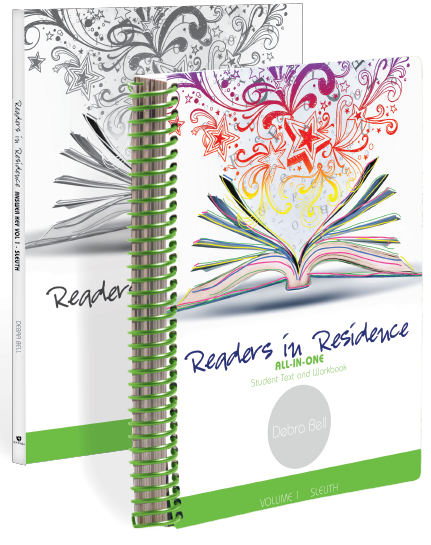
Readers in Residence Volume 1 - Sleuth is a new offering from Apologia Educational Ministries. For our review, we received the "full set" of books for the program (both the consumable/single-use student work/text along with the Answer Key).This new, literature-based curriculum can be used as a standalone reading/literature program, or in conjunction with Apologia's Writers in Residence to create a full (one year) Language Arts program. The target reading/comprehension level for the program is 4th grade, though it is also appropriate for older students.


Apologia: Reader's in Residence (Homeschool Review Crew)

Readers in Residence uses classic literature books (Sarah, Plain and Tall, Charlotte's Web, and Because of Winn-Dixie) as the basis for the instruction. Students are also expected to read a book from each of the chosen works' genre (i.e., a second historical fiction, etc.)   Skills developed through exploring these titles include:

-general reading comprehension/plot awareness
-inference
-vocab from context clues
-literary features: personification, hyperbole, metaphor/simile
-use of grammar and punctuation to achieve effects

The answer key includes fixed replies (i.e., facts about the characters/plot, the correct answer of "choose simile or metaphor for this sentence," etc.) as well as suggested/appropriate answers for open-ended questions ("What do you think...," "Why did she..." etc.)  While I generally read the books I assign to Jude, I appreciated both styles of answers because here, I hadn't read the book in a few years.  I've found that it helps Jude to understand more when he's able to focus more on the story (characters and plot) and less on actually decoding the words, so usually we read the books aloud as he works through a literature study.  To work on his independent reading skills, I expect him to read an age/grade level appropriate book for about 30 minutes each day.   I had assigned him Because of Winn-Dixie as independent reading just before we received this program to review, so while I did read it when we began the RIR program, Jude started the first few lessons before I had a chance to catch up.

Apologia: Reader's in Residence Unit textbook

I'm going to admit up front that overall this program didn't really work well for Jude, for a few reasons.

First, to be successful with the program, you need to start at the very beginning. Each new lesson builds on prior ones; often there are references back to the earlier books.  We had just finished reading Charlotte's Web using his regular literature program (different publisher), so rather than risk losing his interest by backtracking and repeating the book, we decided to dive in with Because of Winn-Dixie, the third book Readers in Residence studies.  There were a few places where I needed to adjust the assignment/discussion.  When they referenced the characters and/or story in Charlotte's Web, we were able to make most the connections, but since he hasn't read Sarah Plain and Tall, anything about that book we needed to skip over.  It leaves Jude with a lot of gaps with this program.

Note: You will need to get the books studied on your own; they are not available directly from Apologia.  Also, specific editions are required - for example, you will need the 60th-anniversary edition (2012) of Charlotte's Web that contains Kate DiCamillo's foreword. If you are purchasing the book new, or have a newer library version, this shouldn't be an issue. However, our copy is from a 2006 printing - according to Amazon, I purchased it in 2008, back when Luke was Jude's age.  Again, we were left with a gap because our book didn't contain this.  You can find out the book titles needed by clicking through to download  the Table of Contents (a 40-page sample of the program is available through a free download as well), but I think it would be much easier to have the titles/editions listed on the program's "purchase here" page(s).

Second, each section teaches different literary elements and forms.   For example,  Unit 1 (Sarah...) addresses character development, and theme, while Unit 2 (Charlotte's Web) discusses the components of plot (rising/falling action, climax, etc.).  Unit 3 (...Winn-Dixie) builds on both of these and adds the story's setting as a way for the author to propel the plot.  Justs being familiar with the plot of one (i.e., what happens) isn't enough to be able to work efficiently with the next because Jude didn't have a good grasp of the terms (they are presented in a different way with his usual program.)  Jude did well with newly introduced concepts but struggled with when they were "revisited" from earlier in the book.

Apologia: Reader's in Residence Literary assessment workbork


Overall, I felt the program was quite thorough with what it presented.  Each presented book takes about six weeks to work through, and then allows time and structure for studying the "Your Choice" books.  I'm definitely considering it for Damien because I like that it ties books together, so the student begins to see something pointed out in an "easier" book, and then it appears again later.  For example, every story in existence follows the same concept of rising action-climax-falling action, and you'll want to know that for later as books get more complex - this is something that I find Matthew struggling with because he doesn't have a sound basis of how to find these in a story.  However, he would be starting the program at the beginning (he sat with us as we read Charlotte's Web aloud, but didn't do a formal literature study like Jude did), and I think that would make a huge difference in the ability to do more than answer the fact-based "what happened in this chapter" questions.  I don't believe this is a program you can switch to mid-year because you want to do a unit study that includes a particular title.  You have to commit to the entire study, not just a section of it.

Fifty families have been reading with Apologia's Readers in Residence program.  Click the banner below to find out their experiences.


Readers in Residence Volume 1 (Sleuth) {Apologia Educational Ministries Review}


©2012- 2016 Adventures with Jude. All rights reserved. All text, photographs, artwork, and other content may not be reproduced or transmitted in any form without the written consent of the author. http://adventureswithjude.com
Wednesday, November 9, 2016

The Critical Thinking Co.™: Sentence Diagramming (A Homeschool Crew Review)

I think there are two kinds of people in the world: those that love to diagram sentences, and those that don't.  In my experience, there is no in-between! Luckily for The Critical Thinking Co.™, I like to diagram sentences for fun.  Lucky for me, when we were asked to choose one item to review from a list of several products, Sentence Diagramming: Beginning was among the choices.  It's for students in grade levels three through 12, and since Jude is entering the grade 3 level of his regular grammar program, I was thrilled to teach him how to diagram, too.


Why do I love diagramming?  I think because it is very orderly. Sentences are made up of specific parts of speech.   Every part of speech has a particular place in the diagram picture, and when you diagram a sentence, you will always put the same words in the same space.


I also think that diagramming truly helps a student become a better writer.  They become more aware of sentence structure, of having a balanced number of adjectives and adverbs rather than none at all or so many that a passage becomes unwieldy. I'm watching Matthew struggle with his writing, and I am thinking that he will soon be adding a sentence or two a day to his workload.  Yes, at first a sentence can take several minutes to decode, but once you've had practice, it takes longer to find a ruler!

(And yes, I've turned into my mother.  When I was in the fifth grade, our only written homework every night was math and one sentence to diagram. I can hear her voice: "Where is your ruler?  A ruler.  I said, FIND YOUR RULER.")


Sentence Diagramming: Beginning is a 72-page soft-sided workbook.  It can be used as a consumable, but the publisher generously allows photocopying within a single family.  As a parent of multiple students, I definitely appreciate this bit of potential frugality! The program begins with breaking down the simplest of sentences: a simple subject and a simple predicate, and adds a new part of the sentence/part of speech with each subsequent lesson.  After finishing a second-grade level general grammar program, Jude knows subjects, predicates, objects, adjectives, adverbs, and conjunctions. This experience creates enough mix-and-match parts of speech for him to be able to start diagramming.

Each lesson contains several pages of practice, progressing from observing completed sentences to independently diagramming.  Students are first asked to compare incorrectly diagrammed sentences with correct ones, then diagram sentences in a fill-in-the-blank scenario, and then given a sentence and basically told: "Have at it!"


We found the first few chapters quite easy.  They focused on subject/verb, subject/verb/direct object, and sentences with adjectives.  Jude did well grasping the concept of where things went but needed a little extra help with practicing.  It is easy to hop from the workbook to a practice notebook and then back again.


Honestly, I think the hard part was trying to figure out sentences that fit the correct pattern.  I would begin to write sentences, but have to go back and change things because I was naturally putting prepositional phrases -- i.e., "The cowboy rode in a rodeo," or wanting to continue "Annie ran," with a modifier like "quickly," that he hadn't yet learned.  I loved that there is an appendix in the back of the workbook with the answers, but I would have really liked a maybe three or four-page section that had a list of sentences that went with each of the exercises. As you continue through the book, the sentences get more detailed, adding in conjunctions, prepositional phrases, etc.   If you want to keep practicing the simpler sentences, you'll need to add in a notebook/outside worksheet program for supplementing.  We are getting into the habit of creating and diagramming two or three sentences each day for practice.  Here are our Election Day practice sentences:


Overall, I think this is a very clear way to introduce sentence diagramming. Jude was intimidated at first, but after a bit of practice, he remarked, "You know, this is kind of fun!"


Hey, Jude?


In addition to this workbook, the Crew reviewed a preschool academics software bundle, Reading, Writing, and Arithmetic Before Kindergarten!™ as well as the Language Smarts Level E program. Click the banner below to read reviews about each of these items.


Language Arts {The Critical Thinking Co.™}


Crew Disclaimer

©2012- 2016 Adventures with Jude. All rights reserved. All text, photographs, artwork, and other content may not be reproduced or transmitted in any form without the written consent of the author. http://adventureswithjude.com

Wednesday, May 18, 2016

Institute for Excellence in Writing: Linguistic Development through Poetry Memorization (A Schoolhouse Crew Review)

When we began homeschooling, I had zero ideas about what homeschooling "style" we were.  "Whatever works," was what I'd say if someone asked me which theory best described us.   We're now in our fifth year of homeschooling, and while I would say we could be categorized as "extremely eclectic," we are finding that a classical, memorization approach to some subjects has been successful for us.  Knowing this, I was eager to try out Linguistic Development through Poetry Memorization from Institute for Excellence in Writing.  Our review package included a Teachers Manual, five audio CDs with five levels of poems and speeches, and a DVD recording of Andrew Pudewa's presentation, Nurturing Competent Communicators, and a .pdf file containing the Student Book.   It also included download codes for six additional audio MP3s (an audio version of Nurturing Competent Communicators is also included).  The student book is also available separately as a pre-printed spiral-bound book, which we also received.


The centerpiece of Institute for Excellence in Writing's curriculum is a core writing program for students and additional, supplemental activities.  One of our favorite add-ons is their Fix It! Writing program.  Luke and Matthew worked on it when we reviewed the program a few years ago, and because of their success, I then used it for Celia (to give her some extra assistance in grammar and writing) and Jude.  While it's not necessarily a purely classical model, Jude's appreciation of the repetitive nature led us to use some other similar programs, including one that uses poetry as a base for learning spelling words and rules. Through the year of using it, Jude's confidence has bloomed; he gets excited when he can say "I remember this," and takes great pride in being able to remember passages without having to wait for me to dictate them.  I looked forward to trying this program that used more adult poetry for source material rather than his other program's "nursery rhymes."

Before beginning the core program, I viewed Nurturing Competent Communicators.  In this presentation, Andrew Pudewa explains the mastery system, how it was used throughout history as a primary way of teaching/learning, and why memorizing poetry can positively impact a student's vocabulary and writing.  Here, he and I agree, but then our opinions diverge.  Mr. Pudewa discusses a long-held belief: if students are well-read, they will also be able to write well.  He makes the argument that many of the books children are exposed to should not be considered a source of language that is "reliably correct and sophisticated."  One one hand, he may have a point, but I would say that any book a child reads is better than one that sits on a shelf.  Having a child who struggled for so long to crack the visual and auditory codes of reading and speech, and even still often fights to comprehend them, I would argue that even a "lesser" book that interests the child and encourages a love of language is priceless.  I agree with the idea that we should read good literature aloud to and with our children, but I think that "good" is in the opinion of the reader.  I would rather Jude choose to read and be engaged with a book about superheroes rather than "check out" when being read a classic, as he did when we read Tales from Beatrix Potter.  (Maybe this is why we do not subscribe to a single educational theory?)

I tried not to let this bit of ruffled feathers affect me when Jude and I began studying. I went with the idea that we were just going to learn these great poems "for fun."  Apparently, my idea of fun and Jude's idea do not agree.

All students (regardless of grade) begin at Level One, and progress at individual paces; once they memorize a poem, it's time to start the next. I thought the Level One poems, with rhymes like "Ooey Gooey" and "Celery, stewed, is more easily chewed," were cute, straightforward, and simple to memorize.  Jude, however, though the opposite.  To him, they were random things to learn.  The student book included the words for him to follow along with (definitely appreciated when auditory processing is not a strength), but there was no lesson to connect with - no copy work, no phonemic chunking, no supporting lesson.  I imagine that the poems could be worked into other lessons/unit studies, but they didn't align with anything we were currently doing.  For him, it was like stepping blindfolded into a room and being expected to remember everyone's names.

He also struggled with enjoying the words.  The first time we went over the poems, they were "sort of" fun.  After that, they were like his speech homework, and he fought working on them (he'd rather lose a privilege for not doing his work than fail at a task).  I'd like to say that repetition at least helped his speech, but it only left him in tears. After much negotiation, we agreed that he would work on making it through the entire poem twice, and be done.  He succeeded in matching the cadence of the recordings, but not the articulation; he just couldn't get his mouth and tongue around the sounds.  Without being able to get the words clearly, he couldn't remember the poems from day to day.  Clearly, this was not a flaw with the program, but it does make want to warn others that if your child struggles with articulation, these may be frustrating for him.

In addition to four levels of poetry, there is a fifth level of (excerpts from) notable speeches.  They are chosen from different eras but serve as examples of great orations.  Among the pieces are the classic Greek Socrates' Apology by Plato,  Lincoln's inspiring Gettysburg Address, and Churchill's rallying We Shall Fight on the Beaches.  It also attributes the Brandenburg Gate Speech to President Ronald Reagan.  While it is the image of Regan standing in Germany, uttering the demand, "Tear down this wall!" that I clearly recall from my childhood, I wish that credit had been given to Reagan's speechwriter, Peter Robinson, for penning the iconic speech.

I know Jude is capable of memorizing because I've seen him do it in multiple situations.  However, Jude's particular set of disabilities made this program nearly impossible for him.  I think that the idea this program is a good one, and the selections that have been chosen are fantastic.  The bylines read like a "Who's Who" of poetry: William Shakespeare, William Butler Yeats, Robert Frost, and Alfred, Lord Tennyson are among the notable authors; it even includes one of my favorite poems, Lewis Caroll's Jabberwocky.   I still think I love the classical ideas of this program, but I've decided we're definitely not purists. This is a substantial exposure to poetry, and I am inclined to use it next year as a spine (not stand-alone) for Matthew's literature course.

For more about this and other IEW programs, follow them on social media or click the banner below. To read our previous reviews, click the titles:

Fix It! Grammar
IEW Resource Trio


Facebook: https://www.facebook.com/excellenceinwriting 
Twitter: https://twitter.com/iew
Pinterest: https://www.pinterest.com/iewriting 
YouTube: https://www.youtube.com/user/iewtv

Linguistic Development through Poetry Memorization  IEW Review


©2012- 2016 Adventures with Jude. All rights reserved. All text, photographs, artwork, and other content may not be reproduced or transmitted in any form without the written consent of the author. http://adventureswithjude.com

Wednesday, March 9, 2016

Here to Help Learning (A Schoolhouse Crew Review)

Here to Help Learning Review

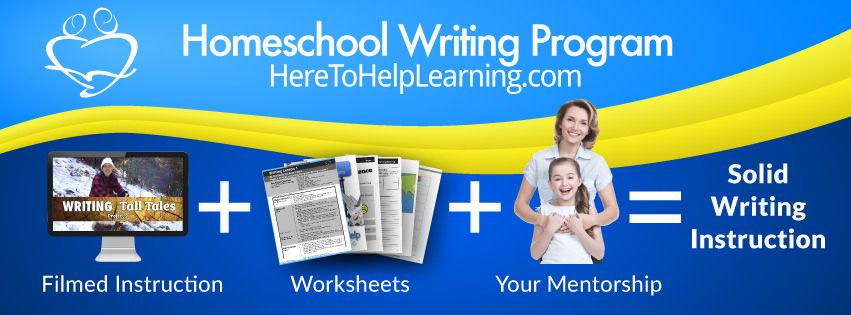
Here to Help Learning is a homeschool writing program created by husband and wife team Forrest and Beth Mora. It stemmed from her experience teaching small groups and co-ops, and it presents video-based lessons that mimic the small group/co-op setting.  We were given a one-year subscription to review; monthly subscriptions are also available. With several children, I appreciate that the subscription rates are per family, not per student.  It includes the instruction videos and printable worksheets and resources for all levels.  (Some side notes - first, a heads up that the Language Helps Booklet is a wonderful resource, but it is set to print in full color and each student will need a copy.  It can be printed in grayscale, but you lose a lot of the visual organization ability.  You'll want to make sure your printer inks are fairly full before you start. There is also a "physical materials" program with color printed teacher’s guides and student workbooks as well as lesson DVDs available in the Here to Help Learning store.)  

About the program's concept

Here to Help Learning has two distinct tracks—paragraph writing - geared to 1st to 3rd grade students,  and essay writing for older (4th to 6th) ones.  I liked that the levels are not labeled by grade.  This means that the student has the potential to work at where he is, and isn't left to feel stigmatized by the grade level assigned.  For example, Jude began with Paragraph Writing, Flight 1.  Even though he's in 3rd grade, he's just learning to write paragraphs. (Some days, I'm happy he uses subject-verb-object sentences!)   You certainly could start an advanced writer further on, but he readily accepted "This is a new program, let's start at the beginning."  


Each of the tracks contains three "Flights".  Each flight covers six assignments and is intended to last approximately one "school year." This means that the Paragraph level students will complete six paragraph assignments, and the advanced Essay Writing students will complete six essays.

The program is designed to complete one lesson each week.  Each lesson includes five parts:
Pre-Flight Check List
Flight Check-In
Take Off
Full Throttle
Flying Solo

Students are expected to work on this class two-ish days per week.  On the first lesson day, they are to watch a video (15 minutes running time; about 30 minutes per lesson including stopping time to complete during-video activities) presented by Beth Mora, and use a second day to complete the work assigned in the video.  Here to Help learning uses a nine-step approach to writing assignment, starting with brainstorming and ending with publishing.  Each project is developed over the course of five or six lessons.   Over the course of study, the student will be exposed to (and will practice) a number of different writing genres.

Our experience

How long it really takes to complete each lesson's work may depend on your child.  Jude took the video day plus two or three more days to complete the assignments.  I don't think they were particularly hard -- he just took a while to grasp things.  Celia gave the program a try as well.  She's my in-schooler, and her Language Arts teacher assigns a "Paragraph of the Week" twice a month.  Even with lots of practice, Celia still sometimes struggles with paragraph writing, especially with organizing her thoughts.  She also started with Flight 1, but completed the first full assignment in only two weeks.  She then went up to the Flight 2 level, and found that she still could comfortably manage 3 lessons every 2 weeks.

Each video begins by going over the key Bible verse and the writing process.  Beth Mora demonstrates the activities that the parent/teacher should do with the students in one of her many "character often includes other students. After each demonstration, Mora tells you to pause the film and do the activity before starting it up again. and ends with assigning the “flying solo” work.  Jude thought the videos were fun.  Celia, however, thought they were too slow, and even complained she was bored.  She thought they were a little baby-ish for older kids.  She said she understood why Ms. Mora taught in that style, but she felt that if an older student was struggling and trying to "catch up", the student might feel "embarrassed or like a dummy."

Matthew is also not a strong writer, and while he's outside the "suggested age range", we thought it might be of help to him.. We looked at the Essay Flights 1 and 2.  (Flight 3 is writing a book.) After about four minutes,  he just flat out refused to work on it, because he thought it was "too much sing-song" and it "hurt his ears."  Ouch.  While I might have put it a bit more tactfully than he actually did, I do agree with him.   The videos are also meant to help the parents be able to help their students on assignment days, I found myself handing out earphones when Celia or Jude was  working.  The over-the-top-ness just was too much for me, too.  If you have a child that is very theatrical, he probably would like this.  If you have more of a "just the facts, ma'am" sort, this probably won't be as good a fit.  (He did say that he would keep his Language Helps booklet - he though that would be of value to him even without the videos.)

I was hopeful that Here to Help would be of more help. This program breaks down writing into manageable and chunks - first a simple "about me" paragraph, then increasing in complexity until the student is capable of writing a short book.  I like how it is organized.  However, with video presentations that felt too caricature-ish for much of the target age range, the execution fall short for us.

To find out more about Here to Help Learning's program, you can follow their blog or their social media channels. For other reviews, click the banner below.

Here to Help Learning Blog: http://heretohelplearning.com/hometohome/

Facebook: https://www.facebook.com/heretohelplearning/
Twitter: https://twitter.com/HTHLTweets
Pinterest: https://www.pinterest.com/HTHLearning/
YouTube Channel: https://www.youtube.com/user/HereToHelpLearning


Here to Help Learning Review


©2012- 2016 Adventures with Jude. All rights reserved. All text, photographs, artwork, and other content may not be reproduced or transmitted in any form without the written consent of the author. http://adventureswithjude.com

Friday, August 1, 2014

Hewitt Homeschooling: Lightning Literature & Composition (A Schoolhouse Crew Review)


Hewitt Homeschooling ReviewLearning about literature is a must for a well-rounded student.  But when you have a student that struggles with reading comprehension, how do you make it easy enough that he doesn't lose hope, yet still strong enough that he gets a good education?  Truthfully, I had no idea.  When the Crew opened applications for Hewitt Homeshooling's programs, Matthew was just about to finish 7th grade in private school and transition to homeschooling.  Having seen his grades (and lived through the comprehension question homework), I knew this was going to be a tough subject to teach.  For a student at his level, were given the opportunity to review the Lightning Literature & Composition program for either Grade 7 or Grade 8.  While Grade 8 would have been the appropriate chronological program, we opted instead for Grade 7 because of its foundational content.

When I first looked at the program, I liked how it alternated reading short works (Rikki Tikki Tavi by Rudyard Kipling, selections from poetry by Shakespeare, Elizabeth Barrett Browning, Henry Wordsworth Longfellow, and Edward Lear,  The Bride Comes to the Yellow Sky by Stephen Crane) with longer novels (The Adventures of Tom Sawyer by Mark Twain, Lewis Carroll's Alice in Wonderland) and non-fiction works such as The Story of My Life by Helen Keller and All Creatures Great and Small by James Herriot. Not only is it a great variety of genres, but the alternating long and short pieces keeps the reading from becoming a drudgery.  Yes, there is assigned reading daily, but the promise of "the next one will be short" is keeping Matthew from giving up on the 36-chapter Tom Sawyer.
 
The full-year Grade 7 program contains three soft-bound books, priced at $20 each:

Lightning Literature and Composition: Grade 7 Student's Guide

The Student Guide contains author biographies, vocabulary words and comprehension words listed by chapter,  sorted by chapter, lessons on the literature readings and composition, and writing exercise guides.

Lightning Literature and Composition: Grade 7 Student's Workbook (consumable)

This book contains practice exercises for the corresponding lessons in the Student Guide; for example, in the text the student will learn to identify parts of a plot and then apply this to a passage written in the workbook.  There are also some "fun" activities - such as crossword puzzles - to reinforce comprehension and/or vocabulary

Lightning Literature and Composition: Grade 7 Teacher's Guide

The Teacher Guide includes an answer key to both comprehension questions and workbook pages, discussion questions, answers to comprehension questions, answers to the workbook pages, extra teaching help for the lessons, help in choosing appropriate writing exercises, and discussion questions.  It also includes a two-semester teaching schedule.

I'm impressed at the vocabulary study.  Matthew has been averaging 5-6 words each day with vocabulary.  Inspired by Ben and Me's word study series, we've chosen to take a similar word study approach to lists.


Sometimes, Matthew has really struggled with words, especially writing sentences.  This has been a good exercise for him to work on not just definition of words, but using them in an appropriate manner - for example, using a noun as a noun and not trying to turn it into a verb.  (It's also been good handwriting practice.  Trust me -- for Matthew, this is pretty tidy.)

Though labeled for grade seven, this program is recommended for students in grades seven or eight.  Knowing this, I felt better about choosing a "lower level" program for Matthew.  We knew he'd be homeschooled for high school, but after his struggles the last two years, we felt that taking the 8th grade year at home would help us all be better prepared for the demands of a high school English program.  While he came from a school with a very strong literature and writing program, his grades showed he may have a poor grasp of the material.   Having used this now for some time, I think he absorbed the information in the past, but just was unable to show mastery.  Where I think this program really helps him is the pacing of lessons.

Rather than reading a piece of literature  by a certain date and then starting a discussion in class, this program purposely works at a steady pace -- about 40 pages per week -- and is meant to work with the discussion questions as you go along, rather than a giant exam at the end. It's much less overwhelming to read a chapter a day than it is to be looking at a 200-ish page novel!  This makes a huge difference; the slower pace allows him time to read rather than skim.   The Teacher Overview is deceptively slow -- 4 chapters a week -- but when you included the accompanying vocabulary and comprehension questions, it certainly provides a significant amount of work to accomplish each week.

There is a lot of writing involved, and in many styles. The guide book's end-of-unit writing exercises range from short-ish (five paragraph) essays to poems to character sketches.  Within the units, workbook assignments include instruction in deconstructing a paragraph into notes followed by a lesson in writing a cohesive essay from a list of notes (like the one pictured), writing to a specific audience, and creating poetry.  There is also a heavy dose of grammar and proofreading.  In addition to the main works studied, the workbook draws from other literary resources; for example, in the workbook pages accompanying Rikki Tikki Tavi, the fairy tale Little Red Riding Hood by Charles Perrault is the practice story for identifying parts of a story's plot, while Thornton Wilder's Our Town is the inspirational work for creating an original dialogue in the unit for The Bride Comes to Yellow Sky.  The program outline calls for this writing to be done between reading the literary works, but we've opted to adjust the recommended schedule and are working on some of the workbook writing while still reading.  Otherwise, I think it would be too large a bolus of writing.

Overall, I think this is a strong literature and writing course.  Some things for Matthew are easier than we anticipated - he does recall what some of the writing styles are (fictions vs. autobiography vs. poetry), and the vocabulary that goes with them.  Some things - like the vocabulary - are hard.  The vocabulary list is certainly exhaustive - even the short Rikki Tiki Tavi had 10 words on its vocabulary list, so I definitely feel he's going to have a drastically increased vocabulary when he's done.  There is plenty of opportunity to practice writing.  While he's had his moments where he's pushed back because he doesn't like writing, or needed help with cleaning up a draft, expectations and directions are clear enough that he can do an appropriate rough draft that simply needs help with polishing, rather than hand-holding the entire way.   I haven't decided if we will complete the entire program, swap for unit studies of same-genre books that are more interesting to him, or possibly consider the 8th grade study program, but I will certainly be using this program as a measuring stick. 


 In addition to the 7th Grade Lightning Literature & Composition program, the Crew reviewed seven other programs for students in grades K-12.  You can read about them by clicking the banner below.  To connect directly with Hewitt Homeschooling, find them on Facebook, Twitter, Pinterest, Google+ or the Hewitt Blog.

Click to read Crew Reviews


©2012- 2014 Adventures with Jude. All rights reserved. All text, photographs, artwork, and other content may not be reproduced or transmitted in any form without the written consent of the author. http://adventureswithjude.com

Wednesday, June 11, 2014

Learning Wrap-ups (A Schoolhouse Crew Review)


Learning Palette Online Program Review from Adventures with Jude

The Crew recently was given the opportunity to review several products from Learning Wrap-ups.  Learning Wrap-ups is a mathematics program developed by a teacher looking for a way to help her students.  Some of her students were not succeeding with memorizing multiplication facts with "traditional" flash cards, so she developed a different way that would work.  The product line has grown from the initial multiplications facts manipulatives kit to encompass other areas of mathematics and other subjects, such as language (English and Spanish), science, and even music theory.  It also has expanded into the Learning Palette program; instead of string and sticks, a round "artist's palette" style base is set with interchangeable cards and colored disks are used to indicate answers.  This program has also been independently expanded into the Learning Palette Online language arts and math program for students in K through 5th grade.  Our family received a full online family subscription from LearningPalette.com  Subscription costs are $25 per year for a single user, or $60 per year for up to five students in one family. Two students in our family,  Jude (1st/2nd grade) and Damien (PK) have been trying it out, with mixed success.  (Note: They are currently offering a 20% discount if you use the coupon code HOMESCHOOL.)

From an academic angle, I think this is a very good program.  The online series contains two sections - Language Arts and Math, and each subject is divided into different levels. The divisions are pretty logical (generally by expectations for that grade), and you can move around within the level/activities.


I also like that you can do different levels within the program.  For example, Jude easily completed the Level 1 math activities, and then started in on Level 2.  However, because his language skills are far behind his math abilities, so it was good to be able to start in the Basic level cards for those.


 The some of the Basic level skills for language arts corresponded with some of the things we have on our "Speech Therapy" activities summer/home program list - matching pictures with sounds, rhyming, etc.


 I foresee us using the language side of the program more as a "speech therapy" activity, rather than an actual "school" activity.

Damien started with Basic levels, and did OK with a few activities.  He didn't get much beyond "Match the Letters" in language arts or matching colors & shapes for math.  I'm ok with that, given he's only almost 4, however, unless you have a really advanced kid, I wouldn't start this earlier than the "manufacturer's suggested age" of Kindergarten.  Schools have been using the Learning Palette program for a long time for independent learning centers, and I agree with this practice. It's really more of a review/drill game, and less of a learning activity -- if the child doesn't know that the word jam starts with a /j/ sound, which is written as the letter j, it's not going to be an independent program.  I think if the boys were just reviewing and able to work on their own, this would have been easier.  Damien even struggled with understanding the "split card" idea - where the colored rings made the top matches and the colored disks matched the bottom. I think because their skills are so limited, it was frustrating because they didn't have a lot of variety to work with, and both needed help figuring out even just how to get from card to card.  For example, Jude eventually figured it out by where/what buttons he clicked on in the past, not by decoding that that shape he clicked said "Next Card."

We had an opportunity to review the physical product but I decided to request only the online program.  Given we spend a lot of time working away from home, I thought that the online version would suit us better because it was a lot less pieces to worry about losing in our travels.  LearningPalette.com works on the HTML5 platform, so it can be used on a computer or tablet, or even an iPhone! (The last one is little small, but it will come up.)  Having used it on both a MacBook and iPad/iPad Mini, I am reconsidering the "it's a lot of pieces" stance.  The trade off for having it online is having to drag the "chips" into place.  On the computer, if Jude resized the window mid-card (usually making it bigger so he could see the farthest top and bottom edges), he had to re-place the tokens.

Regular screen
Resized to full screen

On the iPad, we struggled with moving tiles around.  Sometimes, Jude lifted his finger too soon, an a chip would drop into the wrong space.  Once it was there, we couldn't move it.  (This did not happen on the laptop.)  He got very frustrated, because he knew the answer was wrong, but he couldn't fix it.  Damien struggled moving chips around - his fine motor skills aren't there yet, even using a touch screen.  I think the physical product, with the truly hands-on manipulation would have been better suited to them.  (Plus, it would have been a fantastic fine-motor development exercise.)

Jude also needs a lot of sensory input to maintain focus.  One day, we tried working draped over a Bosu ball.


It was really awkward using the computer, and I think having the physical program would have helped with being able to position himself and the item, plus given him a broader range of movement (picking up chips and moving them to another space/into the palette) rather than having only a 4" x 3" trackpad to move only his finger.


Overall, I liked the concept of the Learning Palette but the online version ultimately didn't suit our needs as well as I would have hoped.  Since the boys will be in the age range for quite some time (math skills are covered through fifth grade, language arts to third), not counting therapeutic use, once our subscription runs out I may consider investing in the physical product.  I'm definitely going to check out the reviews that other crew members did of the physical product Learning Wrap-ups activities - click the button below to join me!

Click to read Crew Reviews


©2012- 2014 Adventures with Jude. All rights reserved. All text, photographs, artwork, and other content may not be reproduced or transmitted in any form without the written consent of the author. http://adventureswithjude.com
Related Posts Plugin for WordPress, Blogger...
Pin It button on image hover