Showing posts with label science. Show all posts

Wednesday, August 1, 2018

WriteBonnieRose: Learning About Science (Homeschool Review Crew)

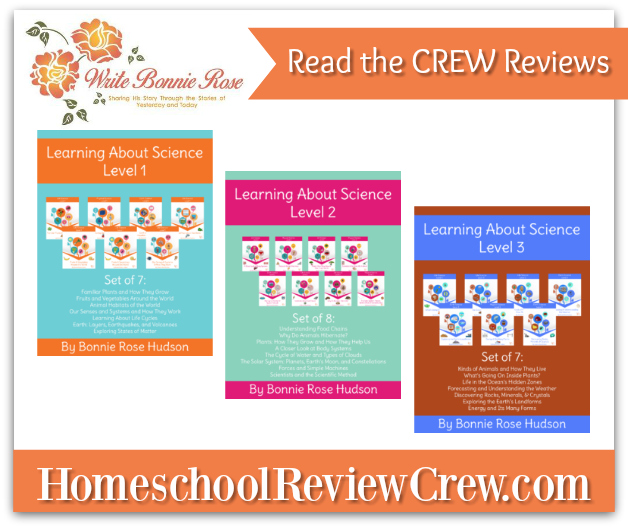
Finding a good Elementary Science program is something that I have always struggled with. Either it's over-simplified and almost a "throwaway" course, or it's written for a wide age range and fits none well.  Jude is finally getting close to grade-leveled middle school science, but since I need something to stress over, my concern is he's going to be under-prepared because he has limited formal science exposure. Since nature abhors a vacuum (there's a science lesson, for you!), I'm hoping to have something different to stress over by the time Damien reaches middle school.  He's been working with the Learning About Science Collection Level 3 (Cursive) from WriteBonnieRose.


WriteBonnieRose is an aggregation of curricula written by Bonnie Rose Hudson.  I've been a fan of hers for some time now.  If you're familiar with the "Build Your Own Bundle" program, she is frequently featured there, which is how I first learned of her writing and history programs. They are generally short and to the point, which is good for younger students.  (I'm not sure I'd call them a "Charlotte Mason" program, but perhaps "CM flavor" -- there is little "twaddle" added.  Let's go with "Enough material to learn, but not so much that you lose a student with ADHD mid-stream.")  The Science collections are leveled one through three; Levels One and Two are print (manuscript) based, while Level Three has both print and cursive options.  Since Damien is already proficient in cursive, we opted for that version.

We received the Complete Collection, which includes seven downloadable PDF unit studies.  (Each unit is also available for individual purchase.) Topics fell under both earth and life science, and across several sub-genres.

  • What's Going on Inside Plants? 
  • Life in the Ocean's Hidden Zones  
  • Kinds of Animals and How They Live
  • Forecasting and Understanding the Weather 
  • Exploring the Earth's Landforms 
  • Energy and Its Many Forms 
  • Discovering Rocks, Minerals, & Crystals
For our review, Damien specifically worked on the plant, ocean, and energy studies.

The studies are about fifteen to twenty pages long, and each took us about two weeks to complete.  As I looked to break them down into assignments, it was a little tricky at first, because there is no visual cue of "stop here for today." The thoughts from one page flow smoothly into the next.


I found I needed to go in and delineate where we needed to stop for the day.  Sometimes, one page was sufficient. For example, the page pictured above right was enough information for Damien for one day.  (The next page began a sub-section of vascular vs. non-vascular plants and their properties.) However, the page above left was actually page three of the section on photosynthesis. One page wasn't enough information for one day -- stopping after page one or two of the section gave him only part of the information, so he was left with an incomplete picture.

This isn't a dealbreaker for the program for me; I include this opinion because if you're a mama reading this and wanting to try it, you'll know to read the study first and figure out what you'll want to cover in a session. If you are only "doing science" once or twice a week, you don't want that many days go by with just half an idea of how photosynthesis works.  I found we were able to divide the lesson into seven sessions (including the review across two days).  He worked three or four days a week, so the entire program took two school weeks.  The same held true for the oceanography unit (nine work days), while the energy unit took three school weeks (twelve work days).   If you're planning across a school year, I would expect the entire Level Three program to take 14-18 weeks at a 4-ish days/week pace, at 2-3 days per week, closer to a full semester.

Black and white graphics accompany most of the concepts. At first, I was kind of unimpressed, and thought "He's going to hate this -- the only way to make a lesson take more than three minutes is by coloring!"  However, Damien really enjoyed this part. It wasn't necessarily the "coloring task" that he liked, but being able to look up and further explore a topic. He particularly liked this with the oceanography unit -- after all, there's only so much excitement that a leave can incite, but a Portugues man-of-war is pretty cool!


My only complaint is there isn't a "blank line" option for any of the studies.  For Damien, tracing is something that becomes more about "staying in the lines" than "writing the word neatly."  I would prefer an open space option, where he could write in the vocabulary words (they're easily identified by bold print in the text) freehand. I think this would help cement ideas better for him (plus allow him to work on his penmanship skills.)


I don't have any personal experience with the lower levels, but in looking at some of the other Crew Reviews for them, they look reasonably appropriate for Damien as well.  While some topics have some overlap (i.e., Level 1 and 3 both have zoology units), there seems to be enough diversity that if I went back to the Level 1 programs, there would be sufficient new information for Damien to do those as well.  I think a slower pace (1-2  lessons per week) might be good for a younger child, but since Damien is in third grade and beginning the "late" elementary phase, I think the three levels combined might make an appropriate full-year program for him.  I'll definitely be checking the Level One and Two reviews carefully (clicking the banner below, of course) to see if the complete Learning About Science program combines to create the science curriculum I'm looking for.

If you're interested in using these for your student, save 50% on the bundled Learning About Science, Levels 1, 2, and 3 with coupon code REVIEWCREW50 through August 15.  This brings the Complete Sets to $6 each! 


Learning About Science collections {WriteBonnieRose Reviews}


Want to keep up with all of our adventures?
Subscribe below to get Adventures with Jude delivered to your inbox.

Enter your email address:


Delivered by FeedBurner


©2012- 2018 Adventures with Jude. All rights reserved. All text, photographs, artwork, and other content may not be reproduced or transmitted in any form without the written consent of the author. http://adventureswithjude.com

Monday, April 2, 2018

Creation Illustrated Unit Study (Homeschool Review Crew)


The Crew offered us the opportunity to review two nature-based unit study programs from Creation Illustrated.  The first was called Snow and the second was Pine Trees.  They are two of eight unit studies that the company currently offers.  Snow goes with the Winter 2018 edition of Creation Illustrated magazine, while Pine Trees can be found in the Fall 2018 volume.  (Note: Links are to digital versions of the magazine.)

The Unit Studies


I have a love-hate relationship with unit studies. I love the concept.  I also have kids who tend to latch onto ideas and run ultramarathons with them.  (Sometimes I wonder how Luke could not have one the science fair in 8th grade.  They asked an Aspie child to explain the mechanics of paper airplanes. I wouldn't have been surprised if they offered him the medal just to stop talking!) I'm always excited to start a unit study and really dig into a topic. The part I struggle with is that by the end I'm usually burnt out and over the concepts, and tired from having to gather up the information and supplies we need.  I often feel very discombobulated by the end -- like we've done a lot of work, but haven't much to show for it.  I think I actually feel differently about the ending of these, for several reasons.


I opened our PDF download of Intricacies of Snow and found there were a lot of embedded links to video and text resources. YAY!!  With these links, the study is almost entirely self-contained.  The exceptions are a few physical items, like a Bible resource, the materials to make snow crystals from Borax, etc.

The studies are in a "notebooking" format.  Another point in their favor.  I've seen so many lapbooking-style studies, and I think sometimes that adds to my sense of "Aren't we done this yet?" because there's so much cutting and pasting to them.  Printing these particular studies as a whole didn't make sense because of so many hyperlinked resources, so we wound up using them from the computer and a composition notebook for the writing.  (Even if you print the PDF out and place it in a binder, you'll need some looseleaf for some of the assignments.)

The only thing to watch out for, however, is if you give your child access to the PDF, he also has access to the answer key.  Jude generally is pretty good at leaving those alone, but some of my other kiddos have not been.  It's definitely tempting having the answers right there! I do like that those pages are pink, not white. It makes them easy to find when I'm looking for the answer, and also easy for me to spot from across the room if someone is taking an unauthorized peek.

When we started this, we were coming to the end of a fairly low-snow winter. The line between "north and west" and "south and east" is generally right at the edge of our township.  When Philadelphia gets snow, we got freezing rain.  When the shore points get pounded with snow, we got more ice.  It also was nearing the equinox, when the sun angle is about the same as late September.   Snow that falls this late in the season doesn't usually stick to the ground.  But lucky for us - and to prove God has a sense of humor - as we worked we got pounded with a slightly east-of-normal nor'easter that left us almost eight inches of the white stuff! It gave us the perfect opportunity to get out there and study it first hand!
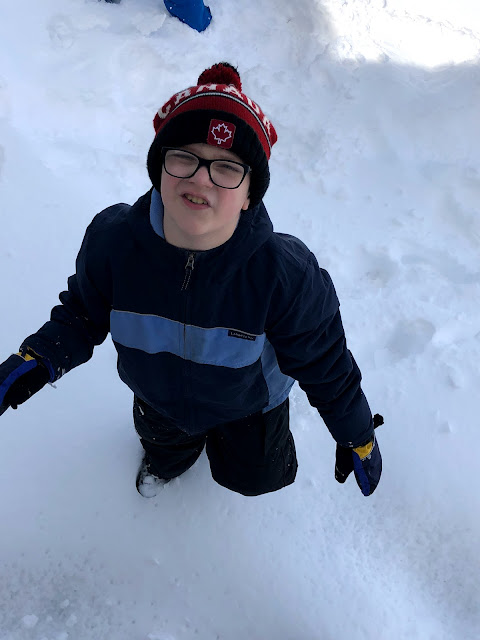

Note: A few of the activities are better if you do have some snow to study. However, if you are studying this in a warmer season or climate, you won't miss out on much, just studying some snowflakes in person. You can easily YouTube videos of snow to re-create everything except direct observation.

The purchase page says the target age is grades 3 through 8, but the Snow and Pine Trees studies each specifically said it was primarily for students in grades 5 through 8.  I think there are some things that younger students might be able to tag along with, like watching the included videos, taking turns reading the Bible verses, etc. An older elementary student might even be able to keep up with the science sections.  However, the math is definitely a bigger-kid section, as is vocabulary.   Because it's so brief, and not really something that, as a curriculum, can be revisited again and again, I'd reserve it for the older kids.

This unit study uses KJV references for the Bible section.  As Catholics, we use the NABRE translation, so when the boys need to look something up, we generally just use our Bible rather than looking up an online King James Bible.  The actual differences in word translation aren't so much of a problem... i.e., "snowy day vs. time of snow," and you get the same idea with clothing vs. raiment being "white as snow."  However, you may find that the particular chapter/verse passages may not align. Here in Psalm 57, you can find references to snow regardless of translation, just not in the exact same spot.  The study asks the student to read Psalm 51:7, which in the KJV translation is:
Purge me with hyssop, and I shall be clean: wash me, and I shall be whiter than snow.
However, Psalm 51:7 in the NABRE is:
Behold, I was born in guilt, in sin my mother conceived me.
and Jude needed to read down to verse 9 for the "snow" reference:
Cleanse me with hyssop, that I may be pure; wash me, and I will be whiter than snow. 
Theologically, it's the same concept, but it's not the same Bible location. I often need to adapt curriculum when there are Bible translations involved, so it's not something new that would keep me from using the program. However, it is something to keep in mind that I need to address, either before I hand over the packet or to remind kiddo, "If you don't find it right there, read a couple verses on either side and come get me if you can't find it nearby."

Another reason to look ahead if you're using a different translation: you also may not find the answer at all!  In Job 9:30 from the NABRE, it says:
If I should wash myself with soap and cleanse my hands with lye.
with no mention of snow at all.  We googled the KJV Version:
If I wash myself with snow water, and cleanse my hands with soap. 

The writing activity assumes your child knows how to write an essay.  Jude is working his way up to multi-paragraphs, so we focused on a single paragraph about his favorite snow activity: making snow angels.


While we've been working on the Snow unit study, I peeked ahead at the Pine Tree unit study we also received.  It is nearly the exact same roster of activities, including Bible study, vocabulary, geography, math, and writing exercises.  (Again, check the Bible verses if you're not using KJV because there's at least one that I've found (so far) that the NABRE translation differs enough that kiddo can't answer the question.)  Snow's math focuses on multiplication and fractions, but Pine Tree's math section explores the concepts of writing equations and the Fibonacci sequence.  I love that it explores so many different types of pine trees.  In our travels, we've seen everything from the white pines we planted on our property line as a windscreen to the lodgepole pines that top the mountains at Yellowstone. I think pine trees are a great way to study God -- pines are as similar yet as unique as all of His Children.  I'm looking forward to doing this one.


Creation Illustrated Magazine


Each edition of the magazine focuses on finding how creation is illustrated "In Nature,"  "In Scripture," and "In Living."  The publisher's goal is to provide a balance of mental, spiritual, and physical renewal in each month's offering.  While Creation Illustrated is appropriate for all audiences, it is very homeschooler friendly, with discussion questions at the end of the magazine for several of the articles.


Each volume also features coloring, photo, and poetry contests. The article we read for our Unit Study, "The Intricacy of Snow" by Brandy Dixon, was from the Winter 2018 edition.


I was impressed because this article used science to explain God, rather than God to explain science.   As Catholics with a belief in theistic evolution, sometimes I find that creation-based studies are almost (or sometimes wholly) bludgeoning Creationist.  Dixon's article beautifully balanced God's presence and work in all things with the scientific explanation for them.  For example, we know that at the center of a snowflake is a dirt particle that forms something for the ice crystals to seed against.  However, rather than going on about how God was so smart in how He got the snowflakes started, she compares that dust speck that to the unfortunate sinful nature of humans.  She goes on to examine this "dirty particle" that through layers and layers of something else (ice for the snowflake, God's grace for us humans), we wind up with a one-of-a-kind work of art.

One thing I noticed by reading through the magazine is that while the one article is mentioned in the Unit Study, there was an explanation of snow on page 66 that was not part of the unit study.  It described three reasons God sends snowstorms: to correct, for the land, and for mercy.  I noticed that the Bible verses Jude read and studied were among those chosen to support these reasons. I wish this article had been included as a resource.

Others have called it, "The Christian answer to National Geographic," and I think that's a fair assessment.  Articles are researched, written, and illustrated well.  The major articles center around four major topics:

  • Creation Up Close - Seeing God's work, plan, and love in a specific part of His creation
  • Re-Creation and Restoration Outdoors explores how God uses nature to bring us back to Him
  • Creatures Near and Dear to Us - God's way of designing animals mimics how He cares for us (plus, the "aww, so cute!" factor!)
  • The Creation Week - a sequential study of the earth in the context of the story of Creation.  
These Creation Week articles are more clearly Creationist and mention/discredit gaps in evolutionary theory.  However, I think it deftly handled the conversion of Antony Flew. It also prompted me to google Flew, so points for motivating curiosity!  He was a British philosopher who ascribed to an "atheist until somebody can prove God exists" mindset.  His studies converted him to deism when he realized that there may be scientific proof of evolution, but there are some principles that simply cannot be explained other than" the hand of God was involved."  I think this describes our family's philosophy well, so I'm comfortable sharing these with the kids without having to do too much "Well, this is how some think, but we believe something different..." I can just say, "This is a well-written article, read it."

After reading both issues of Creation Illustrated that we had access to, I am seriously considering a subscription for our family.  My only complaint about the digital version of Creation Illustrated is the print is tiny.  I tried to zoom in and make it easier for us to read, but then it seemed to slide all over the screen, or the page turned too easily.  Taking screenshots and enlarging was impractical as well - you can see how blurry the text got by looking back at the screenshot of the discussion questions above.  I think if you were only using the magazine to complete the unit study, it would work fine, as long as you are patient.  If you're interested in reading and using the magazine on a regular basis (it publishes quarterly),  I would really recommend springing for a subscription to the print edition. 

I'm really impressed with these two unit studies. They're not in-depth enough to teach a language arts math, science, or "how to research a topic" concept on a middle school level, but they're a well-thought, well-organized way for a child to practice any of these skills he has learned.  The Spring Edition of the magazine will be available soon and will be accompanied by a new, ninth unit study on BUTTERFLIES!  These are some fantastic creatures, and after working with these two unit studies, I'm excited about this new release.

Other crew members have been working with these unit studies.  Click the banner below to read their reviews!

Creation Illustrated Unit Studies {Creation Illustrated Reviews}


Want to keep up with all of our adventures?
Subscribe below to get Adventures with Jude delivered to your inbox.

Enter your email address:


Delivered by FeedBurner


©2012- 2017 Adventures with Jude. All rights reserved. All text, photographs, artwork, and other content may not be reproduced or transmitted in any form without the written consent of the author. http://adventureswithjude.com

Thursday, March 15, 2018

NatureGlo's eScience (Homeschool Review Crew)

NatureGlo's eScience is a STEAM curriculum program presented by NatureGlo. The program is comprised of both live and self-paced courses, making it accessible to students with both fixed and variable schedules.  For our review, we received a subscription to the self-paced version of the  MathArt Online 4-Class Bundle, which consists of four 6-week courses:

  • Math Connections with the Real World
  • MathArt in Ancient Cultures
  • MathArt in the Arts and Sciences
  • Math Art: Patterns in Nature 
Note: As of 3/2018, only the first two programs listed are available in their entirety.  Two lessons for each of the second two are available, with others being uploaded on a weekly basis.


We began with MathArt in Ancient Cultures.  The program is suggested for ages 10 and up, so I thought this might be an opportunity for Matthew.  He has completed nearly all of his core high school requirements, and his transcript is heavily tilted toward math and science -- he just seems to enjoy their black-and-white aspect.  He does have an art credit already, but he struggled with it.  The art history program he took focused more on the actual history of art and where the pieces fit into history, and less about the works themselves and how they were examples of that era (i.e., the use of color, line. shading, etc.)  I thought a cross-curricular, unit-study approach program might be a way to add art instruction in a way that played to his interests and strengths.  Because Matthew is almost in 12th grade, he works mostly independently.  I gave him the login credentials and told him "Go to town!"

He got himself organized downloading the first study guide and began working his way through the first lesson on Babylonian Mathematics. I liked the organization of the webpage - the current activities were in the body of the page, with an easily navigated task list in the margin.  As you completed a task, the list struck itself.  This made it easy for me to keep track of where he was in a course with just a glance.


 Following the directions, he began to read the slideshow and fill out the interactive guide.  It's well laid out and makes the information easy to locate.  (Perhaps too easy for a high-school student, but I can appreciate that this is meant for early middle-schoolers who may be just beginning to learn to take notes.)


The next step was to watch the NatureGlo videos.  If this had been something I had gotten for Matthew to do, I would probably have just let him loose. Since it was a review, we sat down to watch the video together.

What we were watching were the same activities he had already done, just this time with the NatureGlo and other children reading aloud.  It was jarring at first, because NatureGlo is inviting kids to take turns, and asking them questions.  I think I was expecting a self-placed class to be presented as a pre-recorded lecture series, rather than just a recording of a live class.

 Also, the sound was a bit "off." At first, I thought it was our connection causing the distorted sound.  After listening a few more minutes, I realized the reason.  NatureGlo is a full-time RVer, and conducts classes from her home on the road. I think this, unfortunately, limits the quality of the recordings.  We have done many online/streaming programs, but they have had professionally recorded lectures, including sound mixing, which is what I was expecting.  These sound like what I overhear when Celia is talking to her violin teacher during her lessons (they take place via Skype). It appears only the built-in microphone and camera from her computer are being used as recording devices.  Between the sound and the interactions, I felt like we were always just a little "behind" -- kind of like watching live TV on a tape delay.  It was rather disconcerting!


As a mama with lots of homeschoolers, I always like it when we can share products across students. I also like when publishers offer bundled prices!  I rarely comment on the actual prices, because as a small business owner, I understand there are so many hidden "behind the scenes" costs. I also know that quality high school-level classes can be expensive. We are not rich by any means, but since we are unexpected homeschoolers we are also coming from the mindset of "high school tuition that we budgeted for is far more than we're paying to homeschool." I also am willing to pay for something that my kid loves and really learns from -- I genuinely believe education in something a child is passionate about is an investment.  (Please remind me of this when Celia's violin tuition comes due!) However,  when I review, I do try to look at programs from the perspective of "How would I feel if I had paid for this?" and not just automatically love it because I don't have any financial investment. The bundle cost for the four-class group is over $500 (an individual program is priced at $149), and I just don't feel as if the recording quality or content justifies the cost.  (And that's even ignoring any costs for recommended or added projects.) It is also only a one-year subscription, and because my kids are far enough apart in age that they can't double up, that means paying that again as each child is ready.   I can't imagine paying that times four! II have to say that if this weren't a program we had received in exchange for a review, I would have been quite upset and even a bit angry.

From a content perspective, I think this is more appropriate for younger students - maybe the 5th-to-8th grade set. It is too little content for a reasonable high school credit. (A high schooler certainly isn't too old for the information, but it would be a recreational course, not something to count for a transcript.)   First, the first two lessons of each unit are basically the same. He could skip the first PowerPoint-based task and glean the information from the disappointingly short 10-minute video. I was expecting the video part to be 30-45 minutes (given the live classes meet weekly) with the other activities as "homework" during the "week" between classes. However, there's not enough content in the rest.  Doing the program "as is," he could complete the entire lesson in under two hours.  My general rule is there needs to be at least 80-100 hours worth of work, between lectures and independent work. I had expected to throw in an extra project or book here and there with each of the four programs, to round them out, but found I was looking for "more" to bulk up each "week." It also slowed us down in working through the program.  My initial plan for Matthew to work on the 6-week course, and possibly add on one reading/project selection at the end as a "final project," where I would have had the 6 weeks to acquire the extra books/materials for that final part. Instead, we have taken almost four weeks for our first lesson,  and I've been scrambling to gather materials (quickly but without obscene shipping fees!) so we're not constantly looping back to "completed" topics.  Again, it's an added expense to make an already pricey product work for us -- I just can't in good conscience not say, "Be prepared for the added costs."

Thinking that maybe it was just the course we had chosen that was short (given there's only so much information known about the ancient cultures), I began looking through Math Connections in the Real World, which includes topics like the Fibonacci Sequence and it's use in not just "art" but in architecture and engineering.  Again, the lessons are short and not as deep as our needs.  They are a good introduction to the topic, but not enough for an older student.


Overall, I don't think this is a bad program, and what content it does contain is good. For example, the further reading for the Babylons includes an article published in The Mathematical Association of America, as well as a second article with a detailed explanation of how the Babylonians used the sexagesimal system.  Matthew really lit up when working with a third printout, manipulating numbers himself and seeing how both base six and base ten arrived at the same answers but from very different paths. I'm not quite sure I understood it all, but he clearly did.


Overall, NatureGlo's eScience just didn't do what we needed it to do, which was fill an educational gap for a high school student.  To find out how it worked for other Crew families, click the banner below. 


MathArt Online 4-Class Bundle {NatureGlo's eScience Reviews}


Want to keep up with all of our adventures?
Subscribe below to get Adventures with Jude delivered to your inbox.

Enter your email address:


Delivered by FeedBurner


©2012- 2017 Adventures with Jude. All rights reserved. All text, photographs, artwork, and other content may not be reproduced or transmitted in any form without the written consent of the author. http://adventureswithjude.com

Thursday, September 7, 2017

Apologia: Marine Biology (Homeschool Review Crew)

This is not our first Apologia Educational Ministries science program review, and their high school Marine Biology program is a bit of a homecoming for us. While we've studied with several Apologia curricula, our very first Crew review was of their elementary level Swimming Creatures of the Fifth Day.   It was one of Jude's first formal homeschool programs and remains a favorite almost five years later, so I was definitely interested when we had an opportunity to use their upper-level marine biology program with Matthew.

Something that frustrates me about many homeschool companies is their "a la carte" set up.  I always feel like I forgot something -- did I get the student book? The teacher's manual? What about the test book?  While there are still other add-on items for the program, and you'll need to purchase lab materials, the Marine Biology 2nd Edition Advantage Set provides a core program of student and teacher materials - student notebook, textbook, and tests with solutions manual - with one purchase.  Apologia also graciously supplied us with the (optional) Marine Biology 2nd Edition Audio CD, which is a complete audio recording of the course read to the student by Marissa Leinart.  (It and the instructional DVD are included with the Superset purchase option.)

To make this more manageable, I'm going to try to divide it into chunks by learning material. As I tried to write my first attempts at this review, I found myself getting lost in all the information. When I write reviews, I tend to organize my thoughts in my head and let ideas flow from there, but I had to actually break out pen and paper, sort everything out in hard copy, and start over.  There was so much about this program to share that the review overwhelmed itself.


About Apologia's Marine Biology Program

This program, when completed with the labs, is a full high school science credit.  11th grader Matthew is elated to be getting to the "electives phase" of high school, and this is providing a novel elective science for him.  Completion of a biology course is a pre-requisite for the program, and I'd definitely agree with that.  It assumes the student has an understanding of biologic processes, like cell structure and function, photosynthesis, reproduction, etc., and while it does explain some basics in context, it doesn't describe them in detail.  Having a good biology foundation is definitely an asset. However, it doesn't have to be Apologia's biology -- Matthew's course was not, but so far it hasn't been a problem.

While I was very interested in the program because of our prior experience, I was also a bit skittish after Luke and Apologia's high school Chemistry course didn't "gel" well.  However, it's a different class and different kid, so I cautiously approached it with an open mind.  I think that we can call this experience a success!

The Student Notebook

The Student Notebook is a huge, everything-you-need, spiral bound volume.  It's actually as thick as the textbook! Everything a student needs to master the material is included.  It gives the student a solid frame for learning.  I used to think "I never had this, and somehow survived!" but the more education evolves, I begin to wish I had more structure and direction than a blank composition book and the instructions "learn to take good notes." Honestly, I think a large reason why this has been a success for Matthew while Chemistry and Luke didn't get along is the Student Notebook.

At the start of the Notebook is a schedule layout.  I am always so excited when a course lays itself out, and it's not Mama handing out the assignments.  Somehow, when it's "what the book says," there aren't any "But can't I read four pages instead of six?" negotiation attempts.

Each module contains pages to take notes.  I think it's essential for high school students to learn how to take notes -- now is the time to figure out what method(s) are more intuitive for them to both write and recall. The book features a new style of note taking for Matthew (he's used to an  I/A/1/a outline format), but I actually think it's one that might work better for him.  My only complaint is I think there aren't enough note-taking pages for us.  (Though adding more would make the book even larger. I think we'll just use loose leaf paper and staple the pages in.)


The "On Your Own" questions that are at the end of each textbook section are included, as well as a fill-in-the-blanks study guide.  Matthew struggles to write "complete" answers, and I think having a clearly defined space helps him.  He has enough space to write several lines of text, and I've pointed out if they're giving him that much space, the answer needs to be more than four words.


There are actually two study guide options included.  Matthew has been doing both, at different paces.  The first one is more of a traditional question-and-answer format, with definitions and short answer questions.


Many of them are not direct "what is this, find it in the text" questions, and involve using critical thinking skills.  Matthew has been filling that one in as he goes through the Module (chapter), at the end of each day's lessons.


The second one is a fill-in-the-blank that uses vocabulary words from the text.  It's a bit more literal, with some leading and hand-holding. (You can see a sample of it in the next section.) Matthew completes that at the end of the unit, doing a first "what do I remember" pass, followed by one last read-through of notes to prep for his test.  After taking the first test, I can say that it is not terribly hard to do well on the tests if you really put forth a good effort on reading and completing the review questions.  The constant repetition worked well for the "classical style learner" in Matthew.


The Textbook

Have you ever tried to look at a text book and your eyes just start to glaze over? These are not your average textbook.  If you're a Charlotte Mason-style learner, you'll recognize the "living book" approach of a textbook written by a passionate author and not a committee.  While they are chock-full of information, they aren't just pages and pages of text.  Larger chunks of information are broken up visually with headings, pictures, and key terms.  The writing and layout pull the student through the chapter, inciting them to keep reading, rather than leaving them thinking "Is it the end yet?"   These breaks help clue a student into "This is important, write it down!"

The text is also studded with lab opportunities.  (There are five in the first module alone!) There are some that require extra materials (like a small shark for dissection -- the former biology major in me is looking forward to that!), but some use basic household items.  After reading through the materials needed for the "Mountain Formation from Plate Movement" experiment, I realized that the equal parts of salt and brown sugar it used didn't necessarily need to be wasted.  He used a sealable container and extra-clean hands; when we were done, it became part of a tasty brine for that night's pork ribs.


The first module focuses on oceanography basics, and most of our experiments involved household/kitchen items.  This one used salt and water to help demonstrate the ocean's salinity and evaporation/concentration.


We did have two (relatively minor) issues with the textbook.  First, the glossary is really skimpy. While some of the key terms are clearly defined separately from the rest of the text in the chapters themselves, some require a bit of discernment.  While it's good to practice learning to pull definitions from context, having the words defined in the glossary reinforces a specific definition (and gives confidence with a "Yeah, you got that one right!").  Matthew has learned to have a dictionary handy for words that he can understand the concept of but doesn't really have a clear idea of a concise explanation.  We also wished there had been a Periodic Table printed in the book. On the one hand, I recognize it's not a chemistry book. However, Matthew found that when taking notes, writing "Na" instead of "salt" or "P" instead of "phosphorus" saved space.  (It's only a few letters, but when space is finite, it's a logical abbreviation.)  Even having completed chemistry, sometimes Matthew just needed help remembering something. It was an easy fix to print one and glue it onto the inside cover, but it's the sort of simple, basic scientific tool that I think all higher level science books ought to include.


The textbook is available as part of the basic program set.  Each chapter contains the question-and-answer Study Guide, and the fill-in Module Studies are compiled into an index at the back.  This means you don't need the Student Notebook to complete the program -- you could answer the questions onto paper.  However, I would really recommend using the Notebook if you have a student who benefits from having questions with the answers (versus just answers written separately).


Also, just writing the one or two-word answers to fill in the Module Summaries blanks doesn't provide a coherent review - and it's a lot of copying to keep them in context.


Tests and Solutions Manual

There's not a whole lot to go into about these.  They're kind of self-explanatory.   I like that all of the answers are in one book, and I'm not hunting different manuals all the time. It also makes the book slightly thicker -- thicker is harder for me to lose!  The tests are separate from the answer key, and I can hand Matthew the test booklet without worrying about any temptations.  He wrote his answers on loose leaf; after seeing the space allotted in the course notebook, he had a good idea of what was expected, so I wasn't so concerned about a stack of blank lines staring back at him.

Audio CD

This is a resource that we actually didn't find useful for us, for a few reasons. First, it's an MP3 CD, not a "regular" audio CD.  Honestly, I'm not sure of the difference, beyond it only worked in the CD/DV drive for our (Mac) computers. Apparently, not all CD players can play MP3 CDs, so if you have a computer that doesn't have CD capability (like a Chromebook), make sure whatever you do have to play CDs can handle this kind.

I thought that it might be useful for Matthew because sometimes he struggles to simultaneously silently read and process/comprehend text.  He will often read things aloud, which forces him to slow down and focus on what he's reading, rather than racing through to the end.  I liked that the recording reads all of the text, including the information boxes and illustrations.  However, I found that often he'd lose focus and stop listening actively/following along, and the narration would devolve into background noise.  We found it was better to go back to him reading sections aloud (stopping to take notes helped create natural breaks) rather than having it read to him.  While it wasn't a good fit for us, I think if you have a student who does well with audiobooks or remains focused when listening/reading along, it is an excellent addition to the program.

Final Thoughts

This is a keeper of a program!  When we first were chosen, Matthew wasn't sure he wanted to do marine biology.  He's not sure what he does want to do for a career, but "stuff with fish" isn't it.  However, having completed a Geology course, the first module that discussed plate tectonics and ocean movement piqued his interest.  A strong academic program combined with of opportunities for hands-on learning with experiments helped make this program come to life.  Revisiting some of the concepts he learned in biology and chemistry triggered thoughts of "Huh...maybe that wasn't all useless gibberish."  Anatomy and Physiology or Advance Biology are typical science elective offerings, but not many high schoolers get to study marine biology. This program, both in topic and presentation, truly supports the uniqueness of homeschooling high school.

Note: If you have a K-6 student looking to study marine biology, check out our review of Apologia's Swimming Creatures of the Fifth Day


55 Crew families have spent the last six weeks exploring under the sea. Click the Crew banner below to surf the web to their reviews.

Marine Biology 2nd Edition Advantage Set {Apologia Educational Ministries Review}


Want to keep up with all of our adventures?
Subscribe below to get Adventures with Jude delivered to your inbox.

Enter your email address:


Delivered by FeedBurner


©2012- 2017 Adventures with Jude. All rights reserved. All text, photographs, artwork, and other content may not be reproduced or transmitted in any form without the written consent of the author. http://adventureswithjude.com

Tuesday, July 18, 2017

Doctor Aviation (Homeschool Review Crew)


Matthew is just about finished his core requirements, so homeschooling is quickly becoming more engaging for him now that it's all about electives!  I may say "You need to pick a science, so you have a fourth course in that field," but because he's a school district of one, he can pretty much choose any science he pleases (or at least that I can pull a program together for).  Matthew was intrigued when  Doctor Aviation, a new video-based learning Aviation History course became available to review. It's recommended for ages 16+, so that fits right into Junior or Senior year of high school and elective time! (PS. Adults who want to just learn more about the history of flight will enjoy this as well.) We received a six-month membership to the program (the standard program length) for our review.

The founder of Doctor Aviation is Daryl Smith.  In the beginning of the first session, he introduces himself and his credentials.  He's a United States Air Force Academy graduate (undergraduate and masters degrees) and instructor, with a 24 years career as aviator and instructor.  Doctor Aviation is a well-qualified tutor!


His lecture style is very low-key, preferring to let the information shine.  In addition to the spoken lecture (which is filmed in an airplane hangar), there are high-quality graphics that help identify and explain information. I felt that there was enough to keep Matthew's interest, but not so much cutting back and forth that it became difficult to follow and keep up with the provided guided notes.


The entire 15-lesson course is divided into six sections:

  • Course Introduction
  • The Aircraft
  • Air Traffic Control
  • Aircraft Maintenance
  • Aircraft Operations
  • The Aircraft II

Each section is further divided into relevant lessons.  By breaking down the topics into smaller session, it allows the program to explore an area without becoming too overwhelming.  Could you imagine trying to cover all the parts of various planes and their capabilities in just one lecture?


Each video-based lesson is about an hour long (most are in the 45-55 minute range).  The lessons are divided into three segments: Technical Trivia, Notable Innovators, and Legendary Aircraft/Events.  They are individual, self-contained lessons that are tied together by a common theme.  For example, the first lesson is about the basics of how a plane works, the innovators were the Wright brothers, and the legendary event was the first flight at Kitty Hawk.  Lesson five ties together maneuvering a plane, Daniel Bernoulli and his work on speed and pressure, and the catastrophic UAL 232 crash in Sioux City, Iowa.  Though the program presents all three sections within one video lesson, each is clearly defined. A student could watch one part per viewing if pressed for time. (Matthew found the short sections helpful waiting for doctors' visits, knowing that he wouldn't be just getting into the middle of something and his name be called.)

Doctor Aviation also provides some of his own props.  Well...jets, I suppose.  Here he is demonstrating flight principles using a replica of one of the planes he flew during his years as an Air Force pilot.


Downloadable PDF guided notes are supplied for each lesson.  There is a LOT of information presented in the videos, and these guided notes are useful for helping the student follow along.


Matthew found these helpful because while he needed to pay attention to complete them, he wasn't trying to figure out on his own what was important and what was detail.  Doctor Aviation also provides (optional) tests that are based on the videos and notes are also available.  (Prepared tests are definitely helpful since those pesky transcripts need actual grades!)


In addition to just the presentation part of the course, there is an extensive "For more information" section in each lesson.  There are links to follow, suggested books for further reading, and prompts for further study.  With so much added activity, we found each lesson took about two weeks to complete!


Matthew has read a wide variety of resources so far, from biographies and autobiographies to technical books.  They're certainly not required to complete the course, but he's become so interested in the suggested titles that he's found himself wanting to read multiple books from each lesson.  (I said to him, "You need to choose one of these," and read the list for Session 2 aloud. Matthew responded, "Can't I have both?"  Ok, then!!)   Among the books he's read are both Wright brothers' biographies The Bishop's Boys (Tom Crouch) and The Wright Brothers (David McCullough) and multiple books about the Chuck Yeager's career  -- Yeager: An Autobiography (Yeager),  The Quest for Mach One: A First-Person Account of Breaking the Sound Barrier (Yeager et. al.)  and The Right Stuff (Tom Wolfe).   With so much reading, we've actually decided to count at least some of it towards credit in Literature. (Read about how we're planning that.)


There are also opportunities for hands-on learning.  Matthew explored ailerons, rudders, and yaws using paper and foam airplanes that he built himself.   These are among several NASA-produced lessons and pages provided in the "To Learn More" downloads.


However, as much as I loved having the extra information to help "bulk up" the course to make it worthy of a full credit, I found chasing things down to be frustrating.  Some of the suggested books were easily available, but many were out of print and only available secondhand.  (If you don't have a very extensive public library, they may also be harder to find.)  The PDFs say that the links were retrieved in mid-to-late 2015, and unfortunately, by mid-2017, many of the links were broken.  You certainly don't need to follow every link or read every book,  but it was frustrating that so many resources became unavailable over the past two years or so.  My concern would be that while the information in the videos would remain current,  the "For more study" resources may become undependable.  While it's understandable that Doctor Aviation may not be able to keep every book in current publish, I would recommend sporadic link refreshing (at least annually) to make sure the information is still available to viewers.

Finding hidden gems like this is what makes being part of the Homeschool Review Crew so invaluable for our homeschool.  Aviation is not something I would have thought of looking for a course for, and yet it's become a real hit for Matthew!   Who knows what else he'll decide to study, but thanks to Doctor Aviation,  we know the sky is really the limit for elective choices.

Learn about how other Crew Members are taking to the skies for learning by clicking the banner below!


Aviation Course {Doctor Aviation Reviews}


©2012- 2016 Adventures with Jude. All rights reserved. All text, photographs, artwork, and other content may not be reproduced or transmitted in any form without the written consent of the author. http://adventureswithjude.com

Monday, July 17, 2017

11th Grade Curriculum Choices

This post contains affiliate links. Thanks for your support! 


As I was planning Matthew's 11th grade year, I sat with his transcript and wrote in the edges what I felt he needed to graduate.  Our state has no formal rules, but if he chooses to apply to college, I feel he needs a competitive-to-local-students transcript.  It certainly doesn't need to match the ones the public district students will have, but I think it should have a similar composition.  To our delight, we're approaching the "electives" phase of our journey - most of the core requirement classes are complete, so we can really start exploring within his interests or specific needs.


You can see from this screenshot of his transcript that he's planning on some extra sciences.  He seems to be gravitating toward earth sciences, and my theory is if it's something he's interested in, that's half the battle.  Since he has completed four credits in Language, he has a space "open" in his schedule for extra sciences. Thanks to the Homeschool Review Crew, we've got the opportunity to do Aviation and Marine Biology.  Matthew is enthralled with Doctor Aviation, so we're going to take the time far beyond the review period and finish this one out, in addition to Physics, his official "Junior Science" course.  We'll probably work Marine Biology in "part time" and spread it into Senior year, and see what else life throws at him.

Our current plan for Matthew's Junior year is carved in play dough...it might dry into the original, or we might squish it back up and re-mold.  We'll see how it goes.  The current plan is:

Language Arts

We're creating our own interest-based literature program, based on the books suggested for his other subjects.  You can read more about it in this blog post.  The one formal program that we will be continuing with is Memoria Press' program for The Iliad and The Odyssey. It began as a review and is definitely a challenge for Matthew, but he finds the books interesting so we'll continue on.


Math

Matthew just began Thinkwell's Trigonometry program.  That will probably take him into very early spring when he'll start their Calculus program (continuing into 12th grade).

Science

One goal is to finish Chemistry! He has completed the "book" part, but we need to finish up the lab section.  We're working with MEL Science kits, and he'll continue through the school year doing just labs to finish Chemistry once and for all!

Physics is coming from The Great Courses.  We're adding in the recommended textbook & problems as well.  I'm looking into lab options.  I remember my own physics labs and they were pretty simple in terms of activity -- the hard part was using all the formulas and math calculations.  I'm leaning towards the Lab Manual section of BJU's program.

Doctor Aviation is our resource for Aviation. Matthew is really enjoying this - and since "good" electives are the reward for finishing core requirements well, I'm all for it!

Update for Doctor Aviation! Read our review for that by clicking here.

Social Studies

This is another two-course year.  Matthew's continuing with American History, using History of the United States, 2nd Ed. from  The Great Courses.  We'll add in some of the suggested reading, as well as using U.S. History Detective from the Critical Thinking Co.  (In our state, American History is a two-year course.) I'm hopeful we'll get to do a little more traveling and add more National Park site visits to our agenda, too.

His other social studies course, Critical Thinking,  also comes from these two resources.  The Great Courses is our choice for video-based instruction.  His first video course is "Your Deceptive Mind: A Scientific Guide to Critical Thinking Skills", to be followed with "Argumentation: The Study of Effective Reasoning".   He's working on two workbook sets from The Critical Thinking Co.: Basics of Critical Thinking and Practical Critical Thinking.

That brings him up to six "heavy" courses.  That's probably all I'm going to plan on, for now.  Being part of the Review Crew means we'll likely get some new stuff to work with, so I'd rather leave him a little breathing room to try new things.  If he's making really good progress, I'll start planning senior year, or we'll add an arts or music course - something "different" that is challenging but not stressful.


©2012- 2016 Adventures with Jude. All rights reserved. All text, photographs, artwork, and other content may not be reproduced or transmitted in any form without the written consent of the author. http://adventureswithjude.com
Related Posts Plugin for WordPress, Blogger...
Pin It button on image hover