Showing posts with label middle school. Show all posts

Thursday, September 5, 2019

Zeezok Publishing ~ Music Appreciation: Book 2 for the Middle Grades (Homeschool Review Crew)


A few years ago, we had the opportunity to review the first installment of the Great Musicians Series from Zeezok Publishing. The newly released Music Appreciation: Book 2 for the Middle Grades program picks up where the first level series leaves off. The composers are included in this music curriculum are from the Romantic era: Frederic Chopin, Robert Schumann, Richard Wagner, Stephen Foster, Johannes Brahms, Pyotr (Peter) Tchaikovsky, and Edward MacDowell. Units are divided by composer, with four or five weeks allotted to each; and each composer is a self-contained unit, so you can begin anywhere in the program, not just at the start. It makes the most sense, from a timeline perspective, to follow the sequence presented in the book. However, because they are self-contained, a family could study composers from a geographic/world history perspective. Chopin is from modern Poland, while Schumann, Wagner, and Brahms are German;  Foster and MacDowell are American composers. I think this flexibility is helpful as a homeschool parent.

Not pictured: Tchaikovsky and the Nutcracker Ballet, provided via eBook 
The program set includes (and requires) the collection of nine biographies and a consumable student book. The student book may be purchased individually if you wish to use the program with multiple students. A lapbook program and coloring pages are also available. (We did not receive them for review, and I opted not to purchase them because our family does not really enjoy lapbooking.)

Most music appreciation courses focus on music styles, and students listening to pieces from to hear the differences between each era: Renaissance vs. Classical, Baroque vs. Modern.  I don't think this is a bad thing to learn, because each style is a reflection on its position in history. Last year, Matthew completed a (different) music history course that taught these nuances, and even just after eavesdropping, I can now easily tell the difference between epochs when I hear a "classical" composition.  However, I think what can happen then is pieces within a genre start to sound homogenous. Celia will play a violin piece, and I couldn't tell you the difference between Handel and Bach. I've learned to listen for what makes a piece inherently Baroque vs. from the Romantic era, not what makes each composer different. I also know little about what motivated each man. Zeezok provides music study from a different perspective.

These biographical studies focus not only on the composers and their music but also on their family lives and character.  For example, Schumann's courtship and marriage to Clara Wieck are discussed.  Wieck, a lauded pianist in her own right, was a fundamental inspiration to her husband, and, like her husband, a champion of other composers.


Often, it is the salacious or scandalous stories of composers that endures, so I appreciate the perpetuation of the good character traits. I also appreciate that the program does not shy away from them, either; while highlighting Tchaikovsky's closeness to family and generous nature, it does include a note about his troubled relationships with Désiree Artôit and Antonina Milyukova. However, it presents them in a concise, factual manner, with no little color commentary (and no discussion, outright or inferred, to modern biographists conclusions about Tchaikovsky's struggles with his sexuality).

The student book includes comprehension questions that correlate to the biographies, as well as information about other facets of the composers' lives and related music theory information.  Journaling opportunities (prompts are provided; students will need a journal notebook or could use a word processing program) are also liberally offered, allowing students to work on writing skills (short answer, self-reflection, creative writing, etc.). Each unit ends with an overview quiz.


For some families, grades are unimportant. However, since Celia requires a graded transcript to apply to college, I appreciate having the checkpoints and quizzes to help me generate grades for her.  They were short but well-detailed, and easy to adapt to requiring extra effort from a high school student.


A significant difference between Level 1 and Level 2 series is the use of QR Codes.  In the first series, we received a case with several CDs containing music selections. As the student reads each composer's biography, musical selections are woven in. This meant every time we reach a composition, we'd have to hunt down the CDs, find the player, etc. It also made it difficult to take with us if we were doing schoolwork at a doctor's office or the karate dojo.  Having QR codes that linked to an online (YouTube) music library was far more convenient; all kiddo needed was to borrow a phone or iPad with an internet connection.


Additional QR Codes are peppered throughout the book for if the student wishes to learn further about a person or topic. Additionally, related topics and (optional) suggested activities are included with each composer study. While each student requires his own consumable workbook, this makes the program suitable for multiple grade levels.  The publisher notes that while Book 1 is written for grades K-6 and Book 2 is for grades 5-8, they are easily adaptable across a range of educational abilities. A younger student could complete the program solely based on what is contained within the biographical texts and added information, with assistance as necessary, while an older student can work independently and has resources immediately at his fingertips for further research.


One of Celia's favorite "added information" bits was about the conductor.  She has played in a local youth orchestra for several years now and has become used to following a conductor.  Using context clues from the tenor of the music, she has learned what the conductor is trying to convey, but she had an "aha!" moment when she read about how conducting isn't just arm movement but body language as well. Now, the mantra, "Always look back to the conductor!" makes so much more sense; just watching his arms from the corner of her eye as she reads the music in front of her only gives a fraction of the information she needs.


Here, Celia is playing with her summer camp's String Orchestra (she is seated in First Chair, Violin). Dr. Erwin is leaning toward the violins, to pull vibrancy and strength from that instrument section.  Her movements are purposeful, not over articulated or dramatic "feeling the music." 

 
Zeezok includes a planning outline for each composer, allotting four to five weeks for each unit as written.  I think it makes the program a more-than-adequate full-year program for an upper elementary or middle school student. However, with the addition of further research and/or a more accelerated pace, this program could be combined with Music Appreciation 1 to create a full high school credit.  Due to time constraints and for review purposes, Celia worked on the program as written, with little additional study. She completed two units in a little over six weeks.  However, she plans to go back to the beginning and spend another six or eight weeks exploring things in more detail and adding in writing assignments.  While we are using this program to round out an "independent study" program for a multiple-instrument musician, it is certainly adequate for even for a non-music student. Since the focus is more on the composers and less about being able to identify musical pieces, I think it also plays to the strengths of a student who is less musically inclined but has an interest in people or history. As we get close to history buff Jude's high school planning, it is a top contender for a music credit for him.  We are really excited to work with this new program from Zeezok. 

For more about our experience with Level 1 of this series, click here: 


For more information about the Music Appreciation: Book 2 for the Middle Grades program, click the banner below to read other Crew reviews. 

Music Appreciation Book 2: for the Middle Grades {Zeezok Publishing Reviews}


Want to keep up with all of our adventures?
Subscribe below to get Adventures with Jude delivered to your inbox.

Enter your email address:


Delivered by FeedBurner


©2012- 2018 Adventures with Jude. All rights reserved. All text, photographs, artwork, and other content may not be reproduced or transmitted in any form without the written consent of the author. http://adventureswithjude.com

Friday, August 9, 2019

Memoria Press Literature (A Homeschool Review Crew Review)

Memoria Press has become a go-to company for our family.  Several years ago, I found that our family did well with their classical education model, and we have consistently returned to Memoria Press' curricula, especially for literature. After trying several literature programs, I have determined that Memoria Press programs are the most consistent performers for us; returning to a Memoria Press study feels like a homecoming.  Our family had the opportunity to work with the Seventh Grade Literature Set.  While this is available as part of Memoria Press' seventh-grade program package, the guides are available as a set and rated for students in grades six through eight.  The collection includes student and teacher guides for
The 4-volume set we received contained a Student Guide and a Teacher Guide for each book. (While the literature books are available with the individual sets, the four-title set does not include the novels.) We used this program in a unique way, assigning two books to students now (rising 7th grader Jude and rising 10th grader Celia) and saving the other two for later.

The Trojan War


Allow me a moment for a bit of background information, please. As some readers may recall, when Jude worked on the Second Grade Memoria Press literature program, he really struggled. Although the program was marketed for second graders, his skills at the time were not quite on par with Memoria Press' expectations.  I have long felt that the program's expectations are higher than average. Combined with Jude's early struggles with reading, I have intentionally used levels that are below his chronological grade level. In fact, for his sixth-grade year, we began with literature guide for A Cricket in Times Square, part of Memoria Press' fourth-grade program. To my surprise, he easily completed this study, as well as the one for Homer Price, so we skipped ahead to fifth grade's The Chronicles of Narnia. I felt that if he could manage this book, we'd move on to sixth grade; if not, we'd complete the rest of the "fifth-grade" literature. Jude proved to me that he really was beginning to mature in his thinking process, so this summer, we moved up to sixth-grade literature. There was an added benefit: while these books were still a year behind Jude's chronological grade level, they were high-interest for him. I felt this interest would be the ridge between "want to read" and "hard to read."

When offered the opportunity to try the 7th-grade package, I was a little hesitant to try anything intended for an even higher level student. However, hope springs eternal and I figured maybe the challenge would be good for him.  If worse came to worst, we could set it aside after the review period and try again later.  When the books arrived, I gave him the choice of reading any of the three options besides Anne... because I knew that set was going to Celia. As he is an avid reader of all things Greek, Roman, and Norse mythology, I was not surprised when he opted for The Trojan War. 


I think this was a wise decision. Jude usually does better with literature studies when the story is familiar to him. If he already has a grasp of the plotline, he can follow details better, because he's not trying to figure out too many things simultaneously.  And again, high interest became the bridge between desire and ability.
While each chapter follows the elementary school-level framework that his previous literature studies have been patterned in, The Trojan War has a lot of information to absorb.  Jude is simultaneously reading Adam of the Road and completing the 6th-grade workbook, and generally manages a chapter every other day. However, we are finding it is taking us a full week to do each chapter for The Trojan War.

However, I don't think the reason is the material is too hard. I think most of it is a battle of wills. In the past, I've never fussed if Jude's answers weren't precise when compared to the Teacher's guides. As long as I could tell that he had the main idea, I let half-sentences slide. I think part of what is slowing us down is, since he's now officially in "middle school," I am no longer letting three-word ideas pass for answers. Much to his chagrin, I'm marking his book where he only has half-answers, or poorly written thoughts, and making him go back and rework them. This then adds another day to the lesson.  He also wasn't particularly happy when I told him I expected (gasp!) actual paragraphs for answers to the Enrichment questions instead of a few sentence fragments. 

Clearly, his brain is capable, even if his willpower isn't quite as strong.

 If you are familiar with the Memoria Press Classical Studies program, then you know that students begin by studying Greek Myths in the first year of the program, and then continue on to learn about Ancient Rome and Greece. While The Trojan War is included in the literature program, it is also part of the Classics Year 4 Program.  While you might be tempted to skip it, especially if you intend to continue through and have your child study The Iliad and The Odyssey in Year 5, this retelling by Olivia Coolidge is an excellent introduction to the epic.  It provides enough details to draw the reader in, but not so much that he gets lost in the minutiae of them. I think Jude will be well prepared for studying these two epics in depth next year.

At our current rate of a chapter a week, it will take Jude a full semester to complete this guide. I'm comfortable with this pace for two reasons. First, this work sets the foundation for something he will study again, so I'd rather him understand what is going on well so that when he studies The Iliad, he will again be "adding on" rather than "starting new." Secondly, I want him to begin to have better study habits. Jude only likes change when it is his idea, so I have a feeling it is going to take some time before he realizes that he wants to make the changes.

My only complaint about the set is that the tests and quizzes are only in the Teacher's Guide. I know that some parents do not administer tests, but I find them helpful to assess what Jude is retaining as he transitions to working independently. However, doing so is not a smoothly integrated process.
First, the parent/teacher needs to plan out where the tests need to be taken; it's easy for a student to "forget" that there is one coming at the end of each part of the book.  (We found writing reminders at the bottom of the last page before a test to be helpful.  Not only did it remind Jude to ask for the test, but it also helped me factor in study/review days when writing his daily assignment sheets.)  Secondly, the copyright notes in the guide state that no part may be reproduced.  This means that I either break the rules (and with a very literal rule follower child, that's not a good plan!) so he has his own copy, or Jude is writing in a book that I would otherwise have no need to replace (plus, he has temptation in the form of the Answer Key at his fingertips!). We've compromised by him answering the questions in his literature notebook, with the Answer Key paperclipped closed.


I wish the Student Guide had the Student's tests, either interspersed or in an Appendix at the back of the workbook, or that there was a separate (reproducible or consumable) Test Booklet, and that there was a reminder/test placeholder for to help the newly independent student not to race ahead.

Anne of Green Gables


Ah, Anne-with-an-E...I think Miss Shirley is one of my favorite literary ladies. I was probably in middle school when I found my first kindred spirit (Anne), my first Book Hero (Matthew Cuthbert), and my first Book Boyfriend (Gilbert Blythe).  Anne has been on Celia's reading list for quite some time, so this was a perfect opportunity for her.  While Celia was finishing 9th grade during the review, so technically "older" than the program's intended age, she has had a literature-heavy year. I decided to substitute Anne for Henry V for the last of her 9th-grade reading.  Do I think this made it too "easy" for her? Not at all.


L. M. Montgomery may have only written books on paper, but her character's words bring them to life. I think anyone who has read any of the Anne books knows Anne's grandiose imagination supports her flair for the dramatic while providing a foil for the prosaic Matthew and Marilla Cuthbert.  In addition to Vocabulary, Comprehension, and Enrichment exercises,  each chapter explores Expressions for Discussion. These could easily be done as an oral discussion, but I asked Celia to write her interpretations of what the expressions meant.  


While some might think that the answers are obvious, making it "too easy" for a high schooler, I think L.M. Montgomery was brilliant. How many times has a parent/teacher tried to help their student learn to write "less bland, more exciting" essays? Writing exercises always talk about using more specific words, more detailed words, more descriptive words...in other words, stop saying "very"! Perhaps Anne has a tendency to be a bit over-the-top, but she's a shining example of careful word choices. Which pulls your heartstrings more, "I'm used to being disappointed," or "My life is a perfect graveyard of buried hopes"?  I think Anne of Green Gables is a book that all students should read so that they can become better writers!  I love how Memoria Press chooses to really dig into the expressions in the book - rather than selecting a quote or two, there are as many as seven or eight to explore. The program does full justice to the book by really allowing Anne (and the Avonlea residents) to have their say.

Classics become classics because they are enduring, but it would be easy for a book published in 1908 and set in the late 1800s, to contain archaic vocabulary.  I can remember doing vocabulary studies myself and wondering, "When am I ever going to use these words?" However, Memoria Press has focused on words that remain pertinent today. 


Comprehension questions include both literal "what happened here" and critical("What did Anne mean...") queries.  In addition to studying the book itself, the program provides writing opportunities for literary interpretation, opinion/persuasive writing, and exploring Anne's interests (Shakespeare) and tribulations (geometry as compared to Waterloo).  


While Memoria Press offers the literature books for sale, the literature sets do not include them. While some of their studies do require specific editions of books, we found this was not the case with this program.  Last Christmas, Celia received a box set of the Anne series and used the edition that was included.  In this case, page numbers did not need to match, as the program is sectioned by book chapter.

Celia has been working at a rate of a chapter every other day.  On Day 1, she does vocabulary, reading, and the expressions for discussion; on Day 2, she finishes the comprehension questions and completes the enrichment. It could easily be done at a slower pace (one workbook section a day over the course of a week), but I'm hesitant to recommend doing a full chapter a day.  It is possible if your child is a fast reader, but it would take close to 90 minutes a day just for literature.  I have done this with Memoria Press literature when we are in a time crunch (trying to get to a logical stopping point before an extended vacation, or when Luke or Matthew was trying to finish a study guide in the countdown to graduation), but it's not necessarily sustainable long term.  At a rate of 5 chapters per week plus review sections and two exams (also only available in the Teacher's Guide), it will take about 8 weeks, or one academic quarter, to finish the book.  I think that's reasonable for a high school student. 

The Hobbit and The Bronze Bow

When my students were younger, I was more focused on the "grade level" of the program.  Now that we have entered into the middle and high school years, I've learned to focus less on the grade a program is assigned to and more on its content, because middle school books begin to be less about a numbered grade level and more about the individual's literacy level and abilities. Knowing that Jude likes to binge on book series, I will likely keep The Hobbit set aside for another year or two until he is ready for the entire The Lord of the Rings series. Like Anne, I think this is a book that transcends grade level.   I think 7th grade is about the youngest age that a student can truly wring all the finer points out of it, but there is no point where a student "ages out" for exploring the book.  The Bronze Bow is set in 1st Century Israel, so it could be studied as part of the "pre-set" 7th-grade program, or it could be moved to 9th grade and part of an Ancient/World History program. While the lower grade programs involve exposure to literary concepts, the study guides at this level of the program use that familiar framework to explore and apply those ideas to the corresponding novels. I think the studies at the middle school level have the flexibility to help prepare a middle schooler for high school expectations as well as provide a relaxed but not too simple study for secondary level students. Once again, Memoria Press has proven why it has become my favorite literature program.


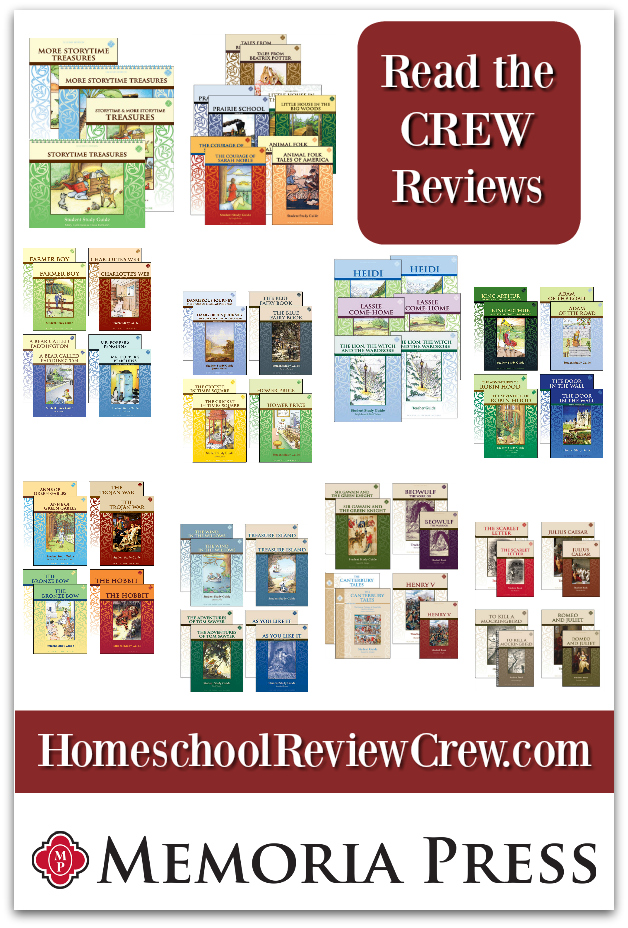
Crew families with students from first through tenth grades have been reading with Memoria Press. Click the banner below to read their reviews of the books they've been studying!   You can also learn about other Memoria Press programs we have worked with by clicking the links to those reviews.

Memoria Press:

First to Tenth Grade Literature Guides {Memoria Press Reviews}


 Crew Disclaimer

Want to keep up with all of our adventures?
Subscribe below to get Adventures with Jude delivered to your inbox.

Enter your email address:


Delivered by FeedBurner


©2012- 2018 Adventures with Jude. All rights reserved. All text, photographs, artwork, and other content may not be reproduced or transmitted in any form without the written consent of the author. http://adventureswithjude.com

Thursday, November 15, 2018

Guitar 360 Method (Homeschool Review Crew)

Most of my readers know that Celia is my instrument player. She has seven years' worth of violin lessons and three years of piano, plus she sang in her grade school choir, but I should consider changing her name to Ariel...as in she can play on her violin "But who cares? No big deal! I want MOOOOORE!!" Several years ago, Matthew took guitar lessons but discovered he is not an instrumentalist, so his guitar has sat in the closet, practically mocking Celia. She's tried a few YouTube lessons but really hadn't gotten very far.  The Crew offered us the opportunity to try more formal, cohesive lessons from Guitar 360 Method...folks, I apologize for the fangirl screaming.


Guitar 360 Method is a new guitar learning program from Krisz Simonfalvi. Mr. Simonfalvi is a musician and teacher who had a circuitous path to his career; he began to play guitar, gave it up because it just did not resonate with him, and then circled back as an adult. He notes that there are two ways to learn to play: one is just by picking at the guitar and learning the technical aspects, and the other is through a theory-based trajectory. The problem is that most theory is based on the piano -- which, while a strong music foundation, doesn't necessarily apply practically to other instruments.  Celia will completely agree with this -- while she can play both violin and piano, it's not like you can interchange music. As she says, "I can play piano music on my violin if I play just the treble clef line, but it may not sound the same or as good as on a piano because I can't play bass clef and treble at the same time on the violin. The melody might sound the same going from violin to piano because you can play just the treble clef." While Guitar 360 Method is actually teaching her a third style of instrument-specific theory, but one that has a practical application to playing guitar.


Have you ever listened to a Billy Joel song? An incredibly strong understanding of how music works is how he could turn what is basically scales into a hit song ("The Longest Time") and morph Mozart's "Pathétique Sonata" into "This Night." Why is theory-based instruction important to me, as a parent? Because theory is what really allows a student to understand what she is doing, why she is doing it, and how to properly play with music. An understanding of theory is critical even just to transpose piano to violin or guitar; without it, you cannot manipulate the music and have it sound right.

Practically speaking, I don't expect her to rise to Mr. Joel's level of renown (if she did, that would be fantastic, but let's face it -- there can only be one Billy Joel), but it's clear to me that the foundation of any musical success is a proper understanding of theory.  Here,  Mr. Simonfalvi shines, because his course is geared toward both the casual student who just wants to learn to play the music in front of him or the student who intends to learn to re-arrange or compose their own music.  He says:


I've taught this content from age 9 and up, however, it is designed for students who want to be creative on the guitar - understanding how music works, rather than JUST learning songs.
This makes it perfect for Celia, because it will teach her both the basics of "how to play" - how to hold the guitar, how to strum, where to put her fingers on the guitar's neck - but also WHY she's holding it where she is and when to use a pick vs. her fingers.  She had an "AHA!" moment right at the start.  Mr. Simonfalvi explains why you press the strings near the frets (better control of the strings and clarity of sound and she looked at me with a dropped jaw. THAT was something she never learned from playing around with other videos; she just thought you stuck your fingers on the strings.  Obviously, in six weeks she's learned more than just where to hold the guitar, but, to me, it's the little things like that - that you don't really know unless you're told - that help make this course worth the tuition.


Guitar 360 Method currently offers two courses. The first is a free introductory level course that will take you from "how to hold a guitar properly" to "I can actually play something, and it sounds like a song" in about three weeks. Obviously, there needs to be a consistent effort on the student's part, but after trying that part out, I can say, "Yes, you will."  While Celia has played around the guitar before, she really was trying to apply what she knew from playing pizzicato on the violin to picking at a guitar. You really don't have the same technique - pizzicato uses a plucking motion, and, of course, there are no frets on a violin neck. Starting at the very beginning helped her realize that playing guitar strings isn't the same at all.

The second, tuition-based course is a 13-week "Semester One." It contains the three-week basics course and then expands beyond "My First Chord" into the major, minor, and pentatonic scales, and then into playing Chords in multiple Keys.  Each week has a clearly defined focus, so the student understands what the goal of the lesson is.

The videos for the lessons total about half an hour, so definitely a reasonable length lesson for beginners - long enough to be worth making an appointment with yourself, but short enough to not be a barrage of information. Celia particularly liked that it's not one long half-hour video, but rather each topic is presented in an individual section.


This meant she could quickly go back over a topic without having to fuss with finding the correct minute mark, or she could break it down into smaller ten or fifteen-minute chunks so that she could learn a concept, ruminate on it a bit, play with it, and then add on the next idea.  Mom liked that there are defined practice exercises assigned for each week. This meant she could go back to the prior week's to work on solidifying those concepts but also had specific activities to reinforce new lessons. There are also quizzes on the ideas, making it ideal for students who need grades for transcripts. While hearing Celia advance in playing skill shows me she is absorbing practical knowledge, the quizzes help me see that she understands the theory behind the playing.


Mr. Simonfalvi promises that students will have enough theory and technique to jump into a band and be able to hold their own by the end of the 13 weeks. Keep in mind, he's not promising to turn your student into Mike DelGiudice and have her be playing in Billy Joel's band in those 13 weeks, but you'll have a competent guitar player that's not only ready to play but also able to understand what she is playing.


Guitar Lessons with Krisz Simonfalvi {Guitar 360 Method Reviews}


Want to keep up with all of our adventures?
Subscribe below to get Adventures with Jude delivered to your inbox.

Enter your email address:


Delivered by FeedBurner


©2012- 2018 Adventures with Jude. All rights reserved. All text, photographs, artwork, and other content may not be reproduced or transmitted in any form without the written consent of the author. http://adventureswithjude.com

Thursday, July 12, 2018

Math Essentials: Math Refresher for Adults (Homeschool Review Crew)

Math Refresher for Adults is a product that fell into my students' laps.  When Math Essentials offered this product for review, my first thought was "LUKE!" He graduated high school two years ago, had good enough grades and placement scores that he was able to skip several pre-requisites and jump into middle and upper-level math courses for this coming fall.  That said, it's obviously been quite some time since he had any formal math.  Because the advertises itself as "The Perfect Solution" for adults who need to brush up on their math skills, I thought this would be perfect for him to work with so that he had a re-solidified foundation.


Once we got the book in our hands and I was able to flip through it, I realized that while it wouldn't hurt him to work with the book, it was probably a little bit basic for his needs.  It focuses on skills such as:

  • General Math
  • Geometry
  • Problem Solving
  • Pre-Algebra
  • Algebra

While all of these are foundational for his courses, this book got re-assigned to Celia. She started Algebra I, but when she took the readiness test for her usual program, she felt she was shaky on some of the basics.  She knew them, but not as well as she would like. She also is transitioning from private school to homeschool, so this was a perfect opportunity for me to assess her skills. Since that was the more pressing need, she found herself the proud short-term owner of the book.

Not Just For Adults 

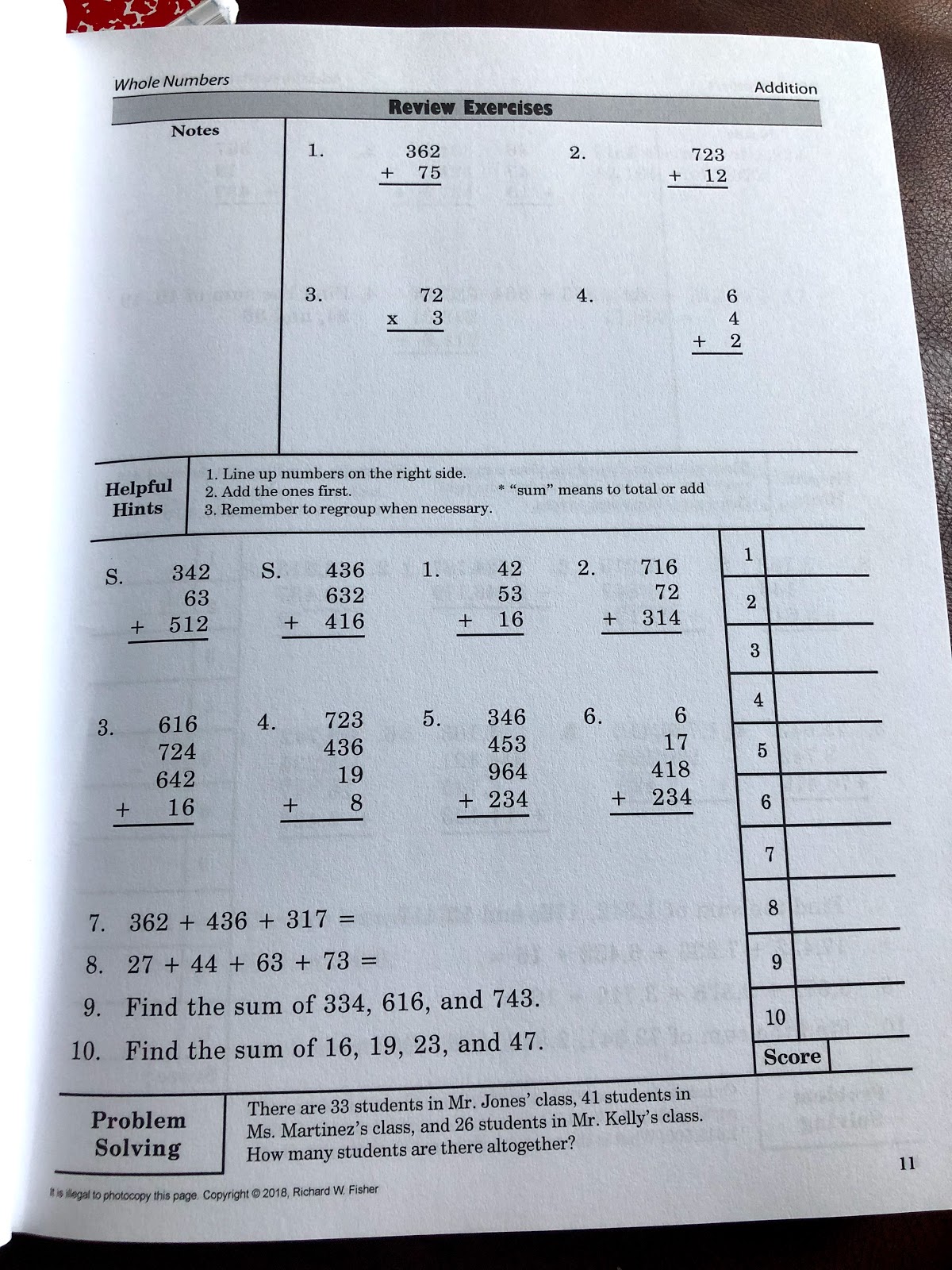
Since Celia was just beginning Algebra, we started with General Math.  This book puts you in the "way back" machine, starting with fairly basic computation - two- and three-column adding, with regrouping.  (If you're an adult working on this, you'll probably be calling it "carrying.")


Each lesson starts with four "review" problems.  At the very start, it doesn't seem like "review" - just more of the same.  As you get further into the book though, they pull from prior lessons.  I like how this keeps presenting opportunities to practice skills.  Let's face it, if you're doing a refresher course, it's because you know "one-and-done" re-exposure isn't going to be sufficient.


Celia felt she was ok with basic math; fractions, decimals, and percents were where she felt weak.  Each page has only about fifteen problems (four review, ten on-topic, and one word problem), so while thirty problems a day sounds like a lot, it only took her about thirty minutes each day to work through them.  She began by doing a page each of Fractions and Decimals, followed by Percents and Integers, alternating groupings each day.  She decided that this would give her the opportunity to review several topics quickly, but also allow her to keep looping back, so it was constant repetition rather than a "topic blitz."

While this is a softcover workbook, it functions better as a textbook.  While you could work some of the problems in the white space, you'd need exceptionally small and neat handwriting for some of them.  Author Richard W. Fisher suggests copying problems onto a separate piece of paper -- which actually helps with understanding, because you're working from start to finish -- and then completing the problem.  Rather than a bunch of scrap paper that could easily get lost, we opted for a copybook.  I laughed when I saw the front of Celia's book, indentifying which Celia the book belonged to -- the "classroom experience" is still active in her mind. Last I checked, we only had one Celia in our school!


As I said, this was an excellent way for me to assess her skills.  This problem showed a couple of weaknesses.


Math isn't just about getting the "right answer." You have to get the process right because otherwise, the correct answer is luck, not skill.  Here, her first try didn't align her numbers correctly.  I followed her thought process, but there were two issues -- either she missed squaring off the problem with a decimal place (and therefore a step in her work), or she wasn't lined up correctly. Her second try fixed the place issue -- but then her computation was off because she "brought down" her decimal point, as if she was adding, rather than "counting over," which definitely affected her answer.  She realized what she did wrong, and got both the correct process and answer on the third go.  While it seems like not a big deal when you're "just" multiplying in a single-step problem, this can become an issue as you move into multi-step problems.  Forget algebra, let's just consider finding a discount and then adding sales tax to determine if you can afford a purchase: when you calculate that 7% add-on, you definitely want to make sure you're figuring based on the correct price!

Heading into Algebra, the extra practice with Integers was helpful.  Again, we found that "setting up" was a weak spot.  Celia wanted to jump right to calculation and answers.  Many times, I had to say "COPY first, THEN work."  Or, show how you get from one calculation to the next.  While I can appreciate when I'm adding multiple numbers I tend to just go across the line in my head, when you're learning to add and subtract integers, it is crucial to do one step at a time until the skills have solidified.


We also learned that she tends to rush, leading to "stupid mistakes."  When you get to upper levels of math, you have to take your time and do problems one step at a time. When I asked her how to solve this problem, her answer was to rush across the line, "Order of Operations, negative seven plus three is negative five, plus eight is three...Oh. Wait a minute."  I pointed out that by trying to do it all at once, one mistake meant the entire thing was wrong. By doing it in steps, she had a chance to see where her mistake was and then an opportunity to fix it. Unfortunately, this is a habit that she didn't learn in school, so it's one we need to set up.


Again, it's not that she doesn't know her times tables -- when I said to her, "um...what is six times three?" she answered, "Eighteen!"  Apparently, she just had a total brain fart here.  Or she was rushing.  (Very likely.) Learning this was as important as actually knowing her times table.  As a parent/teacher, it tells me she needs reminders to slow down. 

Celia will likely continue working through the book to the end.  While she is continuing forward with Algebra 1, it won't hurt her skills to keep practicing basics and making sure she is rock-solid in them. 


Quirks of the Book and Program

One thing I did not like was how the program alternated how it indicated multiplication during algebraic sections.  Here, the answer key in the back was a definite help.  We determined that the x in this problem meant "times," not "the variable x."  That makes a big difference in solving. (Even if you do have to go back and slow down on the times table part.


There were several problems written like this, so when she came to one, I made her stop and ask me which way to do it, but just looking up the answer then primes the student to work backward from the answer, rather than seeking the path to get to the answer.

I also wish the answer key had more detail than "just" the final answers.  For example, there are problems labeled as "muti-step," yet the Answer Key only gives the final answer.  The page's Helpful Hints lists "Decide which operations to use and in what order" but there is no way to check if the student has chosen the right plan of attack.  Yes, this book is supposed to be a refresher course, but I think it's really just providing practice, not actual "how to" refreshing.


It would really be helpful for both the teacher and the independent student to be able to see&nbspnot only that it IS wrong, but WHY the answer is wrong. This might make a single book exceptionally voluminous, but perhaps the program could be converted to a two-volume set that includes a student workbook + answer key.

While I agree with Math Essentials that it is helpful for parents who want to help their children but need a refresher, there were sections where I just looked at the problem and said, "Hmmm...how about YOU show me, and then I'll check it."  Yes, I was hoping that seeing how Celia did something might jog my memory.  (Yes, I could sit and watch the videos, but, like many parents trying to juggle multiple kids, I was looking for the most expeditious route possible.)

Also included with the program book is access to Math Essentials web-based video instruction.  An access code is included in the book for advanced Algebra tutorials.  However, there is no direct correlation for this book -- you'll have to sort through topics from the prior volumes.  The book cover advertises itself as "Excellent for English Language Learners" and for returning students, but I think these are is particular populations that may need extra hand-holding. It's not impossible to find the videos, but locating them definitely less "user-friendly" for this book than for other books.  At first, we didn't even realize that the videos correlated, because we were looking for lessons for this book. It is sensible to use the previously produced videos, but it would have been nice to have a landing page for this volume that leads specifically to the correct videos, or even just a statement saying "Math Refresher students: choose the links that refer to the corresponding Refresher book section."  Yes, we were able to figure it out, but no mention of the book at all makes Math Refresher feel like an afterthought.

Not Just for Crash Review!

Now that we've completed our official review period, I am going to also assign Jude to work in the book, too. He's just finishing elementary math and moving into Pre-Algebra, but looking ahead at his regular math program,  I can see some areas where he would benefit from a few extra "basic math" problems each day. His usual program does build upon what the student has already learned in the Elementary program, but it will be a while before he returns to multiplying fractions. Knowing his strengths and weaknesses, I think it would be better for him to do a few problems of that here and there to keep practicing rather than hoping he can pull it from the depths of his brain a few months from now.  Math Refresher will give him opportunities for extra practice without feeling like he's doing a "baby" workbook or a second curriculum.  While I don't think ten or fifteen review problems a day is excessive for high schooler Celia, I probably will opt to have Jude do half a page each day -- odds on Day 1, evens on Day 2, which will both lessen the burden and extend the exposure. As for poor Luke, who had the book literally ripped from his hands...he's been taking short-session business law, economic theory, and English composition summer courses, so math review has been pushed to the side for now.  He plans to start his math courses in the fall without a review, but keep this book handy if he finds there are things he's just not entirely clear on.

75 Crew Families have been brushing up on their math skills. Click the banner below to read their reviews.

Click here to read our review of Math Essentials: No-Nonsense Algebra.


Math Refresher for Adults {Math Essentials}


Want to keep up with all of our adventures?
Subscribe below to get Adventures with Jude delivered to your inbox.

Enter your email address:


Delivered by FeedBurner


©2012- 2018 Adventures with Jude. All rights reserved. All text, photographs, artwork, and other content may not be reproduced or transmitted in any form without the written consent of the author. http://adventureswithjude.com

Wednesday, July 11, 2018

Bible Study Guide for All Ages (Homeschool Review Crew)

We're no strangers to Bible Study Guide for All Ages.  A few years ago, Celia got to test the program out and really enjoyed working with it.  This time, it was the boys' turn.  New third grader Damien got the Intermediate (3rd & 4th grade) while rising sixth grader Jude had a chance to try the Advanced (5th & 6th grade) program.  Each boy's workbook allowed them to complete the first quarter of each level: Lessons 1 to 26. In our kit was also a pack of large-format Bible Book Summary Cards and a Teacher Key for each program.


Bible Study Guide for All Ages also has programs for students as young as PK3, the elementary levels, and then teens and adults as well.  The program is laid out so that traditional homeschoolers can work on this a little bit each day over the course of a week, but it is short enough that the program used in a co-op, cottage school, or Sunday school setting that only meets for a short time each week. (Note: the workbooks are designed to be consumable products, so if you use them in a group learning setting, each child will need to purchase his own workbook.)

While the Primary level runs independently of the rest of the curriculum, the Beginner, Intermediate, and Advanced levels run in the same sequence, only at different levels.  (Ok, I know that seems like a sentence filled with redundancies, but bear with me.)


The first few lessons center on Joseph of the Old Testament. Lesson 1 in both levels teaches the story of Jacob and the tribes of Israel, focusing on Joseph's Coat of Many Colors (Genesis 35:23-26; 37:1-11), Lesson 2 segues into Joseph's Dreams (Gn 37:12-36), and Lessons 3 through 14 take learners through Joseph's experiences in Egypt and then Jacob's death.  We then jump to study the Book of Daniel, and the Babylonian capture, and more dreams - this time, Nebuchadnezzar's dreams and the promise of a King.  In Lesson 21, we fast-forward to the Gospels of Matthew (Mt 1:1-17) and Luke (Lk 2:23-38) and begin learning about the family of the King of Kings, Jesus.

Notice I didn't say "Jude learned," or "Damien learned."  Despite different workbook activities, each week, the lessons focus on the same stories. If you're Mama reading the passages aloud, it makes reading times simple: everyone can sit and listen together.  By focusing on the same stories in a two-year cycle, it is presented soon enough that there is some familiarity ("I remember that story!") but enough elapsed time that the older student is ready to delve a little deeper.  It also means that in group activities, a family actually becomes a group.


Each of these activities would be difficult to do with just a parent and child.  In the first one, two people don't make a very large web of lies.  In the second, it becomes an "aha!" moment when we realize "telling the truth" isn't just disobedient to adults, but hurtful to their peers as well.

What learning style is your homeschool? It doesn't matter! We're what most would call "eclectic" homeschoolers; I think the term I'd use is "Crew-led." However, there are bits of many learning styles within the program that make it accessible to many.  For example:

Classical Method? Repetition, repetition, repetition.  Not only do you revisit the same stories, but each lesson has a review of the what is learned.

Charlotte Mason? Active and applied activities in lessons are focused, and I'm not sure there's a more "living" book than the Word of God!

Unit Study? You're taking a topic and finessing it until there isn't much left to learn.

Group Setting? If you did this is a group learning setting where you only had 60-90 minutes to work together, I would focus on reading the Bible story, the Memory Workout, map or timeline activities, and the Get Active and Apply It! sections.  The latter two are probably the most suited to a group setting, and the reflection and prayer at the end of the Apply It! makes a naturally good ending.

The Teacher Key is a suggestion at most levels for homeschools but highly recommended for group teachers. I agree with this; how much you will need it will depend on how independently your student is working. Primary Level is the only one where a teacher's key is required, due to the more visual vs. language-based program.


Private Homeschool with multiple children?  There are a few options.  There are a total of 416 lessons for each level, so you have a significant amount of ground to cover in the two years, especially if you're keeping to a "traditional" 180-day school schedule.

The first option is to divide the activities across two days. This would allow for 5 lessons every two weeks.
  • Day 1:  Read the Bible passages as a family, and have each student complete the Guess What... and Map activities.  Do one level of Get Active and Apply It! activities as a group.
  • Day 2: Complete Remember It and Memory Workout sections together, allow students to complete the "paraphrase the story" cartoon activity on page 2, and then regroup for the alternate level of Get Active and Apply It! activities.


The other option would be to do a lesson a day, and just alternate whose "turn" it was for the two group-like activities.  You also may want to double up some days, to keep within that two-school-year range. However, the levels do have some flexibility, so you could start a younger student a little early, or run a little later ending the level, without overwhelming or boring a student.

If you have only one child working on the program, working one-on-one with them to complete activities is an option.  Again, I'd recommend the Teacher Key if you have an independent student, especially at the Advanced level.  I didn't feel I was missing anything by not having the Intermediate Key; most of the answers were quickly figured out by knowing the story. I was glad to have it with Jude because I don't remember the "chapter-and-verse" locations of things through the Bible, so it saved me having to look up if his answers were correct or not.


What Christian denomination are you part of? Again, it doesn't matter.  Because this provides the passages for a story, not the story itself, you are free to use whatever Bible translation you prefer.  So many Bible programs are focused on the King James Version of the Bible, and it is frustrating as a Roman Catholic.  (To us, the KJV is also missing books, but that's another story!) I like that we are able to use our family Bible to read from.


The Bible Summary Cards are full-sheet, full-color, heavy cardstock cards with pictures on one side and written summaries of the topic on the back.  They address most books from Genesis to Revelation -- you will not use them all in a quarter, but rather over the course of the entire program. The pack as a whole works with all levels, so with proper care, they will last through several students. I may consider laminating them since they will have so many hands on them.

I still like this program. (I also can't believe that it's been five years since we used it last!) I think I will be checking out the Teen level as well because it's a program that would simplify Bible study to fit our wide range of ages.  Jude and Damien are enjoying the "easy" work, but I like that it's not just "busywork" but encouraging them to think about the lessons of the Bible.


The Crew received materials for students in PK3 through 6th grade.  Click the banner below to read their reviews of the Beginner, Primary, Intermediate, and Advanced levels, as well as the Bible Study Guide for All Ages Timeline program.


Bible Study Guide For All Ages {Reviews}


Want to keep up with all of our adventures?
Subscribe below to get Adventures with Jude delivered to your inbox.

Enter your email address:


Delivered by FeedBurner


©2012- 2018 Adventures with Jude. All rights reserved. All text, photographs, artwork, and other content may not be reproduced or transmitted in any form without the written consent of the author. http://adventureswithjude.com

Wednesday, June 6, 2018

The Critical Thinking Co.™: Understanding Pre-Algebra (Homeschool Review Crew)

Ok, so I want to know how Jude is ready for middle school math.  I remember sitting at the kitchen table using crayons as manipulatives to get him to be able to add up to ten. Now he's mastered elementary math and is ready to review a book titled Understanding Pre-Algebra? STOP THE CLOCK.


Mama is so not ready for this.

Understanding Pre-Algebra is a full-course worktext style math offering from The Critical Thinking Co.™  This is a standards-based program for students in grades 6 through 8.  However, what makes it different is its organization. Unlike many other programs that just teach how to get the answer, this text stresses critical thinking about the problem's process.  Rather than just learning the steps for how to get from problem to solution, Understanding Pre-Algebra teaches the student to think about the choice of steps and why he's using those strategies.


This "learn why, not just how" is why I like programs from The Critical Thinking Co.™ We've used so many things from their line up.  In the past, we've reviewed their Sentence Diagramming book (I'm very happy to have that still on my shelf for when Celia begins homeschooling later this month!), as well as Pattern Explorer, another math program.  We've even branched out and used several other items: Matthew has worked with their Critical Thinking and US History curricula, and Jude and Damien completed grade-appropriate levels of Mathematical Reasoning this past school year.  This company is a favorite here!


I am not a math person, and I freely admit it.  I survived high school Algebra by the grace of God and the unwavering patience of and tutoring by a dear friend.  He now holds a Ph.D. in math and is a college math professor; clearly, he completely gets math.  For whatever reason, the rules of Algebra just did not click for me.  My last homeschool forays into Algebra were with kids who came with Pre-Algebra "already installed."  Matthew started with Algebra I, while Luke had already completed Algebra I.  Their further higher-level maths have been self-contained, online courses because I've always felt it would be better to have people who specialize in math teach them, the same as if they had gone to a brick-and-mortar high school.  I have been grateful to hold my own through elementary maths with the boys. Teaching a higher math is new territory for me.  I took a deep breath and dove in.

 Chapter 1 focuses on the Family of Numbers...ah, let's just start with a longtime nemesis.  Joy.  (Can't you just feel the radiating enthusiasm?)


I mostly understand Whole numbers when you're talking "How many slices does this cake make?"  I know numbers are a Real pain and think all math is Irrational.  Already, I fear I'm over my head -- how can I explain what I don't understand?

Ah, but here's were "learn why, not just how" makes the difference.  The way number groups are presented is in a logical fashion.  They start with Natural numbers.  They're the ones that come "naturally" to kids...1, 2, 3.  Next come the Whole numbers...the Natural numbers plus the number 0.  Then it adds Integers...which is really just all the numbers you know so far AND their opposite. It made sense to Jude, and it made sense to me. I was getting excited -- I've made it through page 1, and I think I get it.  Yes, I was doing the happy dance in the living room.

Page 2 explains Odds, Evens, and Prime numbers -- all familiar concepts to me.  Jude struggled a little bit, however.  I think it was because his regular math program explained these in a slightly different manner, and he couldn't quite reconcile that they were the "same idea, different words."

I would say that this "Got some, lost some," was prevalent throughout what Jude did. I know this is supposed to be a full curriculum, but the lessons are presented as reading and explaining, not showing how to do.  Jude understood the concept of integers, but the whole "plus and minus" thing right now is a struggle.  The book does include a cute story that he's copied and hung by his desk to help him remember what signs change or carry through:


As a non-mathy person, I really appreciate when it clearly writes out things that you need to know.  (Did my school textbooks do this? I have no idea.)  I think we will be copying this to hang up as well, as a checklist to refer to until the process becomes ingrained.  I wonder if I had thought to copy this order and keep it in front of me (rather than trying to simultaneously memorize and work with it) if later concepts would have come more easily? Chalk one up for second chances.


Comparing this book to the Algebra I text I just got for Celia, I think this book will do a good job of preparing a middle-schooler for Algebra I.  The 15 chapters cover:

  • Family of Numbers
  • Working with Integers, Rational Numbers,
  • Ratio and Proportion, Percents, Probability and Statistics
  • Algebraic Expressions, Equations, Word Problems
  • Inequities
  • Square Roots and Irrational Numbers
  • Geometry: 2 Dimensional, Volume & Surface Area, Transformation & Congruency
  • Graphing: Coordinate Planes
  • Functions


I'm impressed with the content.  I feel that a person who is not naturally mathematically inclined will be able to master the topics and build a strong foundation for higher maths.  However, I don't think we are going to switch and use this for Jude's main math program, for several reasons.

First, this is a text-only book.  It is a lot of reading and trying to comprehend, and Jude is a very auditory or kinesthetic kind of learner.  This is a book that he struggles to do independently -- he often needs me to read things aloud so he can focus on the content, not decoding.  In what we have accomplished, there was only one non-reading based activity - creating integer dice and practicing adding positive and negative integers.


I also think it teaches very quickly.  This book is 367 instructional pages, including an eight-page final exam.  Students need to average a lesson a day to complete the book in a typical 180-instructional day year. However, each lesson has 20 to 30 problems for each lesson.  I think this quantity of problems is a good number to master a concept, but this book is asking him to do as many as 30 problems in a single day.


I think it's too much "all at once" -- he seems to get overwhelmed, and I wind up having to sit with him and refocus him frequently.  I would rather do the lesson plus three 10-problem practice days to allow time for the ideas to sink in, rather than what feels like hour-long cram sessions. However, to keep to the "year-long" schedule, slowing down isn't an option.

If I were going to use this book as my primary teaching option, I would slow it down and take closer to 18 months to complete the course.  I think if you had a younger child, like Jude, who is just entering middle school at an advanced math level, it might be a good way to help him "slow down" his pace by taking the time to build a solid foundation for Algebra, Geometry, etc.  Even if it took Jude two years to complete Pre-Algebra, he'd still start Algebra 1 in 8th grade. If you had an 8th grader who needs to do Pre-Algebra to get to high school maths, I'd be hesitant that it would be too much, too fast and leave him floundering through the levels that build upon these skills.

There also is no cumulative review.  The final exam after Chapter 15 includes questions from Chapter 1, but there is no real opportunity to practice Chapter 1 information once you move on to Chapter 2.  You'd have to make up your own review/enrichment/practice pages.

There is an answer key at the back of the book, which is helpful.  However, it only gives the final answer, not the process. This doesn't help me help him if he's stuck on where he went wrong.  (Dude, we're paddling in the same leaky boat.)


We are going to go back and use Jude's regular math program to teach Pre-Algebra. However, we will continue to use this one for extra practice; since my original plan to have him work on the next level of Math Reasoning, we will just stay with this instead. I think it's good that he is being asked to explain WHY he's choosing to answer in a particular way. Figuring out where a hypothetical student went wrong will hopefully help him be more mindful and avoid them himself. These are something that his usual program doesn't ask him to do, and I think something he would greatly benefit from practicing.


As a person who has learned this stuff before (a VERY long time ago) and still suffers from sweaty palms when it's time to use what I should know, it is an excellent review of concepts and practice. I wouldn't go so far as to say I love algebraic concepts, but I think this book has helped negotiate a truce.

I might even consider their Understanding Algebra I book as enrichment for Celia, who starts this math level soon.  I like the Pre-Algebra book, and The Critical Thinking Co.™ has generously offered to share a coupon with my readers -- FREE SHIPPING plus 15% OFF any order when they use the code TOSCREW18. (It will expire 12/31/2018.)


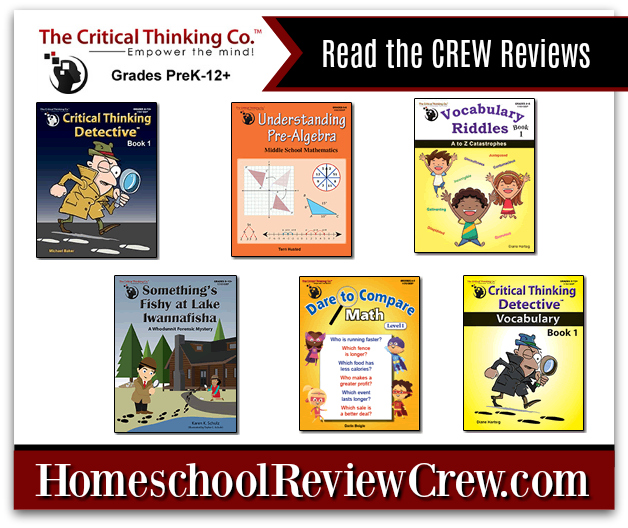
Crew families have been working with several products from The Critical Thinking Co.™ Click on the banner below to see what others thought of both Pre-Algebra and the other programs!


Critical Thinking, Understanding Math & Vocabulary {The Critical Thinking Co.™ Reviews}


Want to keep up with all of our adventures?
Subscribe below to get Adventures with Jude delivered to your inbox.

Enter your email address:


Delivered by FeedBurner


©2012- 2017 Adventures with Jude. All rights reserved. All text, photographs, artwork, and other content may not be reproduced or transmitted in any form without the written consent of the author. http://adventureswithjude.com
Related Posts Plugin for WordPress, Blogger...
Pin It button on image hover