Showing posts with label literature. Show all posts

Friday, August 9, 2019

Memoria Press Literature (A Homeschool Review Crew Review)

Memoria Press has become a go-to company for our family.  Several years ago, I found that our family did well with their classical education model, and we have consistently returned to Memoria Press' curricula, especially for literature. After trying several literature programs, I have determined that Memoria Press programs are the most consistent performers for us; returning to a Memoria Press study feels like a homecoming.  Our family had the opportunity to work with the Seventh Grade Literature Set.  While this is available as part of Memoria Press' seventh-grade program package, the guides are available as a set and rated for students in grades six through eight.  The collection includes student and teacher guides for
The 4-volume set we received contained a Student Guide and a Teacher Guide for each book. (While the literature books are available with the individual sets, the four-title set does not include the novels.) We used this program in a unique way, assigning two books to students now (rising 7th grader Jude and rising 10th grader Celia) and saving the other two for later.

The Trojan War


Allow me a moment for a bit of background information, please. As some readers may recall, when Jude worked on the Second Grade Memoria Press literature program, he really struggled. Although the program was marketed for second graders, his skills at the time were not quite on par with Memoria Press' expectations.  I have long felt that the program's expectations are higher than average. Combined with Jude's early struggles with reading, I have intentionally used levels that are below his chronological grade level. In fact, for his sixth-grade year, we began with literature guide for A Cricket in Times Square, part of Memoria Press' fourth-grade program. To my surprise, he easily completed this study, as well as the one for Homer Price, so we skipped ahead to fifth grade's The Chronicles of Narnia. I felt that if he could manage this book, we'd move on to sixth grade; if not, we'd complete the rest of the "fifth-grade" literature. Jude proved to me that he really was beginning to mature in his thinking process, so this summer, we moved up to sixth-grade literature. There was an added benefit: while these books were still a year behind Jude's chronological grade level, they were high-interest for him. I felt this interest would be the ridge between "want to read" and "hard to read."

When offered the opportunity to try the 7th-grade package, I was a little hesitant to try anything intended for an even higher level student. However, hope springs eternal and I figured maybe the challenge would be good for him.  If worse came to worst, we could set it aside after the review period and try again later.  When the books arrived, I gave him the choice of reading any of the three options besides Anne... because I knew that set was going to Celia. As he is an avid reader of all things Greek, Roman, and Norse mythology, I was not surprised when he opted for The Trojan War. 


I think this was a wise decision. Jude usually does better with literature studies when the story is familiar to him. If he already has a grasp of the plotline, he can follow details better, because he's not trying to figure out too many things simultaneously.  And again, high interest became the bridge between desire and ability.
While each chapter follows the elementary school-level framework that his previous literature studies have been patterned in, The Trojan War has a lot of information to absorb.  Jude is simultaneously reading Adam of the Road and completing the 6th-grade workbook, and generally manages a chapter every other day. However, we are finding it is taking us a full week to do each chapter for The Trojan War.

However, I don't think the reason is the material is too hard. I think most of it is a battle of wills. In the past, I've never fussed if Jude's answers weren't precise when compared to the Teacher's guides. As long as I could tell that he had the main idea, I let half-sentences slide. I think part of what is slowing us down is, since he's now officially in "middle school," I am no longer letting three-word ideas pass for answers. Much to his chagrin, I'm marking his book where he only has half-answers, or poorly written thoughts, and making him go back and rework them. This then adds another day to the lesson.  He also wasn't particularly happy when I told him I expected (gasp!) actual paragraphs for answers to the Enrichment questions instead of a few sentence fragments. 

Clearly, his brain is capable, even if his willpower isn't quite as strong.

 If you are familiar with the Memoria Press Classical Studies program, then you know that students begin by studying Greek Myths in the first year of the program, and then continue on to learn about Ancient Rome and Greece. While The Trojan War is included in the literature program, it is also part of the Classics Year 4 Program.  While you might be tempted to skip it, especially if you intend to continue through and have your child study The Iliad and The Odyssey in Year 5, this retelling by Olivia Coolidge is an excellent introduction to the epic.  It provides enough details to draw the reader in, but not so much that he gets lost in the minutiae of them. I think Jude will be well prepared for studying these two epics in depth next year.

At our current rate of a chapter a week, it will take Jude a full semester to complete this guide. I'm comfortable with this pace for two reasons. First, this work sets the foundation for something he will study again, so I'd rather him understand what is going on well so that when he studies The Iliad, he will again be "adding on" rather than "starting new." Secondly, I want him to begin to have better study habits. Jude only likes change when it is his idea, so I have a feeling it is going to take some time before he realizes that he wants to make the changes.

My only complaint about the set is that the tests and quizzes are only in the Teacher's Guide. I know that some parents do not administer tests, but I find them helpful to assess what Jude is retaining as he transitions to working independently. However, doing so is not a smoothly integrated process.
First, the parent/teacher needs to plan out where the tests need to be taken; it's easy for a student to "forget" that there is one coming at the end of each part of the book.  (We found writing reminders at the bottom of the last page before a test to be helpful.  Not only did it remind Jude to ask for the test, but it also helped me factor in study/review days when writing his daily assignment sheets.)  Secondly, the copyright notes in the guide state that no part may be reproduced.  This means that I either break the rules (and with a very literal rule follower child, that's not a good plan!) so he has his own copy, or Jude is writing in a book that I would otherwise have no need to replace (plus, he has temptation in the form of the Answer Key at his fingertips!). We've compromised by him answering the questions in his literature notebook, with the Answer Key paperclipped closed.


I wish the Student Guide had the Student's tests, either interspersed or in an Appendix at the back of the workbook, or that there was a separate (reproducible or consumable) Test Booklet, and that there was a reminder/test placeholder for to help the newly independent student not to race ahead.

Anne of Green Gables


Ah, Anne-with-an-E...I think Miss Shirley is one of my favorite literary ladies. I was probably in middle school when I found my first kindred spirit (Anne), my first Book Hero (Matthew Cuthbert), and my first Book Boyfriend (Gilbert Blythe).  Anne has been on Celia's reading list for quite some time, so this was a perfect opportunity for her.  While Celia was finishing 9th grade during the review, so technically "older" than the program's intended age, she has had a literature-heavy year. I decided to substitute Anne for Henry V for the last of her 9th-grade reading.  Do I think this made it too "easy" for her? Not at all.


L. M. Montgomery may have only written books on paper, but her character's words bring them to life. I think anyone who has read any of the Anne books knows Anne's grandiose imagination supports her flair for the dramatic while providing a foil for the prosaic Matthew and Marilla Cuthbert.  In addition to Vocabulary, Comprehension, and Enrichment exercises,  each chapter explores Expressions for Discussion. These could easily be done as an oral discussion, but I asked Celia to write her interpretations of what the expressions meant.  


While some might think that the answers are obvious, making it "too easy" for a high schooler, I think L.M. Montgomery was brilliant. How many times has a parent/teacher tried to help their student learn to write "less bland, more exciting" essays? Writing exercises always talk about using more specific words, more detailed words, more descriptive words...in other words, stop saying "very"! Perhaps Anne has a tendency to be a bit over-the-top, but she's a shining example of careful word choices. Which pulls your heartstrings more, "I'm used to being disappointed," or "My life is a perfect graveyard of buried hopes"?  I think Anne of Green Gables is a book that all students should read so that they can become better writers!  I love how Memoria Press chooses to really dig into the expressions in the book - rather than selecting a quote or two, there are as many as seven or eight to explore. The program does full justice to the book by really allowing Anne (and the Avonlea residents) to have their say.

Classics become classics because they are enduring, but it would be easy for a book published in 1908 and set in the late 1800s, to contain archaic vocabulary.  I can remember doing vocabulary studies myself and wondering, "When am I ever going to use these words?" However, Memoria Press has focused on words that remain pertinent today. 


Comprehension questions include both literal "what happened here" and critical("What did Anne mean...") queries.  In addition to studying the book itself, the program provides writing opportunities for literary interpretation, opinion/persuasive writing, and exploring Anne's interests (Shakespeare) and tribulations (geometry as compared to Waterloo).  


While Memoria Press offers the literature books for sale, the literature sets do not include them. While some of their studies do require specific editions of books, we found this was not the case with this program.  Last Christmas, Celia received a box set of the Anne series and used the edition that was included.  In this case, page numbers did not need to match, as the program is sectioned by book chapter.

Celia has been working at a rate of a chapter every other day.  On Day 1, she does vocabulary, reading, and the expressions for discussion; on Day 2, she finishes the comprehension questions and completes the enrichment. It could easily be done at a slower pace (one workbook section a day over the course of a week), but I'm hesitant to recommend doing a full chapter a day.  It is possible if your child is a fast reader, but it would take close to 90 minutes a day just for literature.  I have done this with Memoria Press literature when we are in a time crunch (trying to get to a logical stopping point before an extended vacation, or when Luke or Matthew was trying to finish a study guide in the countdown to graduation), but it's not necessarily sustainable long term.  At a rate of 5 chapters per week plus review sections and two exams (also only available in the Teacher's Guide), it will take about 8 weeks, or one academic quarter, to finish the book.  I think that's reasonable for a high school student. 

The Hobbit and The Bronze Bow

When my students were younger, I was more focused on the "grade level" of the program.  Now that we have entered into the middle and high school years, I've learned to focus less on the grade a program is assigned to and more on its content, because middle school books begin to be less about a numbered grade level and more about the individual's literacy level and abilities. Knowing that Jude likes to binge on book series, I will likely keep The Hobbit set aside for another year or two until he is ready for the entire The Lord of the Rings series. Like Anne, I think this is a book that transcends grade level.   I think 7th grade is about the youngest age that a student can truly wring all the finer points out of it, but there is no point where a student "ages out" for exploring the book.  The Bronze Bow is set in 1st Century Israel, so it could be studied as part of the "pre-set" 7th-grade program, or it could be moved to 9th grade and part of an Ancient/World History program. While the lower grade programs involve exposure to literary concepts, the study guides at this level of the program use that familiar framework to explore and apply those ideas to the corresponding novels. I think the studies at the middle school level have the flexibility to help prepare a middle schooler for high school expectations as well as provide a relaxed but not too simple study for secondary level students. Once again, Memoria Press has proven why it has become my favorite literature program.


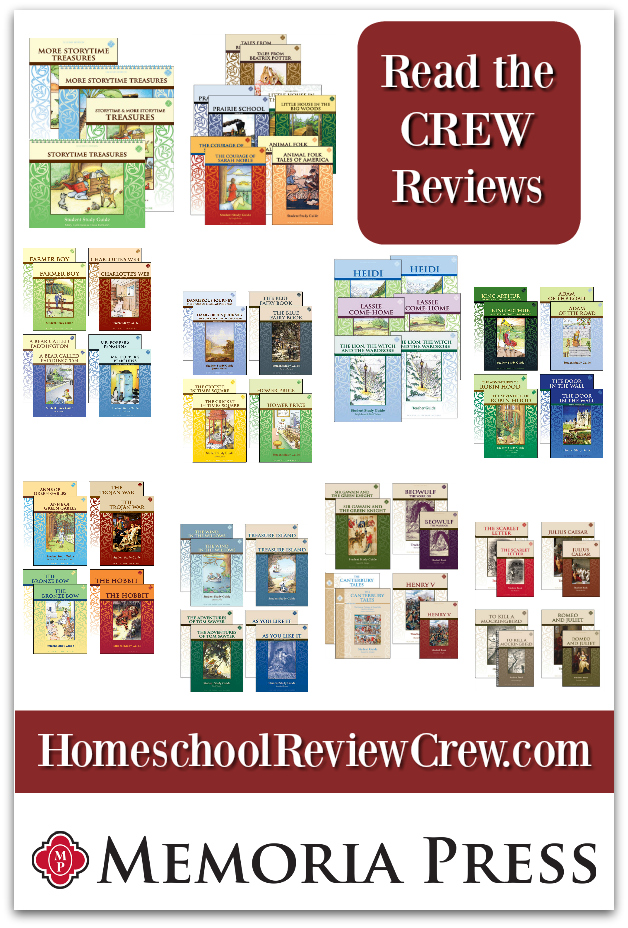
Crew families with students from first through tenth grades have been reading with Memoria Press. Click the banner below to read their reviews of the books they've been studying!   You can also learn about other Memoria Press programs we have worked with by clicking the links to those reviews.

Memoria Press:

First to Tenth Grade Literature Guides {Memoria Press Reviews}


 Crew Disclaimer

Want to keep up with all of our adventures?
Subscribe below to get Adventures with Jude delivered to your inbox.

Enter your email address:


Delivered by FeedBurner


©2012- 2018 Adventures with Jude. All rights reserved. All text, photographs, artwork, and other content may not be reproduced or transmitted in any form without the written consent of the author. http://adventureswithjude.com

Wednesday, May 23, 2018

Home School Navigator (Homeschool Review Crew)


Home School Navigator Reading and Language Arts Curriculum is an elementary-level program with a unique approach to teaching literature and other language topics. Six color-coded levels help elementary students develop literature, grammar, spelling, and writing skills. Jude and Damien have been working on the blue and green levels, respectively, for this review.


The color-coded leveling is a unique identification approach. Most programs delineate levels by grade or by age, which can be a bit of an issue if you have a child who is not on par with his grade or age. Most of Jude's language arts skills have finally caught up to his age; some have even surpassed what is expected of a child finishing fifth grade. However, because he was a later reader and closed the gap quickly, he went from easy-readers to novel series in about 18 months. This means in trying to keep up with what was reading-level appropriate for literature, he missed some of the more basic skills usually learned in the early primary years. Home School Navigator colors begin with red and follow the rainbow to indigo. Conveniently for Jude, the approximately 4th-grade level blue doesn't say it's for kids "younger" than his almost-6th-grade self. Conversely, 2nd grader Damien doesn't get a swelled ego being put "up" into 3rd-grade equivalent green.  I like this system for keeping egos boosted or in check.  When you begin, you have access to all levels so you can place your child where you think he should be, and then work up or down a level if it doesn't seem a good fit. About a month in, you will make a final decision and lock in your choice.

THEY USE PICTURE BOOKS!! I THINK THIS IS BRILLIANT. It's like using Unit Readers, with shorter stories that cluster in a topic but using a stack of "real" books, not a textbook. This is a different approach than most programs, especially for big kids. They are all about chapter books, and reading a chapter a day, etc., and if it's not a book that kiddo likes (or one that it is and he wants to know what happens next) it's TORTURE. Here, the books are shorter, so they can find out the ending in a sitting. And I think the program doesn't leave really good "picture" books to the preschool shelf but shows them as quality for all ages. The titles for the stories are carefully chosen. Each month centers around a theme. I like that each year revisits a variation on the same theme. All levels do Fairy Tales in Month 1, an author study in Month 2, etc.


While some held favorite stories, we've discovered some new loves.  Goldilocks and the Three Dinosaurs (Mo Willems) was deliciously sarcastic and amusing.  Because it's nice and short, it is easy to read and parse on the same day.  Because it is a classic-caliber book, there are enough layers of construction to study that it doesn't feel like "fluff."


In the green (approximately 3rd grade) and blue (approximately 4th grade) level programs, there were also interactive notebooks used to study longer novels. (They also are used at the indigo/5th grade level.) These are longer projects, taking about a week or two, in addition to the small-book studies. These reinforce what the student learns in the daily lessons, making him ready to transition to novel-only studies at the middle school level. (I'll explain more about the interactive notebooks below.)

I am a big believer in independent reading. In high school, we had a daily ten-minute "Sustained Silent Reading" block, which was probably my favorite part of the day. (I would have preferred a six-hour SSR, but generally, I'd choose to read over anything else. Knowing I have a deadline is the only thing getting this review written; otherwise, I'd still have my nose in my current book.) One of the tick-boxes for the daily program is 30 minutes of reading a "just right" book. The "just right" method has solved a problem we were having here: Jude's ability is much higher than his comfort zone. Isn't it amazing when mom says "that's too easy," she can't possibly be correct, but when "Not Mom" says so, it's completely legit?


By using their technique, Jude realized that his beloved Magic Tree House series novels were not "just right" books; they were much too easy. We kept moving through books until we found one that was not too comfortable, not too challenging, but just right. His "30 minutes a day" has turned into "I finished my time, but can I keep going for another hour? How about two?" He also discovered that the Percy Jackson and the Olympians series was not "too hard" for him, and in the space of a month has mowed through that five-book series as well as five-book The Heroes of Olympus series. (He's already asked me to get him "everything else by that author." Mr. Riordan, please write faster! We're going to run out of books soon!) Damien still prefers to discovered while he still prefers the comfort of easier Geronimo Stilton books when he's reading on his own time, he's found books like Charlotte's Web and the "Little House" series are good, too.


There is also a portfolio maintenance option. Once you complete a day's work, you can take a photo with your computer or phone and upload it to your child's file. If you live in a state where you need to compile and submit a portfolio, this would be very handy. We don't have that requirement here, so I didn't upload things. However, I have friends who do live in a state that does, and I can see where it would be beneficial (especially since the uploaded pictures means you don't have to keep a thousand pieces of paper from September until June).

Do you sense a "but" coming? Unfortunately, there are a few that quickly wore the shine off this program for us. Let's just call them "heads ups."

I liked the idea of the interactive notebooks.  They focus on specific elements of the novel, rather than being a more traditional "all literary topics the author threw in here" project.  I liked this perspective and approach.  However, they are in a lapbook style.  I agree with the company's theory,  because it is something different from the daily work and helps create an entirely separate feeling "project" for the novel study.


However, we have learned the hard way that lap books, while a great hands-on, interactive format for learning, just are not ideal for this homeschool.  The reality of this style meant there was more focus on the cutting and assembling than neatly writing correct answers. I have not included pictures of their assembled books because, frankly, I'm embarrassed to show how many cross-outs and re-writes there have been. I think one of our projects will be to re-copy them, and I'll update with those photos.  (It will be a lesson in "If you don't want to have to re-do something, pay attention and do it right the first time.")

The program price includes the curriculum and interactive notebooks, but NOT the literature books.  (The interactive notebook studies are also available ala carte.) If keeping costs down is an issue for your family, this may be an issue. If you have an excellent local library, then you can likely acquire most of these books from there. (I know some other Crew members had difficulty getting some of the titles from their libraries.) If you're like us and live in a rural area with limited library services, you might need just to purchase them directly. I was able to buy ours from Amazon. Some came directly from Amazon, while others were from third-party secondhand resellers. There were several instances where a "gently used" book was more economical, but there were also quite a few books that were no longer in print. We had to take a chance on some that might not have been so well treated. Luckily, our books were in reasonably good condition.

Because of this, Home School Navigator has begun uploading read-aloud videos. This came in handy for Damien's first book.  However, while I do like read-aloud books, I think it is difficult to do a detailed literature study without a book follow along with or to refer back to.

Word study is built in as well. The basis of the program is a "word wall" where the vocabulary/spelling words are posted and added to mostly daily. We wound up skipping much of this activity because we didn't have a place to create a word wall. Because the boys already do separate spelling and vocabulary studies, I didn't feel they missed anything academically because of the program, but it was a portion we weren't able to utilize fully.

I also felt the grammar presented was more of a review than instructive, so I found myself still assigning the boys their usual grammar. For example, one lesson was called "Banish Boring Verbs" and discussed choosing verbs that were less over-used.


 Grammar is combined with writing, so it is not something specifically focused on daily. However, there was no review of "This is what a verb is and does," and the first time that year a student worked on any formal grammar skill.  I felt there should have been a quick review, and then dive into manipulating into synonyms.  If your child does not have strong grammar skills, I would use this for extra practice, but I would still use a separate, formal grammar program

The program is marketed as a "turn it on and go, no planning required" curriculum. This is mostly true; you can print the lesson plans/worksheets for the week, put them in a binder, and hand them over to a kid. He can then go back to the online program and follow along with the video lessons provided. However, for a program that also markets itself as family-friendly, offering discounts for enrolling multiple students, it is not friendly when it is time to do schoolwork. Only one student could be logged in at a time, so there was a constant jockey for "whose turn is it."

Finally, there are optional poetry studies, which are a nice addition to round out literature studies. However, they are not from a single book or source, and for copyright reasons, are not included with printouts. We were able to google the poems; some were easier to find than others. In order to work with them, Jude copied the poems into his notebook.


I wish that they had chosen poems from a single volume, where it would have been a "Here's the poetry book, turn to page ___!" situation, and not letting a kid loose searching the internet.

Will we continue to use Home School Navigator? Yes and no. I think the core literature study part of the program is well-constructed and worth keeping, and much of the writing as well. Despite disliking other parts of the program, I still really do like this approach. Each language arts component is reasonably independent, so skipping one part does not mean kiddo is losing chunks of interactive study.I think I will either adapt the interactive notebooks to suit our needs or just look for other novel-based studies to substitute and continue with our usual grammar and spelling.

Discover the other levels of Home School Navigator and how the Crew fared with them by clicking the banner below.

Home School Navigator Reading and Language Arts Curriculum {Home School Navigator Reviews}


Want to keep up with all of our adventures?
Subscribe below to get Adventures with Jude delivered to your inbox.

Enter your email address:


Delivered by FeedBurner


©2012- 2017 Adventures with Jude. All rights reserved. All text, photographs, artwork, and other content may not be reproduced or transmitted in any form without the written consent of the author. http://adventureswithjude.com

Wednesday, September 13, 2017

Progeny Press: The Silver Chair (Homeschool Review Crew)

When people ask me about my favorite literature study guides, Progeny Press is one that always is at the top of my list.  Our latest review from them is The Silver Chair E-Guide, and it continues to challenge Jude's comfort zone.


The Silver Chair guide accompanies the same-titled book from C.S. Lewis' Narnia series.  (Note: the book is sold separately, though you can purchase it directly from Progeny Press.) I admit a bit of trepidation jumping into the stories of Narnia rather literally in the middle.  Many will argue whether you should read them in the publisher's order or in the order Lewis ultimately intended, but either way, The Silver Chair jumps in in the middle of either listing.

Table credit: Wikipedia

Each of the Progeny Press guides begins with a "before you read" section, and while there are several other activities suggested, this guide suggests reading The Voyage of the Dawn Treader before reading The Silver Chair. (One of the characters in this story visits Narnia for the first time in that volume.) I don't think this is strictly necessary because the book can be read as an independent, self-contained novel, but if I was making longer-term plans, I might consider reading that first.  Guides for most of the Narnia stories are available from Progeny Press, so you could create a literature study of the series and slide this one in in its "proper" place.


This guide is recommended for students in grades five to eight.  Newly minted fifth-grader Jude was the reviewer for this guide.   The Silver Chair has a Lexile score of 840L, which is just about where he's comfortable with me reading and him listening.  (Read more about how I use Lexile levels to determine if a book is going to work for us.)  I think fifth grade is a difficult year; elementary books seem too simple, yet they're not quite ready to make that leap to "middle school" thinking.  When a lesson seems truly on-grade-level, I prefer to work with him and model what I expect of him, providing a little scaffolding and a little cheerleading.  I have him do less challenging books independently, so he gets the "I can do this!" confidence to try harder books on his own.  He did well with understanding the book, especially when it was read with great animation.  Since this book is at the lower end of his true capabilities, I'm not surprised, but the study guide was harder for him than I expected.  We hit a speedbump on the very first page.


I had estimated that it would take him about fifteen minutes to work on the "Context Clues" vocabulary.  Nope.  It was closer to an hour, and at least two teary tantrums.  We're now down to about forty-five minutes, but they are painful.  I'm being "mean" and forcing him to honestly try before getting out his dictionary.  Most of the time he gets them close.  I'm not sure he's ever heard the word moor but blindly guessed it was a "yard" since it was outside.  Other words, like alighted, ultimately needed the dictionary.  Jude gets points for knowing -ed was an ending and the root word was "alight," but he got stuck on light = something you turn on to see.  He has a surprisingly extensive vocabulary (he knew malicious was a synonym for spiteful), so I'm surprised that these were so difficult for him to complete.  On the other hand, he's not used to this format.  He's used to getting a list of words and being told, "Look these up." Learning to read context clues is really important for the early middle school years, and I know he is capable, so I am pushing the issue.

The questions aren't incredibly difficult, provided you've paid attention to the book.  My complaint here is that they are grouped two chapters together.  It's not a huge problem, and a scan ahead shows me where there is a stopping point between chapters.  However, again, if you have a child that thrives on routine, habit, and things not changing unless it's his idea, then this might be a tough sell. When he's done, he is totally chuffed at his accomplishment.   We've negotiated a compromise of reading and doing the workbook only every other day.

I realize this review makes me sound like I didn't like the program, but that's not true at all.  I think that maybe it just was ambitious for Jude right now.  I think we will finish this one, if only because I don't want him to think that I'll let him give up just because something is hard, but I may hold off on introducing more of this level until closer to next summer, when he's approaching sixth grade and more mature.  There are plenty of Upper Elementary choices that will likely provide a less-overwhelming challenge. I'm also considering going back and starting the Narnia series from the beginning, and alternating working with him and letting him try on his own.  If we repeated The Silver Chair in a year or two, I'd be curious to see if his answers were different.

Click the banner below to read other Progeny Press reviews from Crew members; we've also been reading The Bears on Hemlock Mountain, Charlotte's Web, and Macbeth.  You can also read my prior reviews for the guides Sam the Minuteman and Follow the Drinking Gourd.   

Sam the Minuteman   Follow the Drinking Gourd


Study Guides for Literature {Progeny Press Reviews}


Want to keep up with all of our adventures?
Subscribe below to get Adventures with Jude delivered to your inbox.

Enter your email address:


Delivered by FeedBurner


©2012- 2017 Adventures with Jude. All rights reserved. All text, photographs, artwork, and other content may not be reproduced or transmitted in any form without the written consent of the author. http://adventureswithjude.com

Monday, July 10, 2017

A Well-Read Interest-Led Literature Program

When it comes to Matthew and Literature, I'm finding success constantly eluding us.  We've been trying to find a literature study program that works for him, and despite multiple approaches and curriculum companies, we just can't seem to make things click.  I'm not sure why.  He is intelligent and insightful, but I'm leaning toward the idea that "studying literature" just isn't his thing. Getting him to read, and then complete the activities is always a chore, and while he can intelligently (although reluctantly) discuss what he's read, he struggles to find the "right" answers to be able to get a decent grade.

On the flip side, when there is a topic he's interested in, he seems to devour the books.  For example, we recently started a new course about the history of aviation.  The program, Doctor Aviation,  helpfully provides suggestions for further reading.  Matthew has completed only three lessons in as many weeks, but he has read two biographies of the Wright Brothers, Chuck Yeager's autobiography, The Right Stuff by Tom Wolfe, and when given the choice between two books about Yeager's reach for the sound barrier, asked why he couldn't have both. He discusses them eagerly, sharing more information than I ever thought I needed to know about early planes and pilots.


I'm beginning to think I need to stop searching for a traditional literature program and start thinking outside the box.  I still want to make sure he's exposed to all genres of literature.  However, I'm realizing that it might be better for him to be "well-read in general" than fighting with him to read what curriculum writers deem "worth reading." To that end, we're going stop copying others' ideas and make our own (mostly) interest-led program.

I still want Matthew to focus on reading and understanding what he's read, but rather than looking for obscure quotes or metaphoric meaning, the plan will be for Matthew to read books that tie into his other classes, summarize the book as he goes along, and be able to discuss it.  If it's a non-fiction book, a general summary will suffice, but if it's a work of fiction, I'm going to have him focus on outlining the plot and main character development.


I've decided that most books he would read will fall in "catch all" genres: (Auto)Biography, History/Era, and Science/Tech.  He will have to read a set number of books and discuss them competently to receive a specific grade.  If he does a satisfactory job, the book can be checked off from the title list and counted toward the quota. If not, then it doesn't count and he has to pick another title and start over.  (I'm also open to entertaining plus/minus letter grades if he has read seven of two genres but only five of the third.) I want his grades to reflect not just how many books he's flipped through, but how many books he's able to competently discuss.  The discussion part is going to be key to completion.

I also have been thinking that studying literature without anything to anchor the choices to what he already knows hasn't been helping.  He really enjoyed a course on the history of Greek engineering, including how they made their war boats and planned their battle strategies based on the vessels' strengths and weaknesses. It makes sense that he's reading The Iliad and likes it.  I can't help but at least try to sneak classics in there, so my plan is to list is to pick literature that ties to an era or topic that we are studying. Having visited the Mark Twain house in Hannibal Missouri, he has a connection to the author, reading anything by Twain may make more sense to him. In a similar manner,  The Jungle (Upton Sinclair) or The Grapes of Wrath (John Steinbeck) may not precisely "interest-led" but I'm hopeful that they'll appeal as ways to extend what he's learning about (early labor laws, the Depression and Dust Bowl).  There certainly are fictional science books, but I have a feeling that he'll easily reach the quota of those, so I'm leaving fiction out of that category.

Almost all of his other courses have "recommended reading" selections, so I'll start with those as a base to find books.  He's using The Great Courses to study the geology of the National Parks, and we've already added in using the textbook Geology of National Parks (Harris, Tuttle, and Tuttle) to round out the course's credit-worthiness.  Looking through the course's bibliography,  An American Idea: The Making of the National Parks (Kim Wilcox & Jimmy Carter) looks to be a good candidate for inclusion on his reading list as a science/tech option.  I can also take key players in the history of the parks - for example, John Muir or Theodore Roosevelt - and find books to put under (Auto)Biography.  Even though many of them do require a few of the recommended reading books to complete the course, when you're given a choice of four and want them all, then I think it's safe to say "Two for the original course, and two for lit," is a reasonable division of labor.

"Same author, different book," will also be a likely resource. David McCullough is the author of the biography of Theodore Roosevelt,  Mornings on Horseback, that Matthew read for his government course. He liked that enough to say, "I want to read the Wright Brothers one he wrote." (Thankfully, McCullough has a whole shelf full of history books!)  I can't say too much if he finds a favorite author and wants to explore him more; I certainly have my favorites that I binge read, and then stalk their Amazon pages for new titles!

Amazon.com

If we hit a period where we don't have anything to work on, I'll pull out my copy of IEW's Timeline of Classics: Historical Context for the Good and Great Books.  We reviewed  this a while back, and it's really helpful for finding books that go with specific eras.


I initially had thought about giving Matthew a curated list of books, like the IEW Timeline,  but I think he'd wind up choosing a stack of books from one topic and binging.  That defeats the purpose of "well-read." My new plan is to scan ahead in his coursework and the Timeline, see what books are listed within a topic, and then give him a choice of "this or that."

Fingers crossed that this approach works for Matthew.  As a literature lover, I would be thrilled if he learned to love the classics, but ultimately, I'd rather him learn to love reading.  I'm hoping that if he can read a wide variety of books and find what he loves, he will see reading as something enjoyable and not a chore.  That lesson is far more important than the letter that actually goes on his transcript.


©2012- 2016 Adventures with Jude. All rights reserved. All text, photographs, artwork, and other content may not be reproduced or transmitted in any form without the written consent of the author. http://adventureswithjude.com

Wednesday, July 5, 2017

Why I'm Using Lexile Measures to Help Choose Books


After spending the last few months searching for a literature curriculum for the younger boys, I've come to prefer using Lexile Measures to find books, rather than searching by grade level.  Why?Lexile is a standardized measurement, while what "grade level" a book is slotted at seems much more variable.

For example, Memoria Press puts Little House in the Big Woods as part of their 3rd-grade literature program.  Veritas Press says it's for 2nd graders, and Moving Beyond the Page puts it in their 4th-grade equivalent (ages 8-10) program.  That's three high-quality curriculum programs, but they all suggest it for different ages. And it's not just this book in particular - I've noticed literature curricula all seem to have their own ideas of what book is right for what age.


Even Lexile alone is slightly confusing.   The book scores at 930L, which by "grade level" would be readable by a high-average 5th grader.


So just what reading or grade level IS this book for?

Now, I'm not saying it's this or other hard-to-discern-who-should-study-them books aren't good literature for younger (or older) children to hear! The stories of the Ingalls family, or of a spider named Charlotte and a refrigerator full of Poppers Performing Penguins, are perfect for nearly every age! My concern is  trying to determine how to decide what age/grade level is a book going to be most appropriate for use as a lit study, or even as a "here, turn the TV off and read this instead" book, especially when your child isn't average-for-his-chronological-grade.

Now, of course, Lexile has its limits, and the company even stresses that just because one book is at a certain level doesn't mean a child can (or should) read every book in that range.  After all, Charlotte's Web and The Grapes of Wrath are both classic books and at the same Lexile level, but they're definitely not written for the same audience!


So...where do Lexile Measures come in? If they don't tell you how appropriate a book may be, what's the point?  The answer to that is this: a Lexile measurement can be used to identify the appropriate difficulty level of a book.  Using Lexile means I can look at any book the boys or Celia are interested in *individually* and say "This should be easy," "It's a good stretch," or "Um...let's hold off on this for a bit."

Jude's personal comfort zone is the Magic Tree House series, which measures generally in the low 300s. He has also been reading Damien's Geronimo Stilton series books, which are a lofty 600ish. Jude's always been a "Why crawl six feet when I can move four and then stretch my fingertips to reel it in?" kind of kid, so "comfy with 300-level books when definitely capable of 900s" seems about right for his personality.  If I use Lexile's Book Finder feature as my calculator, I can find out what Jude's "ability comfort zone" is.
To encourage him to move all six feet, I've been trying to find high-interest, age-appropriate books for Jude in the low 800 range.  Some of our recent home library additions are books by Roald Dahl (high 700s/low 800s), and Beverly Cleary's Ralph S. Mouse series (860L).  These are quality stories that are great for a 10-year-old boy and are purposely at the low end of the range.  I want him to find books in a "stretch your comfort zone but not be overwhelmed" place, so he discovers the beauty of recreational reading. I'll reserve books that are at the higher end for "school" books. This way, I can help him work through the stories if he runs into problems.  If I look at those for grade level, they're generally labeled for grades 3 to 7.  That's a pretty wide range of age.  However, knowing the content is appropriate for middle-to-late elementary kids, I can be comfortable using Lexile for the ability level and know he's not going to be overwhelmed and give up on reading.

I'm also using Lexile Measures to help Damien find new books. Like most little brothers, he is perpetually trying to keep up with the bigs.   While Jude did really well studying Little House in the Big Woods, Damien struggled a little.  He enjoyed the story, but when it came time to work on the study that went with it, he had a difficult time recalling some of the finer details of the story.  This says to me that 930L is a good zone for a read-aloud that will expose to excellent storytelling, but it's probably too high a mark for him to work with on his own.  This past spring, we read A Bear Called Paddington (750L) and Winnie the Pooh (790L) and he did well with comprehending those. Plugging those into the calculator, that puts his suggested range between 690 and 840.  We'll do the same thing, sticking to books at the lower end for independent reading, and higher for literature studies.  I have a feeling he'll be stealing his brother's Ralph books soon enough!

I can also use Lexile measuring to put some books in the "not right now" pile.  One of the stories Jude would like to read is The Call of the Wild.  It's a high-interest book for him (he's obsessed with sled dogs and Alaska), but at 1120L, the writing would probably overwhelm him.  Knowing that, it's a book that either will become a "later on" book; we'll probably save it for a read-aloud for when after he's comfortable in the high 1000s.   It definitely helps him understand and not feel like it's Mom saying know if I can show him, "This is your range, but this book is much higher, let's save it for later."

I love that homeschooling allows us to tailor the boys' studies to what they are capable of, rather than just picking something and hoping they do well.  Using Lexile measures really helps me find books that both instill confidence and push them to grow without overwhelming them.

©2012- 2016 Adventures with Jude. All rights reserved. All text, photographs, artwork, and other content may not be reproduced or transmitted in any form without the written consent of the author. http://adventureswithjude.com

Wednesday, April 5, 2017

Shepherd, Potter, Spy - and the Star Namer (Homeschool Review Crew)


As an avid historical fiction reader, I looked forward to reading and reviewing Shepherd, Potter, Spy–and the Star Namer by Peggy Consolver - Author.   One of my peeves in a historical book is the accuracy of an author's portrayal of the era.  I don't get bogged down in the minutiae of the facts, but I can't stand when a Duke of the British Regency says "OK, Mom," or an 1880s mail-order-bride travels to meet a groom who had "proved up" his land on a Texas homestead.  I find errors like these fatally distracting from the story because it ruins the whole sense of "I know this isn't a true story, but it could be."  I am impressed with the historical background included in this story.  Of course, Old Testament Canaan history isn't quite as readily available for Google fact-checking, but it's obvious to me that Mrs. Consolver has done her research, from location to character names and jobs.  In preparing this review, I learned that she was part of an archaeological excavation team that worked in Khiret el-Maqatir, Israel -- known in the Old Testament as Ai. While this book ultimately is a work of historical fiction, the characters and plot seem eminently plausible because she has taken care to weave known facts into the story.

As a parent, one thing I want my children to understand is that there are always at least two sides to every story.  Luke and I are both avid Wicked fans, and as we have studied a particular historical event, we'll look at each other and quote from the musical about what gets known as history: "It's all in which label is able to persist."  The "label" and story about the post-Exodus return to Canaan that has mostly persisted since Biblical times has been that of the Israelite side.  Many of the events in the story come from the Old Testament, passed down in the books of Exodus and Joshua. I really liked that this story wasn't a retelling of the Israelite side, but rather contemplates the story of the Gibeonites from the view of one of their own. Many of the events come from the Old Testament (from the books of Exodus and Joshua).  While some of the action occurs in the Hebrew camp, Mrs. Consolver looks at the story from a different perspective, embedding us with the Gibeonites for this story.  She does an excellent job in providing a prospective view from the fearful inhabitants of Gibeon, watching the advancing Israelites.  When readers know the outcome already, it's easy to become lax and show the losing side as weak, but Mrs. Consolver didn't allow the ending to propel the story. I could imagine the fear and uncertainty that the characters were living with during the time.

Sites related to the story of the Hebrews and Gibeonites.
Source: PeggyConsolver.com

Keshub is the central the Gibeonite protagonist, is a 13-year-old shepherd boy who is the fifth son. The story begins with him wondering how he can be noticed as more than just "somebody's little brother."  One brother is a master potter, like their father; another eagerly follows in their footsteps as a novice.  Another brother is a trader, while still another has become a skilled warrior and eventually a spy.  Keshub is in search of his own way, and the story becomes a coming-of-age tale, sharing how he finds his niche in the Gibeonite treaty with Joshua and the impending clash with the Amorites.  Keshub finds himself a shepherd at the beginning of the story, an aide to his Uncle Yaakoub selling pottery in Jericho, and ultimately a bit of a youth-of-all-requests, leading to a stint spying on the Hebrews.

The "Star Namer" is not Keshub, but a god-like higher power.  I think this inclusion adds to the idea that the content of history books may boil down to winners and losers, but it's not countries but people that are fighting.  Keshub sees this group of Israelites bearing down on them, but at times wonders are they so different in what causes this war?  Is it possible that the power they call the Star-Namer is the same as the one that the Israelites believe to be the stars' Creator? I think this is a real idea that is lacking in the us-vs-them, black and white mindset of society today, and the book raises a thought-filled question.


There is a companion study guide for this book, Digging Deeper into HIStory, available as a separate purchase from the author's website. (There is a downloadable free sample available as well.)  It can be used by any reader, from the individual student to a larger Sunday Schools/Youth Groups class to study details of Shepherd, Potter, Spy -- and the Star Namer itself, the Biblical accounts of the Gibeonites, and learning more about the animals and tools mentioned in the story.  There is also a page of links to accompanying maps and research that coordinate with the book and study guide available here.   There is a page of discussion questions at the end of the novel, but they are more of a way of guiding personal response to events, rather than a genuine discussion of the events.


I have to admit, however, that as much as I enjoyed the concept of the book, I really struggled with the book itself.  It's a story you need to be able to pay attention to, or you're going to lose the plot.  I originally had intended to read it myself, albeit quickly as more of a pre-read, and then read it aloud with the boys.  We usually do a chapter or two of a read-aloud daily, and since the chapters in the story average about eight (very full, smallish type) pages each, it seemed doable.  However, my first skim-through had me going back and re-reading, and re-re-reading, and re-re-reading to be able to keep people and places straight.  I think that perhaps here, the accuracy got in its own way.  The names of the people and places were so accurate to the locale and foreign to me that I felt like I almost needed a scorecard.  I found that two, perhaps three, chapters at one time was my limit, or else I began to mix everything up again.  For me, it's definitely a "read-for-learning" book, not a "read because you have a few minutes free as you sit in the car waiting for the kids to come out of Karate. Even though Keshub is only thirteen, leading you to believe that this is about a middle-grades-aged person, the content is really far more dense for that group.  I wonder if having the study guide would have made the reading easier (it was not part of the review).

 Back to the idea of the story presenting shades of gray.  Because of this, this book is something that I would consider for a high school age or adult reader, to facilitate critical thinking and discussion, especially in the context of a larger Bible study.  A good friend of ours has mentioned that her church will hold book/Bible studies that are stand-alone events but also build upon/set up the next study in a series.  I think this story would be a good candidate for something like that. In the Bible, the Gideonites are descendants of Noah's son, Ham.  This line was cursed by Noah because of Ham's actions.  We actually recently have finished another fictional story based on the Bible, and this story shows the struggle the very human Noah had with the curse.  He knew what his son had done was wrong, yet he wasn't intrinsically weak of character.  The Biblical Israelites, descended from Shem, were in Canaan to take back the land from Ham's descendants, so it makes sense to see that there is parallel-ish thinking -- they descended from the same patriarch many generations before.  Their beliefs were corrupted from the original, but they weren't far off.  I think using this book would make an interesting eight or even twelve session group study.  A long-term study would allow the reader to read and discuss the book a few chapters at a time, and potentially delve into the difference between absolute right and wrong, and the idea of "sort of right, sort of wrong, but being sort of wrong doesn't make you all bad."   This book has certainly given me an opportunity to look at life from more than one viewpoint.

80 families have been reading Shepherd, Potter, Spy - and the Star Namer. To read other reviews, please click the banner below.


Shepherd, Potter, Spy--and the Star Namer {Peggy Consolver Reviews}


©2012- 2016 Adventures with Jude. All rights reserved. All text, photographs, artwork, and other content may not be reproduced or transmitted in any form without the written consent of the author. http://adventureswithjude.com

Tuesday, April 4, 2017

Memoria Press: The Iliad & The Odyssey (Homeschool Review Crew)


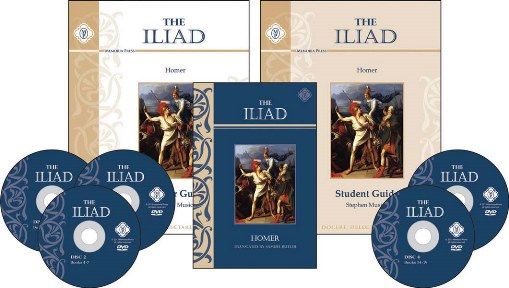
Back when we withdrew Matthew from private school, if you had asked me, "How does your kid learn?" I'd have said, "I have no clue, but I can say that whatever he's doing in school isn't working."  I think we've tried nearly every "method" out there in the last three years. It seems that video-based vs. read-the-textbook presentations have been better for him, but when it comes to literature, there's really not a way to get around reading the book.  After a lot of trial and error, we've found that Jude has really taken to a classical style of learning; he responds well to the structure and pattern of the style. Memoria Press has become a favorite of ours for literature studies, and we were given the opportunity for Matthew to work with their Iliad and Odyssey Complete Set.  This package contains a copy of the literary work as translated by Samuel Butler, a Student Guide, a Teacher's Guide, and a DVD lecture series set for each work.  I decided it was worth trying. With luck, it would turn into a credit-worthy literature study; at worst, we'd know that this style wasn't for him.  Our plan was to begin with The Iliad and then eventually move on to The Odyssey if the first program worked for him.  I skimmed ahead to be able to review the series, but in the interest of him keeping plots straight, he stuck to one program.


I suppose since he and Jude are very much alike, I shouldn't be too surprised by how well he's taken to Memoria's style,  but since literature studies have been a nightmare for him, I wasn't sure how well it would go. This particular program combines the literary work, a Student Guide workbook, and a video lecture that helps explain the highlights, lowlights, and important points of the story.   Memoria Press recommends this program for students in grades 7 through 12; I think most students, especially older high schoolers,  could do this study with minimal parent assistance.  However, although Matthew is in 10th grade, he isn't "most" students.  He has pretty severe ADHD and needs very frequent redirection.  I've sat with him to work on this, partly because it was a review program, but mostly because I wanted to make sure he was fully engaged in the lessons.  He has done well with the routine and structure, but still sometimes needs guidance staying on task.

The Iliad (and The Odyssey) is divided into "books" rather than chapters.  Instructor Sean Brooks explains during one of the videos that this is because the original epic was not divided into chapters, but was too long for a single scroll.  The story was broken into what fit on each scroll, with each scroll being called a "Book." Memoria Press uses a translation by Samuel Butler, and each Book is about 15 to 25 pages.  For Matthew, that's a lot of reading at any one time.


When we first started reading, based on his answers in the Student Guide, he obviously was merely flipping pages and not absorbing anything.  I know Jude and Damien understand books more readily if they are read aloud. When I need to be sure that they are actually reading and not skimming, I make them read aloud, but sometimes it's better if I read aloud because then they can focus on the content and less on the decoding.  We began reading out loud, taking turns with pages, until I realized his reading skills are not what I believed they were.  I began doing all the reading so he could focus on content.  After three books of reading aloud, he started reading on his own, because he wanted to know what happened next and he was tired of waiting for me.  (He works independently earlier in the day, while I'm helping the younger boys, and then we tend to work later in the afternoon or into the evenings.)  I think once he got into the story, he realized he was beginning to enjoy it.  Based on the answers to his questions and discussing the book with him, it's clear that he's reading for content, not just to say "Yeah, I read it," and has barely skimmed the text, and he's retaining what he has read.  We've continued working together with the DVD lecture, but, after reading aloud from three or four books each day for the younger boys, my voice appreciates being able for each of us to read quietly.  I  must admit, though, after the first few books, I'm eager to find out what happens next.

I think the video has made a real difference for Matthew in what he's been able to understand. The lecture series is divided by the corresponding books, and each one runs about 30 to 45 minutes.  It usually takes us closer to twice that to work through a video, because he's often stopping to take notes (he can't write and catch the next bit of information), or stopping to underline key passages in his book.  Mr. Brooks does a thorough job of explaining the story, helping to clarify not just the "what's going on," but the why and the back stories of the culture. As Matthew takes notes and highlights passages, it's definitely helpful that he isn't jumping back and forth with ideas.


Additionally, there are pen-and-ink drawings interspersed through the book.  Often when discussing a passage, a nearby illustration appears on the video screen.  Matthew and I both appreciate this because it helps give a visual cue of where in the book the discussion is focused.  Matthew isn't wasting time trying to figure out where in the story the discussion is, and then trying to go back and forth between book and video.


Rather than leaving Matthew to try to figure out everything from context clues, it has been a benefit for him to have a teacher pointing out key ideas, passages, events, etc.  I think the video lectures have made a big difference in how he has learned to like the story.  He's been working on another Memoria Press literature study (Poetry and Short Stories: American Literature) and asked me if there was a video to go with it.  I wish there were!  I definitely notice a difference in his ability to connect ideas - once he has been given one concept from the lecture, he has been able to find that repeats of it relatively easily, because he understands how Homer presents that idea.  Even though he wishes there was a video guide for that study, he has gotten better because he's gained confidence in his ability to discern ideas from the text.  He's starting to pick up ideas from The Iliad, and when they are confirmed in the video, he visibly puffs up that he got it.  I think it's allowing him to let himself try with the other study -- he doesn't feel like he's completely inept.

The Student Guide workbook contains a lot of guidance for learning beyond the questions.  Principal characters in that specific book, specific quotes, and both comprehension and discussion questions are part of each section.  Also, Appendix tables containing summaries of main characters, military vocabulary, etc. help the student understand the players in the story.  As a parent/teacher, I appreciate the way the Teacher's Guide is arranged.


It mirrors the Student Guide, so there's no flipping around looking for corresponding pages.  There are notes to help guide discussions with the students, but also to help the students prepare for the included quizzes and exams.  I think if you have a student that remembers lots of information and can sort through it easily when presented with an exam, then just reading/studying the Student Guide is sufficient. However, Matthew definitely needs help focusing. Knowing that there were ten characters in a book but only four that he'd have to know exactly who they are for the test helped him not be so overwhelmed.  I appreciate being able to check his answers for each portion, and then saying, "Ok, now make your index cards, using question numbers 1, 4, and 9, and the characters <name, name, and name>.  It makes studying for the cumulative tests (answer keys provided, thank you!) less overwhelming for him.


I've been allotting about five school days for each book.  On Day 1 and/or 2, Matthew reads the assigned book.  On Day 2, we watch the DVD and take notes/highlight passages in the book.  On Day 3, he does the accompanying questions in the student guide, which we review on Day 4.  He then works on creating a study guide for characters, questions, and quotations that are pertinent to upcoming quizzes and tests.   Day 5 has become a "what's left?" day; sometimes he's working on finishing the workbook/notecards; sometimes it has become a test/quiz/write essays day.  If he's managed to get things done a little faster, he gets a day off.  (There's motivation, eh?)  In all, we spend about 5-6 hours on each book.

In the interest of keeping his brain from exploding, we opted to do one work at a time.  Therefore, since he hasn't gotten to working on The Odyssey, I read a little of the book, looked through the guides, and watched a few of the videos.  I'm really looking forward to when we get to this one. The guides and videos repeat the same patterns/content as those for The Iliad.


Although the set is "only" two literary works, between the material presented and the time/effort involved, I'm comfortable considering this set equivalent to a full literature credit for Matthew. Since he hs already nearly completed his 10th-grade literature course, I'm planning on continuing on with the curriculum and crediting it as Grade 11 literature. Having worked through the program for several weeks now, I really think that this particular program is better suited to high school students.  After running several sections of the text through an online scorer, it averages to an 11th-grade reading level.


While I think a younger student could manage the program, I think that just reading this particular translation/text with an average middle school/junior high student could be overwhelming.  Celia is in 7th grade, and while she's an above-average reader, she's definitely not anywhere near ready for this!  If she chooses to be homeschooled for high school, I would definitely consider this again for her as a sophomore or junior literature course, but I certainly wouldn't choose it for right now. The student workbooks are consumable, so to re-use this set with her, I'd need to purchase at least those items.  We'd also need to buy another copy of The Iliad (and presumably, The Odyssey) since Matthew marked this one up with his notes.  This isn't too much of a re-investment; the complete set costs $135, and re-purchasing the student's books needed would run about $48 for both.

I know, $135 seems kind of steep, compared to the cost of just the books, but honestly, I really think the videos are crucial.  I think these make the difference in the program from being "just another read the book" study.  They definitely have helped Matthew, but I've even found them helpful for me personally. While I know the basic stories of The Iliad (and The Odyssey) from "picture-book-ized" retellings, I can't say I've ever said to myself, "Hey, why don't you sit down and read the full stories for fun?" The books are at times overwhelming, and Mr. Brooks even admits when there is something coming up that is going to be a bit of a chore to read.  I think after Book II I'd have given up.  However, the content of the lectures has really made them seem more accessible and enjoyable. These epics were originally meant to be recited as part of Greek history so there would be an understanding of glory, honor, and the role of the Greek gods.  I think it's probably akin to the different between reading a Shakespearean play and seeing it on stage - it just is so much more understandable when it's not just words on a page.  I wish Memoria Press had more studies like this!

It's been interesting working with Matthew; upon learning about Achilles' weak spot, he remarked, "So...you can shoot him in the head or chest, and he's fine, but if he steps on a Lego, he's done."  Having stepped on a few Legos in my day, I could only laugh and (mostly) agree.  I asked Matthew what did he think of the program, and he said, "Pretty good."  Thanks, kid...could you give me a few more words?  He decided on, "I like it because the DVDs give me more depth on the Greek history.  All I remember from history is the Trojan horse, so I kind of like learning about what happened before the horse invaded.  I like that it tells me what's going to be on the tests, so I know what to study.  I don't mind learning about other stuff, because it's important, but it's a lot to remember, so it's good to know what's super important and what's normal important.  I think the instructor's pretty funny, too.  He's not boring, and I feel like he really likes what he's talking about."   I think we've finally found at least one program that will count for 11th grade that won't lead to tears on either part. I call that a win.


Crew members have been exploring three programs from Memoria Press: The Iliad and Odyssey (Complete Set),  First Form Greek (Complete Set), and The Story of the Thirteen Colonies and the Great Republic Complete Set/200 Questions About American History Set.  To read reviews of these, click the banner below.

First Form Greek, Iliad/Odyssey and American History {Memoria Press Reviews}


©2012- 2016 Adventures with Jude. All rights reserved. All text, photographs, artwork, and other content may not be reproduced or transmitted in any form without the written consent of the author. http://adventureswithjude.com
Related Posts Plugin for WordPress, Blogger...
Pin It button on image hover