Showing posts with label art. Show all posts

Thursday, November 15, 2018

Guitar 360 Method (Homeschool Review Crew)

Most of my readers know that Celia is my instrument player. She has seven years' worth of violin lessons and three years of piano, plus she sang in her grade school choir, but I should consider changing her name to Ariel...as in she can play on her violin "But who cares? No big deal! I want MOOOOORE!!" Several years ago, Matthew took guitar lessons but discovered he is not an instrumentalist, so his guitar has sat in the closet, practically mocking Celia. She's tried a few YouTube lessons but really hadn't gotten very far.  The Crew offered us the opportunity to try more formal, cohesive lessons from Guitar 360 Method...folks, I apologize for the fangirl screaming.


Guitar 360 Method is a new guitar learning program from Krisz Simonfalvi. Mr. Simonfalvi is a musician and teacher who had a circuitous path to his career; he began to play guitar, gave it up because it just did not resonate with him, and then circled back as an adult. He notes that there are two ways to learn to play: one is just by picking at the guitar and learning the technical aspects, and the other is through a theory-based trajectory. The problem is that most theory is based on the piano -- which, while a strong music foundation, doesn't necessarily apply practically to other instruments.  Celia will completely agree with this -- while she can play both violin and piano, it's not like you can interchange music. As she says, "I can play piano music on my violin if I play just the treble clef line, but it may not sound the same or as good as on a piano because I can't play bass clef and treble at the same time on the violin. The melody might sound the same going from violin to piano because you can play just the treble clef." While Guitar 360 Method is actually teaching her a third style of instrument-specific theory, but one that has a practical application to playing guitar.


Have you ever listened to a Billy Joel song? An incredibly strong understanding of how music works is how he could turn what is basically scales into a hit song ("The Longest Time") and morph Mozart's "Pathétique Sonata" into "This Night." Why is theory-based instruction important to me, as a parent? Because theory is what really allows a student to understand what she is doing, why she is doing it, and how to properly play with music. An understanding of theory is critical even just to transpose piano to violin or guitar; without it, you cannot manipulate the music and have it sound right.

Practically speaking, I don't expect her to rise to Mr. Joel's level of renown (if she did, that would be fantastic, but let's face it -- there can only be one Billy Joel), but it's clear to me that the foundation of any musical success is a proper understanding of theory.  Here,  Mr. Simonfalvi shines, because his course is geared toward both the casual student who just wants to learn to play the music in front of him or the student who intends to learn to re-arrange or compose their own music.  He says:


I've taught this content from age 9 and up, however, it is designed for students who want to be creative on the guitar - understanding how music works, rather than JUST learning songs.
This makes it perfect for Celia, because it will teach her both the basics of "how to play" - how to hold the guitar, how to strum, where to put her fingers on the guitar's neck - but also WHY she's holding it where she is and when to use a pick vs. her fingers.  She had an "AHA!" moment right at the start.  Mr. Simonfalvi explains why you press the strings near the frets (better control of the strings and clarity of sound and she looked at me with a dropped jaw. THAT was something she never learned from playing around with other videos; she just thought you stuck your fingers on the strings.  Obviously, in six weeks she's learned more than just where to hold the guitar, but, to me, it's the little things like that - that you don't really know unless you're told - that help make this course worth the tuition.


Guitar 360 Method currently offers two courses. The first is a free introductory level course that will take you from "how to hold a guitar properly" to "I can actually play something, and it sounds like a song" in about three weeks. Obviously, there needs to be a consistent effort on the student's part, but after trying that part out, I can say, "Yes, you will."  While Celia has played around the guitar before, she really was trying to apply what she knew from playing pizzicato on the violin to picking at a guitar. You really don't have the same technique - pizzicato uses a plucking motion, and, of course, there are no frets on a violin neck. Starting at the very beginning helped her realize that playing guitar strings isn't the same at all.

The second, tuition-based course is a 13-week "Semester One." It contains the three-week basics course and then expands beyond "My First Chord" into the major, minor, and pentatonic scales, and then into playing Chords in multiple Keys.  Each week has a clearly defined focus, so the student understands what the goal of the lesson is.

The videos for the lessons total about half an hour, so definitely a reasonable length lesson for beginners - long enough to be worth making an appointment with yourself, but short enough to not be a barrage of information. Celia particularly liked that it's not one long half-hour video, but rather each topic is presented in an individual section.


This meant she could quickly go back over a topic without having to fuss with finding the correct minute mark, or she could break it down into smaller ten or fifteen-minute chunks so that she could learn a concept, ruminate on it a bit, play with it, and then add on the next idea.  Mom liked that there are defined practice exercises assigned for each week. This meant she could go back to the prior week's to work on solidifying those concepts but also had specific activities to reinforce new lessons. There are also quizzes on the ideas, making it ideal for students who need grades for transcripts. While hearing Celia advance in playing skill shows me she is absorbing practical knowledge, the quizzes help me see that she understands the theory behind the playing.


Mr. Simonfalvi promises that students will have enough theory and technique to jump into a band and be able to hold their own by the end of the 13 weeks. Keep in mind, he's not promising to turn your student into Mike DelGiudice and have her be playing in Billy Joel's band in those 13 weeks, but you'll have a competent guitar player that's not only ready to play but also able to understand what she is playing.


Guitar Lessons with Krisz Simonfalvi {Guitar 360 Method Reviews}


Want to keep up with all of our adventures?
Subscribe below to get Adventures with Jude delivered to your inbox.

Enter your email address:


Delivered by FeedBurner


©2012- 2018 Adventures with Jude. All rights reserved. All text, photographs, artwork, and other content may not be reproduced or transmitted in any form without the written consent of the author. http://adventureswithjude.com

Wednesday, June 27, 2018

The Master and His Apprentices (Homeschool Crew Review)

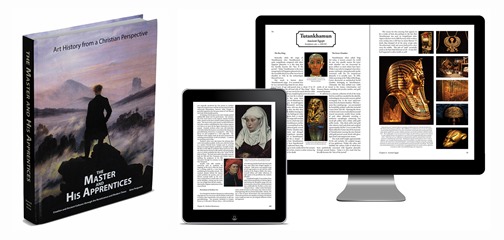
Public school students in our state have relatively strict curriculum requirements, including one year of a "visual or performing arts" curriculum.  On the one hand, homeschoolers do not have to follow the same "mandated curricula" rules - thank heavens for that flexibility! However, I feel that, to have a transcript that is competitive with their peers and not feel like we have to reinvent wheels, it makes sense to use the state's list as a "things we ought to cover" guide. We hoped that one option for fulfilling this "requirement" could be  The Master and His Apprentices: Art History from a Christian Perspective,  a one-year high school art history curriculum published by The Master and His Apprentices.


Initial Thoughts

The Master and His Apprentices is a Christian-viewpoint program.  It is arranged in a manner that helps coordinate Biblical and historical timelines.  This is not unlike a few other of our courses, and I like this perspective.  My school experience was learning things in "parallel universes." Cognitively, I knew that there is overlap in multiple civilizations, but I never tied it all together. When Jude started working on a particular history program, I discovered the idea of teaching "within a timeline" and discovered how much easier it is to understand how civilizations segue from one to the other.  I liked the idea of starting at the beginning (Creation) and then studying art's progression through time.


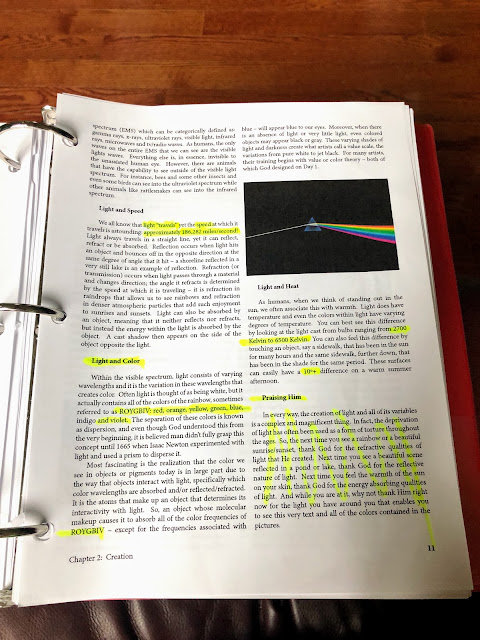
For our review, we received a Digital Edition of the curriculum, which included the Textbook ($34.99 retail) and Teacher Guide ($19.99).  This is a downloadable PDF file that can be viewed on (ideally) a computer screen or a large-format tablet. The file is also formatted for printing; the appropriate margin has been left for a 3 hole punch binder or comb binding.  While it took a considerable amount of time and ink, Matthew preferred a printed copy of the text, which would allow him to mark it for studying.


  The guide includes a single-student license; there is $2 "recopy" fee for use with each subsequent student. (Reviewers received unlimited household recopy rights.)  I can understand the company's view - this program is an investment in their intellectual material - but I don't like the idea of having to go back to the company every time I want to re-use a digital program.  As a parent, I'd rather pay a few dollars more at the beginning for an unlimited single-household license, rather than feel "nickel-and-dimed" over time.

There is also a pre-printed materials option. This includes a 380-page hardcover Textbook ($149.99) and softcover, perforated-page, 120-page Teacher Guide ($24.99).  The teacher's guide is intended to be a consumable material, but digital student reprint rights are available as well ($2 per student).  Again, this feels clunky. I can understand the workbook being consumable. However, if I'm purchasing something pre-printed, it's because it's more cost-effective (either financially or time-wise) than printing it myself.  If the paper guide were less expensive, I'd be more inclined to just purchase multiples of those and be done.

I can understand a per-student charge for non-family group settings (one suggested use of this is with co-op programs), but perhaps that should be a different "call us for pricing" category since the photocopy rights only apply to the workbook; each student still needs to purchase a textbook. I'm also not sure about the textbook and re-printing capability for later students.


Working with the program

I think this should be retitled Western Art History from a Christian Perspective, or even "Western History Through Art".  I had expected this to cover art from around the world, not just the Middle East and Latinized areas.  There is a single 8-page chapter devoted to "the rest of the world," with an explanation that "In a collegiate setting, the study of Western art and non-Western art are quite often divided into separate classes." (p. 314)  That makes sense to me because there is no way that the entirety of art history, when presented in this timeline-based manner, could be done adequately within a single semester.  However, neither the company's website nor samples indicate that there is little attention given to non-Western art.  A mere eight pages are included and meant to point out other cultures; it feels like an "oh yeah, there's this other stuff" afterthought.  I think it would be better to omit it entirely and advertise this program as a history of western art.

The book also mentions "Through Modern Times" in the title.  However, it ends with the Baroque era and covers from Rococo (the 1700s) to current times in 8 pages.  Impressionism - with the greats such as Renoir, Monet, Rodin, and Sargeant - gets a full page, while post-impressionist Van Gogh earns a small example picture and half a sentence.  Again,  if it had advertised itself as "Through the Baroque Era," I would be fine with that.  But if it says "Through Modern Times," then I expect to find at least a mention of artists such as John Singer Copley and Charles Wilson Peale, and discussion of the establishment of the Pennsylvania Acadamy of Fine Arts, the oldest art institution in the United States and one of the first to allow women to receive an arts education equal to their male peers.

This curriculum is meant to be worked over the course of a 36-week school year.  If time is an issue, some lessons may be combined or omitted (the Teacher Manual gives directions for this.)  Matthew worked each week's assignment or two over the course of a few days - reading the chapter one day, and completing the (as many as 30+) questions over a second or third day.
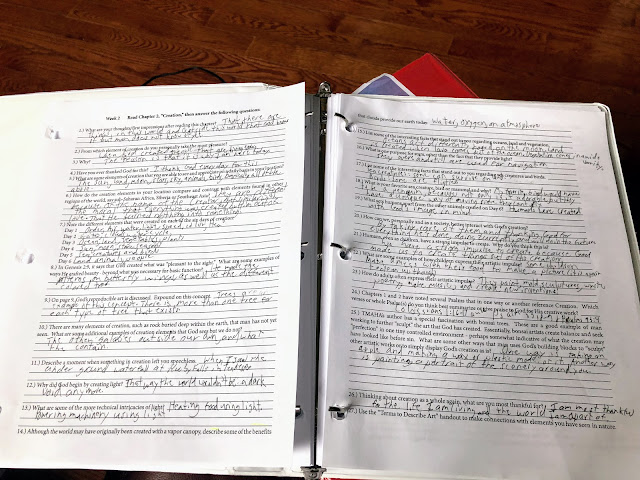


The program also includes four written research papers and four exams.  I appreciated the clear "What to do each week" layout.  I'm not certain what semester the dates included were from -- my guess is this was used with a co-op in a particular year, and these are the corresponding dates.  Practically speaking, it was not a big deal to cross out the printed dates and re-mark the ones that aligned with our work.  There is a note in the corner that this is a sample and there is an editable document available, but that just was an extra step that really seemed more than needed.  (Plus, it involved printing another page.) However, it made the guide seem less "professional" and more "I'll just sell copies of my notes."


The teacher's guide heavily weights "discussion" - I think this works better in a group setting than a single student.  The manual discusses how to use the program in both a one-hour class setting or a longer meeting period. However, for the single-student, it's awkward.  The only person Matthew had to discuss things with was me, and he would look at me and say "I answered the questions, I don't have anything to really add." I think having a group of people with different perspectives would make a difference in how engaging the material could be.


"No Nudity" 

One of my primary concerns with the program is it explicitly advertises "No nudity!"  I felt that Ancient Greece, often filled with nude statuary, could focus on draping, and how artists and sculptors skillfully used light and shadow to create movement in folds of robes.  But how does one effectively teach Renaissance art without using any nudes?  There are nudes on the ceiling of the church where the Pope is elected!  How does any Art History course worth its salt gets around Michelangelo's David?

By picturing only his left foot.


This was just ridiculous. This is a high-school level program.  I'm not an advocate of gratuitous nudity, but nudity in art serves a purpose.  In the Renaissance, it showed not only the skill of the artist in creating work but also reflected the emerging understandings in math and science of both the body itself and how to arrange it on canvas or in stone proportionally and realistically.  (Later in the Baroque era, it reflects the changing attitude of the times.)  David is probably one of the premier specimens of this Renaissance knowledge, as well as an incredible example of general line, movement, and the dynamic Renaissance contrapposto. At the very least, showing David's face and upper body would demonstrate these principles.  Without any of these tenets discussed, my thinking that this is more a "history with art" rather than "art history" course were solidified.

The curriculum also mentions Michelangelo's Sistine Chapel paintings and presents a close-up of God and Adam's hand.


Ok, I could allow this one as a "Christian view," but it is the only illustration of this magnificent work.  Why bother? The program has lost an opportunity to discuss Michelangelo's skills as both a sculptor and painter.

There is a single page discussing Flemish master Peter Paul Reubens.  One of the paintings chosen, The Raising of the Cross is an excellent example of his skill with line, color, light, and movement.  However, never is the term Rubenesque - a name for his iconic, allegorical paintings of voluptuous figures - even mentioned.  How does one study Reubens and never say what he is famous for?

I knew that this program advertised "no nudity," but I had hoped it would be handled differently - perhaps with a lighter touch and more deft cropping.  Yes, I can tell Matthew, "Go Google the David statue," or "Find out what does Rubenesque refer to," but if I'm purchasing a complete curriculum, I shouldn't feel like I need to add to it to provide a complete education.

Other content

The Textbook

I have mixed feelings on this as well.  For example, Chapter 9's Early Christian and Byzantine section features an introduction and four work foci from this period.  However, most some of the topics only encompass two pages! The Hagia Sophia, first a Christian basilica, then a Muslim mosque, and now a state-owned museum, has about a page and a half of text, and a few photographs. Other sections are equally skimpy.  Leonardo da Vinci, arguably the greatest man of the Renaissance era, greater than even Michelangelo, has a mere three pages (including photographs) dedicated to him.

For much of the early medieval period, the Church was the patron of the arts, and it shows in the Romanesque and Gothic Cathedrals.  Reading this book,  you get the sense that a cathedral is just a big church in a big town. (p. 174) However, any big town could have a big church; what makes a cathedral special is it is the center of an (arch)diocese and the seat of the Bishop.  The introduction to "Gothic" comes closer, mentioning that Bishops were, often, political appointees.  But it never identifies the cathedrals as the centers of their domains.  But while it discusses the basic architecture, it never really goes into detail, even about the stained glass and statuary that depicted stories of the Old Testament, Gospels, and saints.  The church building was a way for the illiterate to "read" the Bible - one would expect this to be mentioned in a book with a Christian teaching base.

Kölner Dom/Cologne Cathedral


Additionally, one page is dedicated to the Cologne Cathedral.
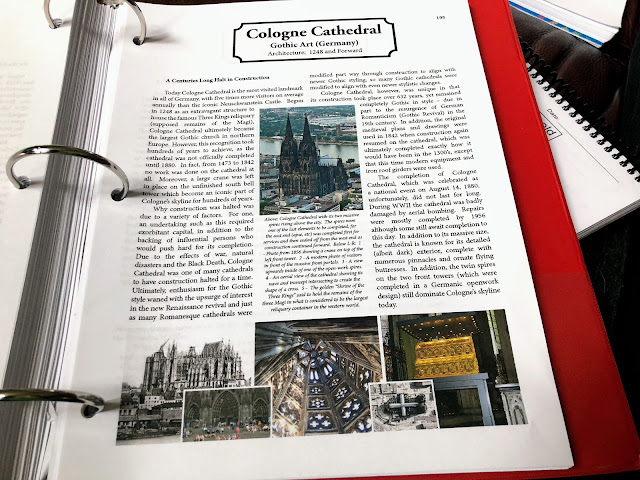


 Nowhere does the text mention that the Cologne Cathedral, included part of the unit on Gothic style, is a UNESCO World Heritage site.  The text is copyrighted 2017, and UNESCO added the Cathedral to its roster in 1996. This is a crucial thing to understand about the Cathedral. The book mentions how it was completed in the 1800s with "modern" iron roof girders, but not that all repairs now - including current restorations -  must be made using the original materials.  Few of the current restorations are because of WWII damage; it is wear and tear from age and pollution that cause the need for repairs. Residents of Köln say, "We know the world goes on, because the Döm is being refurbished. If it no longer has scaffolding, life is over." 


The text mentions "ornated" flying buttresses, but none of the photographs show them.  It talks about how the cathedral is very "dark." I can attest from a personal visit that while the vestibules are dim, the central nave glows from the sunlight streaming in during Sunday services.


Student Activities

Even adding in the four assigned papers (five pages each), I don't feel the program will give a particularly good breadth of knowledge.  These explicitly assign the student to choose one artist, piece, or style to research.


To make this course more generally in-depth, I think I would assign more frequent (monthly vs. quarterly) but shorter papers (2 pages each) so a student would have a better opportunity to study a more extensive range of topics. Here, I think quantity is preferable to "quality" because it would broaden his knowledge of art and its place in history.

Closing Thoughts

I really wanted to like this program, because I feel, even transcripts aside, a well-rounded education should include the arts.  I have another option for Matthew waiting in the wings, but it is a program I will have to build myself in order to reach content and time requirements to count it as a full credit.  I admit that it would have been ideal to have something I could just hand him and say, "Do this, please," especially this year as I have a new student transitioning into our homeschool.  Perhaps in a group setting, this might be an appropriate course -- each student in the group could take work/period and bring a short presentation to contribute to a discussion.  A single-focus five-page paper does allow a student to get in deep with a single idea, but it means risking learning something out of context with the rest of an era of history.   Ultimately, I think that this program is more history than art, omits quintessential works under the guise of modesty, and is inadequate for a single student art history course.

The Master and His Apprentices: Art History from a Christian Perspective {The Master and His Apprentices Reviews}


Want to keep up with all of our adventures?
Subscribe below to get Adventures with Jude delivered to your inbox.

Enter your email address:


Delivered by FeedBurner


©2012- 2017 Adventures with Jude. All rights reserved. All text, photographs, artwork, and other content may not be reproduced or transmitted in any form without the written consent of the author. http://adventureswithjude.com

Wednesday, June 13, 2018

ARTistic Pursuits: Building a Visual Vocabulary (Homeschool Review Crew)

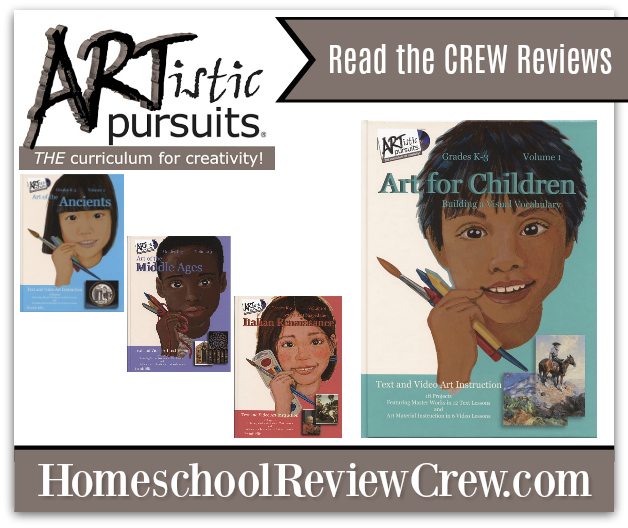
"Art class" is one of those things that always seems to get back-burnered.  My kids enjoy creating art on their own, but it is something that we never seem to have time for instruction in.  I've had plenty of art history courses, but I am not an "artist," so my instructions generally are "Get your markers and draw something." We have used art curriculum books from ARTistic Pursuits, Inc in the past, and while I found them to be high quality, they were a bit overwhelming, because it was still mom having to take the lead as the teacher when it was time to create art projects.  (I like to think of myself as more of a facilitator; that means sometimes, I'm the best teacher for a subject, but other times it is better for me to find somebody more knowledgeable.)  The company has a new program for early elementary students (K-3), titled ARTistic Pursuits Art Instruction Books with DVD and Blu-Ray. This program divides their K-3 program into six hardcover volumes:

  • Art for Children, Building a Visual Vocabulary 
  • Art of the Ancients 
  • Art of the Middle Ages 
  • Artists that Shaped the Italian Renaissance
  • Art of the Northern Countries, Renaissance to Realism
  • Art of the Impressionists

Each book is intended to be a one-semester study, presented approximately at a rate of one lesson a week.  The set is available as individual volume purchases, or as a complete set.  For our review, we received the first book in the series, Art for Children, Building a Visual Vocabulary. 


This text and video art instruction contained 18 lessons in total; 12 text-based lessons featured works of master artists, while the remainings six were video-based instruction on using art materials.

The book teaches are the concepts of "what artists do."  It begins with "Artists compose."


This foundational book contains material featured in the larger Early Elementary Volume 1 book.  (You can read our review of that here.)  However, length notwithstanding, it is not precisely the same program. I feel that new book is almost "ARTistic Pursuits Lite." This book uses the same hands-on learning projects but has fewer questions that examine the individual pictures.


 (The current text is on the left, the older book is the spiral bound volume to the right.)  While I appreciate the larger photography, I was surprised to see the lesson to have less opportunity to dig into the picture.

I also was shocked to discover the photo has been mistitled in both books. When we reviewed the program in the past, I took it at face value. This spring, Neal and I experienced an incredible vacation that included a guided, "Highlights of the Dutch Masters" tour of the Rijksmuseum in Amsterdam.  As I flipped to this page, I thought "Wait, I think we saw this!" (When you only have two hours to see as much as you can cram in, paintings and titles, unfortunately, start to meld in your head.)


Eh, not quite.  But it was a house in Delft.  This 1670 painting, entitled View of the Houses in Delft, Known as "The Little Street" is by Johannes Vermeer, a contemporary of Pieter DeHooch.  Homeschoolers love rabbit holes, so as I started down this one, I learned from the UK's National Gallery that the painting pictured below is actually The Courtyard of a House in Delft.


Public domain via Wikimedia Commons
The painting featured is actually entitled Courtyard with an Arbour. I began spot-checking all the book's Masters reference works to make sure titles and artists aligned. I didn't find any further discrepancies, but I feel like this is something that should not be wrong.  I know -- it didn't bother me before, and I accepted it at face value.  But now, I can't, and between the lighter study and wrong title really overshadowed everything for me. I felt like I had to check everything before we worked on it.

One of his favorite lessons was about observation - just going outside and looking around, and painting what you see.


Here, he combined what he remembered from the lesson on imagination (our house doesn't quite have this color palette) with a newer lesson on observation, and painted a bird flying over the sunny field in front of our house. (It's convenient that we have an Incredible Hulk willing to act as painting stand, isn't it?)

This book contains mostly Masters paintings, and the activities revolve around drawing and painting. There are sculpture choices, including Boy with Bagpipes and Young Bear, that instigates a discussion of form. Instead of painting, construction paper pieces are layered to create paper forms.


A helpful, detailed materials list is included so that the parent/teacher can procure the supplies at the start of the course, and not have to put off instruction because she doesn't have something on hand.  The program suggests specific brands of materials. While these brands are not mandatory, you should try to purchase similar quality items. If you've ever been tempted to buy the cheaper, no-name crayons instead of Crayolas to save a few cents, you've seen how art supplies are something where you truly "get what you pay for." The items they suggest are not cheap, but they aren't expensive either.  Let's call these supplies what they are -- an investment in your child's education.


ARTistic Pursuits also offers a "complete" supply pack kit for each level if you'd prefer everything in one box.  It is independent of the book order, so you can easily increase or restock your supplies if you wish to use the curriculum with more than one child.

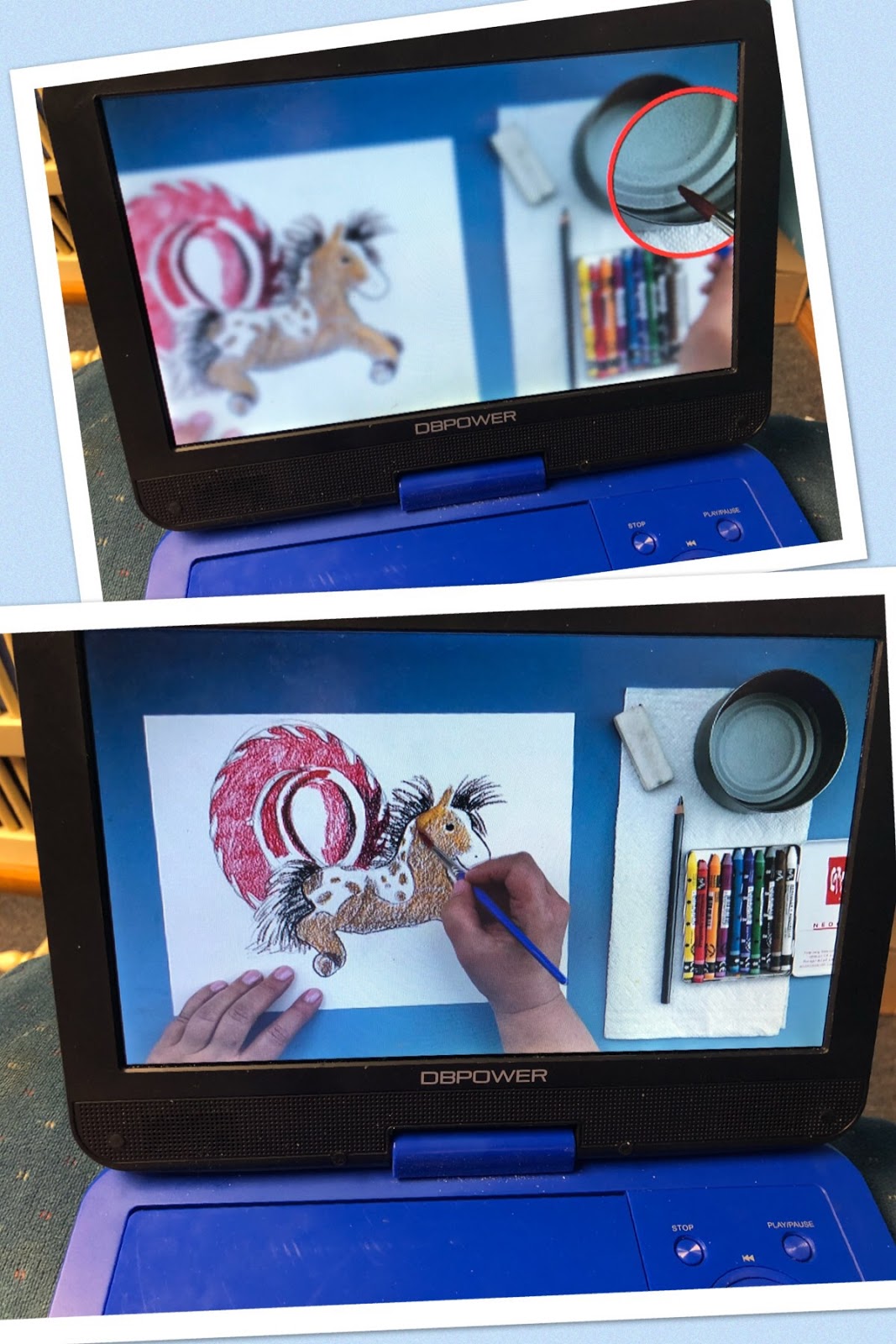
The DVD set was a welcome addition to the program.  Included are a standard DVD disc and a Blue-ray version.  (Matthew tells me that if you don't have an actual Blue-Ray player, Sony Playstations  (PS3 and higher) and North American-purchased Microsoft XBox One video game consoles should be able to play Blue-ray discs. I was unable to check this as we do not have either device.) The DVDs added both vocabulary concepts, as well as demonstrated how to use the art materials in the program.  While I have an arts degree, my background is in performing arts, not visual arts; the scale required for theater set design doesn't lend itself to the same techniques used for small paper and canvas works. One of this volume's favorite mediums is watercolor crayons, so the first lesson of the DVD showed students how to create works with these and pencils.

It began with a study in visualizing what you want to draw/paint and then segues into a discussion of composition, line, and color.  As the video completes the drawing, it shows how to use watercolor crayons to re-create the colors of your composition.


It also teaches painting techniques, starting with "how to have just enough water on your brush," and how to properly use the brush.


The instructors also recognize students in this age bracket may be a bit enthusiastic in their painting, and show how to fix a painting that may get a little flooded.


It concludes with a reminder of how to clean up after you're done and store your paints and brushes.  I honestly think that sometimes it takes outside influence to get a kiddo to clean up properly. Somehow, they accept it as "how it must be done" and not as  "mom nagging again." I definitely appreciated this!

Damien hunted the house and looked for items he could compose to create his own picture.  He chose his favorite fruit, strawberries, arranged in a bright blue bowl.


The second DVD lesson showed color mixing.  For some kids, this will be a reminder (as Damien reminded me, he was in third grade!), but it's a good review of what colors combine to secondary and tertiary colors, but it also shows the technique of how to mix them. As Celia looked over his shoulder, I hear her gasp, "Oh!  THAT'S how it works!"  No, she wasn't shocked that red and yellow made orange, but she had an "aha" moment watching the mechanics of how the on-screen artist blended them.  I wouldn't necessarily recommend the program for middle or high school students- the language and perspective are geared toward the younger student - but if you had older art students, the few minutes on technique in each lesson would be worth sitting in on.


These DVDs are only available with the new book series. I wish they were available as a stand-alone item, especially for those who may already have the older ARTistic Pursuits books and would welcome a video-based supplement.

Overall, this is a good program.  I like that it takes only a few minutes a week for me to sit with Damien and read about/discuss a piece of art, and then it allows him near free-reign over the creative process. This makes it more convenient to fit into our week, and more likely that we will be able to keep up with it.

Crew families have been studying art with the first four books in the series,
  • Art for Children, Building a Visual Vocabulary 
  • Art of the Ancients 
  • Art of the Middle Ages 
  • Artists that Shaped the Italian Renaissance
Click the banner below to read their reviews!

Artistic Pursuits Full Video Lesson Grades K-3 {ARTistic Pursuits Reviews}


Want to keep up with all of our adventures?
Subscribe below to get Adventures with Jude delivered to your inbox.

Enter your email address:


Delivered by FeedBurner


©2012- 2017 Adventures with Jude. All rights reserved. All text, photographs, artwork, and other content may not be reproduced or transmitted in any form without the written consent of the author. http://adventureswithjude.com

Thursday, March 15, 2018

NatureGlo's eScience (Homeschool Review Crew)

NatureGlo's eScience is a STEAM curriculum program presented by NatureGlo. The program is comprised of both live and self-paced courses, making it accessible to students with both fixed and variable schedules.  For our review, we received a subscription to the self-paced version of the  MathArt Online 4-Class Bundle, which consists of four 6-week courses:

  • Math Connections with the Real World
  • MathArt in Ancient Cultures
  • MathArt in the Arts and Sciences
  • Math Art: Patterns in Nature 
Note: As of 3/2018, only the first two programs listed are available in their entirety.  Two lessons for each of the second two are available, with others being uploaded on a weekly basis.


We began with MathArt in Ancient Cultures.  The program is suggested for ages 10 and up, so I thought this might be an opportunity for Matthew.  He has completed nearly all of his core high school requirements, and his transcript is heavily tilted toward math and science -- he just seems to enjoy their black-and-white aspect.  He does have an art credit already, but he struggled with it.  The art history program he took focused more on the actual history of art and where the pieces fit into history, and less about the works themselves and how they were examples of that era (i.e., the use of color, line. shading, etc.)  I thought a cross-curricular, unit-study approach program might be a way to add art instruction in a way that played to his interests and strengths.  Because Matthew is almost in 12th grade, he works mostly independently.  I gave him the login credentials and told him "Go to town!"

He got himself organized downloading the first study guide and began working his way through the first lesson on Babylonian Mathematics. I liked the organization of the webpage - the current activities were in the body of the page, with an easily navigated task list in the margin.  As you completed a task, the list struck itself.  This made it easy for me to keep track of where he was in a course with just a glance.


 Following the directions, he began to read the slideshow and fill out the interactive guide.  It's well laid out and makes the information easy to locate.  (Perhaps too easy for a high-school student, but I can appreciate that this is meant for early middle-schoolers who may be just beginning to learn to take notes.)


The next step was to watch the NatureGlo videos.  If this had been something I had gotten for Matthew to do, I would probably have just let him loose. Since it was a review, we sat down to watch the video together.

What we were watching were the same activities he had already done, just this time with the NatureGlo and other children reading aloud.  It was jarring at first, because NatureGlo is inviting kids to take turns, and asking them questions.  I think I was expecting a self-placed class to be presented as a pre-recorded lecture series, rather than just a recording of a live class.

 Also, the sound was a bit "off." At first, I thought it was our connection causing the distorted sound.  After listening a few more minutes, I realized the reason.  NatureGlo is a full-time RVer, and conducts classes from her home on the road. I think this, unfortunately, limits the quality of the recordings.  We have done many online/streaming programs, but they have had professionally recorded lectures, including sound mixing, which is what I was expecting.  These sound like what I overhear when Celia is talking to her violin teacher during her lessons (they take place via Skype). It appears only the built-in microphone and camera from her computer are being used as recording devices.  Between the sound and the interactions, I felt like we were always just a little "behind" -- kind of like watching live TV on a tape delay.  It was rather disconcerting!


As a mama with lots of homeschoolers, I always like it when we can share products across students. I also like when publishers offer bundled prices!  I rarely comment on the actual prices, because as a small business owner, I understand there are so many hidden "behind the scenes" costs. I also know that quality high school-level classes can be expensive. We are not rich by any means, but since we are unexpected homeschoolers we are also coming from the mindset of "high school tuition that we budgeted for is far more than we're paying to homeschool." I also am willing to pay for something that my kid loves and really learns from -- I genuinely believe education in something a child is passionate about is an investment.  (Please remind me of this when Celia's violin tuition comes due!) However,  when I review, I do try to look at programs from the perspective of "How would I feel if I had paid for this?" and not just automatically love it because I don't have any financial investment. The bundle cost for the four-class group is over $500 (an individual program is priced at $149), and I just don't feel as if the recording quality or content justifies the cost.  (And that's even ignoring any costs for recommended or added projects.) It is also only a one-year subscription, and because my kids are far enough apart in age that they can't double up, that means paying that again as each child is ready.   I can't imagine paying that times four! II have to say that if this weren't a program we had received in exchange for a review, I would have been quite upset and even a bit angry.

From a content perspective, I think this is more appropriate for younger students - maybe the 5th-to-8th grade set. It is too little content for a reasonable high school credit. (A high schooler certainly isn't too old for the information, but it would be a recreational course, not something to count for a transcript.)   First, the first two lessons of each unit are basically the same. He could skip the first PowerPoint-based task and glean the information from the disappointingly short 10-minute video. I was expecting the video part to be 30-45 minutes (given the live classes meet weekly) with the other activities as "homework" during the "week" between classes. However, there's not enough content in the rest.  Doing the program "as is," he could complete the entire lesson in under two hours.  My general rule is there needs to be at least 80-100 hours worth of work, between lectures and independent work. I had expected to throw in an extra project or book here and there with each of the four programs, to round them out, but found I was looking for "more" to bulk up each "week." It also slowed us down in working through the program.  My initial plan for Matthew to work on the 6-week course, and possibly add on one reading/project selection at the end as a "final project," where I would have had the 6 weeks to acquire the extra books/materials for that final part. Instead, we have taken almost four weeks for our first lesson,  and I've been scrambling to gather materials (quickly but without obscene shipping fees!) so we're not constantly looping back to "completed" topics.  Again, it's an added expense to make an already pricey product work for us -- I just can't in good conscience not say, "Be prepared for the added costs."

Thinking that maybe it was just the course we had chosen that was short (given there's only so much information known about the ancient cultures), I began looking through Math Connections in the Real World, which includes topics like the Fibonacci Sequence and it's use in not just "art" but in architecture and engineering.  Again, the lessons are short and not as deep as our needs.  They are a good introduction to the topic, but not enough for an older student.


Overall, I don't think this is a bad program, and what content it does contain is good. For example, the further reading for the Babylons includes an article published in The Mathematical Association of America, as well as a second article with a detailed explanation of how the Babylonians used the sexagesimal system.  Matthew really lit up when working with a third printout, manipulating numbers himself and seeing how both base six and base ten arrived at the same answers but from very different paths. I'm not quite sure I understood it all, but he clearly did.


Overall, NatureGlo's eScience just didn't do what we needed it to do, which was fill an educational gap for a high school student.  To find out how it worked for other Crew families, click the banner below. 


MathArt Online 4-Class Bundle {NatureGlo's eScience Reviews}


Want to keep up with all of our adventures?
Subscribe below to get Adventures with Jude delivered to your inbox.

Enter your email address:


Delivered by FeedBurner


©2012- 2017 Adventures with Jude. All rights reserved. All text, photographs, artwork, and other content may not be reproduced or transmitted in any form without the written consent of the author. http://adventureswithjude.com
Related Posts Plugin for WordPress, Blogger...
Pin It button on image hover