Showing posts with label Apologia. Show all posts

Thursday, September 7, 2017

Apologia: Marine Biology (Homeschool Review Crew)

This is not our first Apologia Educational Ministries science program review, and their high school Marine Biology program is a bit of a homecoming for us. While we've studied with several Apologia curricula, our very first Crew review was of their elementary level Swimming Creatures of the Fifth Day.   It was one of Jude's first formal homeschool programs and remains a favorite almost five years later, so I was definitely interested when we had an opportunity to use their upper-level marine biology program with Matthew.

Something that frustrates me about many homeschool companies is their "a la carte" set up.  I always feel like I forgot something -- did I get the student book? The teacher's manual? What about the test book?  While there are still other add-on items for the program, and you'll need to purchase lab materials, the Marine Biology 2nd Edition Advantage Set provides a core program of student and teacher materials - student notebook, textbook, and tests with solutions manual - with one purchase.  Apologia also graciously supplied us with the (optional) Marine Biology 2nd Edition Audio CD, which is a complete audio recording of the course read to the student by Marissa Leinart.  (It and the instructional DVD are included with the Superset purchase option.)

To make this more manageable, I'm going to try to divide it into chunks by learning material. As I tried to write my first attempts at this review, I found myself getting lost in all the information. When I write reviews, I tend to organize my thoughts in my head and let ideas flow from there, but I had to actually break out pen and paper, sort everything out in hard copy, and start over.  There was so much about this program to share that the review overwhelmed itself.


About Apologia's Marine Biology Program

This program, when completed with the labs, is a full high school science credit.  11th grader Matthew is elated to be getting to the "electives phase" of high school, and this is providing a novel elective science for him.  Completion of a biology course is a pre-requisite for the program, and I'd definitely agree with that.  It assumes the student has an understanding of biologic processes, like cell structure and function, photosynthesis, reproduction, etc., and while it does explain some basics in context, it doesn't describe them in detail.  Having a good biology foundation is definitely an asset. However, it doesn't have to be Apologia's biology -- Matthew's course was not, but so far it hasn't been a problem.

While I was very interested in the program because of our prior experience, I was also a bit skittish after Luke and Apologia's high school Chemistry course didn't "gel" well.  However, it's a different class and different kid, so I cautiously approached it with an open mind.  I think that we can call this experience a success!

The Student Notebook

The Student Notebook is a huge, everything-you-need, spiral bound volume.  It's actually as thick as the textbook! Everything a student needs to master the material is included.  It gives the student a solid frame for learning.  I used to think "I never had this, and somehow survived!" but the more education evolves, I begin to wish I had more structure and direction than a blank composition book and the instructions "learn to take good notes." Honestly, I think a large reason why this has been a success for Matthew while Chemistry and Luke didn't get along is the Student Notebook.

At the start of the Notebook is a schedule layout.  I am always so excited when a course lays itself out, and it's not Mama handing out the assignments.  Somehow, when it's "what the book says," there aren't any "But can't I read four pages instead of six?" negotiation attempts.

Each module contains pages to take notes.  I think it's essential for high school students to learn how to take notes -- now is the time to figure out what method(s) are more intuitive for them to both write and recall. The book features a new style of note taking for Matthew (he's used to an  I/A/1/a outline format), but I actually think it's one that might work better for him.  My only complaint is I think there aren't enough note-taking pages for us.  (Though adding more would make the book even larger. I think we'll just use loose leaf paper and staple the pages in.)


The "On Your Own" questions that are at the end of each textbook section are included, as well as a fill-in-the-blanks study guide.  Matthew struggles to write "complete" answers, and I think having a clearly defined space helps him.  He has enough space to write several lines of text, and I've pointed out if they're giving him that much space, the answer needs to be more than four words.


There are actually two study guide options included.  Matthew has been doing both, at different paces.  The first one is more of a traditional question-and-answer format, with definitions and short answer questions.


Many of them are not direct "what is this, find it in the text" questions, and involve using critical thinking skills.  Matthew has been filling that one in as he goes through the Module (chapter), at the end of each day's lessons.


The second one is a fill-in-the-blank that uses vocabulary words from the text.  It's a bit more literal, with some leading and hand-holding. (You can see a sample of it in the next section.) Matthew completes that at the end of the unit, doing a first "what do I remember" pass, followed by one last read-through of notes to prep for his test.  After taking the first test, I can say that it is not terribly hard to do well on the tests if you really put forth a good effort on reading and completing the review questions.  The constant repetition worked well for the "classical style learner" in Matthew.


The Textbook

Have you ever tried to look at a text book and your eyes just start to glaze over? These are not your average textbook.  If you're a Charlotte Mason-style learner, you'll recognize the "living book" approach of a textbook written by a passionate author and not a committee.  While they are chock-full of information, they aren't just pages and pages of text.  Larger chunks of information are broken up visually with headings, pictures, and key terms.  The writing and layout pull the student through the chapter, inciting them to keep reading, rather than leaving them thinking "Is it the end yet?"   These breaks help clue a student into "This is important, write it down!"

The text is also studded with lab opportunities.  (There are five in the first module alone!) There are some that require extra materials (like a small shark for dissection -- the former biology major in me is looking forward to that!), but some use basic household items.  After reading through the materials needed for the "Mountain Formation from Plate Movement" experiment, I realized that the equal parts of salt and brown sugar it used didn't necessarily need to be wasted.  He used a sealable container and extra-clean hands; when we were done, it became part of a tasty brine for that night's pork ribs.


The first module focuses on oceanography basics, and most of our experiments involved household/kitchen items.  This one used salt and water to help demonstrate the ocean's salinity and evaporation/concentration.


We did have two (relatively minor) issues with the textbook.  First, the glossary is really skimpy. While some of the key terms are clearly defined separately from the rest of the text in the chapters themselves, some require a bit of discernment.  While it's good to practice learning to pull definitions from context, having the words defined in the glossary reinforces a specific definition (and gives confidence with a "Yeah, you got that one right!").  Matthew has learned to have a dictionary handy for words that he can understand the concept of but doesn't really have a clear idea of a concise explanation.  We also wished there had been a Periodic Table printed in the book. On the one hand, I recognize it's not a chemistry book. However, Matthew found that when taking notes, writing "Na" instead of "salt" or "P" instead of "phosphorus" saved space.  (It's only a few letters, but when space is finite, it's a logical abbreviation.)  Even having completed chemistry, sometimes Matthew just needed help remembering something. It was an easy fix to print one and glue it onto the inside cover, but it's the sort of simple, basic scientific tool that I think all higher level science books ought to include.


The textbook is available as part of the basic program set.  Each chapter contains the question-and-answer Study Guide, and the fill-in Module Studies are compiled into an index at the back.  This means you don't need the Student Notebook to complete the program -- you could answer the questions onto paper.  However, I would really recommend using the Notebook if you have a student who benefits from having questions with the answers (versus just answers written separately).


Also, just writing the one or two-word answers to fill in the Module Summaries blanks doesn't provide a coherent review - and it's a lot of copying to keep them in context.


Tests and Solutions Manual

There's not a whole lot to go into about these.  They're kind of self-explanatory.   I like that all of the answers are in one book, and I'm not hunting different manuals all the time. It also makes the book slightly thicker -- thicker is harder for me to lose!  The tests are separate from the answer key, and I can hand Matthew the test booklet without worrying about any temptations.  He wrote his answers on loose leaf; after seeing the space allotted in the course notebook, he had a good idea of what was expected, so I wasn't so concerned about a stack of blank lines staring back at him.

Audio CD

This is a resource that we actually didn't find useful for us, for a few reasons. First, it's an MP3 CD, not a "regular" audio CD.  Honestly, I'm not sure of the difference, beyond it only worked in the CD/DV drive for our (Mac) computers. Apparently, not all CD players can play MP3 CDs, so if you have a computer that doesn't have CD capability (like a Chromebook), make sure whatever you do have to play CDs can handle this kind.

I thought that it might be useful for Matthew because sometimes he struggles to simultaneously silently read and process/comprehend text.  He will often read things aloud, which forces him to slow down and focus on what he's reading, rather than racing through to the end.  I liked that the recording reads all of the text, including the information boxes and illustrations.  However, I found that often he'd lose focus and stop listening actively/following along, and the narration would devolve into background noise.  We found it was better to go back to him reading sections aloud (stopping to take notes helped create natural breaks) rather than having it read to him.  While it wasn't a good fit for us, I think if you have a student who does well with audiobooks or remains focused when listening/reading along, it is an excellent addition to the program.

Final Thoughts

This is a keeper of a program!  When we first were chosen, Matthew wasn't sure he wanted to do marine biology.  He's not sure what he does want to do for a career, but "stuff with fish" isn't it.  However, having completed a Geology course, the first module that discussed plate tectonics and ocean movement piqued his interest.  A strong academic program combined with of opportunities for hands-on learning with experiments helped make this program come to life.  Revisiting some of the concepts he learned in biology and chemistry triggered thoughts of "Huh...maybe that wasn't all useless gibberish."  Anatomy and Physiology or Advance Biology are typical science elective offerings, but not many high schoolers get to study marine biology. This program, both in topic and presentation, truly supports the uniqueness of homeschooling high school.

Note: If you have a K-6 student looking to study marine biology, check out our review of Apologia's Swimming Creatures of the Fifth Day


55 Crew families have spent the last six weeks exploring under the sea. Click the Crew banner below to surf the web to their reviews.

Marine Biology 2nd Edition Advantage Set {Apologia Educational Ministries Review}


Want to keep up with all of our adventures?
Subscribe below to get Adventures with Jude delivered to your inbox.

Enter your email address:


Delivered by FeedBurner


©2012- 2017 Adventures with Jude. All rights reserved. All text, photographs, artwork, and other content may not be reproduced or transmitted in any form without the written consent of the author. http://adventureswithjude.com

Wednesday, June 14, 2017

Apologia Educational Ministries: Internship for High School Credit (Schoolhouse Crew Review)

Internships are expected as a course of study in many fields. Think about student teachers, hospital training for nursing and doctoral students, or even trades apprenticeship programs. They're all practical ways for people to learn about their career fields.  You'd never think of a student teacher or nurse not getting school credit; for most, a semester of student teaching is mandatory for graduation. Why not create a way for high school students to work and gain school credit? Apologia Educational Ministries has the same thoughts! Internship for High School Credit is Apologia's latest high schools course offering.  The program was written by Sherri Seligson, and offers "practical help to explore and direct your career plans," and shows the benefits of an internship and how to document and credit the experience.


I used to think that by high school, you had to know what you wanted to do, so you could just plow through college and get going with your life.  I just knew I wanted to go into the medical field and had aspirations of being a NICU doctor.  And then I got to college and hated pre-med, for a multitude of reasons. I decided to go in an entirely new direction with my life, transferred those credits to a different university, and graduated with a BA in Theater.  Couldn't get more different if I tried!  Looking back, I wonder if I should have paid more attention to what I liked and was good at, and less at what I "thought I wanted."  A high school internship in the field might have saved a lot of anguish and money.  (And God bless my parents, who just said, "OK," and wrote the next semester's check without freaking out - at least not in front of me!)

Fast forward to Luke's high school years. Homeschooling provided us with the perfect opportunity for an internship.  While we live in a state with very relaxed homeschooling rules, I wanted to make sure he had a comparable transcript to his public- and private-schooled peers, if only so that he would be competitive when it was time to apply to colleges. For his "21st-Century Finances" credit, Luke was able to work in two small businesses - in sales/public relations/small business start-up with me,  and in warehousing and supply in Neal's family's established business. Those high school internships led Luke to decide that he wanted to take a year off between high school and college, work in the family business full time, and decide if he still liked it.  After a "gap year" of work, Luke has found that he enjoys the challenge of small business and would like to work in the family business as a career.  An internship allowed him to discover the right path for him.

So, if we managed without the book for Luke, who graduated already, why would we consider using the program with Matthew, who will also likely intern in the family business?

Well, for starters because it allows the student to be more independent.  For Luke, I felt like it was always me pointing things ways to earn credit or lessons to be learned.  In contrast, the program guides the student to find internship opportunities that might fit with potential career paths.  Rather than being about "finding a summer job by looking at who is hiring," activities in the workbook help a student match internships that might not be quite so obvious. For example, a student with a goal of vet school would likely think of looking into programs offered by a local zoo.  However,  Internship... suggests some not-so-obvious options like looking into internships/employment offered by a working farm or animal rescue/shelter.  It then provides instruction on creating a resume and interview preparation.  While Matthew may not need a formal interview to work with his Dad (we joke that the only entry-level requirements are being born into the family and being tall enough to push a broom handle), practicing those skills in a low-stakes situation will only benefit him.

However, an internship is not just "go to work, earn a credit credit." Even if you're working in a job that isn't likely going to lead to a career, there is much to be learned from the people you work with, and the program organizes ways for students to do that.

If your student is looking to achieve one semester's worth of credit, weekly assignments from Internship... will help him earn it.   Weekly activities provide a framework for the student document what he's learned about the job/career, assigning questions and exercises meant to help a student learn more about the business he is working in.  Among them are questions to ask supervisors, to understand where specific jobs fit in the grand scheme of the company.  While it's hard to relate your entry-level job with a business as a whole, it helps an intern realize that each employee plays an important role.  Other exercises target speaking to others in a company and finding out what their educational background is.  I think this is important because if the internship is a stepping stone to your career, you want to know what you need going forward. However, in talking to others, you might find that their stories intrigue you more, and following in their footsteps might be better.  For example, someone who loves animal conservation but honestly can't stomach cleaning animal pens might find their talents would be better served writing grant applications or as an accountant for the organization.

However, a second half-credit can be earned by spreading out the "weekly" activities over the course of two weeks.  In the first week of the assignment, the student does the activities as written.  Over the rest of the lesson period, the student is expected to write about the internship (approximately one to two pages each week),  with the option to do further research about what he discussed with his co-workers.

Although it appears that this program is probably more beneficial for the student working in a larger organization, I think it will still be helpful for Matthew as he begins working in the family business over the next year.  There isn't a broad range of people in our business to interview -- that's the nature of a small business.  However, I think Internship... is a program that could be completed with the help of a good mentor, and if he looked to his father and grandfather as mentors,  Matthew could fulfill this course by focusing on interviewing them about their experiences and educations as laborers who eventually owned the business.  If your student is working in an apprentice program, it might be worth finding a journeyman or master tradesman in the field to serve as a mentor, especially if they are also entrepreneurs as well as tradesmen, and completing the course.

I like this program because it not only provides a way for a student to check off the "21st-century practical living" box, but it helps him explore a career path while still in high school.  It may help cement an idea, or it might spark an entirely new interest.  I don't necessarily expect a 16-to-18-year-old to know exactly what he wants to do for the next fifty or so years, but I think this course can help him use a high-school job to discern what he could potentially find to be a rewarding career.

In addition to the Internship for High School Credit program, crew members worked with How to HOMESCHOOL with Stunning Confidence, Contagious Joy, and Amazing Focus (DVD & Coursebook). Read reviews of both by clicking the banner below.

Homeschool with Confidence & Internship for High School {Apologia Educational Ministries Reviews}


©2012- 2017 Adventures with Jude. All rights reserved. All text, photographs, artwork, and other content may not be reproduced or transmitted in any form without the written consent of the author. http://adventureswithjude.com

Tuesday, April 18, 2017

Apologia: Readers in Residence (Homeschool Review Crew)

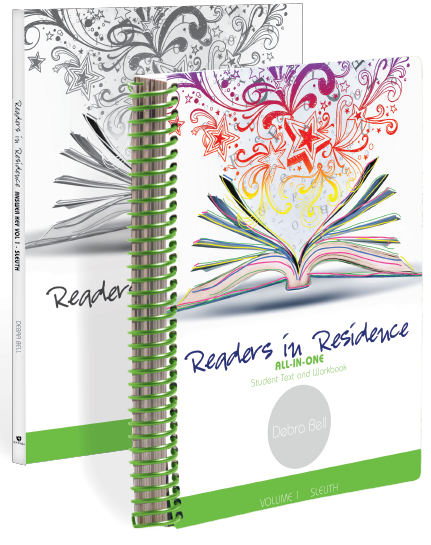
Readers in Residence Volume 1 - Sleuth is a new offering from Apologia Educational Ministries. For our review, we received the "full set" of books for the program (both the consumable/single-use student work/text along with the Answer Key).This new, literature-based curriculum can be used as a standalone reading/literature program, or in conjunction with Apologia's Writers in Residence to create a full (one year) Language Arts program. The target reading/comprehension level for the program is 4th grade, though it is also appropriate for older students.


Apologia: Reader's in Residence (Homeschool Review Crew)

Readers in Residence uses classic literature books (Sarah, Plain and Tall, Charlotte's Web, and Because of Winn-Dixie) as the basis for the instruction. Students are also expected to read a book from each of the chosen works' genre (i.e., a second historical fiction, etc.)   Skills developed through exploring these titles include:

-general reading comprehension/plot awareness
-inference
-vocab from context clues
-literary features: personification, hyperbole, metaphor/simile
-use of grammar and punctuation to achieve effects

The answer key includes fixed replies (i.e., facts about the characters/plot, the correct answer of "choose simile or metaphor for this sentence," etc.) as well as suggested/appropriate answers for open-ended questions ("What do you think...," "Why did she..." etc.)  While I generally read the books I assign to Jude, I appreciated both styles of answers because here, I hadn't read the book in a few years.  I've found that it helps Jude to understand more when he's able to focus more on the story (characters and plot) and less on actually decoding the words, so usually we read the books aloud as he works through a literature study.  To work on his independent reading skills, I expect him to read an age/grade level appropriate book for about 30 minutes each day.   I had assigned him Because of Winn-Dixie as independent reading just before we received this program to review, so while I did read it when we began the RIR program, Jude started the first few lessons before I had a chance to catch up.

Apologia: Reader's in Residence Unit textbook

I'm going to admit up front that overall this program didn't really work well for Jude, for a few reasons.

First, to be successful with the program, you need to start at the very beginning. Each new lesson builds on prior ones; often there are references back to the earlier books.  We had just finished reading Charlotte's Web using his regular literature program (different publisher), so rather than risk losing his interest by backtracking and repeating the book, we decided to dive in with Because of Winn-Dixie, the third book Readers in Residence studies.  There were a few places where I needed to adjust the assignment/discussion.  When they referenced the characters and/or story in Charlotte's Web, we were able to make most the connections, but since he hasn't read Sarah Plain and Tall, anything about that book we needed to skip over.  It leaves Jude with a lot of gaps with this program.

Note: You will need to get the books studied on your own; they are not available directly from Apologia.  Also, specific editions are required - for example, you will need the 60th-anniversary edition (2012) of Charlotte's Web that contains Kate DiCamillo's foreword. If you are purchasing the book new, or have a newer library version, this shouldn't be an issue. However, our copy is from a 2006 printing - according to Amazon, I purchased it in 2008, back when Luke was Jude's age.  Again, we were left with a gap because our book didn't contain this.  You can find out the book titles needed by clicking through to download  the Table of Contents (a 40-page sample of the program is available through a free download as well), but I think it would be much easier to have the titles/editions listed on the program's "purchase here" page(s).

Second, each section teaches different literary elements and forms.   For example,  Unit 1 (Sarah...) addresses character development, and theme, while Unit 2 (Charlotte's Web) discusses the components of plot (rising/falling action, climax, etc.).  Unit 3 (...Winn-Dixie) builds on both of these and adds the story's setting as a way for the author to propel the plot.  Justs being familiar with the plot of one (i.e., what happens) isn't enough to be able to work efficiently with the next because Jude didn't have a good grasp of the terms (they are presented in a different way with his usual program.)  Jude did well with newly introduced concepts but struggled with when they were "revisited" from earlier in the book.

Apologia: Reader's in Residence Literary assessment workbork


Overall, I felt the program was quite thorough with what it presented.  Each presented book takes about six weeks to work through, and then allows time and structure for studying the "Your Choice" books.  I'm definitely considering it for Damien because I like that it ties books together, so the student begins to see something pointed out in an "easier" book, and then it appears again later.  For example, every story in existence follows the same concept of rising action-climax-falling action, and you'll want to know that for later as books get more complex - this is something that I find Matthew struggling with because he doesn't have a sound basis of how to find these in a story.  However, he would be starting the program at the beginning (he sat with us as we read Charlotte's Web aloud, but didn't do a formal literature study like Jude did), and I think that would make a huge difference in the ability to do more than answer the fact-based "what happened in this chapter" questions.  I don't believe this is a program you can switch to mid-year because you want to do a unit study that includes a particular title.  You have to commit to the entire study, not just a section of it.

Fifty families have been reading with Apologia's Readers in Residence program.  Click the banner below to find out their experiences.


Readers in Residence Volume 1 (Sleuth) {Apologia Educational Ministries Review}


©2012- 2016 Adventures with Jude. All rights reserved. All text, photographs, artwork, and other content may not be reproduced or transmitted in any form without the written consent of the author. http://adventureswithjude.com

Friday, April 22, 2016

Apologia Writers In Residence (A Schoolhouse Crew Review)

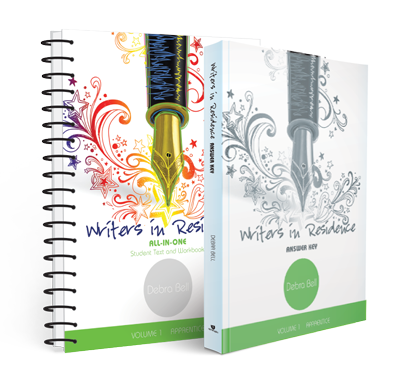
Over the past years, we've used several of Apologia Educational Ministries' homeschool curriculum offerings. Their newest language arts course, Writers in Residence, is an innovative program combining grammar, writing, and editorial skills into an integrated learning experience.  Authored by Debra Bell, a highly experienced language arts and literature teacher, this new writing curriculum is directed at individual homeschoolers or co-op and classroom students in approximately fourth through eighth grades.  Although Matthew is in 9th grade, his writing skills lag behind his grade level, so this became the core of his writing program for the last few weeks.

Apologia: Writers in Residence Review

The Writers in Residence student book is an all-in-one volume that contains both textbook and workbook activities.  An accompanying Answer Key for the parent/teacher contains both defined answers (ie, for grammar/editing questions) and suggested answers (for writing exercises), but no teaching guides/materials. We received the full curriculum bundle that contained both books, but each is also available for individual purchase.

Traditional writing programs generally divide instruction units by style (expository, persuasive, personal, etc.) and teach writing from that genre's singular viewpoint.  However, most writing that adults do doesn't cleave along these tidy lines.  For example, this review spans multiple genres and is both expository and narrative in its presentation; a good editorial will be both expository and persuasive.  Writers in Residence prepares writers for this "real world" style of writing by presenting writing in topical contexts instead of stylistic.  It allows young writers to find a single, encompassing writing voice that will shine through all of their pieces, rather than having many individual style-driven personalities.

The spiral bound student book is fully consumable.  I appreciated that this was a single integrated book, but the combination of text and writing makes this book approach 600 pages!


The thickness also often made it difficult to write in; either it was too thick under Matthew's hand or the huge spiral was in the way. Matthew liked the idea of a mixed text and workbook but thought it might be better if it was split into two "semester-long" books.  However, I was frustrated at not having a separate text to refer to. If he had a question, either he had to come to me with the book, or I would have to stop what I was doing to come read the instructional texts over his shoulder. It just felt awkward to use simultaneously as both instructional and practice.

Included towards the beginning of the student book is a suggested daily schedule, and the entire program is intended to take 32 weeks (a full school year).


 Matthew and I liked the schedule inclusion, even if we disagreed on how to implement it. Generally, assignments were kept to one or two activities per day, while four-day weeks allowed flexibility for scheduling.  For the purposes of this review, Matthew followed the suggested schedule for his first essay. However, none of the individual lessons was particularly long; some were under five minutes for him! For a fourth grade student, the suggested schedule is steady yet not overwhelming, but an older student could easily complete two or three lessons each day.

Each module includes a clear, points-based grading system for activities, along with a reasonably objective scale.


While whether an activity merits  "exemplary" vs. "acceptable" scores is subjective on my part, it did show Matthew a clear line for creating an essay.  Because it showed each task, I could where in the process he lost his way before the essay was irretrievable. Here had only six sentences instead of the required ten. Neither did he follow the activity's direction to write individual sentences; instead he wrote a short draft paragraph. 


Using this step-by-step checklist, we were able to back up immediately so that he only had one "needs improvement" instead of amassing six.  Units also include a clear rubric to guide both writing and grading the completed essay.


I liked the concept of the program and its clearly defined guidelines for both writing and grading. However, the execution just didn't work for us.  Although Matthew was only just above the suggested age for content, he felt like much of the grammar activity was a waste of his time.  He could appreciate how a fourth grader might need extra help in identifying proper noun; however, he found correcting entire passages just for the sake of finding single elements tedious.  I handed sixth grader Celia the book and she felt the same.  Her thought was, "It's supposed to teach me how to write, but it seems like it's spending a lot of time teaching me how to capitalize."  I think the writing content is written on an upper elementary level, but the actual content is activities that younger students generally learn.

We completed the first module completely.  I was underwhelmed by his progress.  I understand the program's initial directions to simply write sentences as they come to you, and then physically move them around into the final order.  I think that makes a lot of sense for a kinesthetic learner.  I remember writing a term paper in college where I had post-its lined up above my dorm bed and physically rearranged them to organize my thoughts.  However, rather than writing a paragraph with a defined topic and supporting sentences, it seemed like Matthew simply wrote a bunch of topical sentences and arranged them in paragraph form. Given that this curriculum is for middle elementary students, I can't be shocked that what he wrote WAS a fourth-grade paragraph.  However, that's not acceptable when your academic grade level is much higher.


One assignment was to write a paragraph that focused on using strong verbs.  While still not the best of paragraphs, focusing on it as a single paragraph and not a conglomerate of sentences led to a higher scoring level.


Thinking the concept and content of the program is better for younger students, I considered getting the program for Jude (3rd grade) but ultimately have decided not to.  Practically speaking, the thickness of the book is difficult for him to write.  I considered breaking the book down and having it rebound, but the program book already is $80, and rebinding would push the cost further up. The student book also does not grant any reproduction rights (even within the same household), so the program can't be used with multiple students in a family to amortize the costs.  I would rather see program materials modeled after Apologia's science reusable text plus consumable workbook programs.  I had hoped that this would help Matthew become a better writer.  It has shown me some specific areas of weakness that he needs more assistance with, but, unfortunately, the program itself it didn't work out to be right for him.

To learn more about Apologia's programs or to read other reviews of Writers In Residence, follow Apologia on social media or clck the banner below.

Facebook: http://www.facebook.com/apologiaworld
Twitter:  http://www.twitter.com/apologiaworld
Pinterest: https://www.pinterest.com/apologia/
Instagram: http://www.instagram.com/apologia

Apologia: Writers in Residence Review


©2012- 2016 Adventures with Jude. All rights reserved. All text, photographs, artwork, and other content may not be reproduced or transmitted in any form without the written consent of the author. http://adventureswithjude.com
Tuesday, June 9, 2015

Apologia Field Trip Journal (A Schoolhouse Crew Review)


When you read about something in a text book, it often has a "remote" feeling, but going and visiting can really make something come alive.  Sometimes, you also learn things you never knew before - things that aren't deemed "important enough" to make it into books.  For example, did you know that Hannibal Hamlin, Abe Lincoln's first Vice President, spent the summer of 1864 helping defend his home state during the Civil War?  We didn't know this either -- we learned it when we visited Fort McClary in Kittery, Maine.  It's easy to read about Gettysburg, but it takes on a new meaning when you stand at the edge of Pickett's Field, imagine the last-ditch surge of fighting that came at the end of the three days of battle, and really feel the history in your soul. To encourage learning through hands-on field trips, Apologia Educational Ministries has created a special resource, the  Exploring Creation Field Trip Journal.

This 64-page spiralbound book is a fantastic addition to your field trip.  It's perfect for homeschooling trips, but it also can be a planner and journal for a non-homeschooling family who enjoys traveling.  The book is divided into 9 sections, to make both planning and recording your field trip easy.


One of my favorite sections is a two-page spread with 100+ field trip ideas.  It divides field trip ideas into "categories," - beginning with broad topics - plants, animals, history, culture, etc. - and then sub-divides these into places that are great for learning about them.  Of course, you have the obvious suggestions, such as museums, aquarium and zoos, but they are followed by some ideas that you wouldn't have though of - or at least that I hadn't thought of!  For example, a trip to a garden nursery.  It sounds more like an item on a to-do list, but it is a great place to study different plants in person.  Many small nurseries also will pre-arrange a short tour of the grounds so you can learn about native and non-native plants, or you can check their webpages to see if they offer specific classes.  We have a local nursery that does offer monthly classes about plants, but in the spring, the owner also offers classes on Pisanki (a Polish Easter egg dying technique.) The journal also suggests some that seem really "out there" -- literally!  How about a trip to the International Space Station?  Ok, so maybe you're not ready to hop a space shuttle, but you could take a virtual tour.  A virtual field trip can be just as exciting!  Also included in the "Trip Prep" area is a web link to some fantastic resources and ideas for trips.

Next, there are two maps - one of the United States and one of the world. When we got our book, we decided to color in each state we had visited. 


We started counting back to all the states any of the kids have been to.  Luke holds the lead with Hawaii, which we visited on our way back from Aunt Jo and Uncle Brendan's wedding in Australia.  We marked our first trip visit to a particular state.  (Living in NJ doesn't mean we get that one for free.)

Thinking back on on the places we had been to on our "first trip" to a state was a nice trip down memory lane.  In 2004, we visited New England for Luke's birthday, and the 2005 states were added during another birthday trip.  The 2006 trip was mainly to Ohio to see doctors for Celia, but we always laugh how the one day we had off from appointments and decided to go to Indianapolis.  We got there and decided we didn't feel like going to the children's museum, so we decided to go to Illinois for lunch, just to say we had been there.  A couple of wrong turns later, we found an overhead sign that said "To Chicago."  Neal and I looked at each other, shrugged and said, "Let's go get a pizza!"  With nothing better to do than sit in a hotel room and wait for morning and more doctor visits, we drove to Chicago, ate a pizza, and drove back to Cincinnati.  Between other visits, we went to St. Louis, MO and went up into the Arch and got some pretty good BBQ.  When we realized the US Skating Nationals began the day we were supposed to leave Cleveland, we just added a day to our trip so skater Luke could experience the men's short competition.  He got to meet one of his heroes - a very gracious Brian Boitano. Admittedly, it was not a fun reason for a trip (we visited two different hospitals), but it's not the hours in hospital and waiting rooms that we really remember -- it's the time we spent together.

There is also a "World Traveler" Map. 


Luke got to color in the countries he's visited.  Matthew added in the Caribbean countries he has been to (he may have been a baby, but his passport is stamped, so they count!).  This page would be fantastic for a military or other expat family stationed overseas, where visiting different countries is not uncommon.  Someday we will add some more - Jude wants to go to France for a field trip.  (He's not settling for Epcot, either.)

We're planning a ginormous field trip this summer, and we've titled it "The Great American History Tour - Round Two." Last year, we took two shorter trips - first through Central MD and Central/Western PA, then to New England - spending about 10 days on the road.  Even when we hosted our Aussie family, we never spent more than a week away from home.  This year, we are taking a big plunge and doing one ginormous three-week trip.  When Neal asked me where we were going, I said, "Monticello, Virginia...via San Antonio (Texas)."


It makes perfect sense, doesn't it?  It started out as "We're heading to Kentucky for Abe Lincoln and to see Jude's friend Isaac.  We might as well see some other stuff while we're out that way..." and morphed into "We're only two hours from where Abe grew up... and a couple hours from Memphis. Jude fell in love with Elvis when we went to the Rock and Roll Hall of Fame, so...and oh, look!  It's only three inches on a map from Memphis to Houston...and by then, we're practically around the corner from the Alamo!"  We're getting really excited.  We are planning to use this as a journal as a daily log for our trip.  We've already begun setting up some of the "Specific Trip" pages:

Of course, with five opinionated siblings, not everyone is going to love every stop.  However, we tried to include enough so that each person has something he or she "chooses" every few days.  What I did was ask each child what she/he wanted to see at "his/her" stop.  Luke chose his must-sees for Allegheny Portage/Johnstown PA, Matthew chose the Adena Burial Mounds as a must-see, and Celia wants to go back to the Cincinnati Museum Complex.  She has been asking to go back since we were there in 2009, and really - we have so many museums here, there's no reason to drive all the way to Ohio.  However, since we need to pass through Cincy to go to visit Isaac, we're making a stop.  She can't wait, because not only is her "wish coming true," but she's getting to learn about Cincinnati, the town where (American Girl) Kit Kittredge "lives"! We are waiting to fill out our pages for Kentucky, because Jude wants to wait to see what Isaac wants to do with us, and will continue filling out pages for later stops after that. 

At the back of the book is the section called "As I See It." It's a way to informally document something.   Maybe you haven't gone to a big destination, but your "field trip" is a nature walk and you'd like to draw what you've seen.  There are several pages with theme prompts such as "Reflections and Shadows," "Predators and Prey," and "Heavens".  There are also several blank pages where you can draw with your own inspiration. 


There are two ways to use this book.  The first would be as an individual student journal, which would be good if your family does the occasional trip.  The retail price of this book is $22.00, so if you're going to use it for a full school year or beyond, it's a worthwhile investment.  However, since getting each student a book is a bit more than I'd like to spend, we're going with the "use it as a family" plan, and each person will get to add their input for each stop.  (We may have to have a designated writer in order to fit ideas.)

As much as I think we will enjoy this book, I see a few shortcomings.  First, I wish this had a way to add extra pages for more trips.  Even as a shared family journal, we are going to need two more journals to be able to log everything on our trip.  I know that a giant trip with nearly 30 places to visit in one month isn't the norm, but if you're a family that likes to do a lot of traveling, this book will fill quickly.  Many families I know do one field trip each week; even at a one-trip-a-month pace, the book may not hold a year's worth of memories.  It seems a waste of paper to get a new journal with hints and preparations pages when all we really will need are the trip pages - a 3-ring binder and refill pages (like a Dayplanner style) would be more practical if you go on frequent field trips.  I also wish there was some sort of envelope/folder so the student could keep mementos (entry tickets, etc.), or a third page for each trip for pasting tickets/photos.  There is ample room on the page already provided for if you have a student who wants to write a paragraph or two about the trip, or for a younger student to place a picture or two in response to the prompts, but not for both.

Overall, we like this journal.  We wish it had a bit more room for more frequent field-tripping, but if you take field trips only once in a while, it could last an entire school year.  Until now, we hadn't really considered keeping an "official" field trip journal, but I think it's going to be a fun addition to our trips!  We're looking forward to writing about what we've seen, and coloring the states we haven't yet visited. 

Where is everyone traveling with their journals? Click the banner below to read more Schoolhouse Crew reviews, or follow Apologia on social media:

Facebook: https://www.facebook.com/apologiaworld/timeline
Twitter: https://twitter.com/apologiaworld
Pinterest: https://www.pinterest.com/apologia/
Google+: https://plus.google.com/105053356034237782125


Exploring Creation Field Trip Journal Review


©2012- 2015 Adventures with Jude. All rights reserved. All text, photographs, artwork, and other content may not be reproduced or transmitted in any form without the written consent of the author. http://adventureswithjude.com

Sunday, November 24, 2013

Sunday Sharing Pinterest Party Week 18

Happy Week-of-Thanksgiving! Welcome back!


How was your week? Our was fantastic! I found out that my application for the 2014 Schoolhouse Review Crew was accepted! Yahoo!!! I'm so looking forward to trying some great things! I hope you'll check back often and see what products we are trying!


On to this week's favorites. Thank you everyone who linked up their pins! You made it so hard to choose my top three!


Amy from The Potter's Hand Academy shared some beautiful Thanksgiving copywork!

http://www.thepottershandacademy.com/wp-content/uploads/2013/11/ThanksgivingCopywork_Page_01.jpg


While Amy's copywork is meant for older students, perhaps you have a younger child and are looking to expand your home library.   Poe at Thoughts from Poe Kitten shares some great ideas for building a great library on a budget. 


 Have I ever mentioned just how much I love, love, love Apologia Science?  Last winter, we reviewed Swimming Creatures of the Fifth Day and loved it.  This fall we got to review Exploring Creation with Chemistry and Physics, and thought that was just as great.  I'm pinning this activity for when we study the Land Creatures of the Sixth Day.


Jen at Thou Shalt Not Whine has a how-to from these adorable snakes.  I know we have a few that have "eaten" bit of soup that could be re-purposed into these, or you could find some ties at a thrift store for next to nothing.  Or is that nexssssssssst to nothing?


This week, there is going to be a slight change.  With the holiday weekend coming up, I'm going to leave this linky open for two weeks, so that everyone has a chance to participate.  I hope everyone has a wonderful and blessed Thanksgiving day!  Have a slice of pie for me...I like pumpkin or apple best!


 ©2012- 2013 Adventures with Jude. All rights reserved. All text, photographs, artwork, and other content may not be reproduced or transmitted in any form without the written consent of the author. http://adventureswithjude.com

Monday, November 11, 2013

Apologia Exploring Creation with Chemistry and Physics (A Schoolhouse Crew Review)

 photo logo_zpsd1be877b.jpg
 Back in February 2013, we were given the opportunity to review Apologia Educational Ministries' Swimming Creatures of the Fifth Day homeschool science curriculum and absolutely fell in love with the Apologia Science program.  Although Luke had tried another high school Chemistry program, he just wasn't happy with it.  Yes, he still has to learn Chemistry, but if he's homeschooling and we have the flexibility to change things, why NOT?  He pulled out Jude's text from before, decided he really liked the program style, and wanted to try Apologia's high school program.  Jude overheard the decision making process and asked, "What's chemistry?" and found out it is a science course that contains potential for "experiments that blow stuff up."  Suddenly, Jude wanted to do Chemistry too.  When Exploring Creation with Chemistry and Physics was offered for review, I practically begged for the opportunity to work on this one.  A first-grade level explanation of how to explode the universe?  Jude was so excited to get started.


The textbook for this program ($39.) is fairly evenly split between chemistry and physics. Chapters 1 and 2 are a good meld of the two, beginning with shared basics like matter and the differences between solids, liquids, and gases.  Then the book starts to get into details.  Chapters 3, 4 and 5 then focus on chemistry - atoms, compounds, and mixtures - before the focus shifts to physics with motion, energy, sound, and light covered in chapters 6 through 10. A last chapter of a more chemistry-leaning topic - thermodynamics- rounds out the Chemistry offerings, and then the physics course completes with electricity, magnets, and machines.  If you had a student who liked new things often, you could follow trajectory of the text as written; if he preferred to explore one subject fully and then another, it would be very easy to skip around from section to section.

One chapter that overlapped with both Luke and Jude was was thermodyamics.  I got a kick out of Luke trying to explain things to Jude.  Jude also enjoyed working with Luke in a pseudo-lab setting (the kitchen).

I am very particular when it comes to lab safety.  Having been a science major at one point, I've see how even the most careful of scientists can have an accident.  Generally, they have only ended in a mess (a half-full bottle of crystal violet goes a VERY long way), but it is so important to wear goggles (the splash as it bounced thankfully got my goggles, not my eyes).  While all of the experiments in this book used household items, and I tend to think cornstarch isn't going to cause any problems,  I was pleased to see the "You will need..." section of many experiments included "safety goggles."  It is never too early to focus on safety, and the student that wears goggles from the start will be less likely to balk as he gets older -- "put on goggles" will just be automatic.

As much as Jude enjoyed working on formal experiments, we were also able to do "real life" things that brought home the ideas.  For example, when studying thermodynamics (Unit , we learned about heat conduction.  Jude now understands why he doesn't want to leave a metal spoon in a hot pot, and he does want to use "oven mittens" because the heat from the oven will make the cookie sheet hot.


 As we studied crystals, we then looked for them in our daily life.  Sugar in the brownies, salt on our french fries -- all were crystals to examine.  Even Mommy's engagement ring -- a diamond -- is a giant bunch of crystals.  We also found a bunch of great videos on minerals.  

We also found a YouTube video from Bill Nye the Science Guy as we read Lesson 4 and chemical reactions.   We learned chemistry is everywhere!  Jude especially enjoyed learning about chemistry in the kitchen - baking soda + vinegar + a few other ingredients =  "Wacky Cake" for dessert!


Jude watched the chemical reaction as he stirred pancakes - when we added milk to the flour and baking powder, the batter grew.   (And while it may not be quite what he had in mind when he wanted to blow things up, he agreed that the small explosions were delicious.)


While we didn't delve into physics too much, we did do a little bit of study in that field.  We learned about simple machines, and how we use them in our daily lives.  We learned about six simple machines - inclined plane, puley, screw, wedge, lever, and wheel and axle.  While we learned about how ancient civilizations, like the Egyptians, Greeks, and Chinese, used simple machines, we also explored them in our daily lives.


 photo juniornotebookingjournal_zpsa179a078.png Apologia's program includes not just the text book but also companion Notebooking Journals.  Because the general program is geared toward students in Kindergarten through 6th grades, there are two levels of journals.  We worked with the Exploring Creation with Chemistry and Physics Junior Notebooking Journals  ($24.)  that are meant for the K-2nd grade crowd.  (If you click on the Crew banner below, you will be able to find out how the program worked with the "regular" journals geared toward 3rd-6th graders.)  In addition to the activity and journal pages, the notebook includes coloring pages and copywork.  I like the illustrations that show the "real" applications of the concepts.  For example, one of the illustrations for the unit on Matter is a trio of children panning a stream for gold.


The illustration clearly matches the concept: scooping up liquid water to separate solid gold.  It is also paired beautifully with a verse from Psalm 19:
The fear of the Lord is pure, enduring forever. The decrees of the Lord are firm, and all of them are righteous.  They are more precious than gold, than much pure gold; they are sweeter than honey, than honey from the honeycomb.  (Psalm 19:  9-10)


Coloring is an activity that often gets overlooked once a child starts school.  It not only develops an artistic eye, but the act of coloring itself strengthens small hands to prepare them for writing, develops eye-hand coordination, and helps a child learn to control the pressure and speed of his hand.  Jude receives occupational therapy once a week, and often his OT would ask for schoolwork for him to do, so that he wasn't having an hour of OT and then having to go home and do school besides. Many of his coloring pages were filled in at the hospital.

Jude and Miss Amanda also usually do a copywork page, so he can work on his handwriting.  This is a fine motor skill Jude needs practice with, but also it's a focusing skill that is hard for him.  20 consecutive minutes of seated work is one of our goals, and handwriting a Bible verse takes him between five and ten minutes, a good start towards his goal.


Damien (PK3) also joined in the fun!  He had his own Junior Notebook as well.  While he stuck mostly to coloring in the notebook, rather than even dictating facts,  he sat and listened as we read the textbook lessons aloud.  He thought the gems in Unit 4 were pretty, and was excited when we made and compared paper snowflakes, stand-ins for the crystal-based real ones.  His snowflake and Jude's snowflake were different, just like they are!


Even though it is written as a program for young students, Apologia's Exploring Creation with Chemistry and Physics is not a lightweight course.  The explanations and examples in the text are simple enough for a younger student begin to grasp the fundamentals of chemistry and physics, but expansive enough for an older student to be well prepared to move on to higher level courses. Even after having read entire chapters aloud, I believe we will be able to return to each one as each boy gets older, and revisit concepts and lab experiments as their understanding grows.  What we liked most was it made chemistry and physics FUN, which is what science should be all about!


Photobucket


©2012- 2013 Adventures with Jude. All rights reserved. All text, photographs, artwork, and other content may not be reproduced or transmitted in any form without the written consent of the author. http://adventureswithjude.com
Related Posts Plugin for WordPress, Blogger...
Pin It button on image hover