Wednesday, July 25, 2018

Love, Honor, and Virtue: Gaining or Regaining a Biblical Attitude Toward Sexuality (Homeschool Review Crew)

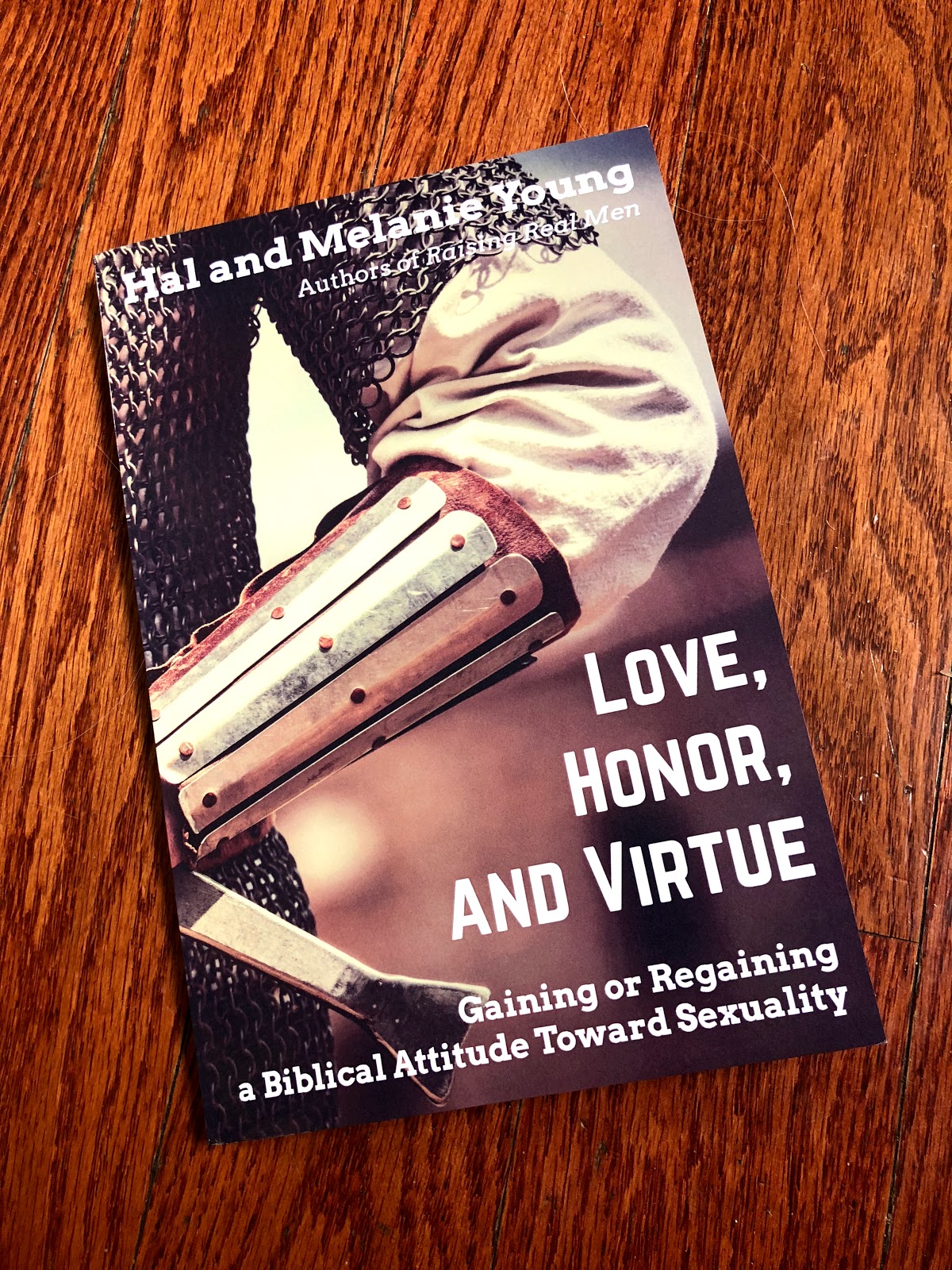
Love, Honor, and Virtue: Gaining or Regaining a Biblical Attitude Toward Sexuality is a book for boys, written by Hal and Melanie Young and published by Great Waters Press.  It is intended for tween and teen boys (ages 12 through 19), and still appropriate for young adults.  We received a print copy, but it is also available as an audiobook.  For our review purposes, a parent was asked to read it before sharing with sons. I am glad I did this because as much as I have liked some of their other books, this one just left me frustrated.


Addressing teens and sex is probably a parenting area where I could grow; I admit to having a "That's your aisle, dear husband," approach.  (And let me add that he's done a fantastic job handling things, man-to-man.) When I first received the book, I had hoped it to be more of an ice-breaker; I could read it, the boys could read it, and it would open avenues of discussion. Having read it, it's more of a "Here, read this, off you go," type of thing.  It's possible that it is because I have a different view that the Youngs on some things, but I felt like it was more "edict of how you should behave," and less "Ok, let me teach you my view so you come to agree with it, rather than just decreeing, 'Thou shalt...thou shalt not..."As I read, I felt that if I gave this to the boys, I'd be spending more time saying, "This is what they say, but this is what your father and I believe..." and sending too many mixed messages.

There are some bits of sage advice, which address things that are novel to this generation.  Sexting, for example, is an activity that seems relatively innocuous but can lead to child pornography charges and becoming labeled a sex offender. I agree that it's not a stellar way to start your adult life.  Yes, it is something that needs to be addressed, and at times, worst-case-scenario does need to be presented, so that kids realize it's a serious issue.  However, their "nothing at all, looking, reading, even thinking about sex" is a bit much. I think to say "Sure, you can think she's pretty, but don't lust after her," is a bit ridiculous. Is it probably wise to not act on it? Sure. (I'd like all of my grandchildren AFTER the weddings, please and thank you.) But the Youngs mention lust shouldn't happen, at all, even if you're talking about the person who is going to become your future spouse.  If there was no lust involved before people get married (I'm discussing sexual attraction, not sexual activity), then the only reason not to marry a relative is science and genetics. Finding another person sexually attractive IS part of discerning "Do I want to marry that person for life?" and a valid relationship trait to assess. A wedding ring isn't going to suddenly make a person sexually attractive. (In my experience, yes, the person becomes more attractive, because of the mental restrictions/stresses it removes and the relationship it affirms, but it's a wedding ring, not beer goggles.) Even as an adult who has been married for nearly 21 years, I can look at a man who is not my husband and objectively consider him handsome - perhaps its objectifying, but a handsome man is like a pretty floral arrangement or a delicious dessert.  Appearance is a qualitative trait, but good appearance doesn't necessarily equal sexually attractive. I think there's a line between "all-consuming lust that you act on when you shouldn't" and "discerning if lust is part of the bigger picture," but this book tries to lump it all together as "sinful and to be avoided." There's too much black and white, and life is shades of gray.

In my opinion, this book also approaches engagement and marriage with more of a "courtship" perspective than a "dating" perspective.  My personal thoughts are more of a middle ground. I don't think dating-for-the-sake-of-dating is wise (it begets its own problems), but a traditional "courtship" where the sole goal is marriage perhaps puts too much pressure on either person.   My personal experience is that yes, dating did lead to a few broken hearts, but I would also like to think that I grew as a person from those relationships.  I learned what I wanted from a partner, what was not negotiable, and, if I'm brutally honest with myself, things I may have said or done that were unkind as well and ways I needed to change to become a better spouse. I would teach my sons (and daughter) to balance respecting others and not having a different date every night with "You don't have to start the first date thinking "Am I going to marry this person?"  Sometimes, the person you don't expect to be "The One" is, and sometimes, the person you think will be just isn't.

I also find myself bristling at the idea of "equal" and "unequal" yoking.  I've seen several instances in my family of what many would consider "unequal," that had little effect on the marriage.  Some were inter-denominational marriages, but Neal's parents began their marriage as an interfaith couple. When they married, his mother was Jewish and his father Roman Catholic.  Talk about unequal! By the time I met Neal, not only had his mother converted and they raised their children as Catholic, but she was what one would consider the active Catholic, not my father-in-law! Both now are strong in their faith and will celebrate their Golden Anniversary this coming spring, so clearly, religion and faith is not something that precluded a strong and happy marriage.  If one partner says "I forbid you to practice your faith," then that's a red flag that this may not be a wise relationship.  But I think the Lord works in His own way, in His own time, and that shouldn't be a dealbreaker if everything else is right.  Who knows what His plans are?

Finally, there was a passage on purity, which included addressing how a boy should view a girl's clothing; a girl in short shorts or a revealing top may be wearing it because she likes it, not "for him." YES! While we do have rules about what we allow our daughter to wear, they are based on our own feeling about appropriateness and modesty.  There are some garments we all find silly; she agrees that if you need a bikini wax to wear a particular pair of shorts, they're too short! I'd like her to realize that regardless of how society may view her, she is more than boobs and a butt, and should dress so as to show how much she values herself.  (Not necessarily her sexuality, just her innate worth as a child of God.)  But then in the next paragraph, it puts it on the guy to say to a girl, "You are too attractive, we need to go elsewhere." Should she want to do what makes him comfortable? If she values him as a person, yes. But this example/phrasing still blames her: "You're tempting me."  I would tell both my sons and daughter that if you cannot control yourself around someone in private, you probably have no business being with him or her in public, either.

This is not a book that I will likely hand to my boys. Could it be used for opening a discussion? Yes, but I think I would do it with Luke (nearly 20), where I would say, "Do you agree? Disagree? Why? Why not? What do you think about this?"  Though it is suggested for this age, it is not a book I'd hand a twelve-year-old. I agree that just waiting until they're fifteen or sixteen to discuss not just the mechanics of sex and reproduction is too late -- it's our job as parents to teach our kids values from the start, but I think it's a bit heavy for a young teen. As much as I really hoped this create a bridge for sharing between my boys and me, I just don't see it as practical for our family.

The Crew has been reading two books from the Youngs: Love, Honor, and Virtue: Gaining or Regaining a Biblical Attitude Toward Sexuality and No Longer Little: Parenting Tweens with Grace and Hope.  Click the banner below to read the Crew reviews.


If you'd like to read our review of No Longer Little..., click here.  This was a book about parenting children through the tween years which I found I could better identify with.


Love, Honor, and Virtue  AND No Longer Little {Great Waters Press Reviews}


Want to keep up with all of our adventures?
Subscribe below to get Adventures with Jude delivered to your inbox.

Enter your email address:


Delivered by FeedBurner


©2012- 2018 Adventures with Jude. All rights reserved. All text, photographs, artwork, and other content may not be reproduced or transmitted in any form without the written consent of the author. http://adventureswithjude.com

No Longer Little: Parenting Tweens with Grace and Hope (Homeschool Review Crew)

No Longer Little: Parenting Tweens with Grace and Hope is the newest title from Great Waters Press.  I was definitely interested to read this one!

I laugh that when you first have your children, there are tons of books out there that tell you how to handle being pregnant, adjusting to a newborn, and parenting toddlers and even preschoolers.  However, it seems like once you get to elementary school, you're on your own until it's time for The Talk, but don't expect any help transitioning to adulthood.  (I'd have paid just about anything for a "What you need to do when your child becomes a legal adult" book -- I feel like the last two years with Luke have been "Oh yeah, we need to do this," or "Right, he needs to fill out that form..." It's a mad scramble.) Having raised two tweens and being in the thick of it with three more (my baby just turned eight!), it is a time that can be absolute chaos for kids and parents alike.


I think the hardest thing about parenting a "tween" is realizing that it's a huge age range.   "Tweens" are generally between the ages of 8 and 12, but authors Hal and Melanie young extend this to age 14.  I think this makes sense - yes, Celia is 14, but we haven't gotten really into the heavy "teen" stuff yet. I think it's quite logical to use "grade school graduation" as a transition mark.  When you have itty-bitties, your ages are relatively well defined: a baby is under a year, a toddler is one or two, and age 3 starts the preschool years. There is so much change in a short time!  However, the tween changes are more gradual, making this time even more frustrating.  I can guarantee you that while both may fit in that age bracket, Damien and Celia (and even Jude parked splat in the middle at 11) are nothing alike. What may be appropriate for her is not for Damien, and the "line in the sand" is constantly shifting.

I don't remember "tween years" as a big milestone age bracket.  I remember turning twelve, and my pediatrician announcing me "pre-pubescent." I admit to being quite pleased with the diagnosis; that well-child visit culminating in the privilege of being taught how to do his signature magic trick that he used for all little-kid immunizations. (Hey, thirty-odd years ago, a tongue depressor employed for "The Bug Trick" was a technological marvel.)  The Youngs start out by addressing the biggest elephant in the room, puberty, right in Chapter 1.


Most of us think of puberty as a linear type of thing. (And the books out there on that make it seem that way: first this, then that, then something else, and boom! Instant grown-up.) Having been through three rounds of it as a mother, I can tell you that while puberty itself may be, the two or three or five years of hormonal fits and spurts leading up to it are no cakewalk.  The child you kissed goodnight last night is NOT the child that woke up this morning, but hey, he might be back next Tuesday!  (Frankly, I think full-on, all-hormones, all-the-time is a relief, because you KNOW each morning is going to be a disaster.) The authors include this tidbit: "Researchers have found both sexes have hormonal surgest exceeding fifty times the normal, stable levels they have in adulthood." (p 7) With that in mind, no wonder it feels like I've lost mine!  (And God bless my parents.  There were three of us within three years...sure, they got the diaper phase over with fast, but it's no wonder my father's hair was turning white before I finished high school!)

Does it feel like they've lost their minds too? They probably have.  The Youngs address this "space cadet" phase with science -- as the brain matures, it dis- and then re-assembles. (p 31).  Once you realize that you are dealing with a person who truly doesn't know which end is up, and logic just no longer is logical, the easier it is. I think it's easy to get into the rut of, "He doesn't understand, I'll let it go..." which is, in my opinion, a bad parenting idea.  Because eventually, he WILL understand and has to possess the skills to navigate with good behavior skills. I think parenting tweens is like parenting toddlers - you know you're going to have to say "No, hands to ourselves" a thousand times before they learn not to poke everything they see.  With tweens, it's like saying, "This is what we expect, now do it," while feeling the wall listens better.  I think the biggest thing I've learned the hard way (and probably would have realized a kid or two sooner with a book like this) is that just because they're larger people doesn't mean they're more grown-up. Yes, Jude is capable of microwaving his own chicken nuggets, but he still needs reminders to put the ketchup away when he's done eating.  Understanding "his brain just isn't quite online" doesn't get him out of cleaning up after himself, but it does help ME be more patient when I'm saying, "Please put that away!" for the eleventy-billionth time.

I particularly appreciated the balanced approach they brought to media and discernment.  It's easy to say, "I survived all the way to 30 without Facebook!" but the reality is, we don't live in that world any longer.  I remember being tethered to one phone on my parent's kitchen wall to talk to my friends - my dad brought home a phone cord long enough that I could lay on the floor as I chattered away.  Celia now wanders the house, FaceTiming her BFF on her cell phone.  We had three network channels and three local ones on the TV; the cable package we have in order to have the internet tier we need for homeschooling streams close to a thousand. And the internet itself...Neal and I met via Temple University's student intranet. Talking online involved specific pages, commands, and dial-up internet, while now I can use Facebook Messenger to text Neal at the same time I'm writing this review and googling the answer to a random question another kid asks.  The authors note that it's important to prepare kids for the world they live in, not the one we wished had stayed.


That said, kids need to learn to discern the good from the bad, the treasures from the junk.  One line sticks with me: "There's not a straight line from the home video console to a police morgue.  The illustration is simply to point out that our young people will need guidance and supervision to keep them out of dangerous territory." (p104). I appreciate how they broke down "You're not old enough for that," into tangible topics of theme, character, and genre.   No "big kid" wants to hear, "You're too little!"  For me, this gives me ways to balance between concrete absolutes ("The rule is 13 and up, you're 8, so no, you're not getting an Instagram account.") and values ("Do you think what that person did in that movie was a good idea?") when guiding appropriate technological things. This old dog is grateful for a new trick that allows for a logical answer, and not "Because I said so." One other thing I have learned the hard way -- let it be a discussion, not a "Mom thinks," because 1) it keeps communication open and 2) sometimes, kid sees it in a different way and it challenges my thinking.

Included in the topics the Youngs discuss are learning how to meet them where they're at.  For example, by the tween years, kids have enough words that they don't always need their fists, but they don't yet realize that words can hurt as badly.  (And sometimes, there will still be fists involved, because those disassembled brains can't find the words.) And back to puberty, they address emerging sexual issues, pointing out that even if you're a Bible-reading-only family, your kid is going to learn about sex. NOW, even though they seem so little, is the time to start laying down your values - not necessarily shielding them from everything adult in nature (though there are the obvious avoids) but encouraging dialogue and explaining why you believe in a certain view, from general modesty to dating perspective.  The Youngs write from a Biblical-driven worldview, but frankly, any parenting viewpoint can benefit from their in-the-trenches perspective. Regardless of your views, their thoughts on behavior, increasing responsibilities, consumerism, and stewardship are well thought and balanced.

Their advice, Don't freak out, is probably the most overarching principle. Parents talk about the "terrible twos," and "teen angst." Nobody tells you the tween years are coming. It's quite a rude awakening when you hit the middle years and it's not the smooth-ish sailing you expect, but rather the water are more like choppy, outer bands of a hurricane. The early tween years are when you need to start laying in supplies, and the later ones, you learn to board the windows quickly - and evacuate when necessary. I will be honest -- it gets worse when you hit the teen years and all the new drama, but don't give up hope.  I can say with (relative) confidence that eventually, they do start to emerge into calmer seas with re-intact brains and civilized personalities -- or at least, my oldest has now that he's almost 20, and and I'm starting to see breaks in the clouds with the almost 17-year-old.  (Which is good - because teens and tweens will eat you out of house and home, and with a new tween in the house, we need more canned goods.)

I think the Youngs summarize the tween years quite well, right in the introduction:
This same child was prayed over from the womb. We read him the Bible...[he] pretended to be John the Baptist.

Then, at age nine, in traffic, he announced from the back of the van, "I think I'm an athiest."

Nobody told us this was coming.
Nobody tells you the tween years are coming, but with their newest book, No Longer Little: Parenting Tweens with Grace and Hope,  Hal and Melanie Young help prepare you for the "Lord, please don't let me drive into that ditch," moments.  (And for the record, the car and family survived, as did that young man's faith. That, friends, is grace, hope, and I'm sure a whole lot of repeating "Don't freak out.")

To read other Crew Reviews of this book and their other book, Love, Honor, and Virtue: Gaining or Regaining a Biblical Attitude Toward Sexuality for teen boys, click the banner below.

Love, Honor, and Virtue  AND No Longer Little {Great Waters Press Reviews}


Want to keep up with all of our adventures?
Subscribe below to get Adventures with Jude delivered to your inbox.

Enter your email address:


Delivered by FeedBurner


©2012- 2018 Adventures with Jude. All rights reserved. All text, photographs, artwork, and other content may not be reproduced or transmitted in any form without the written consent of the author. http://adventureswithjude.com

Thursday, July 12, 2018

Math Essentials: Math Refresher for Adults (Homeschool Review Crew)

Math Refresher for Adults is a product that fell into my students' laps.  When Math Essentials offered this product for review, my first thought was "LUKE!" He graduated high school two years ago, had good enough grades and placement scores that he was able to skip several pre-requisites and jump into middle and upper-level math courses for this coming fall.  That said, it's obviously been quite some time since he had any formal math.  Because the advertises itself as "The Perfect Solution" for adults who need to brush up on their math skills, I thought this would be perfect for him to work with so that he had a re-solidified foundation.


Once we got the book in our hands and I was able to flip through it, I realized that while it wouldn't hurt him to work with the book, it was probably a little bit basic for his needs.  It focuses on skills such as:

  • General Math
  • Geometry
  • Problem Solving
  • Pre-Algebra
  • Algebra

While all of these are foundational for his courses, this book got re-assigned to Celia. She started Algebra I, but when she took the readiness test for her usual program, she felt she was shaky on some of the basics.  She knew them, but not as well as she would like. She also is transitioning from private school to homeschool, so this was a perfect opportunity for me to assess her skills. Since that was the more pressing need, she found herself the proud short-term owner of the book.

Not Just For Adults 

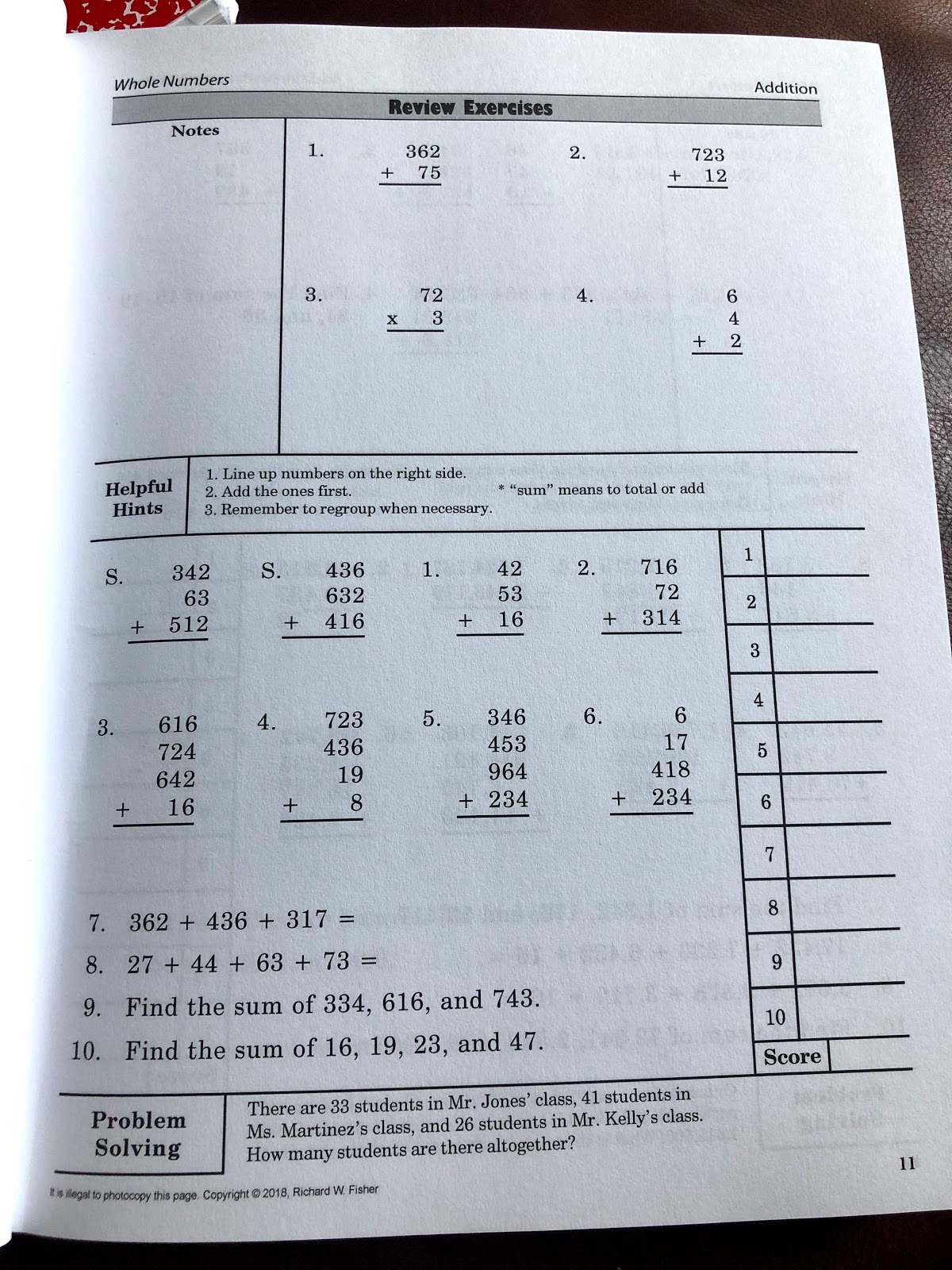
Since Celia was just beginning Algebra, we started with General Math.  This book puts you in the "way back" machine, starting with fairly basic computation - two- and three-column adding, with regrouping.  (If you're an adult working on this, you'll probably be calling it "carrying.")


Each lesson starts with four "review" problems.  At the very start, it doesn't seem like "review" - just more of the same.  As you get further into the book though, they pull from prior lessons.  I like how this keeps presenting opportunities to practice skills.  Let's face it, if you're doing a refresher course, it's because you know "one-and-done" re-exposure isn't going to be sufficient.


Celia felt she was ok with basic math; fractions, decimals, and percents were where she felt weak.  Each page has only about fifteen problems (four review, ten on-topic, and one word problem), so while thirty problems a day sounds like a lot, it only took her about thirty minutes each day to work through them.  She began by doing a page each of Fractions and Decimals, followed by Percents and Integers, alternating groupings each day.  She decided that this would give her the opportunity to review several topics quickly, but also allow her to keep looping back, so it was constant repetition rather than a "topic blitz."

While this is a softcover workbook, it functions better as a textbook.  While you could work some of the problems in the white space, you'd need exceptionally small and neat handwriting for some of them.  Author Richard W. Fisher suggests copying problems onto a separate piece of paper -- which actually helps with understanding, because you're working from start to finish -- and then completing the problem.  Rather than a bunch of scrap paper that could easily get lost, we opted for a copybook.  I laughed when I saw the front of Celia's book, indentifying which Celia the book belonged to -- the "classroom experience" is still active in her mind. Last I checked, we only had one Celia in our school!


As I said, this was an excellent way for me to assess her skills.  This problem showed a couple of weaknesses.


Math isn't just about getting the "right answer." You have to get the process right because otherwise, the correct answer is luck, not skill.  Here, her first try didn't align her numbers correctly.  I followed her thought process, but there were two issues -- either she missed squaring off the problem with a decimal place (and therefore a step in her work), or she wasn't lined up correctly. Her second try fixed the place issue -- but then her computation was off because she "brought down" her decimal point, as if she was adding, rather than "counting over," which definitely affected her answer.  She realized what she did wrong, and got both the correct process and answer on the third go.  While it seems like not a big deal when you're "just" multiplying in a single-step problem, this can become an issue as you move into multi-step problems.  Forget algebra, let's just consider finding a discount and then adding sales tax to determine if you can afford a purchase: when you calculate that 7% add-on, you definitely want to make sure you're figuring based on the correct price!

Heading into Algebra, the extra practice with Integers was helpful.  Again, we found that "setting up" was a weak spot.  Celia wanted to jump right to calculation and answers.  Many times, I had to say "COPY first, THEN work."  Or, show how you get from one calculation to the next.  While I can appreciate when I'm adding multiple numbers I tend to just go across the line in my head, when you're learning to add and subtract integers, it is crucial to do one step at a time until the skills have solidified.


We also learned that she tends to rush, leading to "stupid mistakes."  When you get to upper levels of math, you have to take your time and do problems one step at a time. When I asked her how to solve this problem, her answer was to rush across the line, "Order of Operations, negative seven plus three is negative five, plus eight is three...Oh. Wait a minute."  I pointed out that by trying to do it all at once, one mistake meant the entire thing was wrong. By doing it in steps, she had a chance to see where her mistake was and then an opportunity to fix it. Unfortunately, this is a habit that she didn't learn in school, so it's one we need to set up.


Again, it's not that she doesn't know her times tables -- when I said to her, "um...what is six times three?" she answered, "Eighteen!"  Apparently, she just had a total brain fart here.  Or she was rushing.  (Very likely.) Learning this was as important as actually knowing her times table.  As a parent/teacher, it tells me she needs reminders to slow down. 

Celia will likely continue working through the book to the end.  While she is continuing forward with Algebra 1, it won't hurt her skills to keep practicing basics and making sure she is rock-solid in them. 


Quirks of the Book and Program

One thing I did not like was how the program alternated how it indicated multiplication during algebraic sections.  Here, the answer key in the back was a definite help.  We determined that the x in this problem meant "times," not "the variable x."  That makes a big difference in solving. (Even if you do have to go back and slow down on the times table part.


There were several problems written like this, so when she came to one, I made her stop and ask me which way to do it, but just looking up the answer then primes the student to work backward from the answer, rather than seeking the path to get to the answer.

I also wish the answer key had more detail than "just" the final answers.  For example, there are problems labeled as "muti-step," yet the Answer Key only gives the final answer.  The page's Helpful Hints lists "Decide which operations to use and in what order" but there is no way to check if the student has chosen the right plan of attack.  Yes, this book is supposed to be a refresher course, but I think it's really just providing practice, not actual "how to" refreshing.


It would really be helpful for both the teacher and the independent student to be able to see&nbspnot only that it IS wrong, but WHY the answer is wrong. This might make a single book exceptionally voluminous, but perhaps the program could be converted to a two-volume set that includes a student workbook + answer key.

While I agree with Math Essentials that it is helpful for parents who want to help their children but need a refresher, there were sections where I just looked at the problem and said, "Hmmm...how about YOU show me, and then I'll check it."  Yes, I was hoping that seeing how Celia did something might jog my memory.  (Yes, I could sit and watch the videos, but, like many parents trying to juggle multiple kids, I was looking for the most expeditious route possible.)

Also included with the program book is access to Math Essentials web-based video instruction.  An access code is included in the book for advanced Algebra tutorials.  However, there is no direct correlation for this book -- you'll have to sort through topics from the prior volumes.  The book cover advertises itself as "Excellent for English Language Learners" and for returning students, but I think these are is particular populations that may need extra hand-holding. It's not impossible to find the videos, but locating them definitely less "user-friendly" for this book than for other books.  At first, we didn't even realize that the videos correlated, because we were looking for lessons for this book. It is sensible to use the previously produced videos, but it would have been nice to have a landing page for this volume that leads specifically to the correct videos, or even just a statement saying "Math Refresher students: choose the links that refer to the corresponding Refresher book section."  Yes, we were able to figure it out, but no mention of the book at all makes Math Refresher feel like an afterthought.

Not Just for Crash Review!

Now that we've completed our official review period, I am going to also assign Jude to work in the book, too. He's just finishing elementary math and moving into Pre-Algebra, but looking ahead at his regular math program,  I can see some areas where he would benefit from a few extra "basic math" problems each day. His usual program does build upon what the student has already learned in the Elementary program, but it will be a while before he returns to multiplying fractions. Knowing his strengths and weaknesses, I think it would be better for him to do a few problems of that here and there to keep practicing rather than hoping he can pull it from the depths of his brain a few months from now.  Math Refresher will give him opportunities for extra practice without feeling like he's doing a "baby" workbook or a second curriculum.  While I don't think ten or fifteen review problems a day is excessive for high schooler Celia, I probably will opt to have Jude do half a page each day -- odds on Day 1, evens on Day 2, which will both lessen the burden and extend the exposure. As for poor Luke, who had the book literally ripped from his hands...he's been taking short-session business law, economic theory, and English composition summer courses, so math review has been pushed to the side for now.  He plans to start his math courses in the fall without a review, but keep this book handy if he finds there are things he's just not entirely clear on.

75 Crew Families have been brushing up on their math skills. Click the banner below to read their reviews.

Click here to read our review of Math Essentials: No-Nonsense Algebra.


Math Refresher for Adults {Math Essentials}


Want to keep up with all of our adventures?
Subscribe below to get Adventures with Jude delivered to your inbox.

Enter your email address:


Delivered by FeedBurner


©2012- 2018 Adventures with Jude. All rights reserved. All text, photographs, artwork, and other content may not be reproduced or transmitted in any form without the written consent of the author. http://adventureswithjude.com

Wednesday, July 11, 2018

Bible Study Guide for All Ages (Homeschool Review Crew)

We're no strangers to Bible Study Guide for All Ages.  A few years ago, Celia got to test the program out and really enjoyed working with it.  This time, it was the boys' turn.  New third grader Damien got the Intermediate (3rd & 4th grade) while rising sixth grader Jude had a chance to try the Advanced (5th & 6th grade) program.  Each boy's workbook allowed them to complete the first quarter of each level: Lessons 1 to 26. In our kit was also a pack of large-format Bible Book Summary Cards and a Teacher Key for each program.


Bible Study Guide for All Ages also has programs for students as young as PK3, the elementary levels, and then teens and adults as well.  The program is laid out so that traditional homeschoolers can work on this a little bit each day over the course of a week, but it is short enough that the program used in a co-op, cottage school, or Sunday school setting that only meets for a short time each week. (Note: the workbooks are designed to be consumable products, so if you use them in a group learning setting, each child will need to purchase his own workbook.)

While the Primary level runs independently of the rest of the curriculum, the Beginner, Intermediate, and Advanced levels run in the same sequence, only at different levels.  (Ok, I know that seems like a sentence filled with redundancies, but bear with me.)


The first few lessons center on Joseph of the Old Testament. Lesson 1 in both levels teaches the story of Jacob and the tribes of Israel, focusing on Joseph's Coat of Many Colors (Genesis 35:23-26; 37:1-11), Lesson 2 segues into Joseph's Dreams (Gn 37:12-36), and Lessons 3 through 14 take learners through Joseph's experiences in Egypt and then Jacob's death.  We then jump to study the Book of Daniel, and the Babylonian capture, and more dreams - this time, Nebuchadnezzar's dreams and the promise of a King.  In Lesson 21, we fast-forward to the Gospels of Matthew (Mt 1:1-17) and Luke (Lk 2:23-38) and begin learning about the family of the King of Kings, Jesus.

Notice I didn't say "Jude learned," or "Damien learned."  Despite different workbook activities, each week, the lessons focus on the same stories. If you're Mama reading the passages aloud, it makes reading times simple: everyone can sit and listen together.  By focusing on the same stories in a two-year cycle, it is presented soon enough that there is some familiarity ("I remember that story!") but enough elapsed time that the older student is ready to delve a little deeper.  It also means that in group activities, a family actually becomes a group.


Each of these activities would be difficult to do with just a parent and child.  In the first one, two people don't make a very large web of lies.  In the second, it becomes an "aha!" moment when we realize "telling the truth" isn't just disobedient to adults, but hurtful to their peers as well.

What learning style is your homeschool? It doesn't matter! We're what most would call "eclectic" homeschoolers; I think the term I'd use is "Crew-led." However, there are bits of many learning styles within the program that make it accessible to many.  For example:

Classical Method? Repetition, repetition, repetition.  Not only do you revisit the same stories, but each lesson has a review of the what is learned.

Charlotte Mason? Active and applied activities in lessons are focused, and I'm not sure there's a more "living" book than the Word of God!

Unit Study? You're taking a topic and finessing it until there isn't much left to learn.

Group Setting? If you did this is a group learning setting where you only had 60-90 minutes to work together, I would focus on reading the Bible story, the Memory Workout, map or timeline activities, and the Get Active and Apply It! sections.  The latter two are probably the most suited to a group setting, and the reflection and prayer at the end of the Apply It! makes a naturally good ending.

The Teacher Key is a suggestion at most levels for homeschools but highly recommended for group teachers. I agree with this; how much you will need it will depend on how independently your student is working. Primary Level is the only one where a teacher's key is required, due to the more visual vs. language-based program.


Private Homeschool with multiple children?  There are a few options.  There are a total of 416 lessons for each level, so you have a significant amount of ground to cover in the two years, especially if you're keeping to a "traditional" 180-day school schedule.

The first option is to divide the activities across two days. This would allow for 5 lessons every two weeks.
  • Day 1:  Read the Bible passages as a family, and have each student complete the Guess What... and Map activities.  Do one level of Get Active and Apply It! activities as a group.
  • Day 2: Complete Remember It and Memory Workout sections together, allow students to complete the "paraphrase the story" cartoon activity on page 2, and then regroup for the alternate level of Get Active and Apply It! activities.


The other option would be to do a lesson a day, and just alternate whose "turn" it was for the two group-like activities.  You also may want to double up some days, to keep within that two-school-year range. However, the levels do have some flexibility, so you could start a younger student a little early, or run a little later ending the level, without overwhelming or boring a student.

If you have only one child working on the program, working one-on-one with them to complete activities is an option.  Again, I'd recommend the Teacher Key if you have an independent student, especially at the Advanced level.  I didn't feel I was missing anything by not having the Intermediate Key; most of the answers were quickly figured out by knowing the story. I was glad to have it with Jude because I don't remember the "chapter-and-verse" locations of things through the Bible, so it saved me having to look up if his answers were correct or not.


What Christian denomination are you part of? Again, it doesn't matter.  Because this provides the passages for a story, not the story itself, you are free to use whatever Bible translation you prefer.  So many Bible programs are focused on the King James Version of the Bible, and it is frustrating as a Roman Catholic.  (To us, the KJV is also missing books, but that's another story!) I like that we are able to use our family Bible to read from.


The Bible Summary Cards are full-sheet, full-color, heavy cardstock cards with pictures on one side and written summaries of the topic on the back.  They address most books from Genesis to Revelation -- you will not use them all in a quarter, but rather over the course of the entire program. The pack as a whole works with all levels, so with proper care, they will last through several students. I may consider laminating them since they will have so many hands on them.

I still like this program. (I also can't believe that it's been five years since we used it last!) I think I will be checking out the Teen level as well because it's a program that would simplify Bible study to fit our wide range of ages.  Jude and Damien are enjoying the "easy" work, but I like that it's not just "busywork" but encouraging them to think about the lessons of the Bible.


The Crew received materials for students in PK3 through 6th grade.  Click the banner below to read their reviews of the Beginner, Primary, Intermediate, and Advanced levels, as well as the Bible Study Guide for All Ages Timeline program.


Bible Study Guide For All Ages {Reviews}


Want to keep up with all of our adventures?
Subscribe below to get Adventures with Jude delivered to your inbox.

Enter your email address:


Delivered by FeedBurner


©2012- 2018 Adventures with Jude. All rights reserved. All text, photographs, artwork, and other content may not be reproduced or transmitted in any form without the written consent of the author. http://adventureswithjude.com
Related Posts Plugin for WordPress, Blogger...
Pin It button on image hover