Showing posts with label Schoolhouse Crew Review. Show all posts

Monday, January 6, 2014

2013: Broken, Yet Blessed

It's the start of a new year, and lots of bloggers are looking back on 2013.  Most are making lists of their favorite posts or their most popular posts, and when began to consider what I'd write as my look-back post, those ideas just didn't strike a chord with me. That seemed too simple...too sugarcoated to really explain our year.

After 2012 containing so much upheaval, I thought 2013 was going to be easier.  I was wrong.  It was a crazy hard year.  If you said, "Name the first things that come to mind that shaped your year," they would be moments where we saw some of our deepest lows:


I think if I wanted to, I could easily be mired in despair.  And some days, it does feel better to wallow -- while I know I'll eventually put one foot in front of the other and march forward again, sometimes a good cry is in order.

But if I stop to think about what has shaped my heart, it hasn't been teary trudging, but joy in unexpected places.


Bob Hope said,
 "When we recall the past, we usually find that it is the simplest things - not the great occasions - that in retrospect give off the greatest glow of happiness."
 While the big events could easily overshadow the whole year, the smaller events bring forth joy that even the buckets of tears can't wash away.   Now that 2014 is underway, what would I call 2013?  A year that was broken, yet blessed. 


looking back at 2013


©2012- 2013 Adventures with Jude. All rights reserved. All text, photographs, artwork, and other content may not be reproduced or transmitted in any form without the written consent of the author. http://adventureswithjude.com

Wednesday, November 20, 2013

Our 2013 Schoolhouse Crew Review Favorites


Wow, what a year!  I tallied that we did just about 50 Schoolhouse Crew Reviews.  We had math products, writing courses, some preschool ideas, and several great books.  I never imagined we would have so much to keep us busy!  The best part of being part of the Crew was trying out so many things that we never knew about -- all things that we were either skittish about trying or never even heard of!

The Crew as a whole votes on their favorite vendors and reviews.  I've also polled everyone here at Adventure Academy, and these are our "Blue Ribbon" Favorites.  Well, almost everyone - Damien's Top 3 are based on how much fun he seemed to have with them.

Note: If you click on the vendor names, you will be able to read our full product review.

Luke


Homeschool Spanish Academy   This is Luke's favorite class, and the universe revolves around when Nora is available for a lesson.  He started with the program in July with once/weekly classes, and then we continued with two lessons/week once the review finished.  His already midway through Spanish 1B and it's not even Christmas!  He is registered and scheduled for lessons through Easter - he wanted to schedule his next block early so he didn't miss out!


Writing with Sharon Watson   This is where Luke finally started to "get" writing.  The lessons, hints, and ideas in this program made sense to him.  Luke really struggled late in the Crew year when he took a course with Bridgeway Academy, and often he wound up doing things the "Sharon Watson Way" and then revising to fit the new instructor's requests, because they still didn't work for him and the Greek Temple Prewriting exercise he learned from Writing with Sharon Watson suited the way his brain thought.


YWAM Publishing - George Washington: True Patriot  I have to admit, this was one of my favorites as well.  We learned so much about George Washington!  Not just the basics of the historical figure, but really about the personality of the man and what made him such a great leader.  Luke is currently working on YWAM's book on William Penn, and we will definitely be using this series throughout his US History program.


Matthew


VocabularySpellingCity

Mayan Mysteries

Math Rider


If you take a moment to look at these reviews, you'll see a common thread -- they're all web-based programs that have iPad apps.  Yep, Matthew is a self-admitted "gamer."  VocabularySpellingCity is a program that is a fantastic supplement to his weekly spelling/vocab assignments; Mayan Mysteries and Math Rider are both interactive video game style programs that don't "feel like" learning. 

Celia

MacPhail Center for Music Online Program  Celia loves her teacher as much today as she did six months ago.  Whatever Jeremy says goes.  I suggested she bring her violin on vacation, just to practice a little bit.  I got shot down.  Jeremy said he wants her to be a proficient Twinkler by the time she comes home, so can we please fit her violin in the car somewhere?   Oy.  She is excited to learn and always looks forward to her weekly lessons.


Tie: Time 4 Learning
Tie: Bible Study for All Ages

Celia couldn't decide between these two programs.  She loved the music in the Bible Study program, but also the variety of activities in Time 4 Learning. 

Baker Publishing Group: The Adventures of Lily Lapp  Celia devoured both books 1 and 2 that we read for the review, and then anxiously awaited books 3 and 4.  She had a greater appreciation for the Amish families that we saw when we recently went to Lancaster County, PA.  Her eagle eye spotted this sign at a woodworking shop, and wonders if the woodburner had read the Lily books too -- Whispering Pines is the name of Lily's family farmette.


Jude


Apologia Swimming Creatures of the Fifth Day  This was Jude's favorite.  He still talks about the fish and the whales and all the other sea creatures.   It was one of the first times he realized that learning was supposed to be fun and interesting.

Tie:  Reading Kingdom
Tie:  ABeCeDarian 

Jude's expressive language skills are on par with a 3 year old.  Both of these visual programs really work for him.  He is slowly learning to spell and read simple words with these programs.

IXL K-12 Math and Language Arts Practice  Jude has long liked the IXL program, and now moving up to "First Grade" he is finding it still a fun way to practice math!


Damien


Apologia Swimming Creatures of the Fifth Day  This was really Damien's first foray into homeschooling.  He loved learning about the fish and the animals, and likes this book read to him "for fun."

Moving Beyond the Page   While Luke was actually the review student for this program, Damien is the beneficiary as we invested in their 4/5 year old program after falling in love with the 11-13 program.  Our family's new favorite read-aloud -- well, giggle-along, really -- is the book A is for Musk Ox that is part of the PreK/K program.

Touch Math (Level PK)  This was Damien's first formal math program.  He loved the shapes and manipulating them.  Counting them, reshaping them, and just generally using this tactile program has really grasp concepts quickly.


Meg


MacPhail Online Music Program - I have always wanted to learn how to play the violin.  In order to get Celia to practice more, she is now showing me what she learned and becoming my "teacher."  I'm not ever going to reach the heights of Itzhak Perlman, but I have a passable "Twinkle Twinkle Little Star" and taught myself to play "Adoro Te Devote."  She likes having a partner to play with, and I can cross "learn to play violin" off my bucket list. 


Papa's Pearls: A Father's Gift of Love and Wisdom to His Children and Grandchildren - This is one of my favorite books. The author writes from her heart, in a friendly tone, and makes me feel part of her family.

SchoolhouseTeachers.com  My first Crew Review, and I still love this program.  For us, it is a perfect fill-in for activities that need a little rounding but not an entire curriculum.


I'm so excited that our family has been accepted onto the 2014 Crew!  I can't wait to see what exciting programs the new year will bring!


Click on the ribbon to see what programs were Crew and family favorites!

http://schoolhousereviewcrew.com/announcing-the-2013-blue-ribbon-awards/


©2012- 2013 Adventures with Jude. All rights reserved. All text, photographs, artwork, and other content may not be reproduced or transmitted in any form without the written consent of the author. http://adventureswithjude.com

Tuesday, November 12, 2013

At Home in Dogwood Mudhole Volume One: Nothing that Eats (A Schoolhouse Crew Review)


At Home in Dogwood Mudhole Volume One: Nothing that Eats  is part of a three-volume series complied by Franklin Sanders.  The "Letter-from-the-Editor" entries Sanders wrote to anchored his  monthly newsletter, The Moneychanger, become the base for this book.  These letters, written over a the seven years that span from 1995 through 2002,  chronicle the journey of the Sanders family from city folk to homesteaders.  Though the author and his family live in Tennessee, the subtitle for this volume takes its title from Mrs. Sanders' oft-ignored plea to not return from the Rippley, Mississippi "First Monday" Flea market with "anything that eats."


As I began reading, I was pulled right in to the story.  However, as it went on,  I felt like I was reading two different books.  The first quarter of the book was written in a humorous, light-hearted manner.  I loved it.   It then turned heavy and political over Sanders' issues with the IRS.  I thought maybe the book was a purposeful dichotomy; the initial near banter was going to turn more introspective.   However, it then turns back to the light memoir within two more chapters, then some more political opinion, and then back to the memoir style.  While each chapter was well-written, the book lacked transitions and cohesiveness for me, and I began to wonder which book I was going to get when a new chapter started.  While the narrative of memoir was expository yet lighthearted, the political content felt snarky and rant-like, like the author found a soapbox and was determined to use it, rather than just a continuation of the story from before.   I understand how these experiences affected the family's decisions, but the almost belligerent tone made it difficult for me to want to continue reading. I also was frustrated by the Sanders' obsession with Y2K and the feared "implosion of the universe."   Back in the late 1990s when everyone was starting to panic, I admit that the only "preparing" I did was a few extra groceries because I had a 2 year old and I wasn't leaving the house over Christmas week unless the world really did end.  I often found myself skimming through to read more of his farming stories, which were hysterical.  

 photo Franklin_Deal-300x451_zpsb3f59745.jpgSanders' description of the "Southern Gentleman" personality is clear and  extensive.  While editorially and grammatically proper, you can hear his dialect a-tryin' ta bust on through in the conversational tone of the letters.  During the lighter portions, Sanders is verbose, yet not boring; the writing successfully paints a picture of what is going on and recounts his experiences so matter-of-factly that you just have to laugh.  One of my favorite quotes was:

"Christmastime shredded my schedule. Can you imagine how a knot in a shoelace feels when you pull it through the eyelet? That’s how I felt over Christmas, but I survived, and even remembered once again to buy my wife a present."
I never thought of a shoelace knot as a metaphor for the time around Christmas, but with little kids -- yep, it fits!

I have two friends who are from central Tennessee, and I could hear their voices narrating the story in my head.  Sanders writes like they talk - like he talks.  At times, I almost felt like I needed to take notes, because there were so many players and goings-on; hearing the voices of my friends in my head made it all seem so rapid fire.  These ladies know may have southern accents, but they don't "drawl."  They talk so fast that it takes a careful ear not to miss the second half of a sentence becuase you're still trying to decode the first.  However,  rather than making me want skim ahead because the pace was almost dizzying,  Sanders' bantering descriptions of the people and places make me want to go to Tennessee. 

Being a city girl transplanted to farm country, I can identify with the steep learning curve.  I admit I was only trying to grow a kitchen garden, but if you saw how I had my cucumbers strung up for support that first year, it screamed "Rank Amateur!" I swear I saw the farmer that rents our field laughing at me and wondering who let the City Girl loose at the garden center as he threshed and baled the alfalfa hay. I loved reading about how the Sanders family attempted to outwit the dogs, save the chickens, and wrangle the livestock.  You can read sample chapter "Pig Persuader" to read about one of their wrangling attempts. I can totally agree with the "This seemed like a good idea at the time..." thinking, and the determination they had not to be outsmarted by a critter.  As for me -- one of these years I'll get more than four tomatoes out of six plants, I'm definitely not going to raise chickens, and after reading the chapter "No Green Acres," I am mighty glad we rent that 10 acre hay field for somebody else to farm!

At Home in Dogwood Mudhole Volume One: Nothing that Eats is a satisfactory introduction to the series.  It is available through www.dogwoodmudhole.com.  A paperback copy can be purchased for $22.95; readers with US addresses are eligible for free shipping if they enter the code TOSFREE at checkout.  (Kindle/ePub/PDF versions are available as well; list price is $16.95.  For this review, I read the Kindle version and was happy to see there were no blatant errors in layout, punctuation, etc.) This tome ends as the last of the Y2K supplies - two rolls of toilet paper fished from the bottom of the empty stockpiling barrel - are retrieved for use in September 2002.   Volume 2: Best Thing We Ever Did (scheduled to begin shipping 11/15/2013) is available for preorder as well, and will pick up the next part of the story as human and critter Sanders families expand.


Photobucket


©2012- 2013 Adventures with Jude. All rights reserved. All text, photographs, artwork, and other content may not be reproduced or transmitted in any form without the written consent of the author. http://adventureswithjude.com

Monday, November 11, 2013

Apologia Exploring Creation with Chemistry and Physics (A Schoolhouse Crew Review)

 photo logo_zpsd1be877b.jpg
 Back in February 2013, we were given the opportunity to review Apologia Educational Ministries' Swimming Creatures of the Fifth Day homeschool science curriculum and absolutely fell in love with the Apologia Science program.  Although Luke had tried another high school Chemistry program, he just wasn't happy with it.  Yes, he still has to learn Chemistry, but if he's homeschooling and we have the flexibility to change things, why NOT?  He pulled out Jude's text from before, decided he really liked the program style, and wanted to try Apologia's high school program.  Jude overheard the decision making process and asked, "What's chemistry?" and found out it is a science course that contains potential for "experiments that blow stuff up."  Suddenly, Jude wanted to do Chemistry too.  When Exploring Creation with Chemistry and Physics was offered for review, I practically begged for the opportunity to work on this one.  A first-grade level explanation of how to explode the universe?  Jude was so excited to get started.


The textbook for this program ($39.) is fairly evenly split between chemistry and physics. Chapters 1 and 2 are a good meld of the two, beginning with shared basics like matter and the differences between solids, liquids, and gases.  Then the book starts to get into details.  Chapters 3, 4 and 5 then focus on chemistry - atoms, compounds, and mixtures - before the focus shifts to physics with motion, energy, sound, and light covered in chapters 6 through 10. A last chapter of a more chemistry-leaning topic - thermodynamics- rounds out the Chemistry offerings, and then the physics course completes with electricity, magnets, and machines.  If you had a student who liked new things often, you could follow trajectory of the text as written; if he preferred to explore one subject fully and then another, it would be very easy to skip around from section to section.

One chapter that overlapped with both Luke and Jude was was thermodyamics.  I got a kick out of Luke trying to explain things to Jude.  Jude also enjoyed working with Luke in a pseudo-lab setting (the kitchen).

I am very particular when it comes to lab safety.  Having been a science major at one point, I've see how even the most careful of scientists can have an accident.  Generally, they have only ended in a mess (a half-full bottle of crystal violet goes a VERY long way), but it is so important to wear goggles (the splash as it bounced thankfully got my goggles, not my eyes).  While all of the experiments in this book used household items, and I tend to think cornstarch isn't going to cause any problems,  I was pleased to see the "You will need..." section of many experiments included "safety goggles."  It is never too early to focus on safety, and the student that wears goggles from the start will be less likely to balk as he gets older -- "put on goggles" will just be automatic.

As much as Jude enjoyed working on formal experiments, we were also able to do "real life" things that brought home the ideas.  For example, when studying thermodynamics (Unit , we learned about heat conduction.  Jude now understands why he doesn't want to leave a metal spoon in a hot pot, and he does want to use "oven mittens" because the heat from the oven will make the cookie sheet hot.


 As we studied crystals, we then looked for them in our daily life.  Sugar in the brownies, salt on our french fries -- all were crystals to examine.  Even Mommy's engagement ring -- a diamond -- is a giant bunch of crystals.  We also found a bunch of great videos on minerals.  

We also found a YouTube video from Bill Nye the Science Guy as we read Lesson 4 and chemical reactions.   We learned chemistry is everywhere!  Jude especially enjoyed learning about chemistry in the kitchen - baking soda + vinegar + a few other ingredients =  "Wacky Cake" for dessert!


Jude watched the chemical reaction as he stirred pancakes - when we added milk to the flour and baking powder, the batter grew.   (And while it may not be quite what he had in mind when he wanted to blow things up, he agreed that the small explosions were delicious.)


While we didn't delve into physics too much, we did do a little bit of study in that field.  We learned about simple machines, and how we use them in our daily lives.  We learned about six simple machines - inclined plane, puley, screw, wedge, lever, and wheel and axle.  While we learned about how ancient civilizations, like the Egyptians, Greeks, and Chinese, used simple machines, we also explored them in our daily lives.


 photo juniornotebookingjournal_zpsa179a078.png Apologia's program includes not just the text book but also companion Notebooking Journals.  Because the general program is geared toward students in Kindergarten through 6th grades, there are two levels of journals.  We worked with the Exploring Creation with Chemistry and Physics Junior Notebooking Journals  ($24.)  that are meant for the K-2nd grade crowd.  (If you click on the Crew banner below, you will be able to find out how the program worked with the "regular" journals geared toward 3rd-6th graders.)  In addition to the activity and journal pages, the notebook includes coloring pages and copywork.  I like the illustrations that show the "real" applications of the concepts.  For example, one of the illustrations for the unit on Matter is a trio of children panning a stream for gold.


The illustration clearly matches the concept: scooping up liquid water to separate solid gold.  It is also paired beautifully with a verse from Psalm 19:
The fear of the Lord is pure, enduring forever. The decrees of the Lord are firm, and all of them are righteous.  They are more precious than gold, than much pure gold; they are sweeter than honey, than honey from the honeycomb.  (Psalm 19:  9-10)


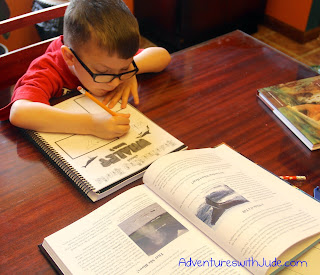
Coloring is an activity that often gets overlooked once a child starts school.  It not only develops an artistic eye, but the act of coloring itself strengthens small hands to prepare them for writing, develops eye-hand coordination, and helps a child learn to control the pressure and speed of his hand.  Jude receives occupational therapy once a week, and often his OT would ask for schoolwork for him to do, so that he wasn't having an hour of OT and then having to go home and do school besides. Many of his coloring pages were filled in at the hospital.

Jude and Miss Amanda also usually do a copywork page, so he can work on his handwriting.  This is a fine motor skill Jude needs practice with, but also it's a focusing skill that is hard for him.  20 consecutive minutes of seated work is one of our goals, and handwriting a Bible verse takes him between five and ten minutes, a good start towards his goal.


Damien (PK3) also joined in the fun!  He had his own Junior Notebook as well.  While he stuck mostly to coloring in the notebook, rather than even dictating facts,  he sat and listened as we read the textbook lessons aloud.  He thought the gems in Unit 4 were pretty, and was excited when we made and compared paper snowflakes, stand-ins for the crystal-based real ones.  His snowflake and Jude's snowflake were different, just like they are!


Even though it is written as a program for young students, Apologia's Exploring Creation with Chemistry and Physics is not a lightweight course.  The explanations and examples in the text are simple enough for a younger student begin to grasp the fundamentals of chemistry and physics, but expansive enough for an older student to be well prepared to move on to higher level courses. Even after having read entire chapters aloud, I believe we will be able to return to each one as each boy gets older, and revisit concepts and lab experiments as their understanding grows.  What we liked most was it made chemistry and physics FUN, which is what science should be all about!


Photobucket


©2012- 2013 Adventures with Jude. All rights reserved. All text, photographs, artwork, and other content may not be reproduced or transmitted in any form without the written consent of the author. http://adventureswithjude.com

Friday, November 8, 2013

IXL K-12 Math and Language Arts Practice (A Schoolhouse Crew Review)


Given that we spend so much time away from home, I'm always looking to streamline the bags.   On a "typical" hospital day, my car trunk looks like this.


My thought when I was chosen for this review was, "Sounds promising!  I'm already carrying around the laptop or tablet...maybe it will be a few less books and we can downsize a bag or two!"


IXL Math


 photo 280956_362445090496975_1685320066_o_zpse8620420.jpg


Jude is an old pro at the IXL program.  I first discovered it when he first became a homeschooler, so this is his third year working on it.  What drew me to it was that the program is simple.  There aren't a lot of bells and whistles, but there are rewards that keep the student's interest. At the end of each activity, if you had enough correct answers, you earned a ribbon; often, you also earned a "sticker" for your effort depending on how much you did (stickers are meted out based on activities mastered, number of problems completed, and time spent working).  When you're a four-year-old preschooler, it's all about the stickers, right?  However, we have transitioned to more of a book-based program as we've gotten beyond "assess what he knows" and Jude is learning new things.  I was curious how well the program would keep up with a first grader.  

When Jude first started, the program didn't go into high school math.  Now, it has programs for students from preschool through 12th grade.  Beyond having the opportunity to see how the first grade program worked, Luke also was able to work with the program. He is currently taking the semester off from math and will start Geometry in the spring.  I liked that it was going to be a six-week-review that forced him to practice his math skills.   Yes, I'm sneaky like that.  I was surprised that he was just as happy to get his "stickers" as Jude.  He wasn't necessarily motivated by getting one, but rather guessing what would be revealed next. 
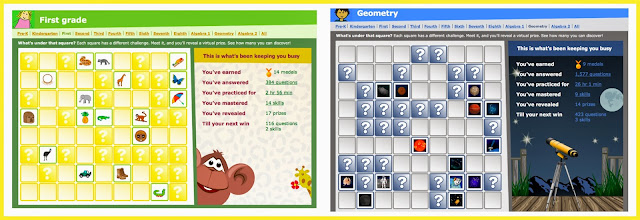


Now, I know there are people who are going to gasp and faint away when I say this, but I will anyway.  I like the concept of the Common Core.  I don't think a standard "everybody needs to know this basic skill" program is a bad thing.  Notice I said I like the concept.  What I don't like is how it gets implemented.  That's a whole disaster unto itself.  But having a checklist of sorts (you can connect to your state's standards)  to make sure you don't miss a basic, foundational skill and realize it a couple years later?  That works for me.   This is a place where IXL is very strong.  It doesn't "implement" anything. What it does do is take the concepts a student is supposed to master in each grade, and break the year down into practice areas and checklists.  The parent gets to choose what concept the student should be working on, and in what order.  If your student completes the tasks at one level, you can start in on the next level and continue building.   If your student is uneven and stronger in one area than another, you can work across multiple grades.  But if a student completes an entire section in a grade (all the addition skills, all the geometry skills, all the money skills, etc.)  you know your student is ready to move onto a new level. I really feel like using this program as a way to make sure I didn't miss anything, and didn't assume he knew something but didn't.
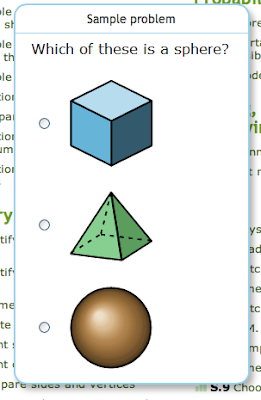

With Jude (first grade), sometimes I choose to review and practice something we are working on currently.  Other times, I will go back and do something "easy" (like counting or adding small numbers) so he gets some kind of math practice.  I also like it as a way to help assess what he has organically learned, so we don't waste the limited "formal school" time we have.  For example, we haven't spent much time formally doing geometry.  However, he breezed through the section on geometry and identifying shapes.  Since he has proven to me he already can identify them, I'm not going to spend time "teaching" them to him.  We'll use the time work on something he struggles with (like skip counting).  One thing that is nice about the way the IXL program is set up is I don't have to do things 'in order."

I like that we can easily stop and start.  If we are working and a doctor comes in, we can exit and not lose our place.  When we come back, I just choose that activity again and we pick up where we left off.  If we are mid-work and I have to run to get somebody from school, we do the same thing.  Or, if Jude just isn't getting it, we can stop and come back another time.  If I thought he knew something and it turns out he didn't, again, I stop, reteach, and then we come back later.

PreK through 1st grade has the added bonus of "click-to-read," so that your child can work independently.  Clicking on the speaker icon activates the program to read the problem aloud.  We found this was kind of mixed.  It is a very mechanical-sounding voice, with very little inflection.  I found it better to work with Jude and read things to him.  He also has speech and hearing issues, so that may just have been what worked better for him - I could add inflection to help him pick up context.  Sometimes, it also just spoke too quickly for him, so repeating the text more slowly helped him understand.  What Jude did like about that audio support was even if he needed me to read the problem, he could click to hear the answers.  Between the context clues of a picture, and the voiceover for the text of the answer, often Mr. Independent was able to choose the correct one without Mom's help.

In some ways, we have been able to use IXL for Jude as a teaching program.  Once you have the idea of adding two numbers together, it's really just practice, practice, practice to gain proficiency, so we started working with adding numbers within five, then up to 10, and now are moving to up to 20. For "new" concepts, we worked on learning about vertices -- the corners of a shape.  Learning and practicing counting the vertices of a square or triangle easily happened simultaneously.  First grade "equations" and geometry is fairly simple to learn.  10th grade geometry...not so much, to Luke's chagrin.

For an older student, IXL truly is more of a practice program.  While if you get a problem wrong, it will explain to you the correct process, it takes a lot of wrong answers to learn how to do it.  IXL is better for reviewing material to make sure the student has the concept.  Luke began working on the Geometry section, and frustration quickly grew.

Having had the equivalent of two years of Algebra 1, I thought the first section -- a review of Algebra 1 concepts like ratios and linear equations would be a breeze for him. I was wrong.

At first, the frustration was over how he typed information.  For example, if the answer is 1234, you can't input "1234" or the programming will mark it as incorrect.   It took about 6 "wrong" answers for him to realize it needed to entered as "1,234" with the comma.  There were other times when he knew he had to do this but simply forgot (unless actually working on place value as a concept, he's never had to include commas in number writing), and it got marked wrong.  This snowballed because IXL uses something called "Smart Score" to assess proficiency.
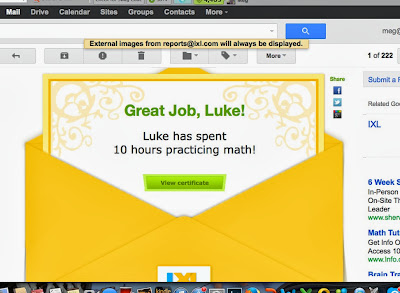
Smart Score is IXL's proprietary algorithm that weights answers based, among other things, on how difficult the problem is and how many in a row you get correct.  Scoring isn't simply complete 20 problems, multiply by 5 and there's your score.  Some problems are worth more (harder problems, problems earlier in the assessment) and some are worth less.  One thing that really frustrated Luke was a wrong answer might lose you 20 points, and it would take four or five questions to gain them back.  If he got two or three problems incorrect (either because he flat out misunderstood, or because of mistakes like addition errors or "that stupid comma thing"),  it would take him a dozen to claw back up to where he was.  At one point, he spent TWELVE HOURS working on a IXL section.  After the second hour, he was disgusted.  After the fourth hour, he was determined.  One time, he was at an 88, and finally felt like he was mastering the topic.  Nope, a mistake on the next answer sent him down to a 75%, and a mistake two problems later landed him in the 60s.  He was devastated.  Another four hours later, and he was still only at 70% proficiency.  I took his laptop away and told him to go to bed, and try again in the morning. If he got to 88 again (the equivalent of a B+, I'd call it good enough).  He was overjoyed to finally score a 90, and I heard him whoop and then say "Just WALK AWAY!!"  He really wanted to hit that 100% mastery -- it was "personal" now.  But he didn't want to spend another 12 hours on math.  He laughed when later that morning, there was a certificate for "10 hours completed" in our email inbox.  When he said "Do you think I'll get another one of these tomorrow?" (I think he was only half joking.) Thankfully, most have gone faster than this, but there have been three very hard-won 90% sections.  When IXL says "limitless" questions, they aren't kidding.  In the 10 hours and 53 minutes he spent on Simplifying Radical Expressions, Luke's 90% proficiency took 623 problems to earn!

The rest of the frustration followed when Luke also attempted the "new" Geometry ideas.  Even ignoring the "Smart Score" and just trying to figure out problems, and then studying what he did wrong if the answer was incorrect, he was way over his head.  He used a web-based program to try to learn the material, but the program didn't click for him.  Though we may revisit some of the lower-grade sections just to exercise his brain, he again "officially on break" from math again but intends to go back to IXL when he formally starts Geometry in the new year. He definitely sees the benefit to using it for practice, but not until after he's learned the topic material.

Having multiple students is not an issue.  Each student can pick an identifying icon, so you can tell easily which profile you are working in.  For a non-reader like Jude, this helps avoid "Mommy, read this to me," and for a big kid like Luke, it lets him pick an avatar that interests him.  (When we first started, I chose a facsimile of him, but he's changed it a few times since.)



You also have the option to add a "secret word" to each student.  For Jude, we didn't add one; for Luke we did so that Jude couldn't accidentally access his section.


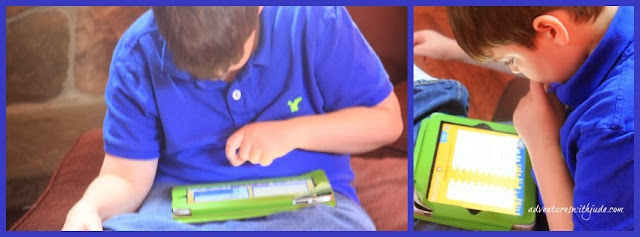
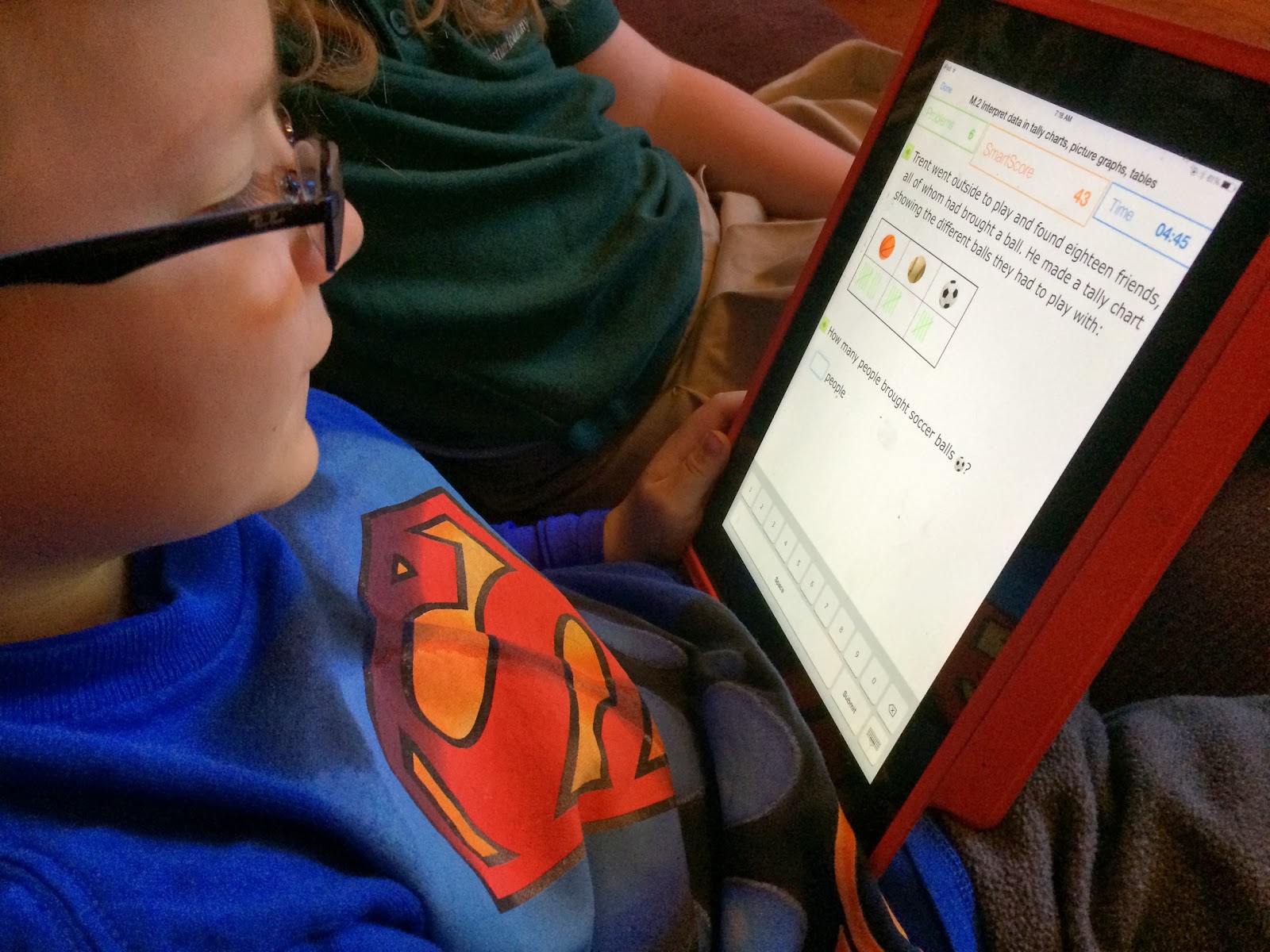
Remember how I said we can use this on the laptop or an iPad?  The iPad app is a relatively new feature.  I really like it.  Jude has tried a few sessions on it, and I have to say that the text is very crisp, even on an older-generation iPad. (Sometimes I find app versions of website programs can be a little fuzzy.)  My approaching-middle-age eyes appreciate this!


I also appreciate that it is easy to navigate AND you can access the sticker rewards via iPad.  I was afraid that the coding wouldn't work so well, but they are easily earned and acquired.


IXL Language Arts



 photo IMG_6332copy-Recovered_zps68039f50.jpg


There is also a Language Arts program for students in grades 2-4. While Jude is on par with his peers for math and spacial skills, his language skills are developmentally closer to a preschool level, so he was unable to do any of the program. Luke, a 10th grader, clearly is too old for the program. This is a new addition to the program this year, and hopefully will be expanded in the future. Since we really enjoy the math program, I will be putting it on my "revisit" list for the little boys as they get older. Adding it to the math program is a very reasonable charge for another way to practice their skills.

Pricing


IXL offers multiple membership options. The first table below shows the pricing schedule for monthly memberships, while the second shows the prices for if you'd prefer to pay annually.


Overall, we are very happy with IXL.  I was happy to get the opportunity to review it using multiple users, and a higher level student.  For our purposes -- being able to do schoolwork with a minimum of things to cart around -- it is perfect.  I can teach on "home" days and use IXL for practice and review while we're on the road, and feel confident that despite our crazy days the boys are learning everything they need to be successful at math.


100 families have been honing their math skills with IXL.  Check out their reviews by clicking the banner below. 

Photobucket


©2012- 2013 Adventures with Jude. All rights reserved. All text, photographs, artwork, and other content may not be reproduced or transmitted in any form without the written consent of the author. http://adventureswithjude.com

Monday, November 4, 2013

Away We Go Media: If You Were Me and Lived in... (A Schoolhouse Crew Review)

 photo carole_p_roman_logo_zps9e0a6d7b.png

 Carole P. Roman has written an adorable international themed book series.  There are four titles:

If You Were Me and Lived in...Mexico
If You Were Me and Lived in...South Korea
If You Were Me and Lived in...France
If You Were Me and Lived in...Norway
Each paperback book is about 25 pages long.  While the books are easily standalone volumes, together they make a foundation for a multicultural unit study for a preschool or early elementary student.  PKer Damien and first grader Jude enjoyed these books, while 4th grader Celia felt they were a bit babyish.  If they were part of a planned unit study, rather than as a standalone reading book, she might have felt differently, but that would still be the very upper edge of the age range I would use these with.  I plan to go back and re-use these as with the little boys as the "reading" half of a read-and-cook program.  I think it would be great to read about the country, and then hop into the kitchen and make a food that the country is known for.  They also would make a great read-aloud for a Daisy or Brownie Troop celebrating Thinking Day.

If you were me Carole Roman review


Rather than spouting dry facts about each country, each books shares information that shows how children from from around the world really aren't all that different after all.  They each go to school, celebrate special holidays, and have favorite foods and sports.  Whether you call her Mamá, Omma, Maman, or Mama, your mother is still a special lady.

It was interesting to see the different popular names.  Some were fun to guess - Alejandro is the Spanish version of Alexander, one of our cousins, and Celia was right about Mathis being the French form of Matthew.  However, I can't say we know anyone named Minjae or Bjørn.

I liked how there was a pronunciation guide at the end.  When reading it aloud to the little boys, the Spanish words were easy to pronounce.  Luke read the books to them as well, and after so many years of Spanish, only faltered a little with French.  I have to say, though, we both stumbled through Norwegian (even after many trips to Epcot, we haven't mastered much beyond a not-yet-caffeinated  "God dag!" as we stumble into the Princess Storybook Breakfast at Akershus) and I'm certain that we butchered Korean, but we gave it our best shot.  Kimchee and taekwando were the only things that came naturally to us on that one.  The pronunciation guide was very helpful.  The books also explained things in reasonable detail so that the language never really was an issue.

These books are filled with simple but detailed illustrations that explain as much as the text.  Each theme has a two page spread with the text usually on one corner of the page and the rest of the area filled with a visual interpretation of the concept.  I liked the pagination detail - each book has a "signature" picture by the page number.  The book on Mexico has a red chile pepper, France features croissant while South Korea's food feature is a bowl of rice noodles.  Norway shows a dog sled team.

The title If You Were Me and Lived in...Mexico is a Summer 2013 recipient of the Pinnacle Book Achievement Award.  This award was given by the National Association of Book Entrepreneurs in the category "Best Children's Interest Book."  Congratulations, Carole!

All of these books are available through the author's website; retail price ranges from $9.99 to $11.99.  We definitely enjoyed them. While they are available individually, I think they would make a great addition as a set to any young student's library.  Be sure to click the banner below to see what other crew members though about these books!


Photobucket


©2012- 2013 Adventures with Jude. All rights reserved. All text, photographs, artwork, and other content may not be reproduced or transmitted in any form without the written consent of the author. http://adventureswithjude.com

Related Posts Plugin for WordPress, Blogger...
Pin It button on image hover