Showing posts with label development. Show all posts

Monday, September 30, 2013

Fundanoodle - Muscle Movers: Upper Case Gross Motor Cards (A Schoolhouse Crew Review)

 photo fundanoodlelogo_zps4636896c.png

 Fundanoodle is an "education readiness" series of programs, designed to develop the skills needed for handwriting and other everyday activities. The program contains 15 modules that address:
  • Fine and gross motor coordination
  • Eye-hand coordination
  • Tactile and visual exploration
  •  Problem-solving, discovery, and self-esteem
Fundanoodle believes that learning these skills should be fun. Their programs attempt to bring a bit of whimsy to learning.  They have several levels of programs.  The youngest level, with the offerings color-coded Orange, are geared toward three-year-olds; Blue level programs are for PK/K students, and elementary levels Green (first grade) and Purple (second and up).   We received the blue level PreK to K Muscle Movers: Upper Case Gross Motor Cards ($16.99).   


Although they are geared for ages 4-5, I thought these would fit right in in our house.  Damien, aged 3, already knows his letters; Jude, age 6, is delayed enough that he's still figuring them out.  Jude can trace, Damien can't. Ying and yan.  I was intrigued because they are "occupational therapist developed."  Since we have at least one OT for each kid on speed dial, I though they would be good for us.  Also, given our life revolves around therapy appointments, I'll admit I am a bit skeptical and jaded.  I wanted to see if the "OT developed" was hype or helpful.

Each card had an animal that started with the letter (armadillo, beaver, cow) and a gross motor activity for the animal (roll, gnaw, moo).  As we went though the alphabet, we alternated choosing a card, acting it out, and tracing.  Jude was able to write on his own; Damien usually needed a little help.

The boys enjoyed acting out the animals! 


Not all of them were active play.  Iguanas hold still.


And even the biggest Falciani kid found them to be fun.  Luke was supposed to be doing grammar and vocabulary but decided this looked more exciting.

Snakes slither!

We had a little bit of miscommunication when it came to the letter V and vampire bats.  According to the Muscle Movers card, they fly.  According to Jude...well, vampires suck blood.


I think by the letter V we were a little too wound up.  One thing I noticed as we moved through the alphabet -- it was harder and harder to settle down to write our letters after acting them out.  Instead of sit-down-and-waits being every few letters, as we approached the latter third of the alphabet, we were starting to have time outs every other letter.  They were getting so excited and wired that we were having safety issues.  

Damien has gotten better at tracing - he did this all by himself. But it took several minutes for him to stop racing around and sit for his turn.


 The cards themselves are made out of heavy laminated paper, and the dry-erase marker wipes off very easily.   On the back side, the tracing letters are clearly marked. Not only are the letters themselves clear, the top and bottom are well defined.  The top of the letter has a green line, and the bottom is lined with a red line.  This helps visually show the top, where you start a letter -- a "go" point; the red shows "stop."  (It's also really helpful with letters like M and W that can be tough without some actual cues.)  They come with a hole punched in the upper corner and a metal ring, so that you can keep them together.  I appreciate not needing a box (that always tears) or a rubber band (that may break, or in our case, we are allergic to!).  I wish the dry-erase marker that came with them had a hole at the end, so you could string it on the ring as well.  I've already had to go hunt it down several times when we wanted to play with the cards.

Jude's therapists (PT and OT) have asked if we would bring schoolwork with us for his visits.  This way, what he is doing there will help reinforce what he is doing at home -- and save him from having to do two hours of therapy and then go home and do a full day of schoolwork.  At one of our  OT visits, I brought these cards.  I told her that we had started using them "as directed," and then had started working with them only a few at a time.  We would do three or four letters, and then take a break for some table work, and then go back and act out a few more when wigglies became an issue. We still were having struggles transitioning.

Miss Amanda (Jude's occupational therapist) and I agree that maybe with a neurotypical child who transitions easily, these would work more easily.  From a "therapeutic" viewpoint, we both agreed that they "might" do what they claim, but at the least, "sensory" as listed was a stretch.  The visual clarity was fairly obvious, but overall there is very minimal tactile sensory input.  If anything, there was too MUCH sensory stimulation with the activity and noise!  Her recommendation was to do one activity for a group of cards - for example, take the letters A through E, do ALL the motion, then sit and do ALL the writing, then do ALL the alphabetical ordering.  If we want to move on and do F-J, etc., we can, but rather than having to constantly change activities, we would be doing each for several minutes before moving on.  We'll be trying that, as well as playing "pick a card" as a one-and-done gross motor activity, or just putting cards in ABC order. However, we will probably not be using them "as directed."


Sleepy, purring kitties.

These cards have lots of both familiar and less-common animals on the front, and a clear tracing guide on the back.  However, the reason I really, really wanted to review these is because they provided gross motor activity combined with literacy activities, which Jude desperately needs.  (When you're six-plus years old and functioning on par with a not-quite-three-year-old, you sneak "therapy" in anywhere you can.)  I admit, I was hoping that we'd love these cards so much we'd go back and purchase other sets (click the Schoolhouse Review Crew banner below and read the reviews of Fundanoodle's other products), but since these fell short for Jude's needs, we probably won't be adding to our Blue collection in the near future.  I think that we may look at some of the Orange level items for younger students for Damien, and revisit the Blue as he gets older and maybe is not working alongside Jude.



Photobucket


©2012- 2013 Adventures with Jude. All rights reserved. All text, photographs, artwork, and other content may not be reproduced or transmitted in any form without the written consent of the author. http://adventureswithjude.com

Tuesday, September 17, 2013

I am with you always, until the end.

Jude finally finished the evaluation merry-go-around we started six weeks ago.  I'm going to choose to look at the good side.  Because looking at the down side just isn't an option.  I've got too much to do to break down.   Frankly, I just am too tired from driving to appointments to cry.  But I am struggling.

The "see it from the good" side:  we don't have to do much to "prove" to the insurance they need to cough up a check to the therapists. 
 
In this era of insurance looking for any loophole it can, that's a good thing, right?

  • His articulation is so terrible that the speech therapist didn't even need to score that section to determine he'd qualify for therapy.  (His pragmatics were worse than we thought, too, but they did need scoring.)
  • There wasn't a whole lot lower he could score on the sensory portion of his Occupational Therapy evaluation.  He has little fine motor control and did "fine" motor skills with his "gross" body -- instead of coloring by moving his hand, he used his entire arm to propel the crayon.  
  • When the physical therapist realized that the age-appropriate test (for ages 6-18 years old) was not going to give us an accurate picture of Jude's skills (basically because he couldn't do any of the skills on the test, she dug out the birth-to-72 months (6yo) evaluation.  Jude has the skills of a child 34-38 months old.   The extra good news is that between his last evaluation in May of 2012 and the one three weeks ago, he didn't lose any actual skills.  He "only" lost the equivalent of 14 chronological months.  (The two months' gain for locomotion is statistically insignificant when you factor in the chronologic age gap AND the fact that she was scoring him as 71 months of age (the top end of the test) when he really was only 6 days shy of 73 months old.)


None of this is a surprise.  What it amounts to is us being able to say to the insurance company, "We TOLD you, now write the check already."  It means that continuing to homeschool is the best thing for him, because it gives us the ability to help him with all of these foundational things,.  It means that he's not STUPID, he's disabled.

I think I am going to cry anyway.

It also means therapy at least two days each week.  Currently, we have PT on Tuesdays and OT and Speech on Thursdays.  We may have to shift things around so he can add another PT session, because one PT each week may not be enough. 

It means homeschooling isn't really a "choice" any more.  There's something to be said for wanting to homeschool vs. having to homeschool because there is no other option.  Because let's face it -- with numbers and delays like those, he is going to wind up killing time in special ed, not being pushed to his potential.  And forget logistics of getting to the appointments around the school calendar -  how on earth would he physically be able to keep up with a full day of school plus therapies?

It means that comparatively, Damien is more advanced than Jude.  Odds are good, in the next six months, he's going to blow right by.  I refuse to pity Jude, or let anyone else do it, but I still know his self-esteem is going to take a hit.  I know that injured hearts can hurt worse than broken bones.  And all I can do is watch it happen, and hug him when it does.

It means accepting that "catching up" is no longer a realistic goal.  Since Jude was first diagnosed with his medical issues at just over one year old, there was the hope that he would "make up" the time.  It would be slow and hard won, but there was hope he would eventually close the gap between his developmental/skill and chronological ages.  When he had last May's testing, we were thrilled that he has remained steady through all of the school-then-homeschool turmoil.  For that period of his life, hold steady seemed a victory.   What is so disheartening is despite all we are doing now, he's barely treading water, and the gaps are actually widening.  You know doctors...there's never a "guarantee" of anything.  Just leaving that shadow of doubt or spark of hope so you don't sue them.  We'll still do everything our power to make him a better Jude, but let's be brutally honest.  He's almost completely unlikely to become an average Jude.

None of this is a surprise.  But to see it in writing still feels like a sucker punch.  It's that whole realization of "We can't pretend anymore that it isn't as bad as it is."

Do I get to be angry?  I don't care if I "get" to be or not.  Because I am.   But I don't know who to be angry at.

I can understand Naomi, who has lost the life she dreamed of. 


Angry at Jude? That's ridiculous.  I can't be angry at him - he's trying so hard to overcome things that he was born with.

I could easily be angry at myself and often am - it's easy to muster "mama guilt and anger" - but logic says I didn't give him these genetics on purpose.  And I followed all the "pregnancy rules" on what to eat, what not to eat.  Heck, when I was pregnant with him, the doctors said "Don't eat nuts or fish or this or that to avoid allergies," so I avoided it all and he's still allergic.  (Because life isn't unfair enough that you can't run after the ice cream truck, but when you finally catch up to the end of the line of every other kid who got there before you, you can't have anything he's got on it, either.)  It's not a lack of love or desire to help him.   I'd take paralyzed legs in a heartbeat if he could run without braces or pitching forward and falling on his face.   I'd do it if it meant he could run in the first place.

For the same reason, I can't be angry at Neal or our parents or our grandparents or wherever we got these genes.  Sure would be convenient to blame my grandmother - it's clear one of the wonky genes came from her,  and she's not here to defend herself.  But it isn't her fault, either, because it came from one of her parents - and which one do I blame there?  (And really, how can you blame a man or woman who was born before anybody began to wrap their heads around Mendel's genetic theories?)

So yeah, God looks like a good scapegoat.  His shoulders are broad enough.  Faith tells me it's not His fault, either, though. He didn't look at his "Babies to create" list and say "Falciani...yeah, give them a house full of ones that need every therapy service known, and while you're at it, how about every doctor clueless on any condition that has more than two syllables.  Ok, I can be benevolent...every doctor except one or two...and give those two year shelf lives. And let them wander the medical desert searching for them."

But nonetheless, I am angry. 

I've long had an affinity to the Blessed Mother.  Her name is Mary.  "Bitter."   Yet she is a model of grace, of acceptance and humility. The very human mother who stood by and watched life happen to her Son, and couldn't do a thing about it, but watch.  Watch Him be ridiculed.  Watch His battered body limp along the road.  Watch Him shamed and battered and broken for being Himself, for being how He was made.

Watch her Son's mouth utter what they all were thinking.


She's a better woman than I am.  Because she just accepted.  Me - I need to open my big mouth and ask. 

My God, my God, why have you forsaken me?  Why have you abandoned me?  Left me like Naomi, mourning what should have been?  I've accepted everything you've thrown at me.  Kept on going.  Kept on marching.  And yet, you still keep throwing more at me.  Me? I can live with it.  I can deal.  I can handle it.  It's just me.  But now, You've messed with my son.

You know those "a year is but a moment, and an age is but a year to You" time frames? How about You come here and live my "year" and see how You like it.  Live my "age."  Yeah, not so much fun.

But what can I do?  To paraphrase Peter, "To whom shall I go?"  I don't have any other options.  After all, we've run out of doctors and therapists at three different hospitals.  We're back in the desert again.  (Forget manna. I bet it has gluten in it anyway.  Send somebody with an MD that knows what an eosinophilic condition is.  Heck, I'll settle for if he can spell it.)

I'm not giving up on my little lost sheep and saying "But I've got a whole flock of others."  I gotta get this kid (pun intended) sorted out and back into the herd.

A doctor or therapist for him is worth more than any gold, so I'm going to light a lamp (or at least the headlights on my car) and look for him or her.

I'm holding You to it when You said,


I sure hope so, because this age is going to have some very long years.


Scripture passages:

"Do not call me Naomi..."  Ruth 1:20-21
"Eloi, eloi, lama sabachthani?" Mark 15:34
Parable of the Lost Sheep, Parable of the Lost Coin - Luke 15:4-10
"Master, to whom shall we go?" John 6:68
"And behold, I am with you always, until the end of the age.”  Matthew 28:20


Hearts for Home Blog Hop Simply Helping Him ThePinJunkie The Life Of Faith


©2012- 2013 Adventures with Jude. All rights reserved. All text, photographs, artwork, and other content may not be reproduced or transmitted in any form without the written consent of the author. http://adventureswithjude.com

Saturday, September 8, 2012

Physical and Sensory Therapy on the Playground

Back in May, Jude had a re-evaluation of his gross & fine motor skills and speech abilities. After numerous phone calls, an incredibly helpful receptionist with a vendetta against the computer system in the records department, several more calls, and an in-person cornering of one of the evaluating therapists, we finally got the report yesterday.

The very excellent news is that he has maintained and built upon all the fine motor skills that we worked so hard to build up two years ago. He and Miss Kathleen met weekly for what we called "Charm School" - they worked on skills used for getting dressed, eating with utensils, and coloring pictures for people. Nine months after his discharge, his Peabody-scaled skills ranged from a 50th percentile/55 mos "age equivalent" grasping skills, and a 63%/65 mos visual motor integration score. Given his chronological age at the eval was 57 months, this is awesome, right? Right.

But that just sets you up for the kill.

Speech -- we expected there to be a delay. It's pretty obvious to anyone who tries to talk to him that this is something he struggles with. His articulation is generally poor, and "intelligibility" scores were 70-80% in known contexts, 50-60% if you didn't know what he was talking about. This seems pretty accurate to me; even being Mom, there are many times I have to say to him, "Honey, I don't understand what you are trying to say." He is being referred for speech services. No big surprise.

What shocked us was how terribly he performed on the gross motor portion of the testing. Doctors have mentioned from time to time that he has some heel cord tightness, but it never has been significant enough to document. It's now documented. However, in a way this makes sense. He has long been a toe-walker, and "true" autism has been excluded as a diagnosis after all of his psychology evals. Toe walking is a classic symptom of tight heels. The Gross Motor Peabody test was also revealing. His overall score quotient was 70, putting him in the bottom 2% for kids his age. (An "average" child will have a raw score of 90-110.)  His overall score puts him at an "average" developmental age of 33 mos (less than 3 years old),  with the individual tests scoring at 30, 32, and 38 mos development (object manipulation, locomotion, and stationary skills, respectively.)  He used to be in PT from about 18 mos of age until last fall and seemed to be fairly caught up. Apparently not. (There was also the thought that peer modeling at school would help him.  Yeah.  Not so much.)  The therapist's assessment was that he is "functional" but unskilled. It makes sense - to look at him, he gets around "fine" but it is obvious when you look at him compared to his peers that he is lagging.

So obviously, he is going to be going back to PT and speech. He was discharged from speech 18 months ago due to behavior issues -- hopefully, we have addressed them enough that maybe it will be less of a struggle.  (We can hope, right?)   They are recommending speech therapy 1-2 times per week, along with weekly physical therapy.  Hopefully, they will also be able to show us how to safely stretch his heels -- the therapist is setting "increase dorsiflexion from 0 to 10 degrees" as a long term goal. I haven't googled enough to figure out what all that means, but it sounds to me like it's a lot to expect if it's considered a long-term goal, lumped in with the seemingly more open-ended/subjective "improve communication and language function to optimal levels."

Obviously, these are definitely not things that will be fixed in a weekly therapy session.  Speech is something we will definitely need to work on all the time with him, by modeling and over-enunciating sounds.  And while a formal PT program is going to be invaluable, the only way to build muscle is to use it, so our homeschool program suddenly is going to add "covert gym classes" to the daily schedule.  The major activity recommended by the therapy team is lots of playground time.


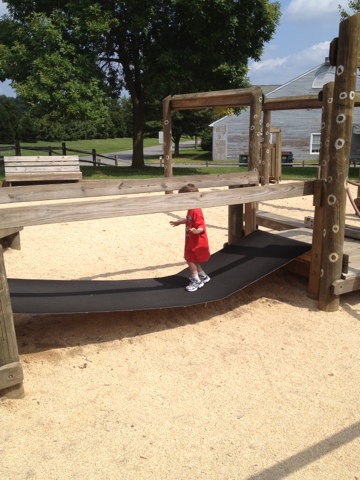
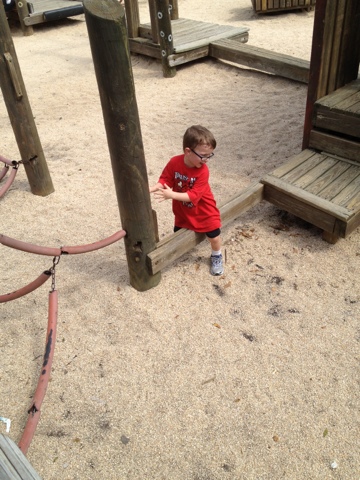
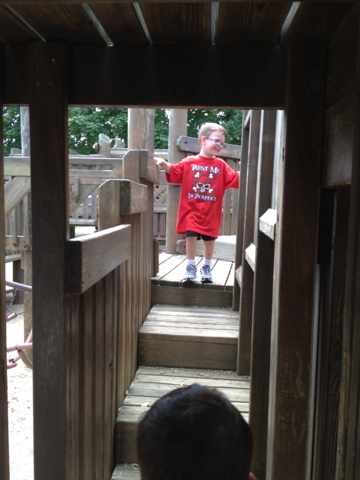
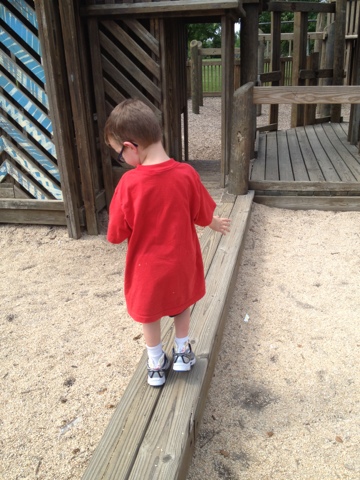
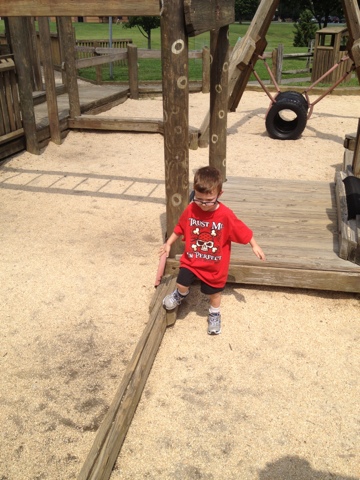
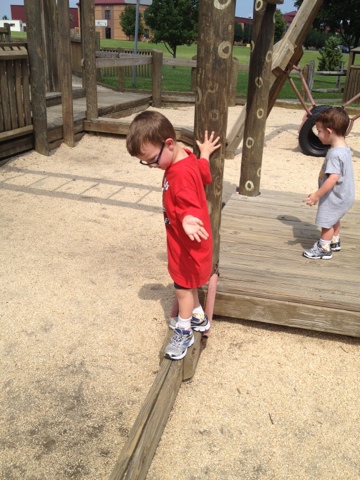
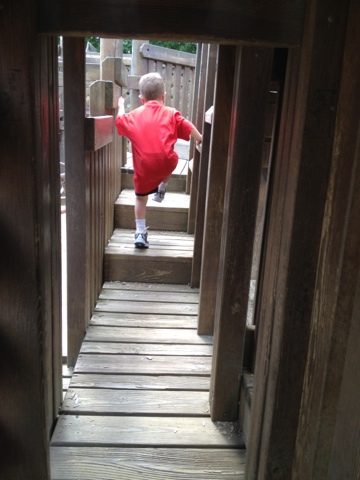
 Concordville Park,pictured here, is one of our favorite places for a "sneaky PT" session.  It is a nearly all-wood playground with lots of opportunities to climb up and down stairs, walk across bridges and balance beams, and over & under climbing. Jude always has a good time on the equipment, but also enjoyed playing Follow-the-Leader. He led Damien and me all over the playground:


Follow me across the bouncy bridge...

This is a new accomplishment for him, because not only is it a wobbly/physical challenge, but from a sensory perspective, it's a whole lot of proprioceptive stress.


Hey! Who put a beam here?  Up and over - use that core!


This beam is easy!


This narrow one, not so much.
 (Makes sense -- putting feet in a direct line position is hard.)


Sideways is a little easier, but he gave up after a few steps. 
Jude's trunk muscles are weak, and that makes even standing in a balanced position difficult. 
His whole body tends to wave like a flag.  But a few steps is better than none!


Stairs are another challenge for him. Balancing on one foot is tough. He is "functional" in that he can get up and down, but he does not properly climb in an age-appropriate alternating step pattern, or even pushing off with his legs - he usually needs a good amount of upper body involvement to propel himself up or lever himself down, or simply climbs up in a toddler-style "bear crawl."


These stairs help with balance, weight shift, eye-foot coordination, perception and muscle strength.Even with all the obstacles ... he's off and running.


©2012- 2016 Adventures with Jude. All rights reserved. All text, photographs, artwork, and other content may not be reproduced or transmitted in any form without the written consent of the author. http://adventureswithjude.com
Related Posts Plugin for WordPress, Blogger...
Pin It button on image hover