Wednesday, May 23, 2018

Home School Navigator (Homeschool Review Crew)


Home School Navigator Reading and Language Arts Curriculum is an elementary-level program with a unique approach to teaching literature and other language topics. Six color-coded levels help elementary students develop literature, grammar, spelling, and writing skills. Jude and Damien have been working on the blue and green levels, respectively, for this review.


The color-coded leveling is a unique identification approach. Most programs delineate levels by grade or by age, which can be a bit of an issue if you have a child who is not on par with his grade or age. Most of Jude's language arts skills have finally caught up to his age; some have even surpassed what is expected of a child finishing fifth grade. However, because he was a later reader and closed the gap quickly, he went from easy-readers to novel series in about 18 months. This means in trying to keep up with what was reading-level appropriate for literature, he missed some of the more basic skills usually learned in the early primary years. Home School Navigator colors begin with red and follow the rainbow to indigo. Conveniently for Jude, the approximately 4th-grade level blue doesn't say it's for kids "younger" than his almost-6th-grade self. Conversely, 2nd grader Damien doesn't get a swelled ego being put "up" into 3rd-grade equivalent green.  I like this system for keeping egos boosted or in check.  When you begin, you have access to all levels so you can place your child where you think he should be, and then work up or down a level if it doesn't seem a good fit. About a month in, you will make a final decision and lock in your choice.

THEY USE PICTURE BOOKS!! I THINK THIS IS BRILLIANT. It's like using Unit Readers, with shorter stories that cluster in a topic but using a stack of "real" books, not a textbook. This is a different approach than most programs, especially for big kids. They are all about chapter books, and reading a chapter a day, etc., and if it's not a book that kiddo likes (or one that it is and he wants to know what happens next) it's TORTURE. Here, the books are shorter, so they can find out the ending in a sitting. And I think the program doesn't leave really good "picture" books to the preschool shelf but shows them as quality for all ages. The titles for the stories are carefully chosen. Each month centers around a theme. I like that each year revisits a variation on the same theme. All levels do Fairy Tales in Month 1, an author study in Month 2, etc.


While some held favorite stories, we've discovered some new loves.  Goldilocks and the Three Dinosaurs (Mo Willems) was deliciously sarcastic and amusing.  Because it's nice and short, it is easy to read and parse on the same day.  Because it is a classic-caliber book, there are enough layers of construction to study that it doesn't feel like "fluff."


In the green (approximately 3rd grade) and blue (approximately 4th grade) level programs, there were also interactive notebooks used to study longer novels. (They also are used at the indigo/5th grade level.) These are longer projects, taking about a week or two, in addition to the small-book studies. These reinforce what the student learns in the daily lessons, making him ready to transition to novel-only studies at the middle school level. (I'll explain more about the interactive notebooks below.)

I am a big believer in independent reading. In high school, we had a daily ten-minute "Sustained Silent Reading" block, which was probably my favorite part of the day. (I would have preferred a six-hour SSR, but generally, I'd choose to read over anything else. Knowing I have a deadline is the only thing getting this review written; otherwise, I'd still have my nose in my current book.) One of the tick-boxes for the daily program is 30 minutes of reading a "just right" book. The "just right" method has solved a problem we were having here: Jude's ability is much higher than his comfort zone. Isn't it amazing when mom says "that's too easy," she can't possibly be correct, but when "Not Mom" says so, it's completely legit?


By using their technique, Jude realized that his beloved Magic Tree House series novels were not "just right" books; they were much too easy. We kept moving through books until we found one that was not too comfortable, not too challenging, but just right. His "30 minutes a day" has turned into "I finished my time, but can I keep going for another hour? How about two?" He also discovered that the Percy Jackson and the Olympians series was not "too hard" for him, and in the space of a month has mowed through that five-book series as well as five-book The Heroes of Olympus series. (He's already asked me to get him "everything else by that author." Mr. Riordan, please write faster! We're going to run out of books soon!) Damien still prefers to discovered while he still prefers the comfort of easier Geronimo Stilton books when he's reading on his own time, he's found books like Charlotte's Web and the "Little House" series are good, too.


There is also a portfolio maintenance option. Once you complete a day's work, you can take a photo with your computer or phone and upload it to your child's file. If you live in a state where you need to compile and submit a portfolio, this would be very handy. We don't have that requirement here, so I didn't upload things. However, I have friends who do live in a state that does, and I can see where it would be beneficial (especially since the uploaded pictures means you don't have to keep a thousand pieces of paper from September until June).

Do you sense a "but" coming? Unfortunately, there are a few that quickly wore the shine off this program for us. Let's just call them "heads ups."

I liked the idea of the interactive notebooks.  They focus on specific elements of the novel, rather than being a more traditional "all literary topics the author threw in here" project.  I liked this perspective and approach.  However, they are in a lapbook style.  I agree with the company's theory,  because it is something different from the daily work and helps create an entirely separate feeling "project" for the novel study.


However, we have learned the hard way that lap books, while a great hands-on, interactive format for learning, just are not ideal for this homeschool.  The reality of this style meant there was more focus on the cutting and assembling than neatly writing correct answers. I have not included pictures of their assembled books because, frankly, I'm embarrassed to show how many cross-outs and re-writes there have been. I think one of our projects will be to re-copy them, and I'll update with those photos.  (It will be a lesson in "If you don't want to have to re-do something, pay attention and do it right the first time.")

The program price includes the curriculum and interactive notebooks, but NOT the literature books.  (The interactive notebook studies are also available ala carte.) If keeping costs down is an issue for your family, this may be an issue. If you have an excellent local library, then you can likely acquire most of these books from there. (I know some other Crew members had difficulty getting some of the titles from their libraries.) If you're like us and live in a rural area with limited library services, you might need just to purchase them directly. I was able to buy ours from Amazon. Some came directly from Amazon, while others were from third-party secondhand resellers. There were several instances where a "gently used" book was more economical, but there were also quite a few books that were no longer in print. We had to take a chance on some that might not have been so well treated. Luckily, our books were in reasonably good condition.

Because of this, Home School Navigator has begun uploading read-aloud videos. This came in handy for Damien's first book.  However, while I do like read-aloud books, I think it is difficult to do a detailed literature study without a book follow along with or to refer back to.

Word study is built in as well. The basis of the program is a "word wall" where the vocabulary/spelling words are posted and added to mostly daily. We wound up skipping much of this activity because we didn't have a place to create a word wall. Because the boys already do separate spelling and vocabulary studies, I didn't feel they missed anything academically because of the program, but it was a portion we weren't able to utilize fully.

I also felt the grammar presented was more of a review than instructive, so I found myself still assigning the boys their usual grammar. For example, one lesson was called "Banish Boring Verbs" and discussed choosing verbs that were less over-used.


 Grammar is combined with writing, so it is not something specifically focused on daily. However, there was no review of "This is what a verb is and does," and the first time that year a student worked on any formal grammar skill.  I felt there should have been a quick review, and then dive into manipulating into synonyms.  If your child does not have strong grammar skills, I would use this for extra practice, but I would still use a separate, formal grammar program

The program is marketed as a "turn it on and go, no planning required" curriculum. This is mostly true; you can print the lesson plans/worksheets for the week, put them in a binder, and hand them over to a kid. He can then go back to the online program and follow along with the video lessons provided. However, for a program that also markets itself as family-friendly, offering discounts for enrolling multiple students, it is not friendly when it is time to do schoolwork. Only one student could be logged in at a time, so there was a constant jockey for "whose turn is it."

Finally, there are optional poetry studies, which are a nice addition to round out literature studies. However, they are not from a single book or source, and for copyright reasons, are not included with printouts. We were able to google the poems; some were easier to find than others. In order to work with them, Jude copied the poems into his notebook.


I wish that they had chosen poems from a single volume, where it would have been a "Here's the poetry book, turn to page ___!" situation, and not letting a kid loose searching the internet.

Will we continue to use Home School Navigator? Yes and no. I think the core literature study part of the program is well-constructed and worth keeping, and much of the writing as well. Despite disliking other parts of the program, I still really do like this approach. Each language arts component is reasonably independent, so skipping one part does not mean kiddo is losing chunks of interactive study.I think I will either adapt the interactive notebooks to suit our needs or just look for other novel-based studies to substitute and continue with our usual grammar and spelling.

Discover the other levels of Home School Navigator and how the Crew fared with them by clicking the banner below.

Home School Navigator Reading and Language Arts Curriculum {Home School Navigator Reviews}


Want to keep up with all of our adventures?
Subscribe below to get Adventures with Jude delivered to your inbox.

Enter your email address:


Delivered by FeedBurner


©2012- 2017 Adventures with Jude. All rights reserved. All text, photographs, artwork, and other content may not be reproduced or transmitted in any form without the written consent of the author. http://adventureswithjude.com

Friday, May 4, 2018

CodeWizardsHQ (Homeschool Review Crew)

One thing on Matthew's "wish list" for electives is learning how to code.  I've been looking for a program, but he's in an odd age bracket. Most of the programs we've found are online guides targeting elementary-age coding hobbyists, rather than actual classes presenting a program that could be high school credit-worthy.  We were given the opportunity to experience and review a class from CodeWizardsHQ, which has a different approach to coding for students in grades five through ten.


CodeWizardsHQ provides weekly live, instructor-led online classes in a small group setting.  Each class has six to eight students, so you get a real interaction with both the instructor and other students.  Students can ask questions, and have them answered in real-time.  The instructor also has their screens mirrored at her location, and she can help target any single-line errors before they cause a cascade of problems.  While they are homeschool-friendly and have a homeschool group option, the company welcomes children of all educational backgrounds. Classes are available in afternoons and evenings, making it ideal for both home- and traditionally-schooled students.  If your child has an exceptionally busy week and misses a class, there is a video option for viewing the course material and "Office Hours" to get one-on-one assistance from an instructor if he needs clarification.

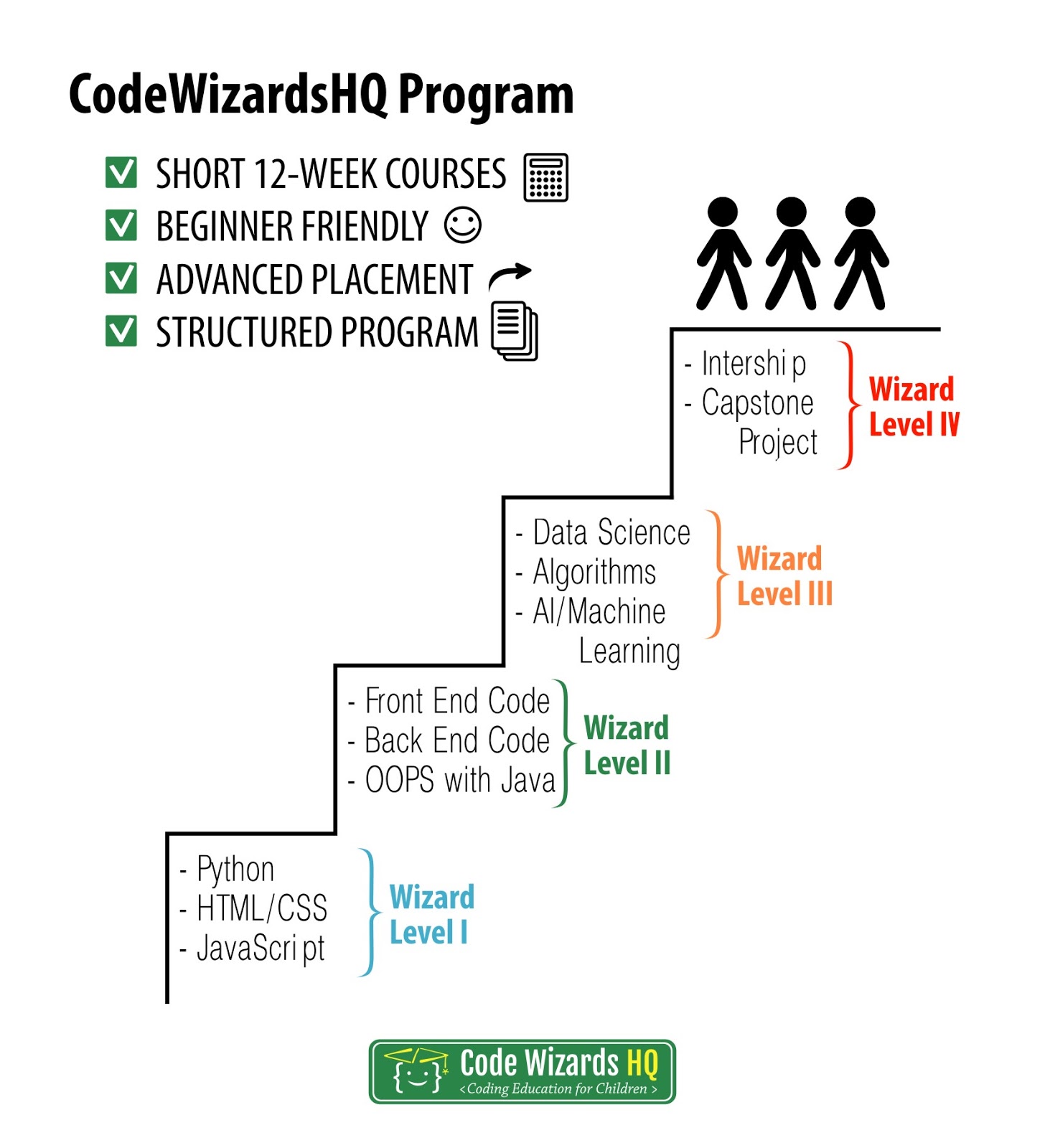
The program has four levels of instruction in practical, real-world coding languages. All students, regardless of age, start at the first level. (If you have coding experience, there is a placement exam to test out of the lower levels.)  The first level consists of three twelve-week courses that cover Introduction to Programming, HTML/CSS, and Javascript.  (There is an accelerated summer program that covers these three activities. These sessions last for three weeks of four classes each.)  Level II instruction includes courses in Front- and Back End Developments and Web Design.  Level III progresses to Mobile App Development, Advanced Algorithms, and Data Science.  The program culminates with Level IV's Internship program, which places students in six-month internships with partnering non-profit organizations and allows them to gain real-world experience. 


Certificates of proficiency are issued at the end of each program, creating achievements that can be highlighted on a college or job resume.  This made the program very appealing to us because it would provide instruction that had a practical application to Matthew's long-term academic and career goals.

The class' instruction platform is GoToMeeting.  CodeWizardsHQ recommends using a headset with microphone for better sound quality, but you can use the ones native to your computer.   Normally he would use a headset, but since I was sitting in, we used the laptop's devices.  The sound quality was fine for us. We didn't really need the microphone, as most communication was through the chat feature.  However, I think the microphone might be used more in long-term class sessions.  Though our instructor, Lynn, did her best to foster a good camaraderie, I think our group was on the quieter side and content to communicated through texting.  It might be different in a long-term class, where students have a few months to get to know each other better.


Lynn asked everyone to introduce themselves with the answers to three queries: what is their preferred name, what was something fun to know about them, and why do they want to learn coding?  She introduced herself as a Seattle-based Front End Developer with over 20 years of experience in the field. She is also an artist.  Matthew responded that he likes picking things apart and wants to be able to write video games.  Lynn told him that's a pretty common reason why kids take their classes, and if he was interested, further study could get him in that direction.


The class' goal was to build a simple comic strip on a web page.  First, Lynn walked the students through the interface they'd be using.  She gave them a brief history of HTML, along with a few pertinent definitions. then they began building.

One thing she pointed out is the kids aren't in total control of the web page.  There is some coding that is pre-written and clearly delineated with "Do not edit above this line" or "...below this line."  This means that things like the page background, social media share buttons, etc. are available (and intact!) when students are done.  While Lynn did show them how to find/create their own files for customizing their web pages, most of what they worked with were files that had been pre-loaded to the class site. It appears nobody blew up the internet (including my kid), so I call that a win.


For this class, there was a good deal of cutting/pasting/changing, as opposed to writing from scratch. I don't think this means the instruction takes the lazy way.  I know when I've done even simple coding, I've tended to work in "batches" - where I'll cut/paste a frame and then enter in modifications. It takes too long to write the same things over and over, so I will set up the framework of what I want and then just edit in the different details.  However, it is easy to get lost in what you've pasted and need to change, so being attentive and careful was an area where they were given special attention.  This class was more to show reviewers how the classes worked, and the kids got a simple project.


I laughed when I saw Matthew's page. I thought it was quite humorous.


I noticed that he was pretty quick at running with the ideas.  He has a little bit of coding experience (he is an avid Minecrafter and has built a Kano computer), so he had a basic understanding to build on.  He really enjoyed the class and is lobbying to be enrolled in the regular program. Quite honestly, it's been some time since I've seen him this intense with schoolwork.


I don't usually comment on the cost of programs that we have reviewed, but I need to give other parents a heads up. The regular program costs $149 per month, and each class takes about 12 weeks to complete.  (The accelerated courses have the same overall cost, but paid in $149/week increments.) If your child has serious dreams of going into fields that require coding knowledge and experience, I think CodeWizardHQ is a worthwhile investment in your child. However, it is expensive, and I would feel my review was a little misleading I didn't share that when you add it up, it does lead to a bit of sticker shock. However, there are scholarships available, so I'd look into those before ruling the program out.

I was impressed with the caliber of the class.  I think what Matthew learned was simple enough that the class wasn't overwhelming, but he didn't feel like anything had been dumbed down.  (CodeWizardsHQ recommends their course for ages Normally there would be a project to be worked on during the week between classes, but for a single self-contained class, I felt like he learned quite a bit in the time they had.  I need to figure out if we can work them into our budget, but we are seriously considering this program for him.

If you'd like to see an overview video about the program, click the video embedded below.  To read about other Crew families' experiences with CodeWizardsHQ, click the banner below!


Live Class Computer Programming for your Students {CodeWizardsHQ Reviews}


Want to keep up with all of our adventures?
Subscribe below to get Adventures with Jude delivered to your inbox.

Enter your email address:


Delivered by FeedBurner


©2012- 2017 Adventures with Jude. All rights reserved. All text, photographs, artwork, and other content may not be reproduced or transmitted in any form without the written consent of the author. http://adventureswithjude.com
Wednesday, May 2, 2018

YWAM Heroes of History: Thomas Edison (Homeschool Review Crew)


This review of Thomas Edison: Inspiration and Hard Work is our fifth review for YWAM Publishing.  It is always a blessing and an honor when vendors come back to the crew, especially multiple times, because it means that we are doing a great job with sharing their products.  However, the blessing is not one-sided. I am always excited to work with these books because the Heroes of History series is one of my favorite history resources.  When we've reviewed prior volumes, Luke or Matthew has read the books and worked on the Unit Studies that accompany the biography.  Our reviews have always come at a time when we're just about at that point in history, so it's a tiny jump to that person's story.  This time, Matthew is studying WWII, and ready to re-visit one of our prior reviews, Douglas MacArthur.  That meant Jude got to pick a new book -- and it's pretty exciting when a fourth child gets something new and not a hand-me-down. He chose the biography of one of his favorite inventors, Thomas Edison.

If you ask people, "Can you name famous people from New Jersey?" their lists would be short. Sure, we have Jon Bon Jovi and Bruce Springsteen in current times,  but most people can't name too many historic New Jersey residents. Most do not realize President Grover Cleveland was a native son, or that President Woodrow Wilson was also from our state.  General George McClellan, Commander at Antietam, followed his military career with a political one, becoming Governor of New Jersey.  However, Thomas Edison tops everyone's list of "Historic New Jersey People." After all, he was nicknamed, "The Wizard of Menlo Park."  Between his inventions and being from our state, that makes him one of Jude's favorite people.

Most biographies focus on Edison's time in New Jersey and his inventions here. Janet and Geoff Benge's story goes all the way back to Edison's childhood in Milan, Ohio, and the very beginnings of his curiosity.  A four-year-old Thomas Alva Edison, nicknamed Al, was full of questions.  At first, they were wonderings about what life would be like for the people he saw heading west in prairie schooners.  His curiosity soon got him in trouble; he nearly drowned in a wheat silo and burned down the town's flour mill.  Though he was nearly twenty years younger than his siblings,  nobody remembered to tell Al he was only a child, and treated him like an equal.  This did not bode well for when 8-year-old Al headed off to school.


Jude found he really identified with Edison here.  He, too, does not learn in a mainstream way.  Like Edison, he only lasted three months in a regular school.  Al's bout with scarlet fever left him with impaired hearing; Jude has issues with auditory processing.  As much as she wanted her son to attend a particular school, Mrs. Edison recognized her son's potential, the damage that school was doing to him, and taught him herself.  I don't claim to be raising another Edison, and there were far fewer fireworks when we withdrew Jude, but I feel a kinship to his mama.  It's not easy keeping up with a curious mind.

The story continues through Edison's adulthood, as he invented and worked in telegraphy, and highlight not only his triumphs and his struggles.  It includes a retelling of when he sold a stock ticker patent to a New York company.  For a child of the rural midwest, New York City was overwhelming.  He had hoped to sell his patent for five thousand dollars, but would settle for three.  The Gold and Stock company offered him forty thousand. That would set him up with a better workshop in nearby Newark to create even more things.  Edison didn't allow near-bankruptcy to stop him; he reapplied himself until he was in the black again.  Then, he moved to Menlo Park.

Jude was particularly interested in this section, because we have been to Edison's workshop in Menlo Park.  It was here that Edison perfected the light bulb, lighting the town with incandescent light on December 31, 1879.  He developed a way to make Bell's telephone transmit sound better, and then took that knowledge and created the phonograph machine.  He determined a way to electrify New York City, and moved his young family there.  Unfortunately, just as the now father of three was reaching success there, he found himself a widower.  We learned how he reinvented his life again, with a new family and a new research facility in East Orange, New Jersey.

I don't think it's giving away the ending too much to say that Thomas Alva Edison died in 1831, at  the age of 84.  The Benges end the story dramatically, including the news reports of his death.  Like many of the newspapers, they quote his speech to the National Electric Light Association.  Like the writers of the past, they chose fitting last words to honor a man who was motored by the repetition of experimental science.  (Sharing those words would be giving away the ending...so you'll just have to read that part yourself.)


As with the other Heroes of History stories, there is an accompanying Study Guide. Like the others, there are hundreds of activities and resources that you could do. Thankfully, you're given explicit permission that you don't have to do them all.  Think of it as a giant brainstorm for all things you might want to do, all in one place.  Then you can decide if you want your child to do traditional things, like answer discussion questions and write essays. If you have a "tinkering" style of learner, like Tom was, there are hands-on activities suggested.  (And while I'd suggest adult supervision, most are not likely to risk needing to call the fire department.)


Because Jude is only in fifth grade, we didn't do much of the unit study on paper.  We're at the point where we are transitioning from "early reader" or "elementary overview" style books to content-driven biographies.  I used the concrete questions to check if he was understanding what was written, saving some of the more open-ended discussions for another time.  One thing I really like about both the books and study guides is they are adaptable for so many ages.  When my high-school level boys used them, they were great for independent learning and writing practice.  For Jude, formal writing is an emerging skill that we haven't really begun to transition to every class, so I was happy to be able to discuss topics with him to help him work through a dilemma in his head and verbalize his thoughts, without the stress of organizing paragraphs.

Included with the guide are suggestions for further reading on Edison, including both children's and adult-level books.  While I will have Jude re-read this book again (likely with a more cursory middle school American History course), long-term planning has me wondering if a third trip through the book when he gets to high school is worthwhile. I can see me keeping the book itself for a long time (he's already made me promise to keep it so he can read it again), but by then it might be good to have a new book to read.  Having the list and the notes about individual suggestions helps me choose books that are good quality.  In the meantime, there are other books now on his wish list, such as Thomas Edison: The Great Inventor (Ed. Caryn Jenner) because of the description.


Once again, YWAM has blessed us with a fantastic book and study. We're very happy to add this to our growing collection.  Jude has moved on to reading the other editions we already have, and is making a list of books he wants to read next.

If you'd like to read our prior reviews follow the links below.  Click the banner below to read this current round of Crew reviews.

Ronald Reagan, Destiny At His Side
Douglas MacArthur, What Greater Honor
Abraham Lincoln, A New Birth of Freedom
George Washington, True Patriot


Christian Heroes, Heroes of History & Study Guides {YWAM Publishing  Reviews}


Want to keep up with all of our adventures?
Subscribe below to get Adventures with Jude delivered to your inbox.

Enter your email address:


Delivered by FeedBurner


©2012- 2017 Adventures with Jude. All rights reserved. All text, photographs, artwork, and other content may not be reproduced or transmitted in any form without the written consent of the author. http://adventureswithjude.com
Related Posts Plugin for WordPress, Blogger...
Pin It button on image hover