Showing posts with label speech. Show all posts

Wednesday, June 15, 2016

Forbrain (A Schoolhouse Crew Review)


Forbrain – Sound For Life Ltd Review

We've done years of speech therapy for Jude. He began as a toddler with our county's early intervention program. Initially, we decided to teach sign language, because his speech was so poor. (We decided it was better to focus on giving him communication skills, even if they weren't necessarily oral speech skills.) Jude has had countless hours of verbal speech therapy with hospital-based therapists as well, and yet continued to struggle. Learning to read has made a big difference for him because now he can see some of the sounds; words like "toaster" has a /t/ sound in the middle, and "box" has an ending /ks/ rather than being pronounced "bah." We still do a lot of modeling, but it is frustrating for him because if you say to him, "Say it like this, 'BAKS.'" he will protest, "I am saying it! BAH!" He just doesn't hear the sounds. We jumped at the opportunity to try the Forbrain bone-conduction headset  from Forbrain - Sound for Life Ltd.


Have you ever listened to your voicemail greeting and said, "Wow, that doesn't sound like me at all?" That's because you're used to hearing yourself through the combination of the vibration of your voice in your head as well as the sound in the air. When you play back recorded voices, everyone else sounds the same as they always do - because those sounds are transmitted through the air. Even traditional earphones and earbuds involve air that is trapped in the ear canal under the speaker. Forbrain headphones are different because they don't go in your ears, but rest on the top of the jawbones instead, using the bone to conduct the sound. The concept is very similar to that of a Bone Anchored Hearing Aid (BAHA), used for patients who have functioning cochleae but are not candidates for traditional hearing aids. In this population, the BAHA transmits sound along the bones to the nerve.

Forbrain - Sound for Life Ltd. has done extensive research and found that combining a microphone with a bone-conduction headset creates a sound loop that allows a person to eliminate sound transmission via air. The headset enhances vibration to help the wearer process sound, and then be able to adjust what he says. The vibrations also enhance sounds, allowing sounds that might otherwise be missed to be heard. Forbrain is not necessarily a medical device; it is geared to helping people with speech modeling and memorization by providing an increased multisensory situation. They recommend teens and adults use the headset for about twenty minutes a day and younger students for fifteen minutes daily for six to ten weeks. Suggested activities are reading aloud, short passage memorization, and reading together (parent and child voices simultaneously).


Jude used this headset for reading aloud, but his favorite activity was singing the memory song from his current Bible study program. Jude has amazed me with how well he memorized the events in the first level of the program. He could easily recite the events in the correct order when the song was turned off. However, when he sang along with the program, the memory song was garbled. Jude was doing well with the parts that had more of a crescendo, but diminuendos or between parts were rough. We decided to try the Forbrain headset when it was time to sing the memory song.


To my surprise, it really did make a difference in what he was singing. I'm not going to say he was as articulate as the program's singer, but I would say what HE sang could be understood far more easily. He thought the headset and how he felt the sound was unusual, but he was excited to be able to keep up with the song.

Next, we did some reading aloud with it. I can't say that using the headset made a huge difference in his oral reading skills. His cadence hasn't significantly changed, and his volume certainly hasn't. It may have helped his recall, but given how rapidly he has progressed with reading comprehension in the past few months, it's very possible that that was simply an organic change.

Finally, we tested it out doing some traditional speech work. For us, this is where we found Forbrain to have the biggest influence. At first, he still struggled, because he was listening to me say a word, and then he would repeat what he heard. What he heard ME saying was coming from air conduction, and it was as garbled as usual. What I then tried was to speak into the microphone, so that he was hearing my voice being conducted. To my amazement, he could hear a difference, and his articulation was much better. After a session with the headset, the constant carryover is about 20-30 minutes. That doesn't seem like much, but considering traditional speaking/listening doesn't even get him success within the session, this was incredible. As time has gone on and we've continued using the headset, he's been able to carry over high-frequency words.

I don't think it has made a huge statistical difference in his day-to-day speech - I'd say he's consistently saying about ten more words correctly compared to before. However, for him, this is a huge gain. When he last received speech therapy, he had hour-long sessions twice a week for twelve months; at the end, he had a 200% increase in skills when comparing his post-therapy evaluation against his entry eval. However, if you compared him to the norms for his age, he went from being in the first percentile to the third. Ten clearer words in six weeks is pretty impressive for Jude. I'm glad we had the chance to try this because he is being referred for another speech evaluation. I will definitely be speaking to his therapist about integrating Forbrain to his therapy (either in sessions with her or for home practice).

I can't say how beneficial this would be for a neurotypical child. I think that the feedback it provides would help a child be able to do higher-level processing (i.e., adjusting cadence, etc.), but Jude's not quite at that point yet. Jude has always been a very visual learner, because of his inability to process sounds. However, I think Forbrain is going to be something that will work for us to help him become less dependent on visual input and more able to recognize words and their component phonemes correctly.

For more about Forbrain, follow them on social media or click the banner below to read more reviews.

Facebook : https://www.facebook.com/forbrainLTD
Twitter : https://twitter.com/forbrainheadset
LinkedIn : https://www.linkedin.com/company/forbrain---retrain-the-way-you-process-information

Forbrain – Sound For Life Ltd Review


©2012- 2016 Adventures with Jude. All rights reserved. All text, photographs, artwork, and other content may not be reproduced or transmitted in any form without the written consent of the author. http://adventureswithjude.com

Wednesday, July 23, 2014

HomeSchoolPiano (A Schoolhouse Crew Review)

HomeSchoolPiano curriculum revew

There's been a lot of study on music exposure and language development.  Jude has seemed to defy all of the research.  It's certainly not for lack of exposure --to me, silence is a vacuum and I invariably have music playing, from classical to country to pop and everything in between, but Jude still has trouble with language skills.  That's no secret.  But until recently, he couldn't -- or wouldn't -- sing.  Most toddlers and preschoolers belt out just about anything, from the song you didn't think they were really hearing to the latest Disney soundtrack, but not Jude.  Toddlers have an amazing sense of rhythm, but Jude never seemed to develop this, and he has no sense of rhyme or cadence.  Even at age 7, he's never done the "cute little kid sing and dance" shtick. His speech therapist recommended beginning a music program with him, because it's a nonverbal way to learn language skills, and it's inherently multisensory - hearing music, playing an instrument involves touch, and a good program teaches rhythm through simultaneously counting aloud and speaking.  When we had the opportunity to study using HomeSchoolPiano and the accompanying HomeSchoolPiano Complete Set of Books I was elated.

About HomeSchoolPiano:


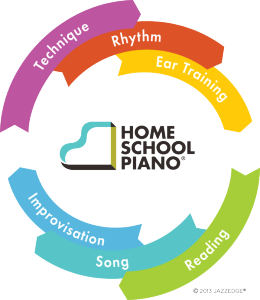
HomeSchoolPiano is almost exactly the type of program recommended for Jude. Willie Myette's vision for teaching isn't just about learning to play notes on an instrument.  It's a total curriculum that combines technique with rhythm, ear training, music reading, song and improvisation.  It starts with absolute basics for students who have no experience with music, yet still has plenty to teach the accomplished pianist who wants to learn to create his own arrangements.  It's a piano program for students of all ages - from "kids whose hands barely fit" to "adults who wish they knew more but don't have time to take lessons."  Yes -- I tried it too!  I've always wanted to learn how to play "properly" -- I can eek out the melody of a song, but I would love to be able to play "both lines" (melody and harmony) of a composition.

 The program is divided into four "books." Each program book has an accompanying PDF file text.

  • Core Piano - for the absolute beginner.  It teaches the before-the-playing fundamentals, like "How do I find a C note?" to proper posture and key-pressing.  Wilie's "Grab Technique" employs what seems like a non-orthodox study aid (a tissue!) but it's a terrific way to show how to slide your fingers along the piano keys, and not just mash at them.  Even if you have some piano experience, it is a good review for all levels.
  •  Book 1 is for the beginner, covering basic scales, theory, and dynamics. This is for the student who has little to no experience with playing.
  • Book 2, for the intermediate student, explores improvisation, fingering patterns, and music styles.
  • Book 3 studies scales and composition for the more accomplished pianist -- maybe you already know how to play what's on the page, but want to "make it your own."  This level teaches you how.

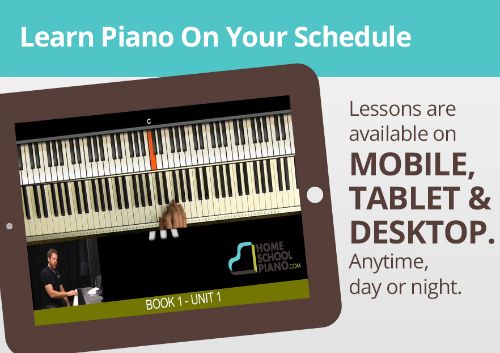
homeschoolpiano is available on any web-enabeled device
The great thing about HomeSchoolPiano is it is online video based.  Anywhere you have internet access -- a laptop, a tablet, even a smartphone! -- and a piano or keyboard, you can have piano lessons.  A student studies at his own pace, when he can fit the lessons in.  Now, I don't recommend 3 am as a good time to be banging away at a piano, but hey...if you don't have sleeping neighbors and that's when it fits in, you can have nite owl sessions!   I love the video-based aspect, because if I don't understand something, I can scroll back (or start over).  If it's been a little while since I had an oppportunity to sit and play, I can skip back a lesson and refresh my memory.  This program  is great for the younger student who wants to try but isn't ready for "regular" lessons.  Once you purchase the program ($299 for up to 5 students; a three month payment plan of $99.97 is available), it's yours forever.  There were weeks of the review where Jude played every day, and then where he'd not want to play for an entire week.  Sometimes he just needed more time to "process" what he was learning, or to repeat the lesson because he just didn't "get" it the first time.  I wouldn't let him move on until he had mastered the prior lesson, but we didn't have the "Did you practice???" arguments that Celia and I sometimes have between her weekly lessons (knowing in the back of my mind that if she hasn't, it's potentially a waste of tuition that coming week).

HomeSchoolPiano in Our Homeschool:

So...now that I've told you all the particulars, the next question to answer is "But did it do what you wanted it to do?  Can Jude play? Did it help his language?"  The answer to both is yes.

If you click on the Crew banner below, you'll find links to other crew reviews.  You will see other students playing their own compositions and arrangements, which shows you how far you can go with the program.   Jude didn't get quite as far as a pianist, but the program has made a difference in the practical uses of language.  For a year now, we've been working on slowing down Jude's speech.  Not only does he mispronounce half of what he says, he speaks so quickly that it's even more garbled. His mouth almost literally can't keep up with his thoughts.  His therapist has been working on having him "Tap It Out" - the idea is to make each syllable a beat, but we'll settle for one word per beat. It's to where many times now we just hold out our hand for him to tap his finger on; we don't even say "Tap it," anymore.  It slowed him down, but it didn't get a "proper speech cadence" going with him.  With HomeSchoolPiano, before you even play, you work on rhythm.  The program consists of a cyclical presentation of themes, and how they are interrelated.

the HomeSchoolPiano approach

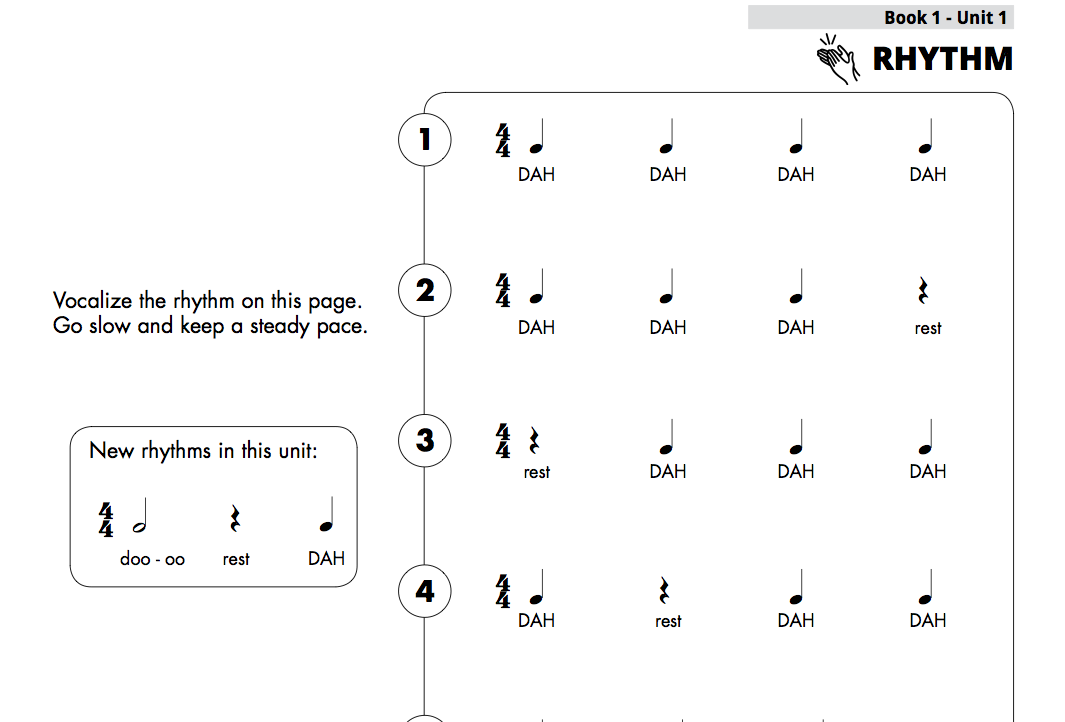
I love how the program doesn't just jump between "here's how to play the notes, here's a song..."  Timing and musicality are just as important to music -- imagine the speedy, mostly eighth notes and 2/4 timing William Tell Overture played instead with the relaxed 3/4 lilt of the Blue Danube Waltz.  Not working for you?  Rhythm in music and speech makes a difference in the tone of the sounds.  The rhythm training has made a big difference in Jude's speech.  Here's a section of a pattern he worked on, right at the beginning:

using music rhythm to establish speech patterns

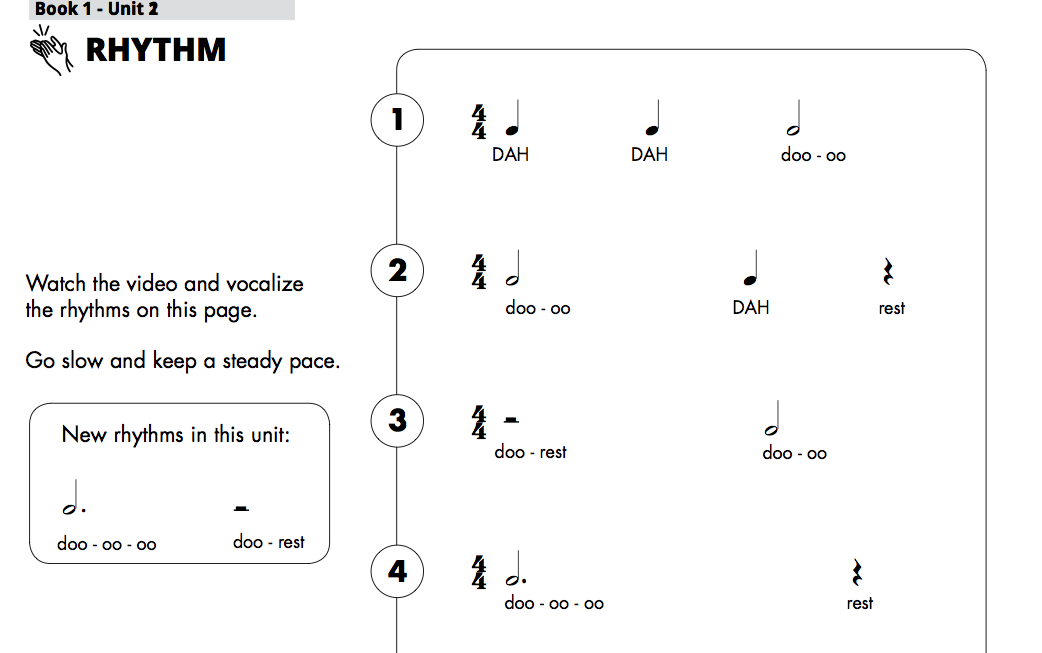
He learned that sometimes you rest at the end, and sometimes you take a rest in the middle.  You know, like to stop and breathe and not just keep racing through.  The little light bulb over his head went off!  We've gone from daily (sometimes multiple times a day) saying "Tap it out" to sometimes entire days where his speech is slow enough to understand.  What I think has made the difference is not just saying/hearing the pattern in speech and even clapping (they're not new for him), but hearing it in music - both in Willie's teaching and in his own playing.   He's also learned that some notes (words) take longer than others to complete, and that's OK too.  Learning to hold longer notes has helped him with multi-syllable words.  We've worked on the concept of "this note = 1 sound tap, this note = 2 sound taps, so "Jude" is one tap, "Mommy" is two taps."

using extended notes to approach multi-syllabic words


"Jude and Mom-my" sound a lot like Rhythm 1, don't they?  The second rhythm can be verbalized with "ap-ple juice." Rhythm 4 draws out a three syllable word -- Dam-i-en - there is room for all of the sounds and no need to skip over the center ones.

As for playing...well, he's not quite at the "composer" level yet.  Although the program eschews "traditional boring" starter pieces and dives into simple songs to keep interest, he's struggling with those.  He's trying to coordinate reading the music with getting his fingers where they need to be (and with smaller hands, just reaching some of the keys sometimes is a literal stretch) and playing in the right rhythm, but he hasn't given up.   He's a bit of a perfectionist, so he won't let me video him again just yet, but here he is coordinating his hands to do scales.  I can say it's HARD to coordinate your left and right hands!


Not perfect, even after lots of practice, but he wants to do the exercise correctly.  For Jude, that is a big hurdle -- for him to want to even try, and not give up after the first stumble, is a big deal.


In addition to Jude continuing with his lessons, I also will be adding Matthew and Luke to the program.  Remember how I said that it's for up to five students?  Each student gets his own sub-account and log in, so there's no "I don't know where I left off...he moved my spot!"  Each book has six units, with the earlier ones being easier/faster to complete than the later ones.  There are also quizzes to test how much the student has grasped of the theory taught, and even if you don't have a truly musical background, testing their mastery of a piece isn't all that difficult (if it sounds terrible, they need more practice!).   Because it already contains so much teaching on music theory, I think if we add a composer unit study to this, it will create the full-year fine arts credit that they will need for high school.

I'm really excited about how well HomeSchoolPiano worked for us.  Even at a snail's pace from a program view (he's still only on Book 1/Unit 2 after 6 weeks),  Jude is making overall auditory progress.  He's beginning to catch on to speech patterns, and can finally match the cadence of his speech to the syllables of the words, at least most of the time.


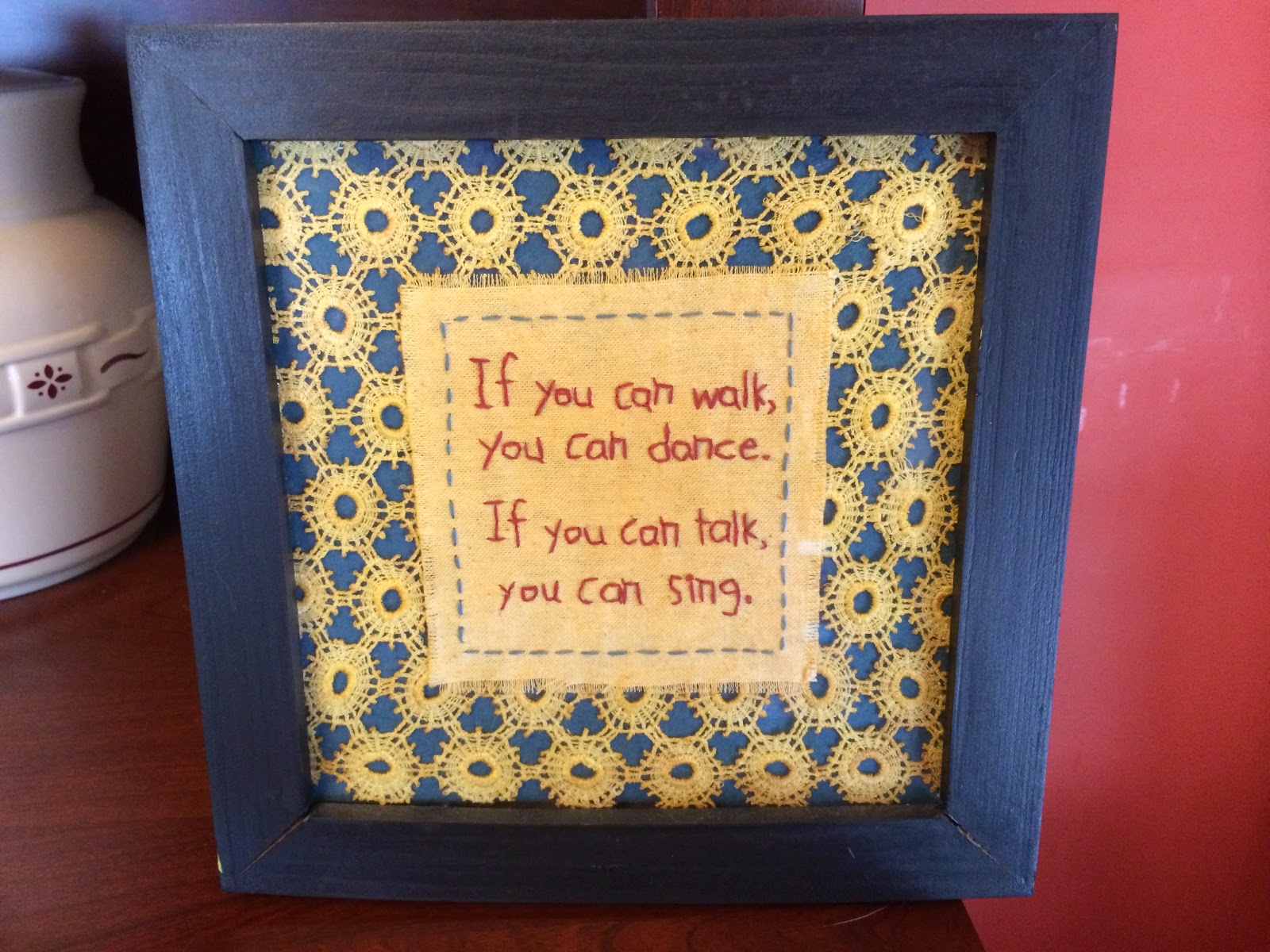
If you can walk, you can dance. If you can talk, you can sing.

This sampler hangs in our house - a reminder to not give up.  For a long time, Jude has talked poorly, and never sung -- he's stumbled over lyrics, but never a true song.  About halfway through the review period, on a rare day when the house was otherwise quiet, I heard a little voice belting, "Let the storm rage ONNNNNNNNNNN!" and couldn't place it.  It was JUDE - he was watching Frozen with his earphones on but singing along like a little mini-Idina (Menzel).   Not only has Jude gotten better at talking, but yes, he can sing!


Click to read Crew Reviews


©2012- 2014 Adventures with Jude. All rights reserved. All text, photographs, artwork, and other content may not be reproduced or transmitted in any form without the written consent of the author. http://adventureswithjude.com
Wednesday, June 11, 2014

Learning Wrap-ups (A Schoolhouse Crew Review)


Learning Palette Online Program Review from Adventures with Jude

The Crew recently was given the opportunity to review several products from Learning Wrap-ups.  Learning Wrap-ups is a mathematics program developed by a teacher looking for a way to help her students.  Some of her students were not succeeding with memorizing multiplication facts with "traditional" flash cards, so she developed a different way that would work.  The product line has grown from the initial multiplications facts manipulatives kit to encompass other areas of mathematics and other subjects, such as language (English and Spanish), science, and even music theory.  It also has expanded into the Learning Palette program; instead of string and sticks, a round "artist's palette" style base is set with interchangeable cards and colored disks are used to indicate answers.  This program has also been independently expanded into the Learning Palette Online language arts and math program for students in K through 5th grade.  Our family received a full online family subscription from LearningPalette.com  Subscription costs are $25 per year for a single user, or $60 per year for up to five students in one family. Two students in our family,  Jude (1st/2nd grade) and Damien (PK) have been trying it out, with mixed success.  (Note: They are currently offering a 20% discount if you use the coupon code HOMESCHOOL.)

From an academic angle, I think this is a very good program.  The online series contains two sections - Language Arts and Math, and each subject is divided into different levels. The divisions are pretty logical (generally by expectations for that grade), and you can move around within the level/activities.


I also like that you can do different levels within the program.  For example, Jude easily completed the Level 1 math activities, and then started in on Level 2.  However, because his language skills are far behind his math abilities, so it was good to be able to start in the Basic level cards for those.


 The some of the Basic level skills for language arts corresponded with some of the things we have on our "Speech Therapy" activities summer/home program list - matching pictures with sounds, rhyming, etc.


 I foresee us using the language side of the program more as a "speech therapy" activity, rather than an actual "school" activity.

Damien started with Basic levels, and did OK with a few activities.  He didn't get much beyond "Match the Letters" in language arts or matching colors & shapes for math.  I'm ok with that, given he's only almost 4, however, unless you have a really advanced kid, I wouldn't start this earlier than the "manufacturer's suggested age" of Kindergarten.  Schools have been using the Learning Palette program for a long time for independent learning centers, and I agree with this practice. It's really more of a review/drill game, and less of a learning activity -- if the child doesn't know that the word jam starts with a /j/ sound, which is written as the letter j, it's not going to be an independent program.  I think if the boys were just reviewing and able to work on their own, this would have been easier.  Damien even struggled with understanding the "split card" idea - where the colored rings made the top matches and the colored disks matched the bottom. I think because their skills are so limited, it was frustrating because they didn't have a lot of variety to work with, and both needed help figuring out even just how to get from card to card.  For example, Jude eventually figured it out by where/what buttons he clicked on in the past, not by decoding that that shape he clicked said "Next Card."

We had an opportunity to review the physical product but I decided to request only the online program.  Given we spend a lot of time working away from home, I thought that the online version would suit us better because it was a lot less pieces to worry about losing in our travels.  LearningPalette.com works on the HTML5 platform, so it can be used on a computer or tablet, or even an iPhone! (The last one is little small, but it will come up.)  Having used it on both a MacBook and iPad/iPad Mini, I am reconsidering the "it's a lot of pieces" stance.  The trade off for having it online is having to drag the "chips" into place.  On the computer, if Jude resized the window mid-card (usually making it bigger so he could see the farthest top and bottom edges), he had to re-place the tokens.

Regular screen
Resized to full screen

On the iPad, we struggled with moving tiles around.  Sometimes, Jude lifted his finger too soon, an a chip would drop into the wrong space.  Once it was there, we couldn't move it.  (This did not happen on the laptop.)  He got very frustrated, because he knew the answer was wrong, but he couldn't fix it.  Damien struggled moving chips around - his fine motor skills aren't there yet, even using a touch screen.  I think the physical product, with the truly hands-on manipulation would have been better suited to them.  (Plus, it would have been a fantastic fine-motor development exercise.)

Jude also needs a lot of sensory input to maintain focus.  One day, we tried working draped over a Bosu ball.


It was really awkward using the computer, and I think having the physical program would have helped with being able to position himself and the item, plus given him a broader range of movement (picking up chips and moving them to another space/into the palette) rather than having only a 4" x 3" trackpad to move only his finger.


Overall, I liked the concept of the Learning Palette but the online version ultimately didn't suit our needs as well as I would have hoped.  Since the boys will be in the age range for quite some time (math skills are covered through fifth grade, language arts to third), not counting therapeutic use, once our subscription runs out I may consider investing in the physical product.  I'm definitely going to check out the reviews that other crew members did of the physical product Learning Wrap-ups activities - click the button below to join me!

Click to read Crew Reviews


©2012- 2014 Adventures with Jude. All rights reserved. All text, photographs, artwork, and other content may not be reproduced or transmitted in any form without the written consent of the author. http://adventureswithjude.com
Wednesday, May 14, 2014

Logic of English Foundations A (A Schoolhouse Crew Review)

Logic of English Foundations A Review from speech therapy viewpoint

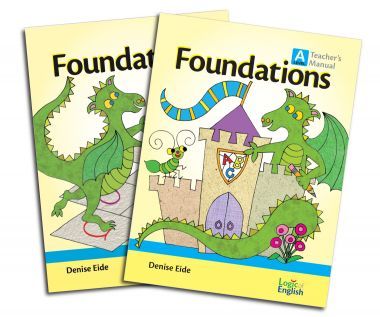
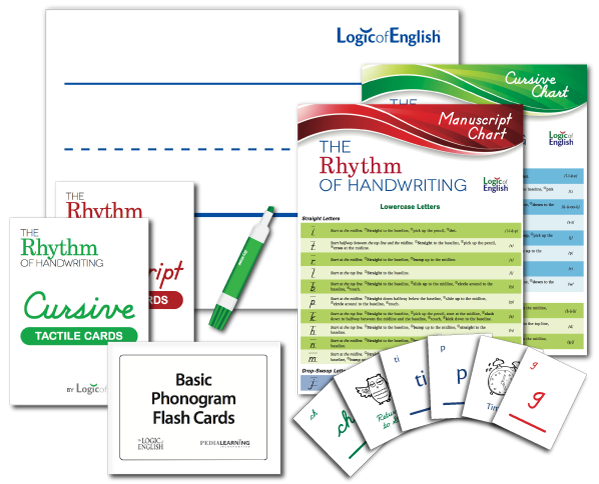
Logic of English is a language arts curriculum program for all ages.  It is divided into two levels: Logic of English Essentials for students ages seven and up, and Logic of English - Foundations for students ages four through seven.  Foundations focuses on phonemic awareness and early writing skills, and is further divided into three sections.   We received the Foundations A program for Jude to work with. The three core texts are the scripted Teacher's  Manual, the student workbook (available in both manuscript and cursive writing), and the book Doodling Dragons: An ABC Book of Sounds ($71, all necessary printed texts).  We also received The Reusable Resource Set.  This $85 package contains Basic Phonogram Flash Cards, Handwriting Tactile Cards, two sets of  Phonogram Game Cards, the Rhythm of Handwriting Quick Reference Chart, and a small Student Whiteboard.  The package contents are also used with Foundations Programs B and C).

LOE Foundations A
Language and reading are a struggle for Jude. I've lost track of how many programs we have tried already, plus we intentionally took a six month break from formal reading lessons. His most recent course of speech therapy started in August, and his therapist (Miss Jaime) and I agreed that before he could learn to read, he really needed to get stronger expressive language skills. Because we are coming to the end of this round of therapy (the clinical model is to alternate intensive therapy with periods of rest in order to allow the child to practice skills and avoid burning out), we decided it was time to start re-attempting a reading program that might help him keep up with the skills he's been learning in therapy. One of Jude's weaknesses is articulation. For example, to him, the words "mud" and "mug" come out the same.  Being able to read a word doesn't mean anything if you don't know what the sounds you are saying mean - even if he can figure out the word on the page is "mug" it makes no sense if his brain is saying "Why are you pouring the root beer into the mud?"

For speech purposes, we needed a program that was phonemic based to help him work on sounds both in isolation and words.  Miss Jaime wasn't familiar with Logic of English, but felt that as long as it was truly phonemic based (vs. "a little phonics and then ultimately memorizing the words"), it was worth a shot. Our philosophy was if it helps him read, great, but right now, let's work on knowing what word you're saying.  After our books arrived, I took them to one of our therapy sessions, and she worked on one section with him. She was very pleased with the program, so that was the first point in it's favor.  She was honest and agreed it was going to be a lot of work for him, but it was definitely compatible with our overall language goals.   We both liked how short each lesson was (less that ten minutes).  For a child with a low frustration threshold, keeping lessons short helps. 

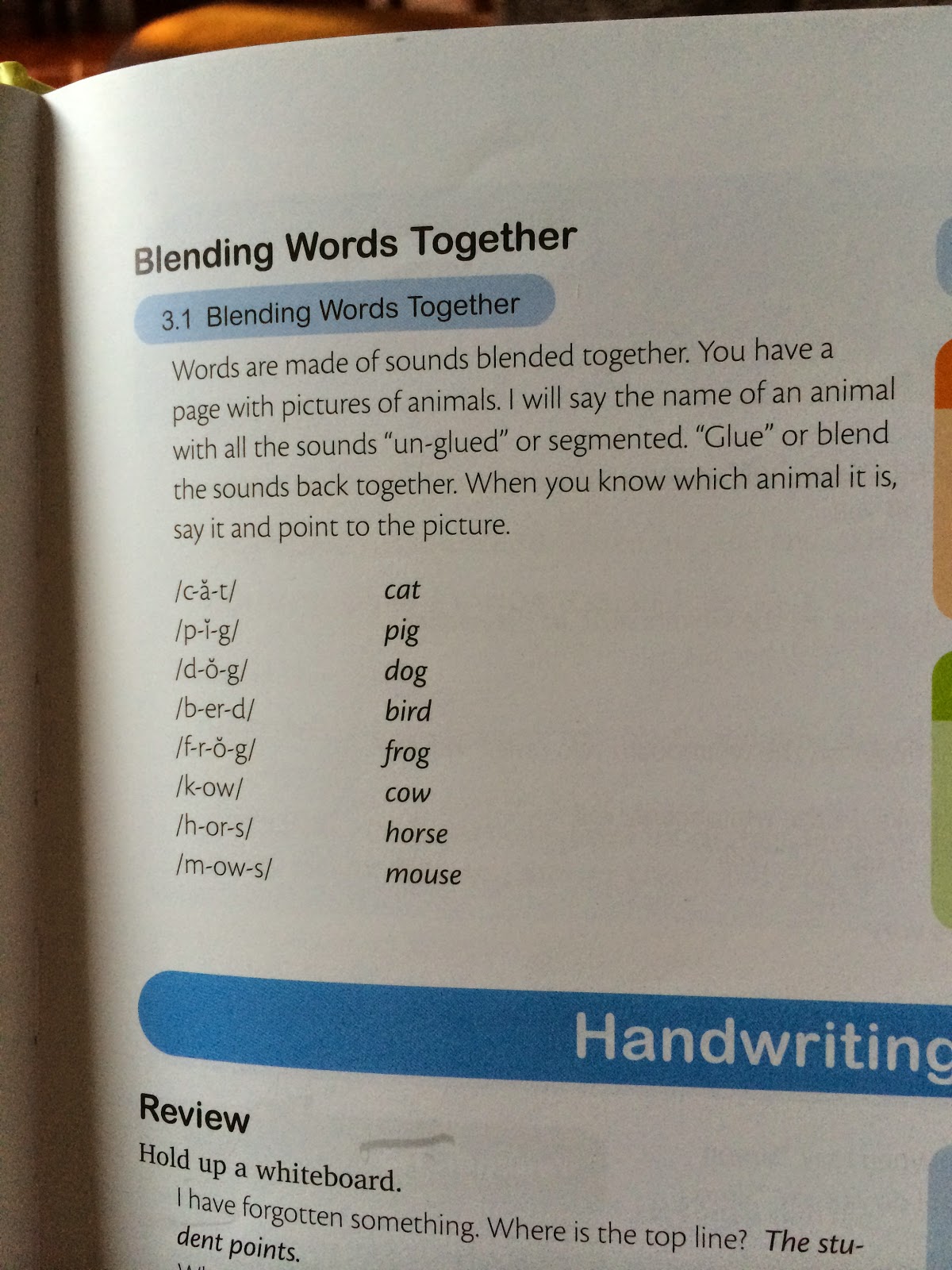
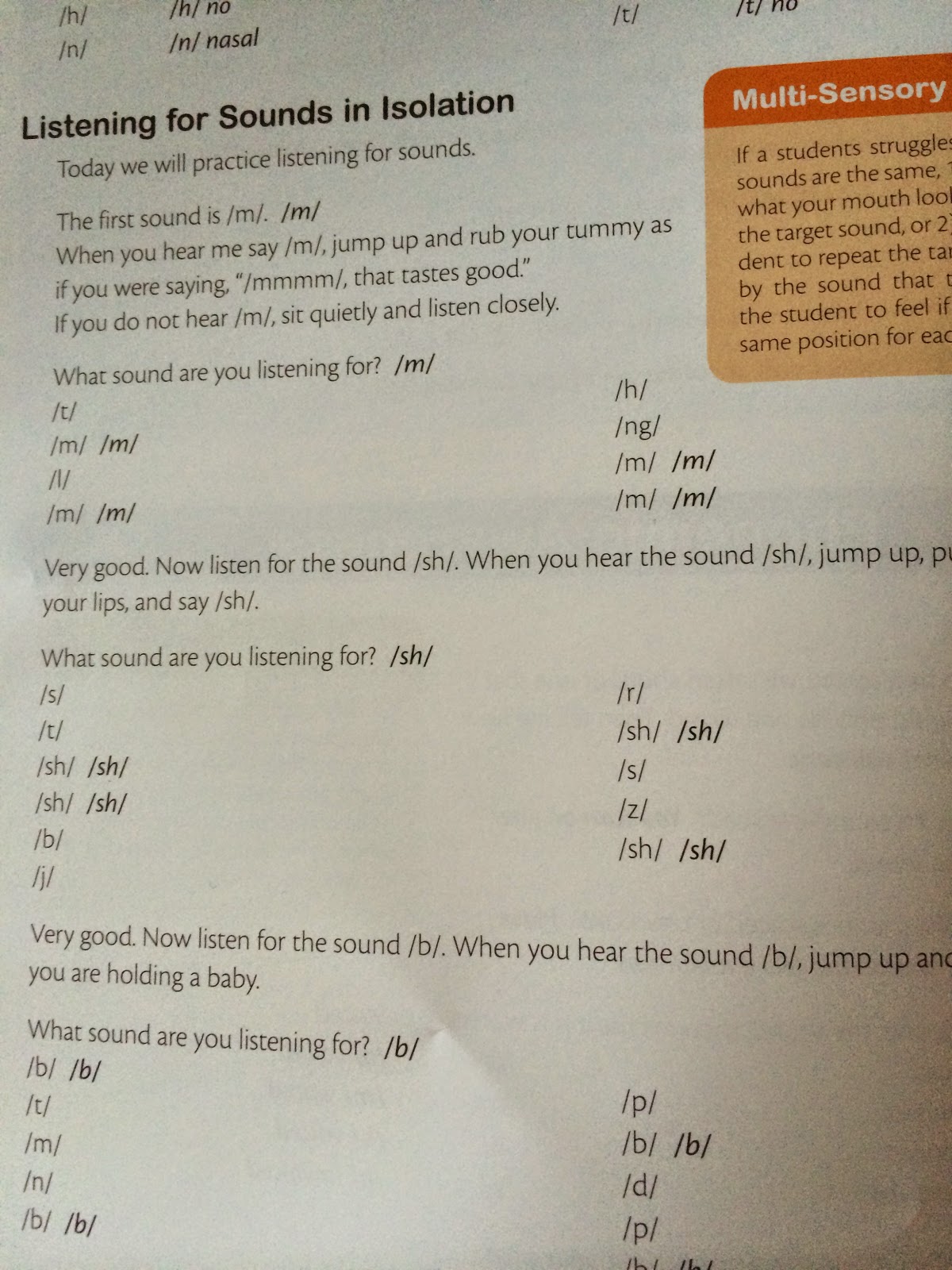
blending phonemes into wordsHowever, one thing she was concerned about was the pace of the program.  For a neurotypical child, the lessons were a suitable pace.  However, Jude has some serious language deficits, and needs a lot of modeling.  She was concerned that he could fake his way through the harder-for-him parts.  For example, blending individual sounds together was something that would be difficult for him to do on his own, but if we practiced enough times, he would just memorize the patterns, not blend the sounds.  I agreed with her (for all of Jude's irregularities, this is definitely one behavior that occurs nearly all the time), so we approached this a little differently.  While most students would be able to complete a lesson a day, we were definitely going to have to go at a slower rate.  We repeated lessons several times, often rearranging the words so he didn't have the pattern to support him.  At the end of the six weeks' review, we are actually only at Lesson 8, having spent almost two weeks just on Lesson 3.  It took him three days to be able to hear sounds in isolation, and then about eight school days to be able to put the blended words together. Between listening, motor planning, and making the sound, the words were just a huge struggle for him.  I don't think it was that the words were inappropriate -- after four days of getting nowhere, this was one of the lessons Miss Jaime looked over, and she agreed that they were reasonable words.  It just was Jude's brain not keeping up - we just needed to keep trying.  In order to keep them fresh, one day we would start at the top of the list and go down, another day we'd go in reverse. I'd mentally number the words, and one day we'd do evens followed by odds, or odds followed by evens, just so that he didn't learn "say cat then pig then dog," and really had to work to put the sounds together.  She also wanted us to use her criteria for "success" - 90% accuracy, three consecutive sessions.   We were all thrilled when Jude hit that...I think by week three of the same words, we were all tired of those words!

isolating voiced and unvoiced soundsThe Teacher's Manual is very well scripted.  Foundations is supposed to "[Equip] teacher to combine the art of teaching with the science of reading."  This definitely is true here.  For example, the terms used are speech science based - using the terms voiced/unvoiced for sounds, explaining pronunciation (/k/ means "say the sound, not the letter"), and explaining the location of the sound and the placement of the mouth/tongue/teeth.  While this is not going to be an overall substitute for Jude's speech therapy, it is definitely a great "between" program that builds on familiar-to-him language.  If you are a parent/teacher with little/no speech training, it is easy to understand - while using "therapeutic" language, it's not so full of jargon that it becomes overwhelming. There are 48 lessons in all - 40 "new material" lessons along with a "review" every fifth lesson to make sure that the student has learned the skills being taught (it's much easier to go back and repeat one or two lessons than try to figure out after Lesson 30 that he didn't quite catch all that was in Lesson 12).


 Each lesson combines listening and repeating sounds, focusing on blending sounds into words, and then learning the proper strokes for writing.   One thing we both were impressed with was that it actually started with listening.  Before the child even begins putting oral sounds together, the lessons start with blending two words into compound words.  The parent/teacher begins by saying two individual words, pausing between each, and the child looks at the provided images to decipher what the words become when combined. Using familiar words and images, the child learns that "sounds go together."  For Jude, who tends to drop middle sounds, this was a perfect exercise.  He could hear, and eventually repeat, all of the phonemes contained in the word.  For example, one of the blends was "butter" and "fly." Instead of saying "bu er fy" he was starting to recognize that there are /t/ sounds in the middle of "butter."  In general speaking, he tends to garble the /l/ sound and now will say the last syllable as "fwy" but with intense focus on the syllable structure will now say "but ter fly."   For him, just recognizing there are sounds in the middle is huge.


LOE Reusable Resources pack
We have been using the Manuscript Workbook  I was torn on which to go with - cursive is supposed to be easier for children with motor skill issues, but Jude's occupational therapist has been focusing on printing with him, because it forces him to be more aware of spacing and line limits.   In order to reinforce the same skills, we opted for manuscript.  Unlike other programs we have used, it doesn't begin with "write this letter" but instead with component strokes.  This is where the whiteboard was really useful.  While the workbook has a space for practicing strokes and letters for each lesson, I found that using the whiteboard helped keep the book "empty" until we were ready to move on from the phonemic section.  Once Jude mastered how to do the sounds, he was very proficient with the strokes/letters.  Yes, the penmanship in his book may be a bit "artificially" beautiful, but using the board kept us from the "but I already DID this, I want to move to the next page" fight.  Though the set comes with a marker, I purchased a set of dry-erase markers, so that each day we were using a different color.   This helped keep it different as well ("We haven't done orange yet!").   Some days, instead of actually pen-and-paper work, we worked with the Tactile Cards.  This program is definitely flexible enough to accommodate many students' paces.   Due to copyright issues, we were unable to copy the workbook pages.  Therefore, instead of circling the images on the first go-around, Jude would simply point to them.  Circling was an "earned" privilege - once he had achieved oral proficiency on that blend, he got to circle it.

While we haven't worked directly with Damien, just being around as we work on things has helped his speech as well.  He is also a patient of Miss Jaime - he receives feeding therapy from her, and she also has been monitoring his speech. (He has not yet had a formal speech evaluation for therapy, but she keeps tabs on his progress so that if we find he does need it, he will be able to start as quickly as possible.) She has definitely noticed his articulation getting better -- at the start of his current round of therapy, we discussed ending the block with a full speech evaluation.  We've since decided that his speech has gotten strong enough to not warrant testing!  I'll likely use this program with him in the fall as well, because it's clear that it's working for him, even indirectly. 

I will admit, this program is not going to be a "magic bullet" for Jude.  Frankly, I don't think any program is going to be -- he just needs a lot of time and practice.  However, of all the programs we have tried, so far this has been the one that has worked best for his disabilities.  We are able to control the pace of the program, from how much is presented at one time to how quickly we move forward.  While each lesson has a small number of sounds/words to work with, keeping him from feeling overwhelmed, there are enough to be able to mix them up so Jude can work on learning the sounds of the words, not the pattern that they are presented in.  He is about to be discharged from speech therapy for the summer (we will take about three months off and then start up again in September), and this is a program that I feel will definitely help reinforce concepts that he has been working on in therapy.  Clearly, the Level A program alone is going to take much longer than average - I'll be shocked if we complete it by September - but I think that it's a program that will work for Jude when taken at his pace. 

Crew members have been working with a number of Logic of English curricula from both programs.  Click the banner to read about the other products reviewed.

Click to read Crew Reviews


©2012- 2014 Adventures with Jude. All rights reserved. All text, photographs, artwork, and other content may not be reproduced or transmitted in any form without the written consent of the author.  This post may contain affiliate links, please see the Disclosures page for details.  http://adventureswithjude.com
Related Posts Plugin for WordPress, Blogger...
Pin It button on image hover