Each of my big kids started a formal, private-school pre-K program at age 4, including Jude. We pulled him to homeschool and decided Damien's school career would become a game time decision. When it came time for Damien to start preschool, Jude was still very delayed and struggling, and Luke had boomeranged home after his school closed. Plus, with his food allergies and feeding tube, it became the easier route from a medical angle. We figured, "At least we've already done preschool before!" Why not homeschool him?
My educational philosophy had begun to change, too. While I wanted to expose Damien to lots of things, I really wanted to focus on letting him learn in a more organic way and at his own pace -- I saw firsthand how difficult it was to "force" a kid to match what the curriculum was "supposed" to do. We had a few preschool-level reviews, so we worked on them a little. (They were tough because so many PK programs are letter/color/shape of the week, and lots of the reinforcement is with food.) Ultimately, he hung out with us and did some coloring or other low-key activities while Jude and I were working, or he watched hours of Super Why!, Liberty's Kids, and Where in the World is Carmen Sandiego? in the car as we drove to therapy appointments.
During Jude's first-grade year, we logged 400 miles a week going to doctor and therapy appointments. Videos were an attempt at some semblance of educational content to the hours spent on the road. Apparently, Damien was paying attention, because he started pointing to letters and showing off beginner math skills.
When Kindergarten time rolled around, we began some very laid-back math and early reading work. Most of the time he still sat on my lap while I was teaching Jude (all the better to be nosy!), so distracting him with a page of "big kid" Math and Spelling got me a chance to stand up and check on Luke's work. Laid back and osmosis seemed to work - by the middle of kindergarten, Damien had taught himself to read! One night, I started reading a new, simple C-V-C book to him. After the title page, he said, "My turn!" and read the entire book. My jaw dropped. There went my "We'll get to learning to read next year" plans!
Once Damien could read, there was no stopping him. He has learned things so quickly that my head is spinning. Like that first night of reading, every time I think I have a plan in place for him, he demonstrates that he's already past there. By early last spring, he was easily completing first-grade work, despite only being in kindergarten. On our trip last summer, he didn't do Junior Ranger programs at the first few parks we went to - he would read over a shoulder but some of them were pretty challenging. After watching Jude fill his hat with badges, Damien decided he wanted his own hatful, too.
Not only did he fill his hat, but much of a vest, too!
By Christmas, he was dipping his toes into second-grade work, and six months later, has barreled through most of that. He's become difficult to plan for because he still often does his own thing. For example: in late January, I gave him a 2nd-grade reading book that should last 36 weeks (it's a page-a-day). I expected it to last him well into the summer. He thought it was fun and easy...and if one page was good, why not three, or five? He completed a year-long workbook (with 90+% accuracy each day) in less than two months!
I'm in no hurry to "move him up" to a higher numbered grade. but I do want to challenge him. Bored Damien is a hurricane on two feet! At the same time, he's still only six-turning-seven. Some of the problems we're running into now, especially with literature, is that while he's capable of reading on a much higher level than his age (his recent K5 Learning placement test put him at a 5th-grade comprehension level!), often those harder levels require more maturity than he has just yet.
I think -- at least for now -- that we've come up with a plan that. I harbor no illusions that it's going to last us until next June, but hey...I think we've got at least a few months' worth of work. We'll also be rotating in some review products, but our core program is shaping up to look like this:
Theology
Ignatius Press Faith and Life - Our Heavenly Father
Math Math U See Gamma
Language Arts
Grammar:
Growing with Grammar - Level 3
Literature:
Independent Lit Study: Moving Beyond the Page, ages 7-9
Read Aloud Studies: Memoria Press - Farmer Boy, A Cricket in Times Square, Homer Price, and Poetry for the Grammar Stage
Independent Reading: interest-led new and classic books in a Lexile Range of 650-800
Spelling: Spelling You See - Wild Things (Level C)
Copywork: George Washington's Rules of Civility
Foreign Language
Latin: Memoria Press Prima Latina
Science
Science Sassafras Science Vol. 1 Zoology with SciDat Logbook
Social Studies
Magic Treehouse series/Magic Tree House Fact Trackers
Who Is/Who Was biography series
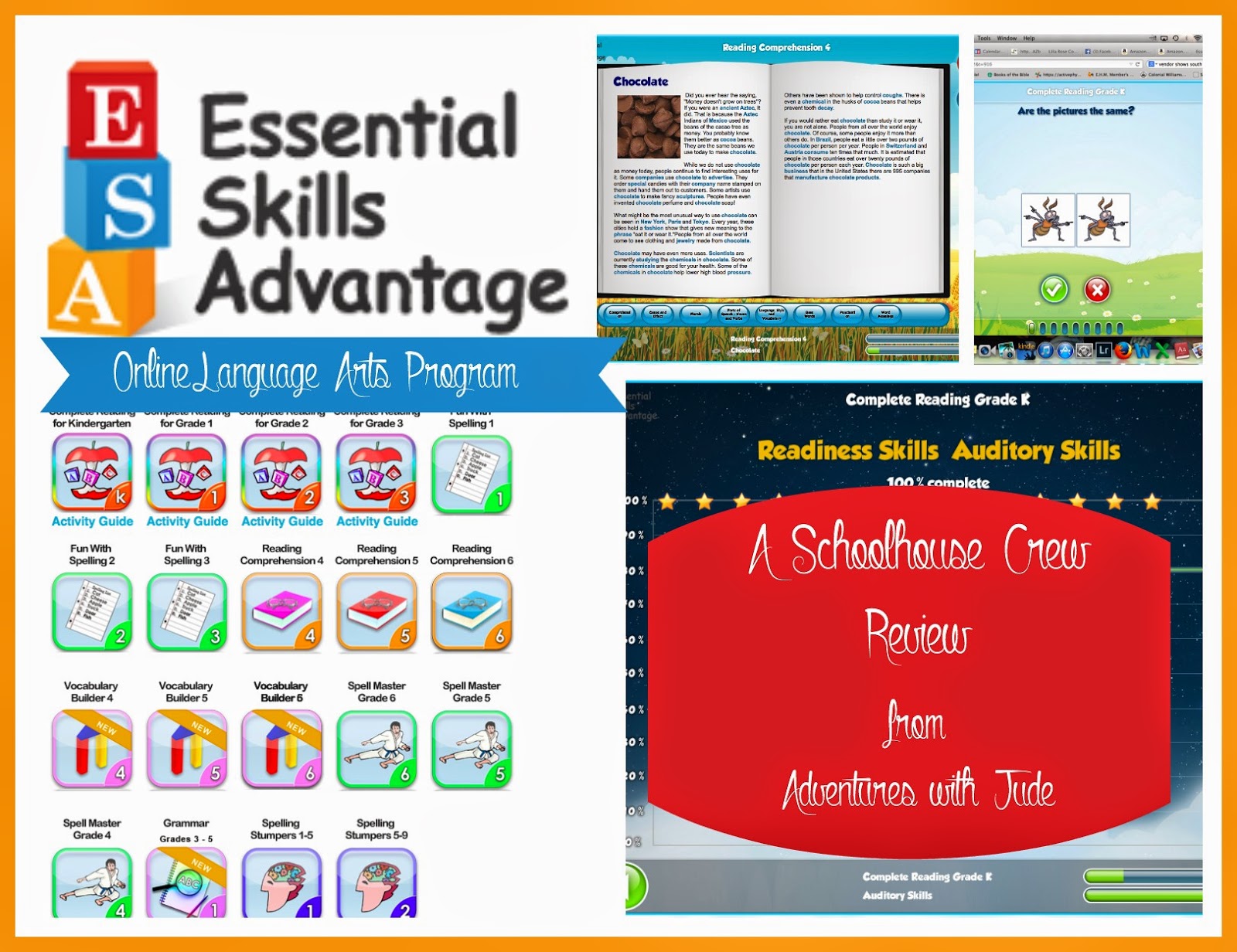
While it is new to the homeschooling scene,Essential Skills Advantage has been providing a language arts supplemental program to school systems for over ten years. The eponymous Essential Skills Advantage online language arts program is for homechooled and co-schooled children in kindergarten through sixth grade. While most language arts programs focus on individual language components (phonics vs. sight words, grammar vs. reading vs. spelling), ESA combines all of these into a comprehensive web-based curriculum.
Jude now wants to learn to read - in the past, having no real motivation to learn may have been a hurdle, but now, he begs me daily, "Mommy, I want to be a genius, teach me how to read!" And yes, my heart breaks a little every day because it's just not clicking for him. I've lost track of how many language programs we've done with Jude,
and have felt "Hey, this is working!" only to get a little further in
and hit a wall. When we applied for this program with the Crew, we were asked to rate our interest level on a scale of 1 to 5 (1 being "Please pick me and I'll send you chocolate!" and 5 being "Please, no...my head will explode if I have to do one more thing right this moment!" I averaged out my interest level to a 2, with the following note:
Part of me wants to say "YES!! Pick me, I'm desperate, and maybe this will be the moment and program and planetary alignment that clicks and works for Jude!" Part of me wants to say "I'm so disgusted at how many wheels we are spinning, and nothing is truly working, I quit and my interest level is 'when cheeseburgers fly.'" On the flip side, that's not fair to him, and of course I'm not giving up on him. What we'll do if we don't get chosen...I don't know, we'll figure it out. If we do get picked, it will save me from having to make a choice and we'll give it everything he's got and see what we can make of it.
Obviously, the Crew leaders decided to give Jude the opportunity to try and added us to the review, so we gave it our best shot. I'll admit that it's been slow going at times, because sometimes it's take us two or three (or six!) tries to complete an activity proficiently, but we're working our way through. Jude's confidence is slowly growing, and towards the end of the six-week review period, he was starting to want to do more, because it's not so impossible now.
I like that while the program encompasses many levels and activities, they are all available simultaneously. To start the program, the parent logs into their account, and then the parent or student chooses the program to be worked on, logging the student in after choosing. I like this because if a student is working at multiple levels - perhaps a 4th grade reader needs some extra help spelling and drops back to 3rd grade for that - you can mix and match to get a better fit for the child, rather than being locked into a single level.
Here's a little touch that impressed me. Most programs will switch hide your password by changing characters to asterisks. For security, I see the value. However, it makes it very difficult for a child to be independent because remembering a sequence or even just hitting the correct keys can be tough. With ESA, the main level of account security is in the parent login; the student's password remains visible until the child clicks to log in, making independent use a little bit easier.
Although Jude is officially a second grader, his language skills are still far behind (3rd-6th percentiles) so we started at the very beginning - Kindergarten. I wanted to see what his skills were compared to the expectations of the program. I have to say, I was impressed at how the program was arranged at that level.
It's very clearly laid out, with short areas to work on. Because I was trying to assess Jude's skills (we haven't done a formal reading program since last August), we worked on one area at a time. ESA is meant to be used more as a supplemental program rather than a full curriculum, so if you were working on reading skills in "real time" you could skip around to reinforce a particular skill you were working on.
Some of the skills that Jude worked on:
Here Jude was working on what appears to be the same skill -
discriminating same or different - from different perspectives. In one,
he has to determine if the two pictures are the same or not; in the
second activity, he knows there is a difference and he needs to find it.
The activities at the beginning of the task were easier and more
overt, while as the activity progressed they became increasingly
difficult. Having the easy ones first helped him build confidence -
something that he really doesn't have with language skills.
One majorly challenging activity was listening to words to determine if they rhymed. When we started this one, Jude really struggled with the concept of rhyming. We needed to detour a little bit to find some other methods of learning what rhyme was, and then we came back to the program to practice listening for rhymes. Among the activities we did was watch this Sesame Street video, and he has since fallen in love with Grover and the Blue Guy. I love it too...no reason, just rhyme!!
When we started working on ESA, sometimes it was tough to get him started, but with the promise of getting to watch one "Grover and Blue Guy movie" when he's done his work, he's willing to get down to business. (Sometimes, he even has fun doing the work and forgets about the video unless I remind him!)
After the student logs in, a "white noise" of chirping crickets and
birds turns on, and remains on during the activities. There have been a
number of studies that show white noise is beneficial for focusing and
memory. I can't prove or deny their claims, but I will say that it was
very frustrating for Jude to have to isolate speech sounds from white
noise. There is no way to turn off the white noise without turning your
computer speakers off - which then means the auditory program doesn't
work. It would be really great if there was a way to turn it down and
make it more "background" and less of a big muddle.
Matching a sample word from a selection. This was hard for him to read across - we wound up taking a piece of paper and covering the choices below the one we were working on to help him better isolate the specific matches.
For the student who likes to check his progress, there are several tangible rewards. First is an end-of-activity star (and in the program, the little puppy dances to a few bars of music).
Second, there is a "star chart" so the student can check his progress. Jude liked having all of his stars lined up at the top, and would often retry an activity to better his score and move a star up into the "right" place.
Both of these are on-screen rewards. For the student who likes a certificate to hang on the refrigerator, there are downloadable/printable section proficiency certificates available through the parent account.
Damien (PK4) also tried the program. At first, he did well with non-written activities - identifying colors, shapes, animals, etc., but some of the more letter-based activities were too hard for him. In exchange for the review, I received a full year's subscription for each child, but normally subscriptions cost $9.95/child, payable monthly. Having a year's subscription for him, I'm not concerned that he was only able to do a few activities here and there, and will probably be six months before he is ready for more, and I definitely plan to go back to it with him. However, I would be very frustrated if I was paying on a monthly basis for him to use here and there. Under normal circumstances, I would wait until he was in Kindergarten fully so that he could use the program more consistently (even if a bit of it was more "review" task than new learning.)
NOTE: The first 14 days of a membership are a free trial,
and you may cancel at any point during that time at no charge. Essential Skills Advantage is currently offering a coupon code -TOS50 through OCTOBER 1, 2014, good for a 50%
discount. This discount will apply
as long as you are a member and will reduce the monthly fee to $4.99 per
student. There is also a sponsored version of the site available at ESA Learning.
9/1/2014 Clarification: The sponsored version of the program is the same as the paid program. The difference is the sponsor's landing page contains ads (not the student program itself), as does the weekly newsletter.
Celia also worked on this one - she gave grades 4 and 5 a workout. For a summer program, it was perfect - a little reading, a little spelling, and nothing overly strenuous for her. I felt the reading passages were age appropriate, and with appropriate support with pronunciation where words were particularly tricky. Though there are activities from comprehension to parts of speech with the passages, I think at this level, it is definitely only a supplemental program. If I was using it as a homeschool program for her, I would probably use it as a "between books" filler.
Overall, I'm really pleased with the program. The sequence of activities in each level feels developmentally sound. We've had more visits and test sessions with our developmental specialist than I care to count, and this program's sequence is very much like the testing that she does each time we visit, especially in the auditory skills areas (Jude's area of weakness and most frequently assessed area). I'm not sure how much Celia will work on it now that school is starting back up, but we will definitely be continuing with it into the fall with Jude. Looking ahead at the First Grade activities, I think he will be able to do a number of them at the beginning. Some early ones appear to almost be reviews of Kindergarten activities and then progress in difficulty, repeating the same sequence of confidence first, challenge second. For my struggling reader, that alone makes the program worthwhile to me, because he needs that confidence boost to keep on trying. Is the the silver bullet for him? I don't know. But he likes it, he wants to work on it, and he's starting to come around to the idea that maybe he can do "Reading" after all, and to me, that's priceless.
Click the banner below to read other Crew reviews, or catch up with Essential Skills Advantage on social media: Facebook Twitter Pinterest Google+
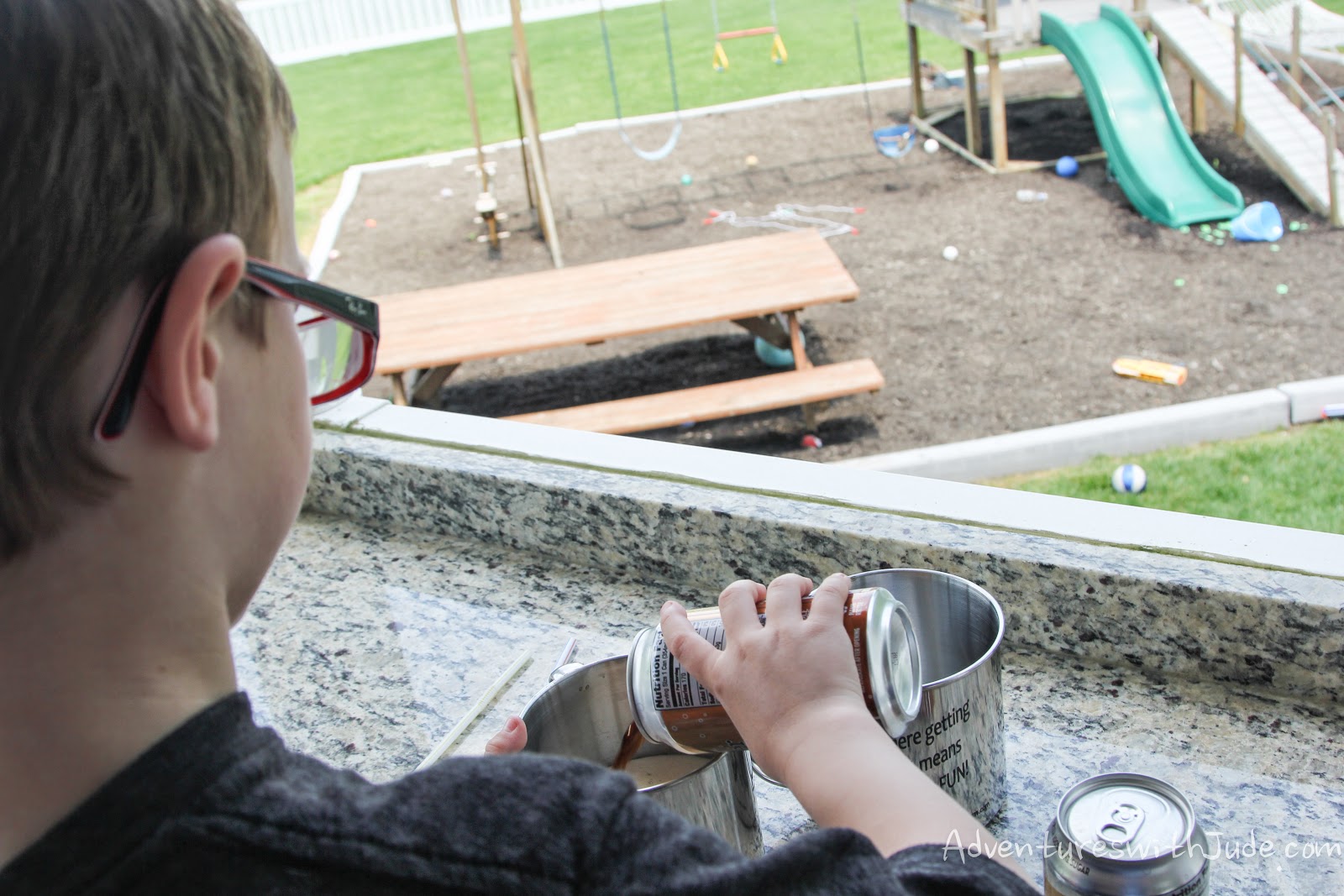
Recently, we had the opportunity to reviewtwo DVDs from the Go Science series. Volume 1 is subtitled Sound, Gravity, Space and one of the experiments that Ben Roy and his students do is to use soda cans to produce a high pitched squeal. Given there was root beer involved and lots of noise (and I think mostly root beer), Jude wanted to try this one right away.
Materials needed:
Two empty soda cans
A straw
Of course, we didn't have any empty cans. Jude solved that problem.
The root beer gave him something to...erm...wet his whistle.
Procedure:
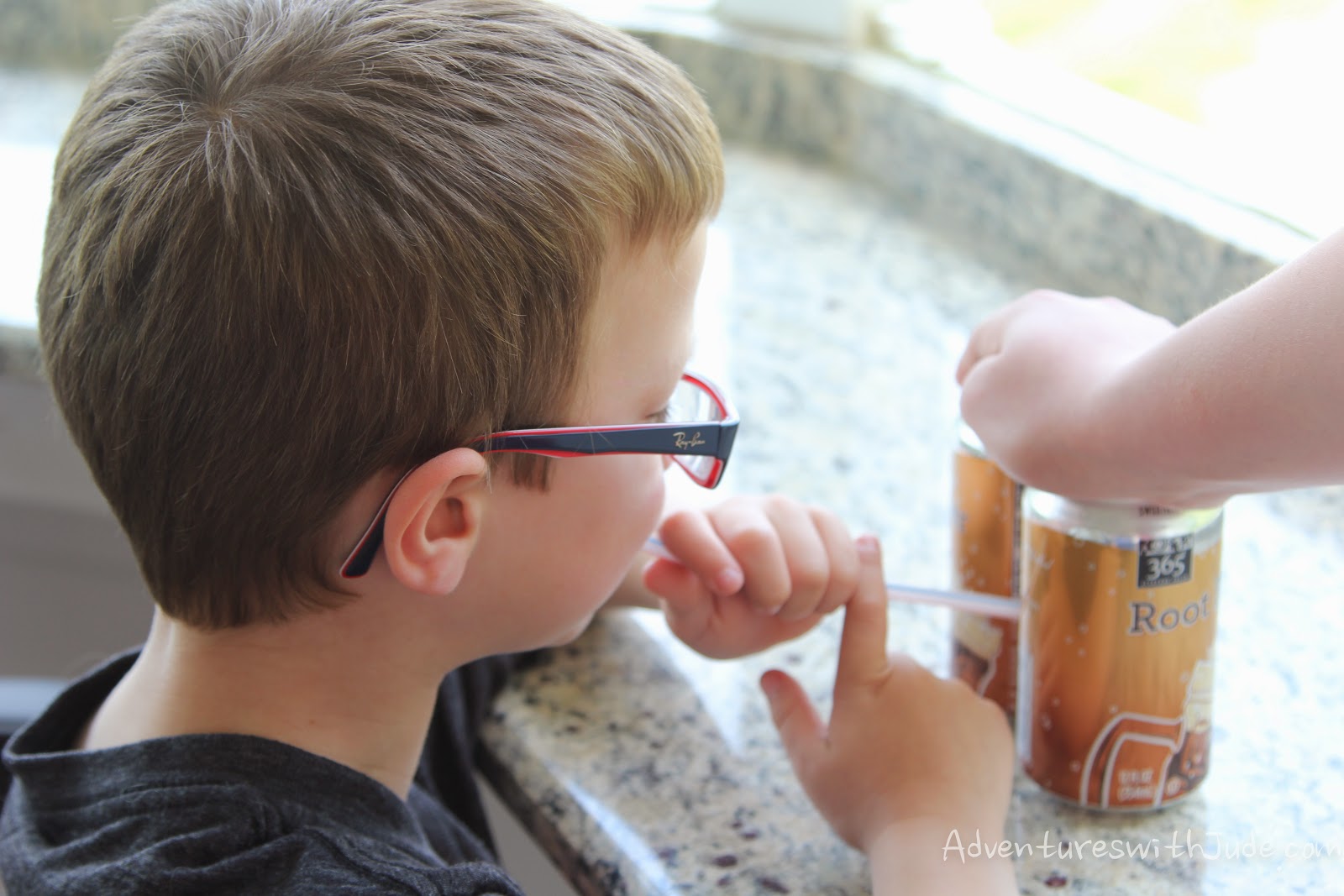
1. Place the two soda cans together, nearly touching. Hold them still so they don't get knocked around or blown away.
2. Place your straw into between the cans, placing the end just where the gap is between the cans. You don't want to put it in front of the cans, but in the space.
3. Blow until you hear a high-pitched screech. It might take a few tries, but keep adjusting how far apart your cans are, and how close your straw is to the gap -- it will happen.
Results: If the air is forced out strongly enough, it makes a really loud, spine tingling screech. You need a strong, sharp exhalation, not a long blow.
Conclusion: We learned that the air being forced through the tiny space is what creates the noise. The air makes the cans vibrate, and the vibrations produce sound energy. The straw condenses the air so it is forced into the smaller are, rather than your breath blowing the cans around. If you put them too close together, there's no space for the air to make noise; too far apart and the cans won't vibrate.
Be sure to recycle your cans when finished. Another thing we want to do is see if this works with plastic and glass bottles.
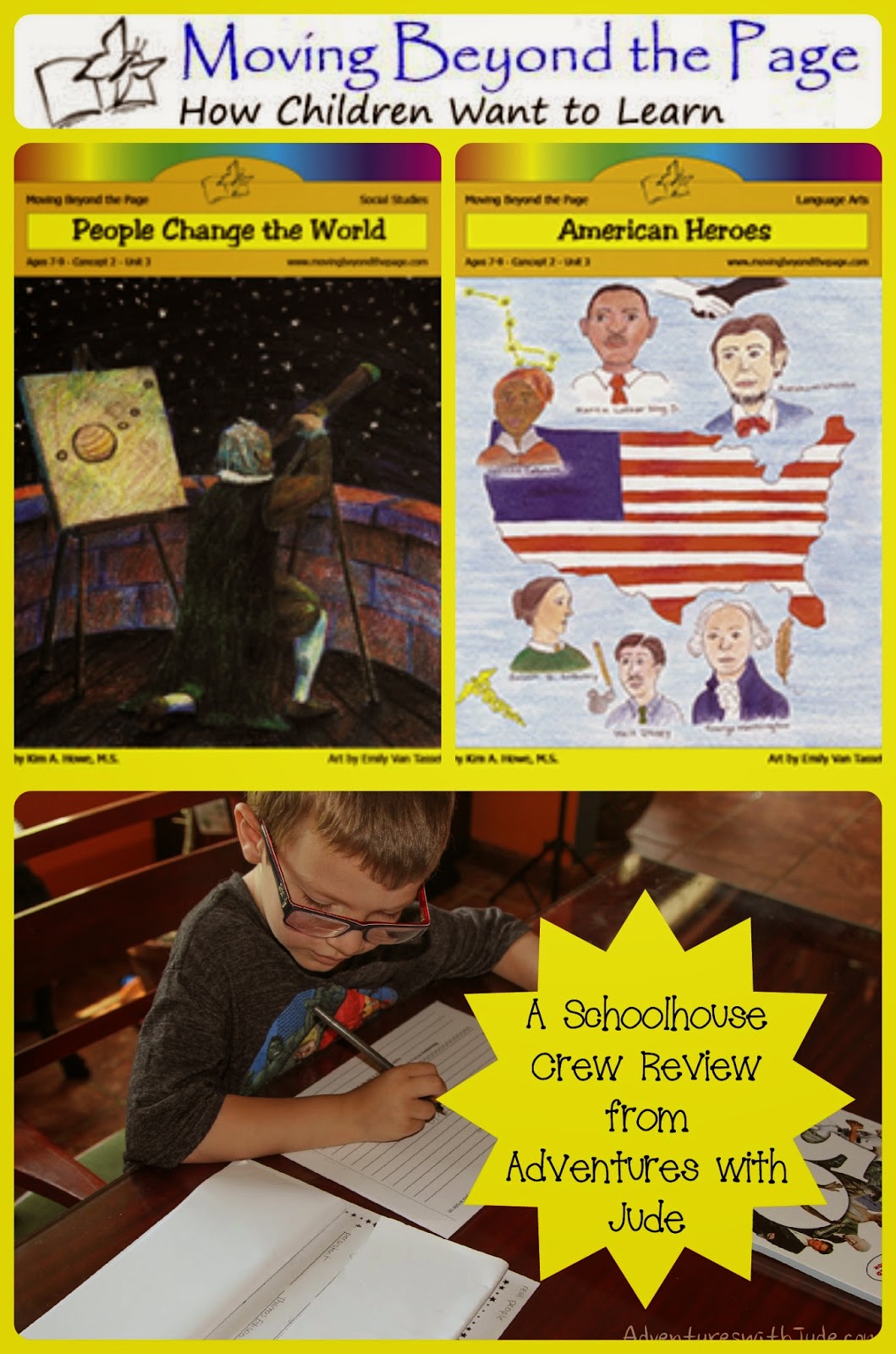
Moving Beyond the Page, an interdisciplinary homeschooling curriculum for students ages 4 to 14, is a program that we have been using for over a year now for the boys. Luke has been using the 12-14 level for some of his literature units, while Damien and Jude have been using the preschool (Ages 4-5) and kindergarten (Ages 5-7) levels. The programs - a blend of Constructivist, Classical, Waldorf and Montessori teaching/learning styles - suit our family's mish-mash learning style well. This spring, we had the opportunity to review two programs from the ages 7-9 level: Language Arts program American Heroes ($27.88 for all texts with online workbook) and Social Studies program People Change the World ($32.97, with texts and printed workbook).
I knew this was a big jump for Jude (a new second grader), but he has been surprising us all this year, so I decided that it was a perfect time to push him a little bit and see what he was capable of doing. For the youngest students, Moving Beyond the Page is available as general units. Programs for ages 4-5 and 5-7 (as well as 6-8) provide a literature based yet broad introduction to language, science, and social studies, presented as an integrated program. Ages 7-9 begins splitting these subjects into individual core subject unit that are more focused on one area of learning.
There are several ways to purchase curriculum for ages 7-9 and up. The most economical is purchase an
entire
year's full curriculum (containing Language Arts/Literature, Science and
Social Studies units), as purchasing this way also gives a steep discount. (For Reading and Math, they recommend ABeCeDarian and Life
of Fred, respectively, and have them available for (separate)
purchase.) 9 week "themes" are also available for purchase, if a parent preferred to create a topic-specific unit study that encompassed those three major subjects. Individual subjects can be purchased (ie, just the Language Arts curriculum). Finally, individual theme units, like we
received, are also available to create shorter unit studies that fill in a specific topic area.
The Moving Beyond the Page curriculum (any program) is available in two formats. The first is as an online access
workbook. When you purchase a unit in this format, you have to activate
it to gain access to the PDF workbook(s). You have an unlimited amount
of time from the time of purchase to do so; however, once you activate
the unit, you have just over 3 months to complete the unit before it
expires. This should be more than ample time (each unit has about 19
days' worth of activity, but you can easily combine most days and
complete it faster), but you can contact them for about extensions if
necessary. If you prefer to have a completely offline curriculum, units
are also available in a paper book format. For this,
you will receive a pre-printed, self-contained consumable workbook.
Both options are available as a complete unit, including textbooks, or
as a consumables-only package.
Items for our two units arrived promptly. With the exception of the online workbook for American Heroes, everything we needed came in the box. I appreciate not having to hunt down a book before we get started, because when you order from different places, things never arrive at the same time. I like that I'm not waiting a week for a book to start an online course. Because Jude loves American History, I chose American Heroes to explore some fantastic Americans, and People Change the World for its lessons on citizenship. I knew that we were going to have to adjust some of the activities to his level, at least in terms of how much writing we'd be doing. Jude's acuity is there, but literacy skills begin at non-existent and peak at horrible. (We've considered Dragon Software for him, but his speech is less than 50% intelligible, and reading what was transcribed would be an equal guessing game.)
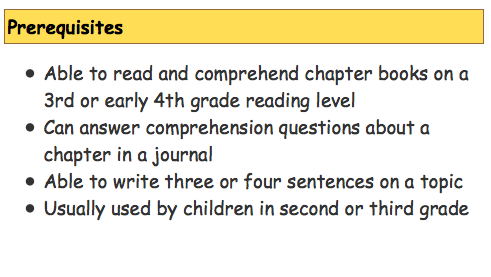
I think we overestimated Jude. That's really hard to admit, but it's the unvarnished truth. This program is really intense. For ages 7-9 it lists as prerequisites:
I knew he was going to struggle with answering questions - but the plan was to talk about the readings, not necessarily write them. I was less concerned with his ability to write for sentences, and was happy with a three to four sentence discussion. He's young -- just entering second grade -- but not terribly immature, so I thought he'd be able to grasp the concepts. I was hopeful. He was excited. We both were upset when it just wouldn't work for us. Jude really struggled with how language and book-based the program is.
For example, in the American Heroes unit, Jude struggled with the difference between a historical/real life "hero" and a fictional "superhero." He was trying to comprehend Ben Franklin as a "hero" (he insisted Ben wasn't a "hero" but a "brilliant Founding Father scientist") when he saw a story about Christopher Reeve. Jude couldn't separate his legendary character, Superman, pictured at the top of the biography page, from Reeve's real-life bravery after he became paralyzed. I think it would take a very mature second grader, who had a firm grasp on real vs. pretend. The textbook for the unit, 50 American Heroes by Dennis Denenberg and Lorraine Roscoe, gives short but thorough biographies, but I often wound up looking online for any videos about the people we studied. (These Muppet Show/Sesame Street videos really helped Jude understand the Christopher Reeve who played Superman and then the post-accident Christopher Reeve confined to the wheelchair.)
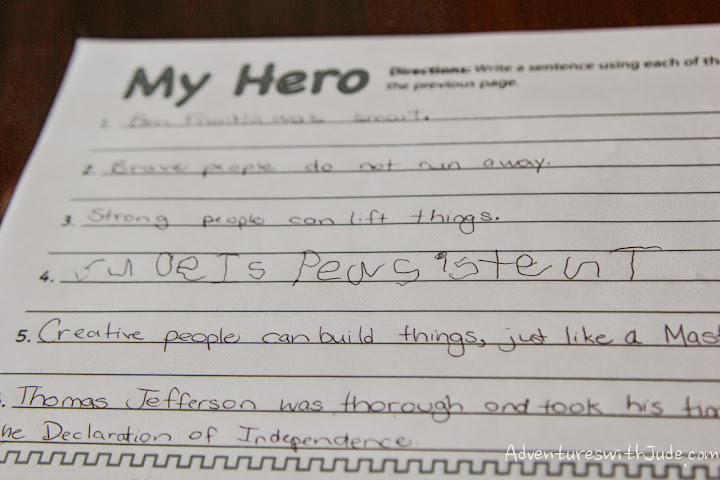
One of the activities was to name qualities of heroes. He came up with a few, and then we wrote sentences. Actually, most of them he dictated and I wrote (not unlike what he does in speech therapy, so there was some nice overlap between programs), but I asked him to write this one himself - he wrote "Jude is" and then copied one of our adjectives...
It means Jude keeps trying and never gives up.
(Yes, he's Mama's hero.)
We worked on the grammar activities, such as parts of speech (like this adjective exercise) but ultimately left a lot behind (like punctuation skills). I think he got the pragmatics of things, even if he didn't quite grasp "official" definitions.
People Change the World was even more difficult for him. This Social Studies Unit encourages the student to look within himself more. From the get-go, Jude was overwhelmed. He doesn't understand "How do people make positive and negative changes?" If you ask him "Who did good things?" he will readily answer...yep, Benjamin Franklin. If you ask him "What are some bad thing people have done?" his response is "The Redcoats wouldn't leave George Washington alone." Both true...but I'm guessing the program is looking for something a bit more modern. Asking him what it means to be a "citizen" gets you a dissertation on Spiderman helping his fellow citizens. Ultimately, we left behind much of the the workbook, and focused more on the books that came with the program. Miss Rumphius by Barbara Cooney became popular as a bedtime story, but The Starry Messenger by Peter Sis was still over his head. We often skimmed much of the story with that one. We wound up changing the focus of "citizenship" by putting it on Miss Rumphius and how she did her part to make the world better, and then added other stories at night with a similar theme. For example, we read The Rag Coat by Lauren Mills -- another story about how a little bit here and there adds up, how we should help people out however we can, and that it's not always about being just one person but part of a group working together that changes the world. By the time we were done working, I do believe he got the concept, but I know it was nowhere in the way intended.
I really loveMoving Beyond the Page's approach to learning. Ultimately, I think that these two units could really be a stretch for a second grader, even an average one. I would lean more towards using this with an average third grader, and even as a fourth grade program. I knew going in it was a risk to try it, and had hoped that we would be able to make simple adaptations to bring it to Jude's skill level, but ultimately, there was just too large a gap between the program and his skills for it to be successful without significant modification. I'm not giving up on Moving Beyond the Page, but I think we will definitely backtrack to the lower overview-style units before moving back to the subject-focus units.
With so many great units to choose from, there are a lot of Crew Reviews for this one.
Grab a cup of coffee and settle in to read them all.