Showing posts with label electives. Show all posts

Monday, September 9, 2019

The New Adventures of Violin Girl

Anybody else remember when we first chosen to work with MacPhail Center for Music six years ago?  I was amazed at the idea of being able to take music lessons remotely and be able to do it well.


Since then, she's continued to take lessons with her instructor, Jeremy.  With his help, Celia worked her way into the Rowan Youth Orchestras.  She spent two years as a violinist with the Youth String Orchestra, and last year worked her way up to playing in the full symphony Orchestra.


She also has worked through Level 6 of MacPhail's Crescendo Program.  Her repertoire piece for her last jury was Selections from The Boy Paganini, which then became her audition piece for this year's summer camp.


Celia has also taken piano lessons with MacPhail.  Heading into this fall, she wasn't sure she wanted to continue.  She didn't hate lessons and practicing, but her heart just wasn't in it.  While she was deciding what to do, she headed off to String Camp this past July. There she made a few new friends who played cello.  After they let her try their cellos, Celia made her decision. If she was going to play another instrument, she wanted to stick to strings. After a flurry of emails with Jeremy, she had decided she wanted to add viola to her repertoire.  It was still a smallish instrument (so easily portable), but most importantly, Jeremy also teaches and plays the viola, so she knew she'd like her teacher.  Violin Girl has a new alter ego: Viola Lass!

When she bought her viola, she also picked up secondhand copies of the Level 1 and 2 books that coordinated with what she and Jeremy had used for violin.  She figured that if she had guessed correctly, she had saved a few dollars.  If she was wrong, she had only spent a few bucks on books she could use for extra practice.  Likely because she already knew so much of the basics (bow hold, fingering, etc.), they zipped through to halfway through level 2.  After her second lesson, she came out of the study saying "Mom, can you order me..."

This is Bach's Musette for viola, after only two weeks of lessons.


She has played this piece before, back when she first was learning violin. However, it was not just practicing something old on a new instrument. Violin and viola are played with two different composition clefs; the violin is a treble clef instrument while the viola is an alto clef instrument.  This means learning a new note "language".  I think she's right to stick with strings - she definitely has talent there!  Her goal is to play viola with the RYSO next spring, but continue violin with the RYO. I think that's a definite possibility.


Want to keep up with all of our adventures?
Subscribe below to get Adventures with Jude delivered to your inbox.

Enter your email address:


Delivered by FeedBurner


©2012- 2018 Adventures with Jude. All rights reserved. All text, photographs, artwork, and other content may not be reproduced or transmitted in any form without the written consent of the author. http://adventureswithjude.com

Thursday, September 5, 2019

Zeezok Publishing ~ Music Appreciation: Book 2 for the Middle Grades (Homeschool Review Crew)


A few years ago, we had the opportunity to review the first installment of the Great Musicians Series from Zeezok Publishing. The newly released Music Appreciation: Book 2 for the Middle Grades program picks up where the first level series leaves off. The composers are included in this music curriculum are from the Romantic era: Frederic Chopin, Robert Schumann, Richard Wagner, Stephen Foster, Johannes Brahms, Pyotr (Peter) Tchaikovsky, and Edward MacDowell. Units are divided by composer, with four or five weeks allotted to each; and each composer is a self-contained unit, so you can begin anywhere in the program, not just at the start. It makes the most sense, from a timeline perspective, to follow the sequence presented in the book. However, because they are self-contained, a family could study composers from a geographic/world history perspective. Chopin is from modern Poland, while Schumann, Wagner, and Brahms are German;  Foster and MacDowell are American composers. I think this flexibility is helpful as a homeschool parent.

Not pictured: Tchaikovsky and the Nutcracker Ballet, provided via eBook 
The program set includes (and requires) the collection of nine biographies and a consumable student book. The student book may be purchased individually if you wish to use the program with multiple students. A lapbook program and coloring pages are also available. (We did not receive them for review, and I opted not to purchase them because our family does not really enjoy lapbooking.)

Most music appreciation courses focus on music styles, and students listening to pieces from to hear the differences between each era: Renaissance vs. Classical, Baroque vs. Modern.  I don't think this is a bad thing to learn, because each style is a reflection on its position in history. Last year, Matthew completed a (different) music history course that taught these nuances, and even just after eavesdropping, I can now easily tell the difference between epochs when I hear a "classical" composition.  However, I think what can happen then is pieces within a genre start to sound homogenous. Celia will play a violin piece, and I couldn't tell you the difference between Handel and Bach. I've learned to listen for what makes a piece inherently Baroque vs. from the Romantic era, not what makes each composer different. I also know little about what motivated each man. Zeezok provides music study from a different perspective.

These biographical studies focus not only on the composers and their music but also on their family lives and character.  For example, Schumann's courtship and marriage to Clara Wieck are discussed.  Wieck, a lauded pianist in her own right, was a fundamental inspiration to her husband, and, like her husband, a champion of other composers.


Often, it is the salacious or scandalous stories of composers that endures, so I appreciate the perpetuation of the good character traits. I also appreciate that the program does not shy away from them, either; while highlighting Tchaikovsky's closeness to family and generous nature, it does include a note about his troubled relationships with Désiree Artôit and Antonina Milyukova. However, it presents them in a concise, factual manner, with no little color commentary (and no discussion, outright or inferred, to modern biographists conclusions about Tchaikovsky's struggles with his sexuality).

The student book includes comprehension questions that correlate to the biographies, as well as information about other facets of the composers' lives and related music theory information.  Journaling opportunities (prompts are provided; students will need a journal notebook or could use a word processing program) are also liberally offered, allowing students to work on writing skills (short answer, self-reflection, creative writing, etc.). Each unit ends with an overview quiz.


For some families, grades are unimportant. However, since Celia requires a graded transcript to apply to college, I appreciate having the checkpoints and quizzes to help me generate grades for her.  They were short but well-detailed, and easy to adapt to requiring extra effort from a high school student.


A significant difference between Level 1 and Level 2 series is the use of QR Codes.  In the first series, we received a case with several CDs containing music selections. As the student reads each composer's biography, musical selections are woven in. This meant every time we reach a composition, we'd have to hunt down the CDs, find the player, etc. It also made it difficult to take with us if we were doing schoolwork at a doctor's office or the karate dojo.  Having QR codes that linked to an online (YouTube) music library was far more convenient; all kiddo needed was to borrow a phone or iPad with an internet connection.


Additional QR Codes are peppered throughout the book for if the student wishes to learn further about a person or topic. Additionally, related topics and (optional) suggested activities are included with each composer study. While each student requires his own consumable workbook, this makes the program suitable for multiple grade levels.  The publisher notes that while Book 1 is written for grades K-6 and Book 2 is for grades 5-8, they are easily adaptable across a range of educational abilities. A younger student could complete the program solely based on what is contained within the biographical texts and added information, with assistance as necessary, while an older student can work independently and has resources immediately at his fingertips for further research.


One of Celia's favorite "added information" bits was about the conductor.  She has played in a local youth orchestra for several years now and has become used to following a conductor.  Using context clues from the tenor of the music, she has learned what the conductor is trying to convey, but she had an "aha!" moment when she read about how conducting isn't just arm movement but body language as well. Now, the mantra, "Always look back to the conductor!" makes so much more sense; just watching his arms from the corner of her eye as she reads the music in front of her only gives a fraction of the information she needs.


Here, Celia is playing with her summer camp's String Orchestra (she is seated in First Chair, Violin). Dr. Erwin is leaning toward the violins, to pull vibrancy and strength from that instrument section.  Her movements are purposeful, not over articulated or dramatic "feeling the music." 

 
Zeezok includes a planning outline for each composer, allotting four to five weeks for each unit as written.  I think it makes the program a more-than-adequate full-year program for an upper elementary or middle school student. However, with the addition of further research and/or a more accelerated pace, this program could be combined with Music Appreciation 1 to create a full high school credit.  Due to time constraints and for review purposes, Celia worked on the program as written, with little additional study. She completed two units in a little over six weeks.  However, she plans to go back to the beginning and spend another six or eight weeks exploring things in more detail and adding in writing assignments.  While we are using this program to round out an "independent study" program for a multiple-instrument musician, it is certainly adequate for even for a non-music student. Since the focus is more on the composers and less about being able to identify musical pieces, I think it also plays to the strengths of a student who is less musically inclined but has an interest in people or history. As we get close to history buff Jude's high school planning, it is a top contender for a music credit for him.  We are really excited to work with this new program from Zeezok. 

For more about our experience with Level 1 of this series, click here: 


For more information about the Music Appreciation: Book 2 for the Middle Grades program, click the banner below to read other Crew reviews. 

Music Appreciation Book 2: for the Middle Grades {Zeezok Publishing Reviews}


Want to keep up with all of our adventures?
Subscribe below to get Adventures with Jude delivered to your inbox.

Enter your email address:


Delivered by FeedBurner


©2012- 2018 Adventures with Jude. All rights reserved. All text, photographs, artwork, and other content may not be reproduced or transmitted in any form without the written consent of the author. http://adventureswithjude.com

Thursday, November 15, 2018

Guitar 360 Method (Homeschool Review Crew)

Most of my readers know that Celia is my instrument player. She has seven years' worth of violin lessons and three years of piano, plus she sang in her grade school choir, but I should consider changing her name to Ariel...as in she can play on her violin "But who cares? No big deal! I want MOOOOORE!!" Several years ago, Matthew took guitar lessons but discovered he is not an instrumentalist, so his guitar has sat in the closet, practically mocking Celia. She's tried a few YouTube lessons but really hadn't gotten very far.  The Crew offered us the opportunity to try more formal, cohesive lessons from Guitar 360 Method...folks, I apologize for the fangirl screaming.


Guitar 360 Method is a new guitar learning program from Krisz Simonfalvi. Mr. Simonfalvi is a musician and teacher who had a circuitous path to his career; he began to play guitar, gave it up because it just did not resonate with him, and then circled back as an adult. He notes that there are two ways to learn to play: one is just by picking at the guitar and learning the technical aspects, and the other is through a theory-based trajectory. The problem is that most theory is based on the piano -- which, while a strong music foundation, doesn't necessarily apply practically to other instruments.  Celia will completely agree with this -- while she can play both violin and piano, it's not like you can interchange music. As she says, "I can play piano music on my violin if I play just the treble clef line, but it may not sound the same or as good as on a piano because I can't play bass clef and treble at the same time on the violin. The melody might sound the same going from violin to piano because you can play just the treble clef." While Guitar 360 Method is actually teaching her a third style of instrument-specific theory, but one that has a practical application to playing guitar.


Have you ever listened to a Billy Joel song? An incredibly strong understanding of how music works is how he could turn what is basically scales into a hit song ("The Longest Time") and morph Mozart's "Pathétique Sonata" into "This Night." Why is theory-based instruction important to me, as a parent? Because theory is what really allows a student to understand what she is doing, why she is doing it, and how to properly play with music. An understanding of theory is critical even just to transpose piano to violin or guitar; without it, you cannot manipulate the music and have it sound right.

Practically speaking, I don't expect her to rise to Mr. Joel's level of renown (if she did, that would be fantastic, but let's face it -- there can only be one Billy Joel), but it's clear to me that the foundation of any musical success is a proper understanding of theory.  Here,  Mr. Simonfalvi shines, because his course is geared toward both the casual student who just wants to learn to play the music in front of him or the student who intends to learn to re-arrange or compose their own music.  He says:


I've taught this content from age 9 and up, however, it is designed for students who want to be creative on the guitar - understanding how music works, rather than JUST learning songs.
This makes it perfect for Celia, because it will teach her both the basics of "how to play" - how to hold the guitar, how to strum, where to put her fingers on the guitar's neck - but also WHY she's holding it where she is and when to use a pick vs. her fingers.  She had an "AHA!" moment right at the start.  Mr. Simonfalvi explains why you press the strings near the frets (better control of the strings and clarity of sound and she looked at me with a dropped jaw. THAT was something she never learned from playing around with other videos; she just thought you stuck your fingers on the strings.  Obviously, in six weeks she's learned more than just where to hold the guitar, but, to me, it's the little things like that - that you don't really know unless you're told - that help make this course worth the tuition.


Guitar 360 Method currently offers two courses. The first is a free introductory level course that will take you from "how to hold a guitar properly" to "I can actually play something, and it sounds like a song" in about three weeks. Obviously, there needs to be a consistent effort on the student's part, but after trying that part out, I can say, "Yes, you will."  While Celia has played around the guitar before, she really was trying to apply what she knew from playing pizzicato on the violin to picking at a guitar. You really don't have the same technique - pizzicato uses a plucking motion, and, of course, there are no frets on a violin neck. Starting at the very beginning helped her realize that playing guitar strings isn't the same at all.

The second, tuition-based course is a 13-week "Semester One." It contains the three-week basics course and then expands beyond "My First Chord" into the major, minor, and pentatonic scales, and then into playing Chords in multiple Keys.  Each week has a clearly defined focus, so the student understands what the goal of the lesson is.

The videos for the lessons total about half an hour, so definitely a reasonable length lesson for beginners - long enough to be worth making an appointment with yourself, but short enough to not be a barrage of information. Celia particularly liked that it's not one long half-hour video, but rather each topic is presented in an individual section.


This meant she could quickly go back over a topic without having to fuss with finding the correct minute mark, or she could break it down into smaller ten or fifteen-minute chunks so that she could learn a concept, ruminate on it a bit, play with it, and then add on the next idea.  Mom liked that there are defined practice exercises assigned for each week. This meant she could go back to the prior week's to work on solidifying those concepts but also had specific activities to reinforce new lessons. There are also quizzes on the ideas, making it ideal for students who need grades for transcripts. While hearing Celia advance in playing skill shows me she is absorbing practical knowledge, the quizzes help me see that she understands the theory behind the playing.


Mr. Simonfalvi promises that students will have enough theory and technique to jump into a band and be able to hold their own by the end of the 13 weeks. Keep in mind, he's not promising to turn your student into Mike DelGiudice and have her be playing in Billy Joel's band in those 13 weeks, but you'll have a competent guitar player that's not only ready to play but also able to understand what she is playing.


Guitar Lessons with Krisz Simonfalvi {Guitar 360 Method Reviews}


Want to keep up with all of our adventures?
Subscribe below to get Adventures with Jude delivered to your inbox.

Enter your email address:


Delivered by FeedBurner


©2012- 2018 Adventures with Jude. All rights reserved. All text, photographs, artwork, and other content may not be reproduced or transmitted in any form without the written consent of the author. http://adventureswithjude.com

Friday, May 4, 2018

CodeWizardsHQ (Homeschool Review Crew)

One thing on Matthew's "wish list" for electives is learning how to code.  I've been looking for a program, but he's in an odd age bracket. Most of the programs we've found are online guides targeting elementary-age coding hobbyists, rather than actual classes presenting a program that could be high school credit-worthy.  We were given the opportunity to experience and review a class from CodeWizardsHQ, which has a different approach to coding for students in grades five through ten.


CodeWizardsHQ provides weekly live, instructor-led online classes in a small group setting.  Each class has six to eight students, so you get a real interaction with both the instructor and other students.  Students can ask questions, and have them answered in real-time.  The instructor also has their screens mirrored at her location, and she can help target any single-line errors before they cause a cascade of problems.  While they are homeschool-friendly and have a homeschool group option, the company welcomes children of all educational backgrounds. Classes are available in afternoons and evenings, making it ideal for both home- and traditionally-schooled students.  If your child has an exceptionally busy week and misses a class, there is a video option for viewing the course material and "Office Hours" to get one-on-one assistance from an instructor if he needs clarification.

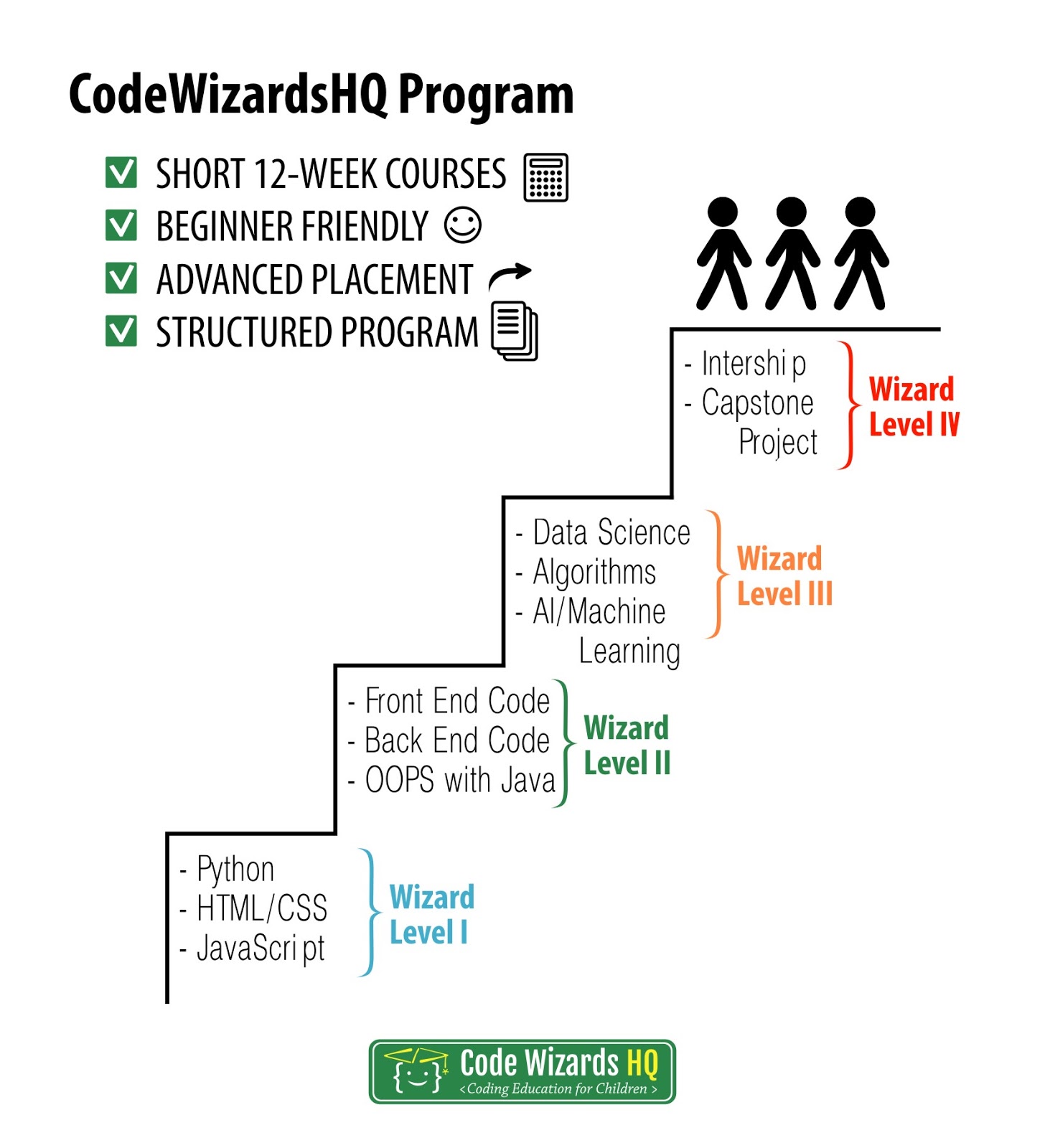
The program has four levels of instruction in practical, real-world coding languages. All students, regardless of age, start at the first level. (If you have coding experience, there is a placement exam to test out of the lower levels.)  The first level consists of three twelve-week courses that cover Introduction to Programming, HTML/CSS, and Javascript.  (There is an accelerated summer program that covers these three activities. These sessions last for three weeks of four classes each.)  Level II instruction includes courses in Front- and Back End Developments and Web Design.  Level III progresses to Mobile App Development, Advanced Algorithms, and Data Science.  The program culminates with Level IV's Internship program, which places students in six-month internships with partnering non-profit organizations and allows them to gain real-world experience. 


Certificates of proficiency are issued at the end of each program, creating achievements that can be highlighted on a college or job resume.  This made the program very appealing to us because it would provide instruction that had a practical application to Matthew's long-term academic and career goals.

The class' instruction platform is GoToMeeting.  CodeWizardsHQ recommends using a headset with microphone for better sound quality, but you can use the ones native to your computer.   Normally he would use a headset, but since I was sitting in, we used the laptop's devices.  The sound quality was fine for us. We didn't really need the microphone, as most communication was through the chat feature.  However, I think the microphone might be used more in long-term class sessions.  Though our instructor, Lynn, did her best to foster a good camaraderie, I think our group was on the quieter side and content to communicated through texting.  It might be different in a long-term class, where students have a few months to get to know each other better.


Lynn asked everyone to introduce themselves with the answers to three queries: what is their preferred name, what was something fun to know about them, and why do they want to learn coding?  She introduced herself as a Seattle-based Front End Developer with over 20 years of experience in the field. She is also an artist.  Matthew responded that he likes picking things apart and wants to be able to write video games.  Lynn told him that's a pretty common reason why kids take their classes, and if he was interested, further study could get him in that direction.


The class' goal was to build a simple comic strip on a web page.  First, Lynn walked the students through the interface they'd be using.  She gave them a brief history of HTML, along with a few pertinent definitions. then they began building.

One thing she pointed out is the kids aren't in total control of the web page.  There is some coding that is pre-written and clearly delineated with "Do not edit above this line" or "...below this line."  This means that things like the page background, social media share buttons, etc. are available (and intact!) when students are done.  While Lynn did show them how to find/create their own files for customizing their web pages, most of what they worked with were files that had been pre-loaded to the class site. It appears nobody blew up the internet (including my kid), so I call that a win.


For this class, there was a good deal of cutting/pasting/changing, as opposed to writing from scratch. I don't think this means the instruction takes the lazy way.  I know when I've done even simple coding, I've tended to work in "batches" - where I'll cut/paste a frame and then enter in modifications. It takes too long to write the same things over and over, so I will set up the framework of what I want and then just edit in the different details.  However, it is easy to get lost in what you've pasted and need to change, so being attentive and careful was an area where they were given special attention.  This class was more to show reviewers how the classes worked, and the kids got a simple project.


I laughed when I saw Matthew's page. I thought it was quite humorous.


I noticed that he was pretty quick at running with the ideas.  He has a little bit of coding experience (he is an avid Minecrafter and has built a Kano computer), so he had a basic understanding to build on.  He really enjoyed the class and is lobbying to be enrolled in the regular program. Quite honestly, it's been some time since I've seen him this intense with schoolwork.


I don't usually comment on the cost of programs that we have reviewed, but I need to give other parents a heads up. The regular program costs $149 per month, and each class takes about 12 weeks to complete.  (The accelerated courses have the same overall cost, but paid in $149/week increments.) If your child has serious dreams of going into fields that require coding knowledge and experience, I think CodeWizardHQ is a worthwhile investment in your child. However, it is expensive, and I would feel my review was a little misleading I didn't share that when you add it up, it does lead to a bit of sticker shock. However, there are scholarships available, so I'd look into those before ruling the program out.

I was impressed with the caliber of the class.  I think what Matthew learned was simple enough that the class wasn't overwhelming, but he didn't feel like anything had been dumbed down.  (CodeWizardsHQ recommends their course for ages Normally there would be a project to be worked on during the week between classes, but for a single self-contained class, I felt like he learned quite a bit in the time they had.  I need to figure out if we can work them into our budget, but we are seriously considering this program for him.

If you'd like to see an overview video about the program, click the video embedded below.  To read about other Crew families' experiences with CodeWizardsHQ, click the banner below!


Live Class Computer Programming for your Students {CodeWizardsHQ Reviews}


Want to keep up with all of our adventures?
Subscribe below to get Adventures with Jude delivered to your inbox.

Enter your email address:


Delivered by FeedBurner


©2012- 2017 Adventures with Jude. All rights reserved. All text, photographs, artwork, and other content may not be reproduced or transmitted in any form without the written consent of the author. http://adventureswithjude.com

Thursday, September 7, 2017

Apologia: Marine Biology (Homeschool Review Crew)

This is not our first Apologia Educational Ministries science program review, and their high school Marine Biology program is a bit of a homecoming for us. While we've studied with several Apologia curricula, our very first Crew review was of their elementary level Swimming Creatures of the Fifth Day.   It was one of Jude's first formal homeschool programs and remains a favorite almost five years later, so I was definitely interested when we had an opportunity to use their upper-level marine biology program with Matthew.

Something that frustrates me about many homeschool companies is their "a la carte" set up.  I always feel like I forgot something -- did I get the student book? The teacher's manual? What about the test book?  While there are still other add-on items for the program, and you'll need to purchase lab materials, the Marine Biology 2nd Edition Advantage Set provides a core program of student and teacher materials - student notebook, textbook, and tests with solutions manual - with one purchase.  Apologia also graciously supplied us with the (optional) Marine Biology 2nd Edition Audio CD, which is a complete audio recording of the course read to the student by Marissa Leinart.  (It and the instructional DVD are included with the Superset purchase option.)

To make this more manageable, I'm going to try to divide it into chunks by learning material. As I tried to write my first attempts at this review, I found myself getting lost in all the information. When I write reviews, I tend to organize my thoughts in my head and let ideas flow from there, but I had to actually break out pen and paper, sort everything out in hard copy, and start over.  There was so much about this program to share that the review overwhelmed itself.


About Apologia's Marine Biology Program

This program, when completed with the labs, is a full high school science credit.  11th grader Matthew is elated to be getting to the "electives phase" of high school, and this is providing a novel elective science for him.  Completion of a biology course is a pre-requisite for the program, and I'd definitely agree with that.  It assumes the student has an understanding of biologic processes, like cell structure and function, photosynthesis, reproduction, etc., and while it does explain some basics in context, it doesn't describe them in detail.  Having a good biology foundation is definitely an asset. However, it doesn't have to be Apologia's biology -- Matthew's course was not, but so far it hasn't been a problem.

While I was very interested in the program because of our prior experience, I was also a bit skittish after Luke and Apologia's high school Chemistry course didn't "gel" well.  However, it's a different class and different kid, so I cautiously approached it with an open mind.  I think that we can call this experience a success!

The Student Notebook

The Student Notebook is a huge, everything-you-need, spiral bound volume.  It's actually as thick as the textbook! Everything a student needs to master the material is included.  It gives the student a solid frame for learning.  I used to think "I never had this, and somehow survived!" but the more education evolves, I begin to wish I had more structure and direction than a blank composition book and the instructions "learn to take good notes." Honestly, I think a large reason why this has been a success for Matthew while Chemistry and Luke didn't get along is the Student Notebook.

At the start of the Notebook is a schedule layout.  I am always so excited when a course lays itself out, and it's not Mama handing out the assignments.  Somehow, when it's "what the book says," there aren't any "But can't I read four pages instead of six?" negotiation attempts.

Each module contains pages to take notes.  I think it's essential for high school students to learn how to take notes -- now is the time to figure out what method(s) are more intuitive for them to both write and recall. The book features a new style of note taking for Matthew (he's used to an  I/A/1/a outline format), but I actually think it's one that might work better for him.  My only complaint is I think there aren't enough note-taking pages for us.  (Though adding more would make the book even larger. I think we'll just use loose leaf paper and staple the pages in.)


The "On Your Own" questions that are at the end of each textbook section are included, as well as a fill-in-the-blanks study guide.  Matthew struggles to write "complete" answers, and I think having a clearly defined space helps him.  He has enough space to write several lines of text, and I've pointed out if they're giving him that much space, the answer needs to be more than four words.


There are actually two study guide options included.  Matthew has been doing both, at different paces.  The first one is more of a traditional question-and-answer format, with definitions and short answer questions.


Many of them are not direct "what is this, find it in the text" questions, and involve using critical thinking skills.  Matthew has been filling that one in as he goes through the Module (chapter), at the end of each day's lessons.


The second one is a fill-in-the-blank that uses vocabulary words from the text.  It's a bit more literal, with some leading and hand-holding. (You can see a sample of it in the next section.) Matthew completes that at the end of the unit, doing a first "what do I remember" pass, followed by one last read-through of notes to prep for his test.  After taking the first test, I can say that it is not terribly hard to do well on the tests if you really put forth a good effort on reading and completing the review questions.  The constant repetition worked well for the "classical style learner" in Matthew.


The Textbook

Have you ever tried to look at a text book and your eyes just start to glaze over? These are not your average textbook.  If you're a Charlotte Mason-style learner, you'll recognize the "living book" approach of a textbook written by a passionate author and not a committee.  While they are chock-full of information, they aren't just pages and pages of text.  Larger chunks of information are broken up visually with headings, pictures, and key terms.  The writing and layout pull the student through the chapter, inciting them to keep reading, rather than leaving them thinking "Is it the end yet?"   These breaks help clue a student into "This is important, write it down!"

The text is also studded with lab opportunities.  (There are five in the first module alone!) There are some that require extra materials (like a small shark for dissection -- the former biology major in me is looking forward to that!), but some use basic household items.  After reading through the materials needed for the "Mountain Formation from Plate Movement" experiment, I realized that the equal parts of salt and brown sugar it used didn't necessarily need to be wasted.  He used a sealable container and extra-clean hands; when we were done, it became part of a tasty brine for that night's pork ribs.


The first module focuses on oceanography basics, and most of our experiments involved household/kitchen items.  This one used salt and water to help demonstrate the ocean's salinity and evaporation/concentration.


We did have two (relatively minor) issues with the textbook.  First, the glossary is really skimpy. While some of the key terms are clearly defined separately from the rest of the text in the chapters themselves, some require a bit of discernment.  While it's good to practice learning to pull definitions from context, having the words defined in the glossary reinforces a specific definition (and gives confidence with a "Yeah, you got that one right!").  Matthew has learned to have a dictionary handy for words that he can understand the concept of but doesn't really have a clear idea of a concise explanation.  We also wished there had been a Periodic Table printed in the book. On the one hand, I recognize it's not a chemistry book. However, Matthew found that when taking notes, writing "Na" instead of "salt" or "P" instead of "phosphorus" saved space.  (It's only a few letters, but when space is finite, it's a logical abbreviation.)  Even having completed chemistry, sometimes Matthew just needed help remembering something. It was an easy fix to print one and glue it onto the inside cover, but it's the sort of simple, basic scientific tool that I think all higher level science books ought to include.


The textbook is available as part of the basic program set.  Each chapter contains the question-and-answer Study Guide, and the fill-in Module Studies are compiled into an index at the back.  This means you don't need the Student Notebook to complete the program -- you could answer the questions onto paper.  However, I would really recommend using the Notebook if you have a student who benefits from having questions with the answers (versus just answers written separately).


Also, just writing the one or two-word answers to fill in the Module Summaries blanks doesn't provide a coherent review - and it's a lot of copying to keep them in context.


Tests and Solutions Manual

There's not a whole lot to go into about these.  They're kind of self-explanatory.   I like that all of the answers are in one book, and I'm not hunting different manuals all the time. It also makes the book slightly thicker -- thicker is harder for me to lose!  The tests are separate from the answer key, and I can hand Matthew the test booklet without worrying about any temptations.  He wrote his answers on loose leaf; after seeing the space allotted in the course notebook, he had a good idea of what was expected, so I wasn't so concerned about a stack of blank lines staring back at him.

Audio CD

This is a resource that we actually didn't find useful for us, for a few reasons. First, it's an MP3 CD, not a "regular" audio CD.  Honestly, I'm not sure of the difference, beyond it only worked in the CD/DV drive for our (Mac) computers. Apparently, not all CD players can play MP3 CDs, so if you have a computer that doesn't have CD capability (like a Chromebook), make sure whatever you do have to play CDs can handle this kind.

I thought that it might be useful for Matthew because sometimes he struggles to simultaneously silently read and process/comprehend text.  He will often read things aloud, which forces him to slow down and focus on what he's reading, rather than racing through to the end.  I liked that the recording reads all of the text, including the information boxes and illustrations.  However, I found that often he'd lose focus and stop listening actively/following along, and the narration would devolve into background noise.  We found it was better to go back to him reading sections aloud (stopping to take notes helped create natural breaks) rather than having it read to him.  While it wasn't a good fit for us, I think if you have a student who does well with audiobooks or remains focused when listening/reading along, it is an excellent addition to the program.

Final Thoughts

This is a keeper of a program!  When we first were chosen, Matthew wasn't sure he wanted to do marine biology.  He's not sure what he does want to do for a career, but "stuff with fish" isn't it.  However, having completed a Geology course, the first module that discussed plate tectonics and ocean movement piqued his interest.  A strong academic program combined with of opportunities for hands-on learning with experiments helped make this program come to life.  Revisiting some of the concepts he learned in biology and chemistry triggered thoughts of "Huh...maybe that wasn't all useless gibberish."  Anatomy and Physiology or Advance Biology are typical science elective offerings, but not many high schoolers get to study marine biology. This program, both in topic and presentation, truly supports the uniqueness of homeschooling high school.

Note: If you have a K-6 student looking to study marine biology, check out our review of Apologia's Swimming Creatures of the Fifth Day


55 Crew families have spent the last six weeks exploring under the sea. Click the Crew banner below to surf the web to their reviews.

Marine Biology 2nd Edition Advantage Set {Apologia Educational Ministries Review}


Want to keep up with all of our adventures?
Subscribe below to get Adventures with Jude delivered to your inbox.

Enter your email address:


Delivered by FeedBurner


©2012- 2017 Adventures with Jude. All rights reserved. All text, photographs, artwork, and other content may not be reproduced or transmitted in any form without the written consent of the author. http://adventureswithjude.com

Tuesday, July 18, 2017

Doctor Aviation (Homeschool Review Crew)


Matthew is just about finished his core requirements, so homeschooling is quickly becoming more engaging for him now that it's all about electives!  I may say "You need to pick a science, so you have a fourth course in that field," but because he's a school district of one, he can pretty much choose any science he pleases (or at least that I can pull a program together for).  Matthew was intrigued when  Doctor Aviation, a new video-based learning Aviation History course became available to review. It's recommended for ages 16+, so that fits right into Junior or Senior year of high school and elective time! (PS. Adults who want to just learn more about the history of flight will enjoy this as well.) We received a six-month membership to the program (the standard program length) for our review.

The founder of Doctor Aviation is Daryl Smith.  In the beginning of the first session, he introduces himself and his credentials.  He's a United States Air Force Academy graduate (undergraduate and masters degrees) and instructor, with a 24 years career as aviator and instructor.  Doctor Aviation is a well-qualified tutor!


His lecture style is very low-key, preferring to let the information shine.  In addition to the spoken lecture (which is filmed in an airplane hangar), there are high-quality graphics that help identify and explain information. I felt that there was enough to keep Matthew's interest, but not so much cutting back and forth that it became difficult to follow and keep up with the provided guided notes.


The entire 15-lesson course is divided into six sections:

  • Course Introduction
  • The Aircraft
  • Air Traffic Control
  • Aircraft Maintenance
  • Aircraft Operations
  • The Aircraft II

Each section is further divided into relevant lessons.  By breaking down the topics into smaller session, it allows the program to explore an area without becoming too overwhelming.  Could you imagine trying to cover all the parts of various planes and their capabilities in just one lecture?


Each video-based lesson is about an hour long (most are in the 45-55 minute range).  The lessons are divided into three segments: Technical Trivia, Notable Innovators, and Legendary Aircraft/Events.  They are individual, self-contained lessons that are tied together by a common theme.  For example, the first lesson is about the basics of how a plane works, the innovators were the Wright brothers, and the legendary event was the first flight at Kitty Hawk.  Lesson five ties together maneuvering a plane, Daniel Bernoulli and his work on speed and pressure, and the catastrophic UAL 232 crash in Sioux City, Iowa.  Though the program presents all three sections within one video lesson, each is clearly defined. A student could watch one part per viewing if pressed for time. (Matthew found the short sections helpful waiting for doctors' visits, knowing that he wouldn't be just getting into the middle of something and his name be called.)

Doctor Aviation also provides some of his own props.  Well...jets, I suppose.  Here he is demonstrating flight principles using a replica of one of the planes he flew during his years as an Air Force pilot.


Downloadable PDF guided notes are supplied for each lesson.  There is a LOT of information presented in the videos, and these guided notes are useful for helping the student follow along.


Matthew found these helpful because while he needed to pay attention to complete them, he wasn't trying to figure out on his own what was important and what was detail.  Doctor Aviation also provides (optional) tests that are based on the videos and notes are also available.  (Prepared tests are definitely helpful since those pesky transcripts need actual grades!)


In addition to just the presentation part of the course, there is an extensive "For more information" section in each lesson.  There are links to follow, suggested books for further reading, and prompts for further study.  With so much added activity, we found each lesson took about two weeks to complete!


Matthew has read a wide variety of resources so far, from biographies and autobiographies to technical books.  They're certainly not required to complete the course, but he's become so interested in the suggested titles that he's found himself wanting to read multiple books from each lesson.  (I said to him, "You need to choose one of these," and read the list for Session 2 aloud. Matthew responded, "Can't I have both?"  Ok, then!!)   Among the books he's read are both Wright brothers' biographies The Bishop's Boys (Tom Crouch) and The Wright Brothers (David McCullough) and multiple books about the Chuck Yeager's career  -- Yeager: An Autobiography (Yeager),  The Quest for Mach One: A First-Person Account of Breaking the Sound Barrier (Yeager et. al.)  and The Right Stuff (Tom Wolfe).   With so much reading, we've actually decided to count at least some of it towards credit in Literature. (Read about how we're planning that.)


There are also opportunities for hands-on learning.  Matthew explored ailerons, rudders, and yaws using paper and foam airplanes that he built himself.   These are among several NASA-produced lessons and pages provided in the "To Learn More" downloads.


However, as much as I loved having the extra information to help "bulk up" the course to make it worthy of a full credit, I found chasing things down to be frustrating.  Some of the suggested books were easily available, but many were out of print and only available secondhand.  (If you don't have a very extensive public library, they may also be harder to find.)  The PDFs say that the links were retrieved in mid-to-late 2015, and unfortunately, by mid-2017, many of the links were broken.  You certainly don't need to follow every link or read every book,  but it was frustrating that so many resources became unavailable over the past two years or so.  My concern would be that while the information in the videos would remain current,  the "For more study" resources may become undependable.  While it's understandable that Doctor Aviation may not be able to keep every book in current publish, I would recommend sporadic link refreshing (at least annually) to make sure the information is still available to viewers.

Finding hidden gems like this is what makes being part of the Homeschool Review Crew so invaluable for our homeschool.  Aviation is not something I would have thought of looking for a course for, and yet it's become a real hit for Matthew!   Who knows what else he'll decide to study, but thanks to Doctor Aviation,  we know the sky is really the limit for elective choices.

Learn about how other Crew Members are taking to the skies for learning by clicking the banner below!


Aviation Course {Doctor Aviation Reviews}


©2012- 2016 Adventures with Jude. All rights reserved. All text, photographs, artwork, and other content may not be reproduced or transmitted in any form without the written consent of the author. http://adventureswithjude.com
Related Posts Plugin for WordPress, Blogger...
Pin It button on image hover