Saturday, August 31, 2013

Homeschool Spanish Academy (A Schoolhouse Crew Review)


Vivimos en una economica mundíal.  Es muy importante que una persona estadounidenese se puede leer y escribir una idoma otro de inglés.  Pero, si una persona solamente se puede leer y escribir, tiene solamente un medio de la lengua.  Es igualmente importate que una persona puede comprender una conversación en la otra idoma, porque es muy probable que él tiene que hablar a personas en esa lengua.   La programa de Homeschool Spanish Academy es excelente para un estudiate aprender como todos los partes de la lengua español. Casi todas las lecciones se completó en español - desde el principío "¡Hola! ¿Como estas? Me llamo Nora, su profesora.  ¿Como se llama?"

Ok.  Está bien.  That's enough Spanish for now.  I purposely started this review in Spanish, the same as Nora, Luke's teacher, began their very first session together.  Translated, the above says:

We live in a world economy. It is very important that a United States citizen can read and write in a language other than English.  However, if a person can only read and write in this other language, he only has half the language.  It is equally important that a person can understand a conversation in this foreign language, because it is very likely that at some point he will need to speak to someone using this language.  Homeschool Spanish Academy's program is excellent for a student to learn all the parts of the Spanish language.  Almost all of the lessons are done in Spanish - from the beginning introduction, "Hi! How are you? I'm Nora, your teacher.  What's your name?"
Homeschool Spanish Academy
Homeschool Spanish Academy is the brainchild of founder Ron Fortin.  After college and a stint in the Marine Corps.,  Mr. Fortin became a corporate IT consultant.  After just 18 months of this, he found himself called to become an educator.  Where did he feel led to? A school in Guatemala that was seeking a principal.  While he was there, he also saw an opportunity to teach not just the children there, but American children, by providing quality Spanish education and tutoring to the homeschoolers he knew from "back home."  Mr. Fortin gathered certified Spanish educators from notable Guatemalan institutions, and HSA was born.  When you've been in the Marines, you know a bit about high standards, and he holds his teachers to some pretty tough ones.  All have experience in teaching, but that doesn't guarantee them a position in his company.  All teachers must pass rigorous interviews and teaching simulations, and those that earn their positions must complete ongoing English, educational, and technology training.  Parents are asked to rate their instructors, and if there are problems, retraining is done to make sure the teacher meets HSA's exacting standards.  This company isn't looking to make a quick buck; it's looking to earn the privilege of teaching your student.

The customer service team at HSA is fantastic.  First, they have put together several videos to help the prospective and current student, from "What is Homeschool Spanish Academy?" to "How to set up an account" and " How to turn in your homework." Each video is available on HSA's YouTube Channel.   When I experienced some technical issues, they returned my email with directions on how to fix the problem within a few hours.  Luke mentioned to Nora that he wanted to continue after the review period, and before I could sit down and focus on registering, we got a phone call from HSA offering to register him for me.  All I'd have to do was pay the bill (via Paypal) and schedule the times of his classes. Be my guest!


HSA offers classes for everyone, from early elementary students to adults.  When you sign up for lessons from HSA, you can choose from several intensities.  Lesson packages are offered for classes once or twice a week, and for multiple durations.  If you want to just give it a try, you can do once a week for half a semester (7 lessons) for as little as $59.99 (Elementary Students) - less than $9 per lesson!  Luke's high school level course, given to us by HSA so we could do this review, had a value of $99.99 (a still reasonable $14.28 per lesson).  Of course, if you sign up for longer commitments, the costs decrease - after this review ends, we will be continuing on (at our expense) for the full 2 lessons per week for 15 weeks (1 semester).  The cost for that package is $299.99, which works out to only $10 per class.  No, it's not "cheap" when you look at it as a $300 outlay every four months, however, for us it is a great value because  I am absolutely certain that there is no way I could hire a private tutor for him for $10 an hour.  HSA also offers a complimentary introductory class, so you can test out the program.  This video from their YouTube channel shows you what a lesson may look like.


 This price includes EVERYTHING - lessons, texts, testing, and transcripts.  HSA will hold your information on record for up to 10 years, so that it can be accessed for record information. 

With this program, we can schedule instruction at a time when it is convenient for us.  This summer, we had once weekly lessons on Wednesday afternoons. This worked because we were able to coordinate Celia's violin lessons with Luke's Spanish lessons, and I just kept our Wednesdays free from other commitments.   When I asked them about the scope of the program, it was recommended to do two lessons each week in order to complete an entire year's worth of program in two semesters, especially for high school level.  (In two 30-hour semesters, you will complete enough to earn a full credit for the year. If you do less frequent classes,  it will take longer to earn the credit.)   Luke is happy that we are able to schedule his classes while the others will be at school (or in Damien's case, during naptime), so he has the quiet he needs to focus.  HSA recommends a headset with microphone, but we had no problem using the built in speakers/microphone in our computer (we have a MacBook Air) while in a quiet room with the door shut.   Depending on your choice of instructor, you have a choice of morning, afternoon, or even evening lessons, making this a great choice for students who are otherwise unavailable during the daytime.  If my other children weren't already receiving Spanish instruction at school, this would be a great supplemental program because they could easily work after school; an adult could take evening lessons.  
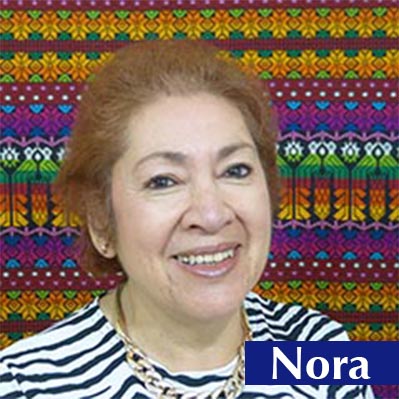
Luke's teacher, Nora Aguilar, is a teacher with 8 years experience.  She is well qualified with Bachelor's degrees in Bilingual Secretary and English Teaching.     Though she especially enjoys teaching younger students, I believe she and Luke have done well together.   When I registered Luke, I looked to find a few instructors who were available at a time that worked for our crazy summer schedule.  I found three, and gave Luke his choice.  He chose Nora because she looked strikingly like his former Math teacher, whom he really liked.  Nora and Mrs. M must be separated by birth, because Nora is also very patient and kind, especially when Luke starts tripping over his words because he can't coordinate his brain and his mouth.


The curriculum itself is very strong.  We have a slightly different background than many homeschoolers; this is Luke's first year of homeschooling so he has experience with Spanish instruction on both an elementary and high school (Spanish I) level.  Luke feels that while he is re-learning a little bit of what he knows (for example, the use of ser vs estar for the word "to be," names of world countries) but in a totally different, more in-depth way.  Along with practice with "ser o estar" he has significantly expanded his vocabulary.  Despite a total of 9 years of Spanish instruction, Nora delves into a vocabulary that he's never seen.  As for countries, he had learned the basic ones and their names before, mostly those in the Hispanic world.  For example, he already knew Spain is España and Republica Dominicana was the Spanish translation for Dominican Republic.   With Nora, he has delved into a number of other countries:  Germany is translated as Alemania, and a traditional German food would be called a comestible alemán.  While he knew that the United States was called los Estados Unidos, he learned that its citizens aren't really los americanos but rather los estadounidenses.  He has also learned that while citizens of Puerto Rico are called puertorriqueños, citizens of Costa Rica are not "costarriqueños" but instead are los costariquenses. These are important differences that in the business world can make a difference between success and insulting someone.  HSA's immersion-style curriculum includes practical learning that is important for conversational skills.


Because Luke has had prior instruction, including a year of high-school-level Spanish, he is able to compare a class setting program with the 1-on-1 opportunity that HSA offers.  Though they have not been able to expedite vocabulary learning (because there are so many new words he is learning), Luke feels that the concepts of things are being taught at a pace that acknowledges he's not a complete novice.  For example, with ser o estar, Luke had to work harder at learning the vocabulary of the sentences/phrases in the unit, but flew through the concept of "ser=permanent, estar=transient." Nora still will touch on things during their class time, to practice and ensure he knows it, but will not assign that section of homework, because she recognizes it is redundant effort.  He also really enjoys having private instruction.  Last summer, he applied to test out of Spanish I and was very nearly successful - only about 8 points shy of the qualifying exam grade.  He was frustrated because he already knew quite a bit and anxious to fill in that gap between what he knew and proficiency,  yet there were students who either had never had Spanish lessons before or that just were more inclined to distract the teacher so they had less work.  He has said that having lessons with Nora means he can go at his pace.  She will answer any questions and slow down if he's struggling, but he doesn't have to wait for another student to catch on (or want to catch on).


Speaking of that bane of every student's existence...if I had a nickel for every time I asked if somebody's homework was done, I could probably pay for an Ivy League education.  Homework for HSA is very simple.  Nora usually emails when she has posted the lesson's homework.  Luke then logs into his HSA account and downloads a PDF.  It took us a little to figure out how to get it to a fill-in form - it needs to be downloaded and saved, not just downloaded and viewed in a preview.  From there, Luke was able to enter his answers in.  Most weeks, homework is a five to six page document. Half is a lesson/summary, the other half is fill-in-the-blank.  It has included "identify this picture" (vocabulary review),  conjugating verbs to agree with the subject (syntax),  and writing/responding to sentences (conversation, vocabulary, and syntax).  It is a very reasonable amount of work, even for a high school student.  It takes Luke about half an hour to complete.  He then saves it with a new file name (he adds his name to it - this way Nora can see its his before she even has to open it, plus it makes it easy for him to tell if he has completed an assignment by looking at the file name) and uploads it using HSA's upload process.


Homeschool Spanish Academy fills a definite need in our curriculum plans. Luke needs to complete a minimum of two years of a foreign language in order to receive a high school diploma in New Jersey (though realistically, having three or four would make him more attractive to colleges).   With HSA,  I think he's going to become very proficient by the end of the high school program - he thinks more so than if he was in a regular group class.

Otras familas estudiando con Homeschool Spanish Adademy.  Algunos estudiando este nivel, y otros estudiando por otros edades.  Haga clic para leer acerca de sus lecciones.

Other crew families reviewed not just High School Spanish but other levels as well.  Click to find out what they learned.    

Photobucket


©2012- 2013 Adventures with Jude. All rights reserved. All text, photographs, artwork, and other content may not be reproduced or transmitted in any form without the written consent of the author. http://adventureswithjude.com

Thursday, August 29, 2013

Our trip to Hopewell Furnace National Historic Site


We went on our first field trip of the year this past week.  I had wanted to do several trips this summer, but it just didn't work out between therapy appointments and the weather.   On Monday, I realized we didn't have another commitments, and the weather was going to be nice.  Field trip day!!  At first I thought we would go to Valley Forge National Historic Park, but decided instead to do a visit to Hopewell Furnace National Historic Site.  I used to be a counselor at a nearby-to-there Girl Scout camp; in fact, many times each summer I would take a group of girls hiking in French Creek State Park, which surrounds the Furnace area.  However, I never had actually been to the Furnace Plantation, so I was as excited as the others!  We packed a picnic and started off.

Hopewell Furnace NHS is in Everson, PA, about 2 hours from our home.  We stopped for a restroom break and a snack on our way so we could save our picnic for our "dinner."  I knew that it made more sense to eat dinner while we were gone - otherwise coming home in rush hour traffic through Philadelphia would have been even more onerous.  Rule no. 1 - do not give your teenage navigator a sandwich.  If you give a teen a sandwich, he will lose track of the map.  When he loses track of where you are, you will go by your turn and he'll say "I think we were supposed to turn back there," about half a mile beyond the intersection.  Ay.  I rerouted the car, and finally we got there.

Nearly all places in the National Park System offer a "Junior Ranger" program.  Many have guides that you can download in advance.  Hopewell Furnace does not have theirs online, so when we arrived, our first stop was the visitor center.  A park ranger warmly greeted us and gave us our Ranger guides.  The program has two levels: a single-sided picture-finder with very little writing for younger students, and a more traditional two-sided fill-in-the-blank form for older children.


I pointed out to Jude where to write his name - on the top blank line.  He then decided that all the blank lines must be for his name.  I felt badly erasing such neat printing, but I don't think "Jude" was in charcoal wagon or the name of the building with the water wheel.  Luke's paper got a little mangled in the chase after Damien to get him out of the way of the Ranger in the golf cart.


As a writing assignment, Luke will be sharing about the history of Hopewell Furnace, so I'll give just a brief summary.  In 1771, Mark Bird started the Hopewell Furnace plantation.  Situated in an area of Pennsylvania rich in iron ore and forest and only a 3 day trek to Philadelphia, it was an ideal place for this type of business.  The colliers produced charcoal that fed the furnace, and local iron ore and limestone was fed into the furnace to make iron.  Due to its proximity to Valley Forge - less than 30 miles - it became a prominent provider of munitions to the Contienental Army during it's winter encampment at Valley Forge.  Though we know it was not nearly enough to care for all of them, residents of Hopewell Furnace also shared their winter food stores with the soldiers.  During peacetime, the forge churned out iron stoves and pig iron.  It eventually shut down in 1881, when it could no longer compete with more "modern" technology, especially the steel mills.  In 1938, the plantation was restored by the Civilian Conservation Corps.  Today it is a National Historic Landmark under the direction of the US Department of the Interior.   The Junior Ranger program is part of a self-guided tour of the site, including several short videos detailing the work at the forge, a tour of the Visitor Center Museum, an 11-minute movie on the history of the plantation, and then a self-guided walking tour of the outdoor areas.  The kids all earned an extra sticker for their eagle eyes -- the park ranger offered it as an incentive to figure out what role she was playing in the film.  Her only hints were she was not wearing her glasses and she was the only person doing this in the movie.  (Hint for if you go: she was seated in a rocking chair doing a particular activity.)

We started by watching the short videos on life at the forge.


They include how the colliers made the charcoal that fired the blast furnace, how the stoveplate molds were set up, how the iron was poured, and the role of the blacksmith.  The films appear to be a bit dated -- possibly from the 1970s - but very informative and the kids enjoyed them.  They were also closed-captioned which was helpful for when Damien wanted to have a (not quiet) conversation.

Unfortunately, Hopewell Furnace does not receive too many visitors.  In a way this was good for us -- we had the center nearly to ourselves.  I understand that they are trying to carefully and authentically increase their draw -- being fairly isolated from other Philadelphia area Revolutionary-era sites, it's out of the way for many.  I hope they are successful, because this is a really a historical treasure.


One benefit for having no one else there is we were able to spread out.  When it came time to fill in the answers on her paper, Celia just parked herself on the floor.  Out in the main village, when they found an answer, the boys were able to stop and fill it in without being in anyone else's way.


 There are picnic facilities at the Visitor Center, but Jude was happy to sit on a bench and eat one of his sandwiches before we got started.  There are restrooms at the Center as well, so we made the requisite stop there as well.  The great majority of the village is in an open field, so I highly recommend water bottles for while you're walking around - it's about a two hour trek.  It is not stroller or wheelchair friendly due to gravel paths and very steep hills, so Damien just walked.  I was impressed at how well his little legs held up!


Of course, he was good and tired when we were done.  The Visitor Center has a small gift shop, and we went out to the car to sit for a few, regroup, and I could get my wallet.  Both he and Jude were fast asleep within minutes.


The videos are really important to filling out the upper level Junior Ranger sheets.  Some of the questions - what roles did men and women play, and how did they make charcoal, and why did the furnace go cold are all within these videos and nowhere else.  While Jude's sheet focused more on the outdoors areas, having seen the check-off items in the films helped him find them.  After the videos, we headed outside.  While Jude ate his sandwich, the big kids compared notes on the videos.


For example, as soon as we went up one hill, he saw the (charcoal) in the Teamsters' wagons, and the burn pit and collier's hut (check!).  He set to work filling in the answers. He needed help spelling the words, but he did a good job of filling them out.


As we walked around, he would get excited as he recognized things, shouting "Mommy, Mommy, give me my paper. I need to check that off!"

 Blast Furnace.


 Water wheel.


Horse.

Check. Check. Check.

 The big kids' papers had them looking carefully for clues. Though the Ranger wouldn't tell them the answer to the question "What year was the Schoolhouse built?" she did tell them where the answer was - on a tile board just past the footbridge. Only the schoool's foundation is still visible.

As you go along the paths, there are a number of ruins, reproductions, and  restored buildings.

You can see the ruins of two examples of "modern isn't always better."  First, an anthracite coal furnace that was abandoned when the cost of purchased anthracite coal surpassed the cost of paying woodsmen and colliers to produce charcoal.


The colliers tried to find a way to avoid having to build charcoal pits by building these brick charcoal ovens.  They weren't successful, either.  All that's left now is an outline of the foundations.


Each summer, the Rangers re-enact producing charcoal, complete with collier hut and charcoal pit.


  Among the restored areas is the Furnace house itself...


 Pig iron molds in the hearth floor.  The bars this mold made was called "pig iron" because the mold looked like a mother sow and her nursing piglets.  The bars of pig iron were much more easily stacked and transported than other castings.


 ...and the Smithy.

The sample Tenants' houses have been restored.  One is empty, with an audio recording to listen to while you sit in the empty room.  The other has been filled with reproductions of things that would have filled the homes in the 17- and 1800s.   There is even a sign on the table that says "PLEASE TOUCH!"

 To the right is a fenced in "Dye Garden," filled with plants and herbs that would be used for dying cloth.

Items in the Tenant house are crockery...

A rope and straw ticking bed. Luke said it was extremely uncomfortable, even to sit on. He couldn't imagine sleeping on it.


 Household goods like a butter churn....


A famous Hopewell Stove...

and some children's articles like this ball-and-cup toy, a rag doll...


And this McGuffey's Primer.  Amazing how far technology has come - Jude and I reviewed an iPad app version of McGuffey's primer this past spring!


On the stoop.

These two room buildings are tiny -- in fact, my bedroom is about as large as the entire cottage.  This one had an iron stove, while the other, empty one, had a fireplace and cooking arm.


The kids noticed the wood floor of the house, and then the dirt floor where the fire would have been - a safety measure to prevent the house (and the village) from burning down.

 On the front lawn.


This is the men's boarding house.  All the single men would live here, with a landlady who would provide their meals and laundry service.  The outside has been restored, but the inside is closed to the public.

At the "Big House" where Mr. Bird and later plantation owners lived, the Spring House has been restored...


Laundry.  I feel much better now -- if there is still laundry left from the 1800s, I can assume I will never catch up and just move on.  (I wish.)

In the Big House, several rooms on the first floor are refurbished and on display.  It contains a total of 19 rooms on four floors.  Grand by today's standards, and downright enormous by those of Colonial times.  It served as both home and office to the Plantation manager while the furnace was in blast, and today is both exhibit and Ranger Office.

 One question on the green Ranger paper was "What musical instrument was at the Big House?"  Luke found this pianoforte, while Celia spied a violin case and bow.

In this sitting room, with its fireplace decorated for summer, was a beautiful hobby horse. 

The Big House had an enormous front porch. We rested there for a few minutes and check to make sure we had all our answers. 

 It's our "Class Picture!"


After making sure we had all the answers, we headed back up to the Visitor's Center.  These steps really were the better option over the gravel path, but they were really steep and uneven.  There is even a sign saying they are not made to a "standardized modern" rise, and to be careful.  After we returned, the Ranger checked our papers, stamped them, and gave each new Junior Ranger his or her own badge.


After we were done, we went to a nearby picnic area in French Creek park.  The site was near Hopewell Lake.


We definitely intend to go back.  While I think we've exhausted the Junior Ranger program, there are both Halloween and Christmas specialty presentations, and we did not have a chance to check out  Bethesda Church.   I've made sure to "like" Hopewell Furnace on Facebook so we won't miss out on those programs.    One thing that absolutely amazed me -- I brought five children, ranging in age from 3 to 15, not a single one said "I'm bored," and all of them are clamoring to go back.

If you are visiting the Philadelphia area, Hopewell Furnace is about an hour and a half west of the city.  (All major direction-givers say about 60 minutes, but honestly -- it's 90 minutes hours with non-rush-hour traffic - that part of the state is just becoming so built up!)  It is about the same distance north of Wilmington, DE and the Brandywine Valley,  just over an hour from Lancaster, PA and about 2 1/2 hours from Baltimore MD or New York City.   Hopewell Furnace is one of many forges that dotted the Southeastern Pennsylvania countryside, and the only one registered as a National Landmark.   It is less than an hour from Valley Forge, PA and the National Historical Park located there.   Hopewell Furnace's buildings and forge really are a national treasure that you should try to visit!


UPDATE: Luke has completed his assignment. You can now read his more detailed History of Hopewell Furnace.


©2012- 2013 Adventures with Jude. All rights reserved. All text, photographs, artwork, and other content may not be reproduced or transmitted in any form without the written consent of the author. http://adventureswithjude.com
Related Posts Plugin for WordPress, Blogger...
Pin It button on image hover